
Top Scholarships for Indian Students to Study Abroad in 2026

Top Scholarships for Indian Students to Study Abroad in 2026 Top Scholarships for Indian Students to Study Abroad in 2026 Studying abroad is a dream for many Indian students who want to pursue quality education, explore international opportunities, and build a successful global career. However, tuition fees, accommodation, travel, and daily living expenses can make studying overseas financially challenging. The good news is that several international scholarships and financial aid opportunities are available for eligible students. These scholarships can help reduce the cost of studying abroad and, in some cases, provide support for tuition fees, living expenses, travel, and other educational costs. In this guide, we will explore the top scholarships for Indian students to study abroad in 2026, including popular government-funded scholarships, international fellowship programmes, and university-based financial aid options. We will also discuss eligibility requirements, scholarship benefits, application tips, and how students can prepare for their study abroad journey. Why Should Indian Students Apply for Study Abroad Scholarships? Studying abroad offers opportunities to gain international exposure, experience different cultures, and access universities with diverse academic programmes. Scholarships can make these opportunities more affordable for students and their families. Here are some important benefits of applying for scholarships: Financial support: Scholarships may help cover tuition fees and other education-related expenses. Reduced financial burden: Financial assistance can reduce the amount students need to pay from personal savings or loans. Access to international education: Scholarships can help eligible students explore universities in countries such as the USA, UK, Canada, Australia, Germany, and other popular destinations. Academic and professional growth: Studying abroad can provide opportunities for research, networking, and international career development. Recognition and opportunities: Some prestigious scholarships offer access to alumni networks, leadership programmes, and professional development activities. Scholarship benefits differ from one programme to another. Students should always check the official scholarship website for the latest eligibility criteria and funding details. Top Scholarships for Indian Students to Study Abroad in 2026 1. Fulbright-Nehru Scholarships – USA The Fulbright-Nehru scholarship programme is a well-known opportunity for Indian students and professionals interested in higher education in the United States. These scholarships are designed for eligible Indian applicants pursuing selected postgraduate studies, research, and academic exchange opportunities in the USA. Key features: Opportunities for eligible Indian students and professionals. Support for selected master’s-level study and other academic programmes. Scholarship benefits may include tuition support, living expenses, airfare, and health-related coverage, depending on the programme. Strong emphasis on academic achievement, leadership, and professional experience for applicable awards. Who can apply? Eligibility depends on the specific Fulbright-Nehru programme. Applicants should review the relevant requirements for educational qualifications, work experience, academic background, and English proficiency. Official scholarship information: Fulbright-Nehru Programme – United States-India Educational Foundation 2. Chevening Scholarships – UK Chevening is a prestigious scholarship programme for students and professionals who want to pursue a master’s degree in the United Kingdom. It is particularly relevant for Indian applicants interested in developing leadership skills, gaining international academic experience, and contributing to their professional or community goals. Key features: Designed for eligible international students, including Indian applicants. Supports eligible one-year master’s degree programmes in the UK. Scholarship funding can include tuition fees, living allowance, and travel-related support, subject to programme terms. Selection considers leadership potential, career plans, and relevant experience. Eligibility requirements: Applicants generally need an eligible undergraduate degree, relevant work experience, and admission to an eligible UK master’s course. Specific requirements and application dates should be checked on the official website. Official scholarship information: Chevening Scholarships 3. Commonwealth Scholarships – UK Commonwealth Scholarships provide opportunities for students from eligible Commonwealth countries to pursue higher education in the United Kingdom. These scholarships are relevant to Indian students planning postgraduate study and research in selected academic fields. Key features: Opportunities for eligible students from Commonwealth countries. Supports selected master’s and doctoral study programmes. Funding depends on the specific scholarship and award conditions. Academic merit and development-related objectives are important parts of relevant programmes. Who should consider this scholarship? Students planning a master’s or PhD in the UK should explore Commonwealth scholarship opportunities and review the eligibility criteria for Indian applicants. Official scholarship information: Commonwealth Scholarship Commission 4. Erasmus Mundus Joint Masters Scholarships – Europe Erasmus Mundus Joint Masters scholarships are an attractive option for Indian students who want to study in Europe. These programmes are delivered by international university partnerships and may involve studying in more than one European country during the degree. Key features: Opportunities to study in participating European universities. Selected joint master’s programmes may offer full scholarships. Scholarship benefits can include tuition-related support, travel assistance, and living allowances, depending on the programme. International learning and academic collaboration are important parts of the experience. Eligibility requirements: Requirements vary by master’s programme. Students should check the academic qualifications, language requirements, application process, and deadlines for their chosen course. Official scholarship information: Erasmus Mundus Joint Masters 5. DAAD Scholarships – Germany The German Academic Exchange Service (DAAD) offers scholarship and funding opportunities for international students, graduates, researchers, and academics. Germany is a popular destination for Indian students interested in engineering, technology, management, research, and other academic fields. Key features: Scholarship opportunities for selected postgraduate and research programmes. Funding varies according to the scholarship. Some programmes may provide monthly financial support, travel allowances, or other benefits. Opportunities are available across different academic disciplines. Who can apply? Eligibility depends on the particular DAAD scholarship. Students should check the required academic qualifications, language skills, work experience, and programme-specific conditions. Official scholarship information: DAAD Scholarships 6. Australia Awards Scholarships – Australia Australia Awards Scholarships are government-funded opportunities for eligible students from participating countries who want to pursue selected higher education programmes in Australia. Indian students should check whether they meet the nationality and programme-specific eligibility requirements before applying. Key features: Opportunities for eligible students from participating countries. Supports selected undergraduate or postgraduate-level programmes, depending on the award. Funding may include tuition fees, living expenses, and other approved study-related benefits. Programme conditions and eligible fields vary. Eligibility requirements: Applicants must meet the specific
Study Abroad Costs in 2026 Tuition Fees, Living Expenses & Budget Planning

Study Abroad Costs in 2026: Tuition Fees, Living Expenses & Budget Planning Study Abroad Costs in 2026: Tuition Fees, Living Expenses & Budget Planning Studying abroad is a dream for many Indian students who want to pursue quality education, gain international exposure and build a successful career. Countries such as the UK, Canada, Australia, USA and Germany offer a wide range of courses and educational opportunities for international students. However, one of the most important things to consider before applying is the total cost of studying abroad. Tuition fees, accommodation, food, transportation, health insurance, visa charges and other daily expenses can significantly affect your study abroad budget. Understanding these costs in advance can help you choose the right country, university and course according to your financial situation. If you are planning to study abroad in 2026, this complete guide will help you understand tuition fees, living expenses, scholarships, financial planning and other important costs involved in studying overseas. Why Is Budget Planning Important for Studying Abroad? Studying abroad requires more than just paying university tuition fees. Students also need to manage their daily living expenses, travel costs and other financial responsibilities. A well-planned budget can help you: Understand the total cost of international education. Compare different countries and universities. Choose a course according to your financial capacity. Prepare for tuition fees and living expenses. Explore scholarships and financial aid. Arrange the required financial documents. Avoid unexpected financial difficulties. Plan your education journey with greater confidence. Before selecting a university, Indian students should calculate both the initial expenses and the expected yearly cost of living. Main Expenses of Studying Abroad in 2026 The total cost of studying abroad depends on several factors, including the destination country, university, course, city and lifestyle. Here are the major expenses Indian students should consider. 1. Tuition Fees Tuition fees are usually one of the biggest expenses when studying abroad. Universities charge different fees depending on: Country and university. Undergraduate or postgraduate course. Course specialization. University type. Duration of the program. Academic level. Course-specific requirements. For example, a business degree, engineering course and healthcare program may have different tuition fees. Students should check the official university website for the exact tuition fee of their selected course. 2. Accommodation Costs Accommodation is another major expense for international students. Students may choose from: University accommodation. Private student residences. Shared apartments. Private rental properties. Homestay accommodation. The cost of accommodation depends on the city, location, room type and facilities. Living in a major city may cost more than living in a smaller town. Sharing accommodation with other students can help reduce monthly expenses, depending on the rental arrangement. 3. Food and Grocery Expenses Students need to budget for meals, groceries and everyday food requirements. Monthly food expenses may depend on: Cooking at home. Eating at restaurants. Grocery prices. Dietary preferences. City and lifestyle. Meal plans provided by accommodation. Preparing meals at home can help students manage their food budget. 4. Transportation Expenses Transportation costs may include: Public transport. Bus and train tickets. Local commuting. Travel to university. Occasional taxi or ride-hailing services. Travel between cities. Students should research the transport options available near their university and accommodation. 5. Health Insurance Health insurance may be required depending on the country, visa conditions and student status. The cost can vary based on: Destination country. Insurance provider. Duration of coverage. Type of policy. Applicable student requirements. Before travelling, students should understand the insurance requirements for their destination. 6. Student Visa Fees A student visa or study permit may involve application charges and other related expenses. Depending on the country, students may need to budget for: Visa application fees. Biometric charges where applicable. Immigration health-related charges where applicable. Required medical examinations. Document processing. Travel to the visa application centre. Visa charges and conditions can change. Always check the official government immigration website before applying. 7. Flight and Travel Expenses International travel is another cost that students should consider. Expenses may include: Flight tickets from India. Airport transportation. Additional baggage. Travel documents. Local transportation after arrival. Flight prices can vary depending on the destination, booking date, travel season and airline. 8. Study Materials and Other Expenses Students may also need to pay for: Books and study materials. Laptop or other academic equipment. Stationery. University registration charges where applicable. Mobile phone and internet. Clothing suitable for the destination. Personal expenses. Emergency funds. These expenses may not be the largest part of your budget, but they should not be ignored. Country-Wise Study Abroad Costs for Indian Students in 2026 The cost of studying abroad differs from country to country. The following sections explain the major expenses students should consider in popular destinations. Important: Tuition fees and living expenses vary by university, course and city. The information below is a budgeting guide, not a fixed fee list. Check official sources for current 2026 costs. Study Abroad Costs in the UK The United Kingdom is a popular destination for Indian students pursuing undergraduate and postgraduate education. Students can explore courses in: Business and Management. Engineering. Computer Science. Healthcare. Law. Finance. Data Science. Arts and Humanities. Tuition Fees in the UK Tuition fees depend on the university and selected course. Before applying, check: Annual tuition fees. Total course duration. Deposit requirements. Additional university charges. Scholarship opportunities. Payment deadlines. Postgraduate and undergraduate programs may have different fee structures. Living Expenses in the UK Students should prepare a budget for: Accommodation. Food and groceries. Transportation. Mobile and internet. Personal expenses. Study materials. Other daily requirements. Living expenses can differ significantly between London and other UK cities. Other Costs in the UK Students should also consider: Student visa costs. Immigration-related charges where applicable. Health-related requirements. Flight tickets. University application fees where applicable. Always check the latest UK student visa guidance before making financial arrangements. Study Abroad Costs in Canada Canada is another popular destination for Indian students looking for international education. Students can explore programs through universities and colleges in fields such as: Business. Engineering. Information Technology. Healthcare. Data Science. Hospitality.
Study Abroad 2026 Complete Guide for Indian Students

Study Abroad 2026: Complete Guide for Indian Students Studying abroad is a dream for many Indian students who want to pursue quality education, explore international opportunities and build a successful career. With universities across the UK, Canada, Australia, USA, Germany and other countries, students have a wide range of options to choose from. However, planning to study abroad requires careful preparation. From selecting the right course and university to preparing for IELTS or PTE, arranging finances and applying for a student visa, every step plays an important role in your journey. If you are planning to study abroad in 2026 or preparing for the next admission intake, this complete guide will help you understand the essential steps, requirements and considerations before applying. Why Should Indian Students Study Abroad? Studying abroad provides students with an opportunity to experience a different academic environment, learn from international faculty and develop valuable skills. It can also help students gain exposure to different cultures and educational systems. Here are some important reasons why Indian students consider international education. 1. International Education and Learning Opportunities Many international universities offer a variety of undergraduate, postgraduate and research programs. Students can explore courses that match their academic interests and career goals. Studying in a new academic environment can also encourage independent learning, teamwork and practical knowledge. 2. Global Exposure Living and studying in another country allows students to interact with people from different backgrounds. This experience can help improve communication, cultural awareness and confidence. 3. Career and Skill Development International education can provide opportunities to develop academic knowledge, technical skills and professional experience. However, career outcomes depend on the selected course, university, individual skills and employment conditions. 4. Personal Growth Managing studies, finances and daily responsibilities in a new country can help students develop independence and time-management skills. 5. Wide Range of Courses Students can explore courses in business, engineering, information technology, healthcare, data science, design, arts and many other fields. Popular Study Abroad Destinations for Indian Students in 2026 Choosing the right country is an important part of your study abroad journey. Every destination has different admission requirements, tuition fees, living costs and visa rules. Before selecting a country, consider your academic background, budget, preferred course and long-term career plans. Study in the UK The United Kingdom is a popular destination for students looking for undergraduate and postgraduate education. Students can explore programs in business, management, engineering, computer science, healthcare, law and other disciplines. Things to consider before studying in the UK: University and course entry requirements. Tuition fees and living expenses. English language requirements. Available scholarships. Student visa requirements. Course duration and admission deadlines. Students should check the official university website and UK government guidance for current information. Study in Canada Canada offers a wide range of programs for international students through universities and colleges. Students can explore different study options based on their academic qualifications, interests and career goals. Important factors to consider: Institution and program eligibility. Tuition fees and accommodation costs. English language test requirements. Scholarship opportunities. Current study permit rules. Admission deadlines. Always verify the latest requirements through the institution and official Canadian government sources. Study in Australia Australia is another destination students can consider for international education. It offers programs across several fields, including business, engineering, information technology, healthcare and more. Before applying, students should research: Course eligibility. University or institution requirements. Tuition and living expenses. English language requirements. Available scholarships. Student visa conditions. Study in the USA The United States offers a variety of undergraduate, postgraduate and research programs. Students can explore universities based on their academic interests, preferred location, budget and course requirements. Before applying, check: Academic eligibility. English language requirements. Standardized tests where applicable. Tuition fees and financial aid. University application deadlines. Student visa requirements. Study in Germany Germany is another option for students interested in international education. Universities and institutions offer programs in areas such as engineering, technology, business and other disciplines. Students should check whether their selected course is taught in English or German and review the academic and language requirements. Important considerations include: Recognition of previous qualifications. Course-specific admission criteria. Tuition fees and living expenses. Language requirements. Available scholarships. Visa and financial requirements. Best Courses to Study Abroad in 2026 The best course depends on your interests, academic qualifications, skills and career plans. Instead of selecting a course only because it is popular, understand what you want to learn and where the qualification can take you. 1. Business and Management Business and management courses are suitable for students interested in areas such as marketing, finance, accounting, entrepreneurship and business operations. Popular study options include: Bachelor of Business Administration. Master of Business Administration. International Business. Finance and Accounting. Marketing and Management. 2. Engineering Engineering is a broad field with many specializations. Students can explore: Mechanical Engineering. Civil Engineering. Electrical Engineering. Electronics Engineering. Computer Engineering. Course requirements and career opportunities vary by specialization and country. 3. Computer Science and Information Technology Computer science and IT programs are popular choices for students interested in technology and software. Possible areas of study include: Computer Science. Software Engineering. Information Technology. Cybersecurity. Cloud Computing. Software Development. 4. Data Science and Artificial Intelligence Students interested in programming, mathematics and technology may explore data science and artificial intelligence programs. These courses can include subjects such as data analysis, machine learning, statistics and programming. 5. Healthcare and Life Sciences Students interested in healthcare and science can explore programs in: Public Health. Biotechnology. Biomedical Science. Nursing. Healthcare Management. Other health-related disciplines. Some professions require additional licensing or registration. Check the rules for your intended career before applying. 6. Arts, Design and Humanities Students interested in creative and academic fields can explore: Graphic Design. Architecture. Media Studies. Psychology. Social Sciences. Literature. Fine Arts. Review the course curriculum, portfolio requirements and career relevance before selecting a program. Eligibility Requirements to Study Abroad Eligibility requirements vary depending on the country, university and course. Students should always check the official admission page for their chosen program. Eligibility for Undergraduate
UNDERSTANDING THE DIFFERENCE BETWEEN: YOU AND YOU’RE
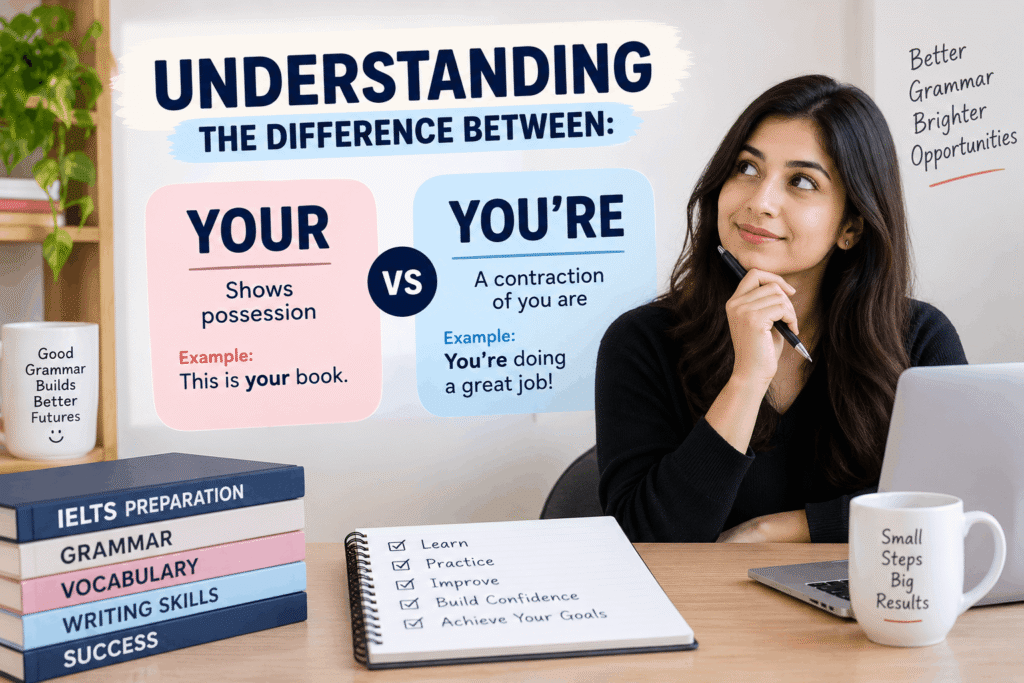
UNDERSTANDING THE DIFFERENCE BETWEEN: YOUR AND YOU’RE Many learners get confused between “your” and “you’re.” They look similar, sound the same, and often appear in similar sentences. Because of this, people hesitate while writing. This short guide will clear the confusion quickly so you can use both forms correctly. Why does the confusion happen “Your” and “you’re” are homophones (same sound, different meaning). They appear in everyday English. Many learners rely on sound instead of meaning while writing. Meaning of “your” and “you’re” Your Shows possession or ownership. Always comes before a noun. Example idea: your bag, your class, your plan. You’re Short for “you are.” Used to describe someone or their action. If you can replace it with “you are,” it is correct. The Difference Your:Is a determiner: A modifying word that determines the kind of reference a noun or noun group has. You’re:Is a contraction: A word that commonly combines a pronoun or noun and a verb, or a verb and not, in a shorter form. Examples of ‘Your’ Your phone is ringing. I liked your idea. Don’t forget your appointment. Your teacher called. This is your seat. Examples of ‘You’re’ You’re doing a great job. Make sure you’re ready on time. You’re very kind. If you’re confused, ask for help. You’re improving every day. Other Commonly Confused Words There / Their / They’re Its / It’s To / Too / Two Then / Than We will discuss these pairs in upcoming blogs to help you strengthen your grammar step by step. About Focus Education Focus Education provides simple, clear, and practical English learning support for IELTS, PTE, and spoken English students. Follow our blogs for easy grammar explanations and effective learning tips.
How to Write a Strong Overview in IELTS Writing Task1
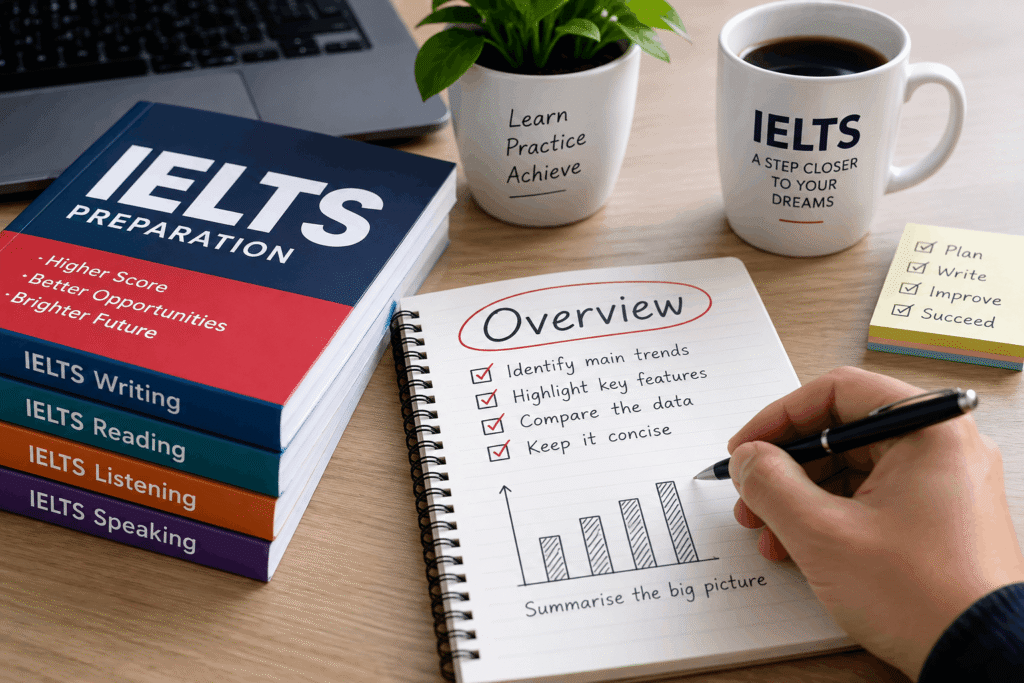
How to Write a Strong Overview in IELTS Writing Task 1 In IELTS Writing Task 1 (Academic), you are required to describe visual data such as a bar graph, line graph, pie chart, table, map, or process diagram. You should spend about 20 minutes on this task and write at least 150 words. One of the most important parts of your answer is the overview. Many students ignore it or write it poorly, and this directly affects their band score. What Is an Overview? An overview is a short paragraph (usually 1–2 sentences) that summarises the main trends or key features of the chart. It does not include specific numbers. Instead, it answers the question: What are the most noticeable things in this data? According to the IELTS marking criteria, a clear overview is essential for achieving a Band 6 or higher in Task Achievement. Where Should You Write the Overview? You can write the overview: After the introduction (recommended), or At the end of the report Most teachers suggest writing it after the introduction, so the structure becomes: Introduction Overview Body Paragraph 1 Body Paragraph 2 This keeps your answer organised and easy to follow. What Should You Include in an Overview? Your overview should include: The main trend (increase, decrease, fluctuation, stability) The highest and lowest points Any major differences or similarities Any significant changes over time You should not: Write exact numbers Give detailed comparisons Explain reasons Give opinions Example of a Weak Overview “Overall, the graph shows different changes in the data.” This is too general. It does not highlight key features. Example of a Strong Overview “Overall, it is clear that sales increased steadily over the period, with Company A consistently outperforming Company B.” Notice that: No numbers are used. The main trend is clearly identified. The comparison is summarised. How to Identify Key Features Quickly Before you start writing, spend 2–3 minutes analysing the chart. Ask yourself: Is the trend upward or downward? Which category is the highest? Which is the lowest? Are there any dramatic changes? Are there similarities between categories? For example: If one country shows a sharp rise while others remain stable, that is a key feature. If all categories follow a similar pattern, that is also important. Your overview should focus only on the big picture, not small details. Overview for Different Types of Task 1 Questions Line Graph / Bar Graph / Table: Focus on trends, highest and lowest values, and comparisons. Pie Chart: Focus on the largest and smallest proportions. Map: Focus on major changes (new buildings, removed areas, expansion). Process Diagram: Focus on the number of stages and whether it is a linear or cyclical process. Example for a process: “Overall, the process consists of five stages, beginning with the collection of raw materials and ending with distribution.” Common Mistakes Students Make Writing too many details in the overview Copying sentences directly from the question Forgetting to include an overview Writing opinions like “This is a good development.” Remember, Task 1 is an objective report. You only describe what you see. Final Advice A strong overview shows the examiner that you understand the data clearly. Even if your vocabulary is simple, a clear and accurate overview can significantly improve your score. Practice identifying key features from different charts, and train yourself to summarise them in 1–2 clear sentences. At Focus Education, we guide students step-by-step on how to structure Writing Task 1 effectively and write strong overviews that help them achieve higher band scores.
Vocabulary for Giving Examples & Explanationsin IELTS Writing Task 2
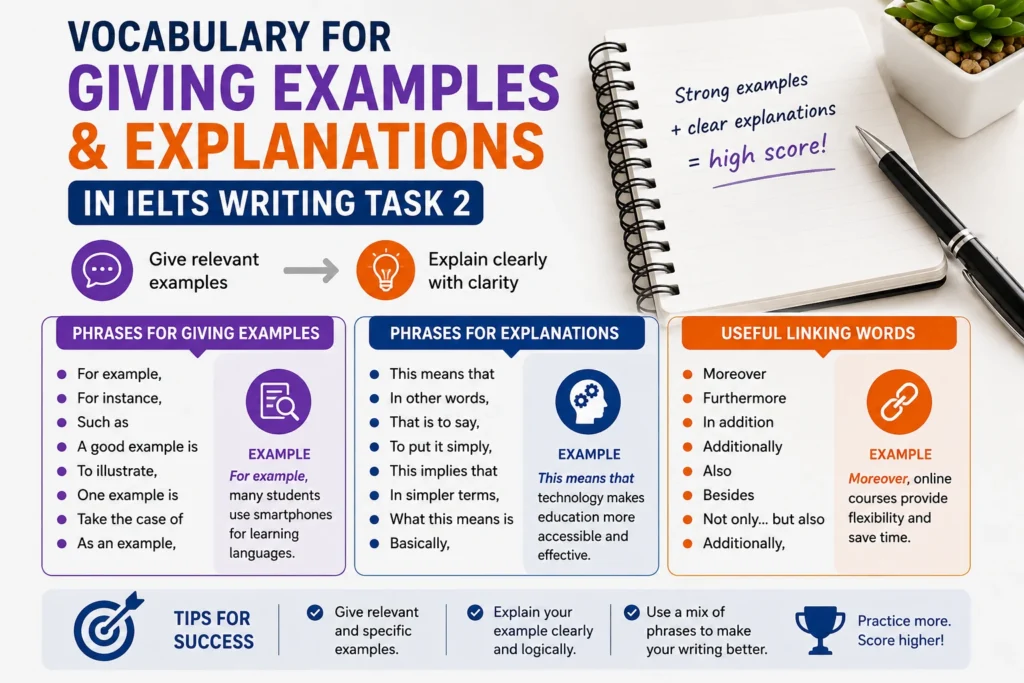
Vocabulary for Giving Examples & Explanations in IELTS Writing Task 2 Many IELTS students believe their problem is grammar. Some think they lack ideas. However, in reality, a large number of candidates lose marks because they do not develop their ideas properly. They write a main point. They add one short example. And then they move to the next paragraph. The result? An essay that feels incomplete. In IELTS Writing Task 2, strong vocabulary is not only about advanced words. It is about using the right phrases to introduce examples, explain them clearly, and connect them back to the main argument. This is what separates a Band 6 essay from a Band 7 or higher response. Why Development Matters So Much The IELTS examiner evaluates your essay based on four main criteria. Three of them are directly affected by how you use examples: Task Response – Are your ideas fully developed? Coherence and Cohesion – Is your logic easy to follow? Lexical Resource – Do you show variety in language? If your example is short and unexplained, the examiner feels your idea is underdeveloped. Even with good grammar, your band score may remain limited. That is why learning how to expand examples is essential. Step 1: Stop Repeating “For Example” Most students rely heavily on: For example, For instance, These are correct, but when used repeatedly, they reduce your lexical range. Instead, you can rotate between more academic expressions such as: To illustrate this point A clear example of this is This can be seen in One compelling example is A good illustration of this idea is Using varied phrases makes your writing sound more mature and controlled. However, vocabulary alone is not enough. Step 2: Always Explain the Example This is where real band improvement happens. Many students give an example but fail to explain why it matters. In IELTS, an example without explanation feels incomplete. After giving your example, you can continue with phrases like: This demonstrates that… This highlights the fact that… As a result… Consequently… This means that… In other words… These connectors help you link the example back to your argument. They show logical thinking, which examiners value highly. Weak vs Strong Development Let us compare two short versions of the same idea. Weak version: Many people prefer online education. For example, students can study from home. This paragraph feels unfinished. The example is clear, but there is no analysis. Improved version: Many people prefer online education. For example, students can study from home. This reduces commuting time and provides greater flexibility, making learning more convenient and cost-effective. The second version explains the impact of studying from home. The idea is now developed. It feels complete. This small change can significantly affect your Task Response score. A Simple Structure You Can Follow If students struggle with idea expansion, they can follow a practical four-step paragraph model: 1. Topic sentence 2. Explanation of the idea 3. Example 4. Further explanation or result This structure ensures that no paragraph feels rushed. It also naturally increases word count in a meaningful way, without adding unnecessary filler. The Real Goal: Clarity, Not Complexity Many candidates try to memorise complicated vocabulary to impress the examiner. But IELTS writing rewards clarity over difficulty. Instead of learning rare words, focus on: Explaining ideas logically Connecting examples clearly Showing cause-and-effect relationships Avoiding sudden jumps between ideas When your examples are well-developed, your essay automatically sounds more academic. Band 7 and above essays are not necessarily filled with difficult words. They are filled with clear thinking and structured development. Final Thought Improving IELTS Writing Task 2 is not about writing more. It is about writing better. When students learn to introduce and explain examples properly, their essays feel more complete, more persuasive, and more organised. That is when band scores begin to improve consistently. If you want structured guidance on idea development, vocabulary building, and high-scoring writing techniques, the mentors at Focus Education provide specialised IELTS training designed to help students break through the Band 6 plateau. Strong writing is not a talent. It is a skill that can be trained — with the right method and feedback. Ready to upgrade your IELTS writing? Connect with Focus Education and take your preparation to the next level.
HOW TO SOLVE SUMMARY COMPLETION IN IELTSREADING
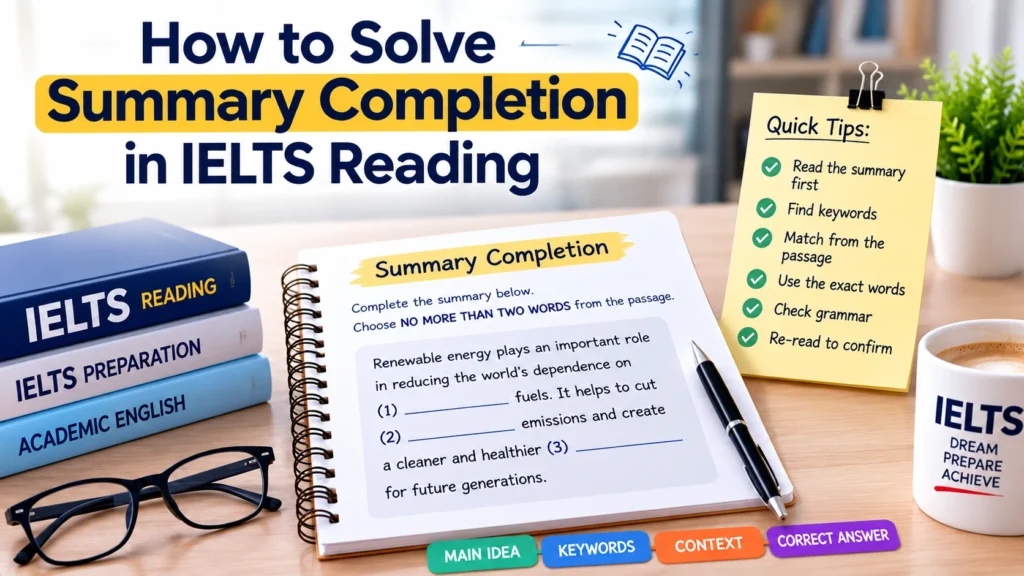
HOW TO SOLVE SUMMARY COMPLETION IN IELTS READING What Is Summary Completion in IELTS Reading? Summary completion is a common question type in the IELTS Reading test where you are given a short summary of a part of the passage, and you must fill in the missing words. The summary presents the main ideas in a concise form, but certain keywords or phrases are removed. Your task is to complete these gaps accurately so the meaning remains clear and matches the information in the text. There are two variations of summary completion: Selecting words directly from the passage – where the instructions tell you exactly how many words you may choose (for example, NO MORE THAN TWO WORDS). Selecting words from a given list of answer options – where the gaps must be filled using the set of options provided. In IELTS Reading, you will often find that the options in matching questions use different forms of the same idea. Sometimes the words in the questions appear as synonyms or antonyms of those found in the passage, and other times they are taken directly from the text with slight changes in form. Because of this, candidates need to build a strong vocabulary, understand word families, and learn how to identify groups of related words. This skill helps them recognise the correct information even when the wording is different. In this blog, we will focus on the second type, where you choose the correct answer from a list. Sample Academic Reading Summary Completion ATTITUDES TO LANGUAGE (An extract taken from Cambridge 9, Test 3, Passage 1) In its most general sense, prescriptivism is the view that one variety of language has an inherently higher value than others, and that this ought to be imposed on the whole of the speech community. The view is propounded especially in relation to grammar and vocabulary, and frequently with reference to pronunciation. The variety which is favoured, in this account, is usually a version of the ‘standard’ written language, especially as encountered in literature, or in the formal spoken language which most closely reflects this style. Adherents to this variety are said to speak or write ‘correctly’; deviations from it are said to be ‘incorrect! All the main languages have been studied prescriptively, especially in the 18th-century approach to the writing of grammars and dictionaries. The aims of these early grammarians were threefold: (a) they wanted to codify the principles of their languages, to show that there was a system beneath the apparent chaos of usage, (b) they wanted a means of settling disputes over usage, and (c) they wanted to point out what they felt to be common errors, in order to ‘improve’ the language. The authoritarian nature of the approach is best characterised by its reliance on ‘rules’ of grammar. Some usages are ‘prescribed,’ to be learnt and followed accurately; others are ‘proscribed,’ to be avoided. In this early period, there were no half-measures: usage was either right or wrong, and it was the task of the grammarian not simply to record alternatives, but to pronounce judgement upon them. These attitudes are still with us, and they motivate a widespread concern that linguistic standards should be maintained. Nevertheless, there is an alternative point of view that is concerned less with standards than with the facts of linguistic usage. This approach is summarised in the statement that it is the task of the grammarian to describe, not prescribe, to record the facts of linguistic diversity, and not to attempt the impossible tasks of evaluating language variation or halting language change. In the second half of the 18th century, we already find advocates of this view, such as Joseph Priestiey, whose Rudiments of English Grammar (1761) insists that ‘the custom of speaking is the original and only just standard of any language! Linguistic issues, it is argued, cannot be solved by logic and legislation. And this view has become the tenet of the modern linguistic approach to grammatical analysis. Complete the summary using the list of words, A-I, below. Write the correct letter, A-I, in boxes 9-12 on your answer sheet. According to 9 ____ , there is only one correct form of language. Linguists who take this approach to language place great importance on grammatical 10 _____. Conversely, the view of 11 _____, such as Joseph Priestley, is that grammar should be based on 12 ____. A descriptivists B language experts C popular speech D formal language E evaluation F rules G modern linguists H prescriptivists I change Step 1: Read the Question (Strategy 1 in action) Before touching the passage, we first look at the summary: According to ___, there is only one correct form of language… Linguists who take this approach… place great importance on grammatical ___… Conversely, the view of ___ such as Priestley… is that grammar should be based on ___. From this, we note: The first gap needs a group of people or a type of linguist. The second gap requires something related to grammar (rules, evaluation, standards). The third gap refers to another group of people. The fourth gap needs something grammar should be based on (probably “popular speech” or “custom of speaking”). This prediction prepares us for what to look for in the passage. Step 2: Read the Passage for the Main Idea (Strategy 2 in action) Now we read the passage, especially the first two paragraphs, because they talk about prescriptivism and descriptivism. We do not search for single words yet. We notice: “Prescriptivism” emphasises one correct form of language. They value “rules”. The “alternative view” is by descriptivists like Joseph Priestley, who believe grammar should be based on the “custom of speaking”, meaning everyday speech. Understanding this overall meaning makes matching the options easier. Applying Both Strategies: Solving the Example Summary Sentence 1 “According to ___, there is only one correct form of language.” In the passage, this idea clearly describes prescriptivists. Answer: H (prescriptivists) Summary Sentence 2 “Linguists who take this approach place
True, False, Not Given – How to Finally Master the Trickiest IELTSReading Task
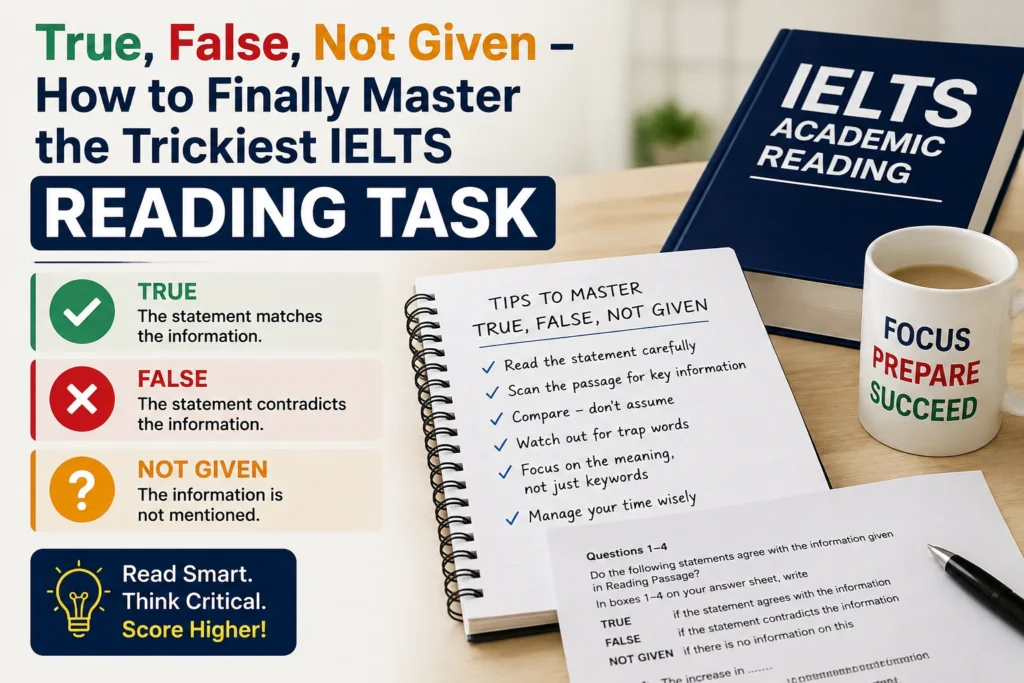
True, False, Not Given – How to Finally Master the Trickiest IELTS Reading Task If there’s one IELTS Reading question type that confuses almost every test taker, it’s True / False / Not Given. Many students lose easy marks here just because they don’t fully understand what the test wants from them. Let’s make it simple today. 1. What Are True / False / Not Given Questions? In this type of question, you’ll read a passage and then a few statements related to it. Your task is to check whether each statement agrees with the information in the passage. These questions are designed to test your reading accuracy and understanding — not your general knowledge. That means you must rely only on what’s written in the passage, not what you personally know or think is true. 2. True / False / Not Given vs. Yes / No / Not Given Many students don’t realize these two are slightly different. Here’s how you can tell them apart easily: Type Used For What You Check True / False / Not Given Facts Does the statement agree with factual information in the text? Yes / No / Not Given Opinions or beliefs Does the statement agree with what the writer or speaker thinks or believes? So, when the passage says “Scientists believe…” or “The writer suggests…”, the question will usually use Yes / No / Not Given. When it’s about simple facts or data, it’s True / False / Not Given. 3. Understanding the Difference Between True, False, and Not Given Let’s break it down simply: TRUE → The statement matches the information in the passage exactly (even if the wording is different). FALSE → The statement contradicts the information in the passage. NOT GIVEN → The passage does not mention this information clearly, so you can’t decide. Example: Example 1: (Cambridge IELTS 15 – Reading Test 1 inspired) Passage extract: “Some experts believe that children learn languages faster than adults because their brains are more flexible during early development.” Statement Answer Explanation Children are able to learn new languages faster as their brains are more adaptable. TRUE Same meaning – “more adaptable” = “more flexible.” Adults can learn languages more quickly because their brains are fully developed. FALSE Contradicts the passage – adults are not said to be faster. Most adults are not interested in learning new languages. NOT GIVEN Interest of adults is never mentioned. Example 2: (Cambridge IELTS 14 – Reading Test 2 inspired) Passage extract: “The railway system expanded rapidly in the 19th century, improving both travel speed and trade connections across Europe.” Statement Answer Explanation The development of railways helped increase trade between European countries. TRUE Matches the idea of “improving trade connections.” Railways reduced the need for road transport completely. FALSE The passage never says “completely reduced.” Railways were first built in the 20th century. FALSE Contradicts the 19th-century detail. Example 3: (Cambridge IELTS 17 – Reading Test 3 inspired) Passage extract: “While many scientists agree that climate change affects rainfall patterns, they disagree on the extent to which it influences ocean currents.” Statement Answer Explanation All scientists think climate change affects ocean currents in the same way. FALSE The passage clearly says they “disagree.” There is general agreement that climate change has some effect on rainfall. TRUE Matches “many scientists agree.” Scientists believe rainfall changes are caused mainly by human activity. NOT GIVEN Cause of rainfall change is not mentioned. These examples show that IELTS tests your ability to understand meaning, not matching words. Even small differences like “all scientists” vs “many scientists” can change the answer completely. 4. Tips to Solve These Questions Better These questions become easy once you follow a clear step-by-step process. Step 1: Locate the right area Use keywords from the question to find where in the passage that topic is discussed. These keywords can be: Names (e.g., Einstein, London) Numbers (e.g., 1995, 3 million) Adjectives (e.g., difficult, dangerous) if no names or dates are present. Step 2: Read carefully Once you locate it, read that section slowly. Don’t rush! You’ll often find the meaning hidden behind paraphrasing — the same idea expressed in different words. Step 3: Match ideas, not words Don’t look for exact word matches. IELTS loves to use synonyms or change sentence structure to test real understanding. Step 4: Watch for negative words and contrasts Words like “not,” “however,” “although,” “but,” “only” can completely change meaning. Missing one small word can turn a True into a False. 5. The Myth of the “False Word List” You may find lists online claiming that if you see certain words like “always,” “never,” “every,” or “none,” the answer will be False or Not Given. That’s completely wrong. The IELTS exam is designed to test meaning, not trick you with keywords. While these words can indicate extreme statements, they don’t automatically decide the answer. You still need to read the passage carefully and understand the context before choosing. Final Thoughts True / False / Not Given questions test how well you can understand and interpret information — not how well you can guess. If you train your eyes to notice paraphrasing, logical contrasts, and exact meaning, this section can actually become your strongest area. Learn Smarter with Focus Education At Focus Education, we don’t just teach IELTS — we train you to think like the examiner. For more such practical tips and tricks, join our IELTS coaching today! Come for admission now and get exciting rewards!
Debunking Common Myths About IELTS Writing
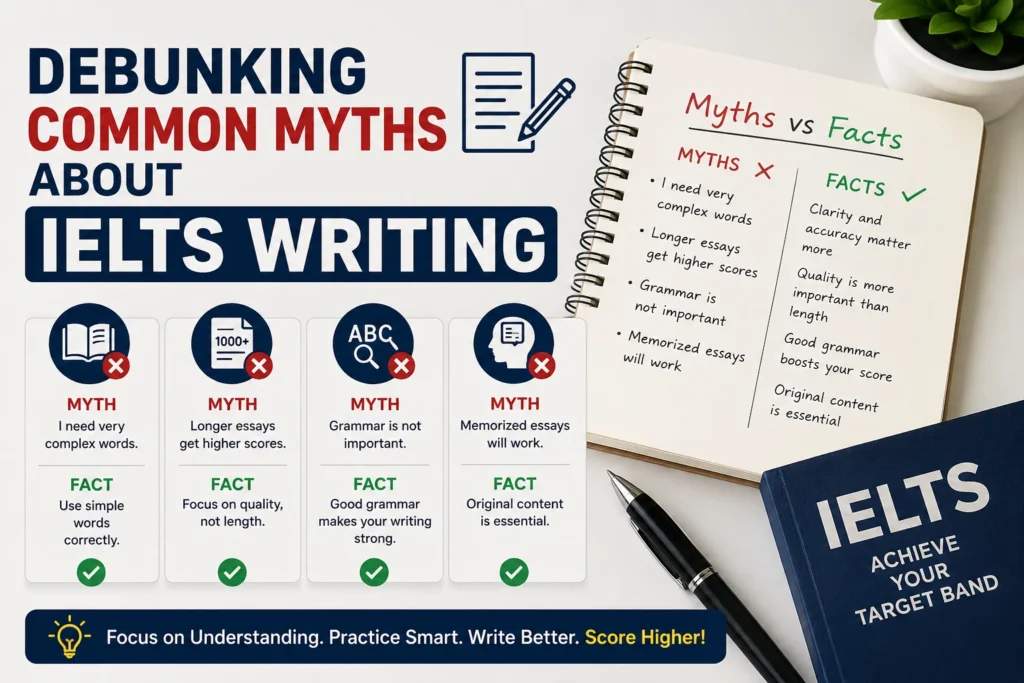
Debunking Common Myths About IELTS Writing Preparing for the IELTS Writing test can be confusing. With so much advice available online and from peers, students often end up believing things that aren’t true. These myths can easily affect their performance and lower their overall band score. At Focus Education, we often meet learners who work hard but struggle because of these misconceptions. Let’s clear up some of the most common ones and understand what truly matters in IELTS Writing. 1. Task 1 is less important than Task 2 While Task 2 carries slightly more weight in the overall writing score, Task 1 is still crucial. Many students focus only on essays and neglect Task 1, which results in an unbalanced score. Both tasks test your ability to organize ideas, present information clearly, and use correct grammar and vocabulary. Ignoring Task 1 can reduce your overall band, even if your essay is strong. A balanced approach to preparation is key. 2. Using fancy vocabulary guarantees a high score Examiners do not reward difficult or uncommon words if they are used incorrectly. Using words just to sound impressive often leads to awkward or unclear sentences. What truly helps is using vocabulary that is accurate, suitable for the context, and shows some range. Simplicity with precision is far better than complexity with confusion. 3. Using too many linking words boosts cohesion Linking words like however, moreover, and on the other hand are useful, but overusing them can make your writing look mechanical. Cohesion is about the smooth connection of ideas, not about inserting connectors everywhere. Natural transitions and logical flow are what examiners value, not a checklist of linking phrases. 4. Trying multiple tenses shows grammatical range Some students believe that switching tenses frequently can demonstrate their grammar skills. In reality, it usually causes errors and breaks the flow of writing. IELTS Writing rewards accuracy and consistency. If the question is about a general issue, stick to present tenses. If you describe a past trend or data in Task 1, use the past tense. Choose the right tense for the context, not for display. 5. Only creative or intellectual ideas can get Band 8+ Examiners are not judging your creativity; they assess how well you answer the question. A clear, logically developed argument is far more effective than an unusual or “interesting” one. Even simple examples or common ideas can earn high bands if they are relevant, coherent, and well-supported. IELTS rewards clarity, not cleverness. 6. Memorizing templates can save time and effort Templates may seem like a shortcut, but they can limit your ability to express original thoughts. Examiners can easily recognize memorized patterns, and this often lowers your score under “Task Response” and “Coherence and Cohesion.” Learning how to structure an essay is useful, but relying on the same sentences in every answer will make your writing repetitive and less natural. 7. Length equals quality Many students believe that longer essays automatically score higher. However, once you exceed 300 words, you’re more likely to make grammatical mistakes or repeat ideas. Examiners prefer essays that are concise, well-organized, and stay within the recommended word range—150 words for Task 1 and around 250 words for Task 2. Quality of expression always outweighs quantity. Final Thoughts The IELTS Writing test isn’t about using fancy words or lengthy essays—it’s about how effectively you communicate your ideas. Understanding what the exam truly measures can help you focus your preparation on clarity, structure, and precision. At Focus Education, we help learners build these exact skills through practical guidance and feedback-driven writing practice. Our aim is to help every student understand how to write smarter, not just more.
IELTS Writing Task 1 Marking Criteria Explained Simply
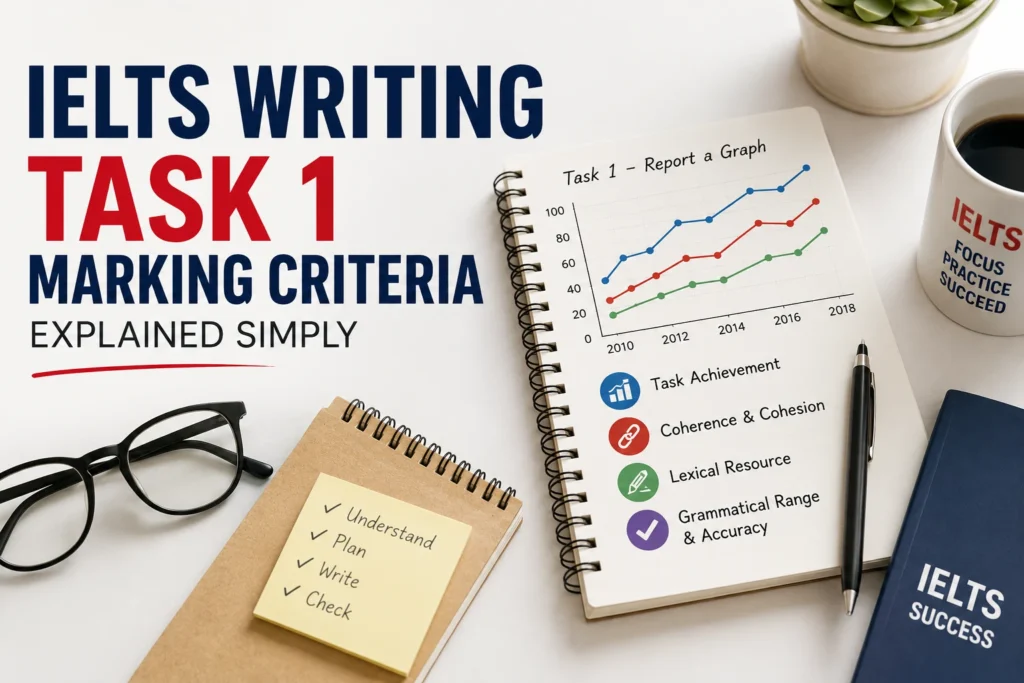
IELTS Writing Task 1 Marking Criteria Explained Simply Many IELTS candidates practise Writing Task 1 by memorising formats or learning vocabulary, but still struggle to improve their band score. One major reason for this is that students often do not clearly understand how IELTS examiners actually mark Writing Task 1. In this blog, we will break down the four official IELTS Writing Task 1 marking criteria simply and practically, so you know exactly what examiners look for and how you can score better. What Is IELTS Writing Task 1? In IELTS Academic, Writing Task 1 requires you to describe visual information such as a graph, chart, table, map, or process diagram. You are expected to write at least 150 words in around 20 minutes. Your answer is not judged on opinions or creativity, but on how clearly, accurately, and logically you present the given data. The Four IELTS Writing Task 1 Marking Criteria Each criterion carries equal weight, which means ignoring even one can limit your band score. 1. Task Achievement Task Achievement checks how well you have understood and answered the question. Examiners look for: A clear introduction that paraphrases the question A proper overview highlighting key trends or features Accurate reporting of main data and comparisons No personal opinions or irrelevant details Common mistakes students make: Missing the overview Writing too much detail without comparing Including reasons or explanations not given in the graph To score well, your content must be relevant, complete, and accurate, not lengthy. 2. Coherence and Cohesion This criterion focuses on how well your ideas are organised and connected. Examiners check: Logical paragraphing (Introduction, Overview, Body Paragraphs) Clear grouping of information Smooth flow between sentences Appropriate use of linking words Good coherence means your reader can easily follow your report without confusion. Good cohesion means your ideas are connected naturally, not forcefully. A common misconception is that using many linking words improves the score. In reality, overusing connectors can make your writing sound unnatural. 3. Lexical Resource (Vocabulary) Lexical Resource assesses how effectively you use vocabulary to describe data. Examiners look for: Topic-appropriate words (increase, decline, fluctuate, proportion) Ability to paraphrase the question Avoidance of repetition Correct word choice and spelling Using “fancy” or uncommon words does not guarantee a higher band. In fact, incorrect or forced vocabulary can reduce your score. Clear, precise, and accurate vocabulary is always better than complicated language. 4. Grammatical Range and Accuracy This criterion checks how well you use grammar. Examiners assess: Sentence structure (simple and complex) Correct tense usage Subject-verb agreement Punctuation and articles You do not need extremely complex grammar to score well, but you must show control and accuracy. Frequent grammatical errors, even in simple sentences, can significantly affect your band score. How These Criteria Work Together Many students focus heavily on vocabulary and grammar, but forget Task Achievement and Coherence. However, a high band score comes from balance. For example: Good grammar without a clear overview limits your score. Strong vocabulary with poor structure confuses the examiner. Accurate data without comparisons looks incomplete. Understanding the marking criteria helps you write with purpose, not guesswork. Final Thoughts IELTS Writing Task 1 is not about memorisation; it is about understanding what examiners expect and delivering it clearly. Once you know how your writing is evaluated, your preparation becomes more focused and effective. At Focus Education, we train students to approach Writing Task 1 strategically by working closely with the marking criteria, analysing real band descriptors, and providing detailed feedback after every practice task. A clear understanding of the criteria can make a noticeable difference — and the right guidance makes it easier to achieve.