
Listening is often one of the most challenging sections in tests like IELTS or PTE. Many students struggle not because they cannot understand English, but because they do not read and interpret the questions properly. Knowing how to read listening questions effectively can give you a clear advantage and improve your accuracy. Let’s explore how.
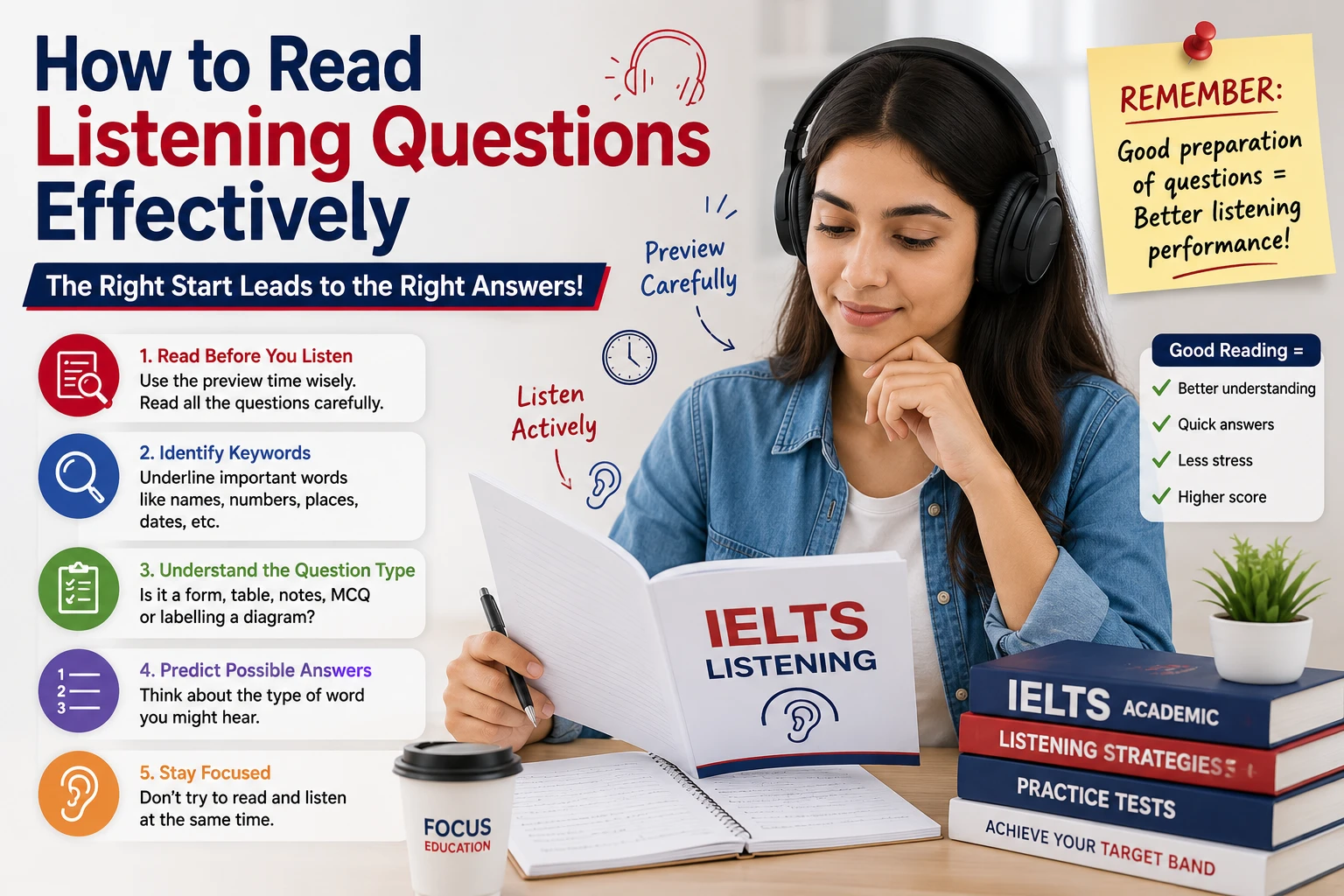
Always skim through the questions before the audio starts. This allows you to know what to listen for—names, numbers, dates, opinions, or specific facts.
Example: If a question asks, “What time does the seminar start?” you know to listen for a time-related answer instead of getting distracted by other details.
Identify the main words that carry the question’s meaning. These can be nouns, names, numbers, or descriptive terms.
Example: In “What solution does the speaker suggest for traffic congestion?”, the keywords are solution and traffic congestion. Focusing on these will guide your listening.
Different question types need slightly different approaches. Here are some examples:
After reading the questions, try to guess the kind of answer that might appear. Prediction makes it easier to catch the correct information.
Example: For “Why do people prefer online shopping?”
Your prediction could be convenience, variety, or lower prices.
Words like not, except, mainly, or usually can change the meaning completely.
Example: “Which of the following is NOT a benefit of exercise?” — you need to find the negative option, not the positive ones.
Test audios rarely repeat the exact words from the question. Look for synonyms or paraphrases.
Example: Question: “What method does the speaker recommend for reducing energy consumption?”
Audio: “Using energy-efficient appliances can lower your electricity bills.”
Match: method → using, reducing → lower, energy consumption → electricity bills.
Don’t spend too long on one question. Scan quickly, listen, answer, and move on. Prediction and keyword recognition help you stay focused and manage time effectively.
Reading listening questions effectively is a skill that improves accuracy and confidence. Skim questions first, highlight keywords, understand question types, predict answers, watch for tricky words, and recognize paraphrasing. With regular practice, these strategies will make the listening section much easier to handle.
If you want structured practice and personalized tips for listening and other IELTS modules, Focus Education can guide you step by step. Our experienced trainers provide mock tests, feedback, and strategies to boost your confidence and help you achieve your target band. Start your journey with Focus Education and make every listening task count.