Study at top Australian universities and gain globally recognised degrees.Australia offers high-quality education, excellent career opportunities, and a vibrant student lifestyle.

Study at top Australian universities and gain globally recognised degrees.Australia offers high-quality education, excellent career opportunities, and a vibrant student lifestyle.

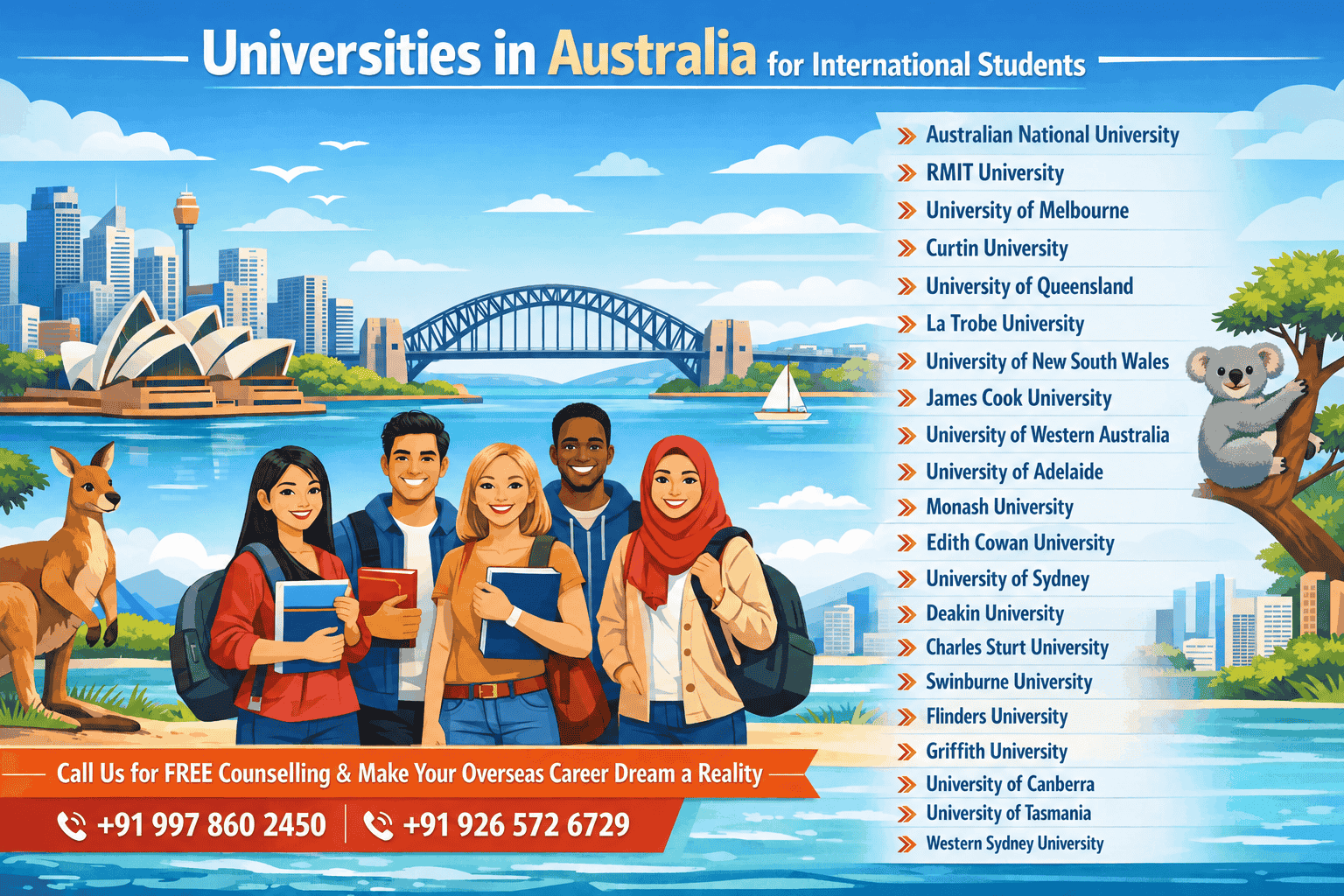
Australia is one of the top study destinations for international students, welcoming more than 600,000 students from over 125 countries every year. Known for its globally recognised education system, Australia offers high-quality academic programmes and excellent career opportunities. Major cities like Sydney, Melbourne, Brisbane, Perth, and Adelaide provide a safe, vibrant, and student-friendly environment.
Planning to study in Australia requires careful consideration of study programmes, admission requirements, timelines, and financial planning. With the right guidance, students can choose the right course and university that align with their academic background and career goals, ensuring a successful international education journey.
Australia also offers many advantages for international students, including top-ranked universities, great scholarships, and post-study work opportunities. With a relaxed lifestyle, a diverse culture, and strong employment prospects, studying in Australia allows students to receive a world-class education while enjoying a high quality of life.
| Programme | Duration | Academic Criteria | English Language Proficiency | Aptitude Examination | Study Cost |
|---|---|---|---|---|---|
| Bachelor’s | 3–4 Years | Minimum 65% | IELTS 6.5 / PTE 59–54 | Not Required | $25,000–$45,000 Per Year Onwards |
| Master’s | 2 Years | Minimum 65% In Previous Qualification | IELTS 6.5 / PTE 62–54 | Not Required | $30,000–$50,000 Per Year Onwards |
Australia is one of the most preferred destinations for international students due to its globally recognised education system, modern lifestyle, and excellent career opportunities. Universities in Australia offer world-class education with practical learning experiences and globally accepted degrees.
Students can choose from a wide range of undergraduate and postgraduate programmes in fields such as Business, Information Technology, Engineering, Healthcare, Hospitality, and Data Science.
Most universities require students to demonstrate English language proficiency through exams like IELTS or PTE. In addition, many Australian universities offer scholarships and post-study work opportunities for international students.
With a safe environment, multicultural society, and high quality of life, Australia provides students with the perfect balance of education, career growth, and lifestyle.

Scholarships are a great way for international students to reduce the cost of studying in Australia. Many Australian universities offer a variety of scholarships based on academic performance and student profiles. Eligible students can receive scholarships ranging from 10% to 25%, while some top universities may offer 70% to 100% scholarships depending on the student’s qualifications and achievements.
Australia also offers excellent job opportunities for international students during and after their studies. Students are allowed to work up to 48 hours per fortnight during academic sessions and full-time during holidays. After graduation, eligible students can apply for a Post-Study Work Visa, allowing them to stay and work in Australia for up to 6 years depending on their course and study level, with job opportunities available in sectors such as retail, hospitality, logistics, customer service, and administration.
Everything you need to know before starting your study abroad journey.
Australian universities have three intakes a year – February, July, and September. However, the majority of courses are offered in September intake, so the students those who are in their final semesters can start preparing as early as 6 to 7 months before the planned admission intake to ensure course availability, financial arrangements and adequate processing time.
International students can pursue the courses registered with the Australian immigration department, known as CRICOS-approved programs, by applying for the Subclass 500 Student Visa.
Australian Universities usually have annual tuition fees ranging from AUD 35,000 to 55,000 for Master’s Degree programs. On the other hand, bachelor’s programs generally have annual tuition fees around AUD 30,000 to 40,000.
No. International students are required to pursue full-time, on-campus (in-class delivery) courses only, as per current regulations.
Yes, both documents play an inevitable role in the application success leading to acceptance into the chosen program. Hence, properly drafted SOPs and LORs are required.
A university admission SOP should be clear, concise, and academically focused.
It should include:
Introduction: Course applied for and your academic motivation.
Academic Background: Relevant qualifications, coursework, projects, or research.
Relevant Experience: Internships, work, or research linked to the course (if any).
Why This Course & University: Specific modules, teaching style, or academic strengths.
Skills & Strengths: Key academic and professional skills with brief examples.
Career Goals: How the course supports your short- and long-term plans.
Conclusion: Reaffirm motivation and readiness for the program.
The tone should be formal and a generic approach should be avoided.
Each university has its own strengths in specific domains. Based on recently completed studies and inclination towards the major or multidisciplinary field, students should shortlist the universities according to rankings, tuition fees, and acceptance ratios.
Australian Universities have their respective online application platforms where personal and academic information is filled in, along with uploading the supporting academic and experience documents application completion.
Moreover, as the primary assessment of finances are also being carried out at the early stage of application by the Universities itself, applicants are required to submit parents’ or relatives’ financial documents as their sponsor for studies.
It is the document issued by Australian Universities after assessing the student through interviews and financial checks. Confirmation of Enrollment is mandatory for filling the visa application under Subclass-500.
Australian universities require candidates to appear for English Proficiency Tests such as IELTS, PTE or TOEFL, which are also mandated by the visa authorities to be submitted along with visa application.
These test scores also enhance visa credibility in the eyes of the visa officer.
On a student visa, work rights begin from the course start date mentioned on the CoE.
During the ongoing term, students are allowed to work 48 hours per fortnight (a fortnight is 14 days and starts on a Monday). It is up to you how you use those hours. For example, you can work 30 hours one week and 18 hours the following week.
During the term breaks (Christmas or Easter holidays), you are allowed to work full time with no hourly limits. Just keep in mind that school is in session even through the exam period. Even though you might have finished your exams, the course may still be considered in progress. Also note that public holidays do not count for full work rights if class is in session.
Students pursuing Masters by Research or a PhD programs have unlimited work rights.
It varies from universities and programs applied to, as some of the postgraduate research and PhD programs may take up to 6 to 8 weeks, whereas postgraduate taught as well as under-graduate programs usually release decisions within 2 to 4 weeks.
Yes, in Australia, students in their final year/semester of their undergraduate program can apply for the conditional acceptance, provided they submit proof of course completion before final enrolment.
This procedure allows students to reserve the seat for a short-period.
Yes, academic gap after Higher Secondary Certificate is accepted up to 1 year only for undergraduate studies, whereas for Master’s degree applications, recently introduced age restriction is up to 26 years, after which the applicants may not be accepted regardless of work experience.
Yes, it is possible to change the institution after arriving in Australia; however, only after the completion of first year as per the Home Affairs Immigration Regulations. It is strongly recommended that course level is not downgraded while changing institutions.
In Australia, universities are classified under Regional and Urban Zones. Based on this classification, post-study work rights range from a minimum of 3 years to a maximum of 4 years, particularly for graduates from universities located in regional areas.
In Australia, universities conduct a mandatory interview known as the Genuine Student (GS) interview. Applicants are assessed on their awareness of the chosen program, ability to manage financial responsibilities, sponsor awareness as well as future plans after the completion of course in their home country.
This burden of explanation weighs over the student, which allows universities to approve the student as per the regulations.
It is the document issued by Australian Universities after assessing the student through interviews and financial checks. Confirmation of Enrollment is mandatory for filling the visa application under Subclass-500.
Australian universities require candidates to appear for English Proficiency Tests such as IELTS, PTE or TOEFL, which are also mandated by the visa authorities to be submitted along with visa application.
These test scores also enhance visa credibility in the eyes of the visa officer.
On a student visa, work rights begin from the course start date mentioned on the CoE.
During the ongoing term, students are allowed to work 48 hours per fortnight (a fortnight is 14 days and starts on a Monday). It is up to you how you use those hours. For example, you can work 30 hours one week and 18 hours the following week.
During the term breaks (Christmas or Easter holidays), you are allowed to work full time with no hourly limits. Just keep in mind that school is in session even through the exam period. Even though you might have finished your exams, the course may still be considered in progress. Also note that public holidays do not count for full work rights if class is in session.
Students pursuing Masters by Research or a PhD programs have unlimited work rights.
It varies from universities and programs applied to, as some of the postgraduate research and PhD programs may take up to 6 to 8 weeks, whereas postgraduate taught as well as under-graduate programs usually release decisions within 2 to 4 weeks.
Yes, in Australia, students in their final year/semester of their undergraduate program can apply for the conditional acceptance, provided they submit proof of course completion before final enrolment.
This procedure allows students to reserve the seat for a short-period.
Yes, academic gap after Higher Secondary Certificate is accepted up to 1 year only for undergraduate studies, whereas for Master’s degree applications, recently introduced age restriction is up to 26 years, after which the applicants may not be accepted regardless of work experience.
Yes, it is possible to change the institution after arriving in Australia; however, only after the completion of first year as per the Home Affairs Immigration Regulations. It is strongly recommended that course level is not downgraded while changing institutions.
In Australia, universities are classified under Regional and Urban Zones. Based on this classification, post-study work rights range from a minimum of 3 years to a maximum of 4 years, particularly for graduates from universities located in regional areas.
Get expert guidance for admissions and visas with personalised support designed for your goals.Begin your study abroad journey confidently with trusted counsellors by your side.