
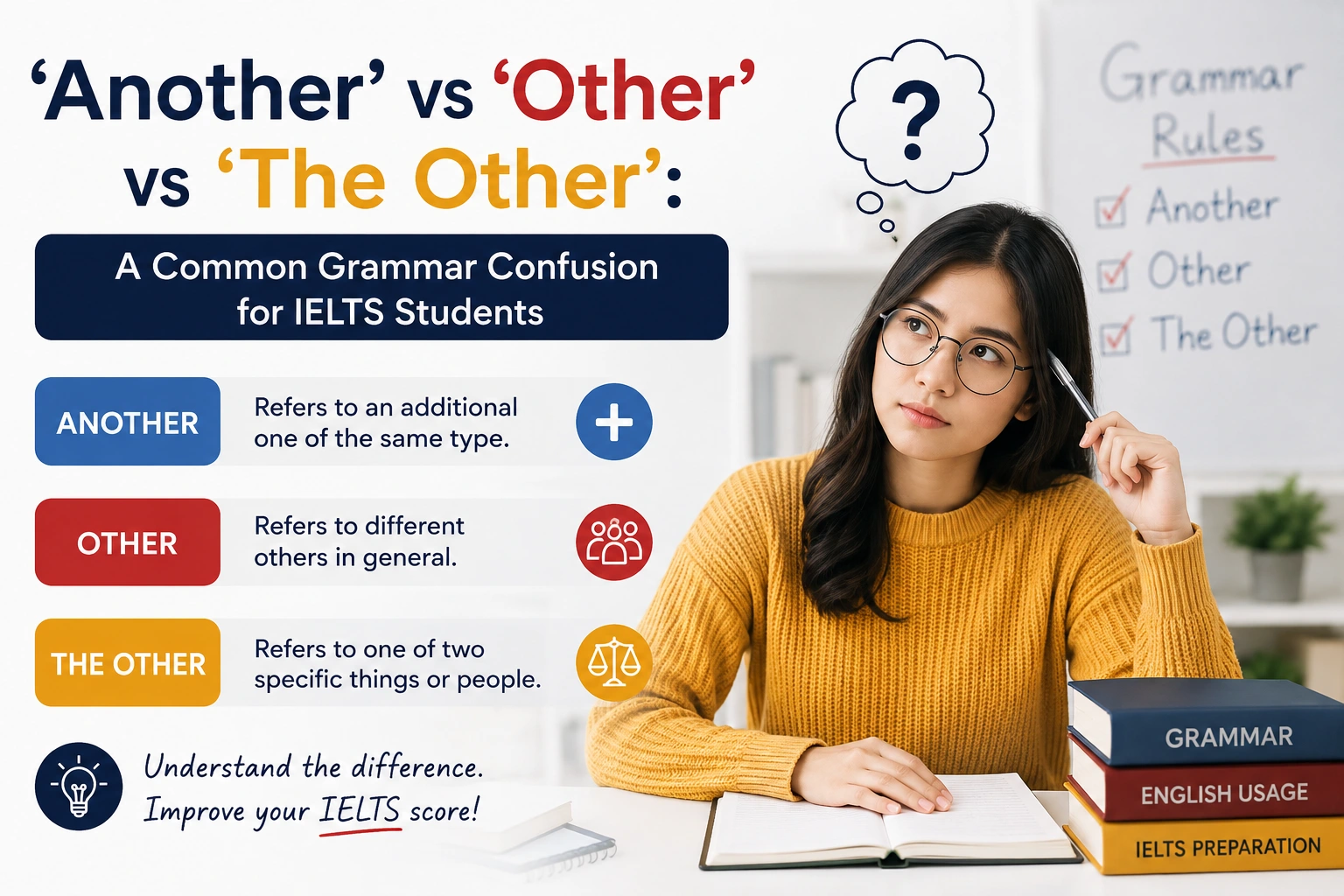
Grammar accuracy plays a crucial role in the IELTS exam, particularly in Speaking and Writing, where even minor word choices can significantly impact clarity and meaning. One area where many students struggle is the correct use of another, other, and the other. Although these words look similar and are often used interchangeably by learners, they have clear grammatical differences.
Understanding when and how to use these words correctly helps students sound more natural and precise in the English language.
Another means one more or an additional one. It is generally used with singular countable nouns and refers to something that is not specific. It answers the idea of “one more of the same type”.
For example:
In IELTS Speaking, another is commonly used when suggesting alternatives or adding ideas, which makes your responses sound more fluent.
Other is used to talk about additional or different items, usually in a general sense. It can be used with both singular and plural nouns, depending on the context.
For example:
Here, other does not point to something specific. It simply refers to alternatives or differences in a broad way.
The other is used when referring to the remaining one or ones from a specific group. It is definite and specific, which means both the speaker and listener know exactly what is being talked about.
For example:
In IELTS Writing Task 1, the other is particularly useful when comparing two visuals, categories, or trends.
Confusion usually happens when students forget whether the noun they are referring to is specific or general, or whether the group is already defined.
A frequent mistake is using another with plural nouns or using the other without a clearly defined group.
Incorrect:
Correct:
Such errors may seem small, but repeated mistakes can reduce your Grammatical Range and Accuracy score.
Before choosing between another, other, or the other, ask yourself:
This simple mental check can prevent confusion during the exam.
Words like another, other, and the other are small, but they carry important meaning differences. Mastering their usage helps IELTS candidates express comparisons, alternatives, and ideas more clearly and confidently.
At Focus Education, students are trained to recognise such common grammar traps and correct them through guided practice and exam-focused examples, ensuring stronger performance in both Writing and Speaking.