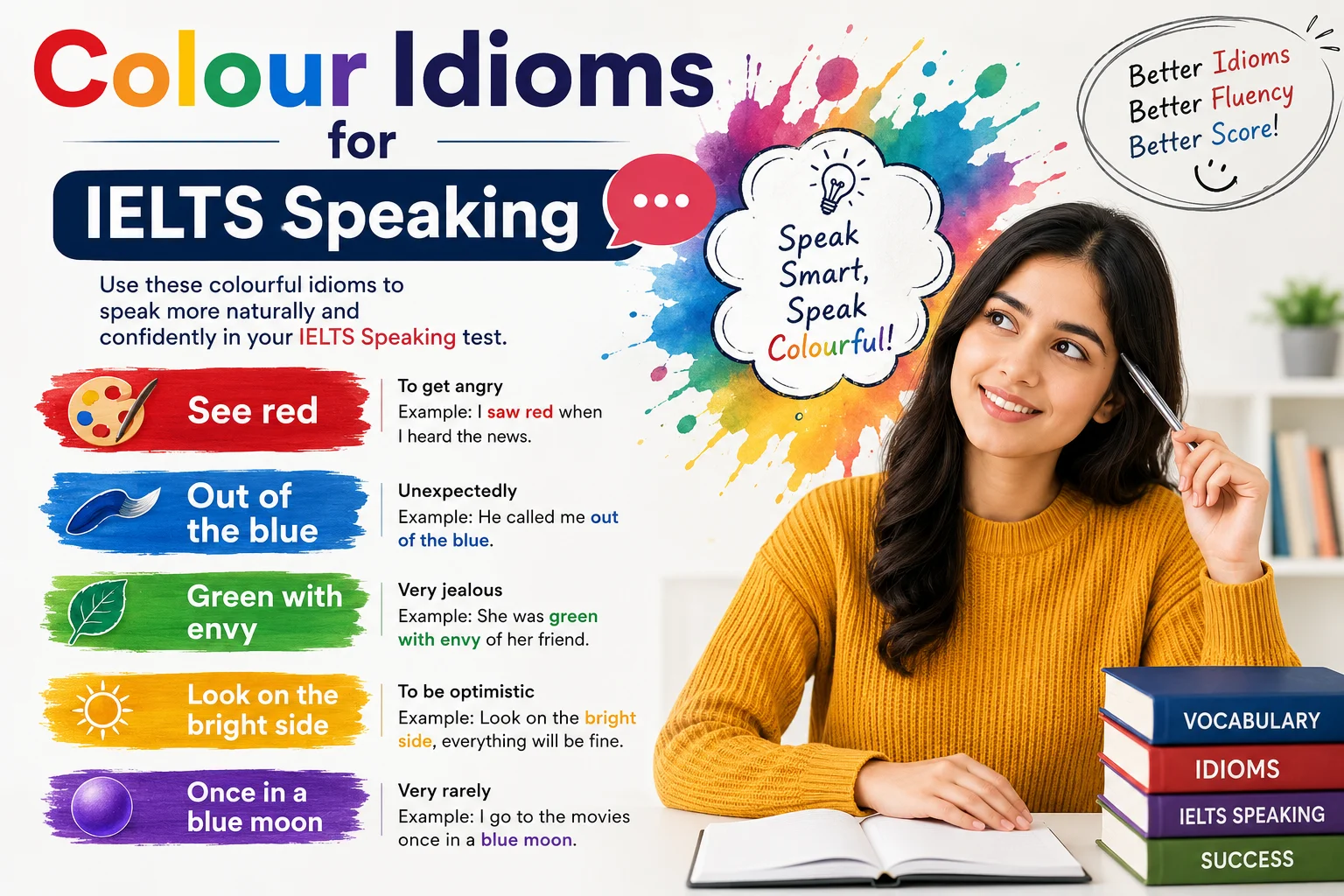
Idioms are commonly used expressions whose meanings are different from the literal meaning of the words. Native speakers use idioms naturally in everyday conversations, which is why they can be useful in the IELTS Speaking module. However, idioms should be used carefully and only when they fit the context naturally.
In IELTS, idioms are not required for a high band score, but using a few common and appropriate ones can help make your answers sound more fluent and natural—especially in Speaking Part 2 and Part 3. Below are some easy and commonly used colour idioms that students can remember and use confidently.
Common Colour Idioms with Examples
- 1. Once in a blue moon – something that happens very rarely.
I visit my hometown once in a blue moon.
Such events don’t happen often; they occur once in a blue moon.
- 2. In the black – financially stable or making a profit.
The company is finally in the black after many losses.
Small businesses aim to stay in the black.
- 3. In the red – facing financial loss.
The shop is in the red due to low sales.
Many startups remain in the red initially.
- 4. White lie – a harmless lie told to avoid hurting someone.
I told a white lie to avoid upsetting my friend.
Sometimes, white lies are socially acceptable.
- 5. Green with envy – very jealous.
I was green with envy when I saw his new car.
People often feel green with envy on social media.
- 6. Black and white – very clear, with no confusion.
The rules are written in black and white.
The law is not always black and white.
- 7. Grey area – something unclear or uncertain.
Online privacy laws fall into a grey area.
Some ethical issues remain a grey area.
- 8. Red flag – a warning sign.
Poor communication is a red flag in relationships.
Late submissions are a red flag for employers.
- 9. Green light – permission to start something.
The manager gave us the green light to begin.
Once approved, the project got a green light.
- 10. Out of the blue – unexpectedly.
He called me out of the blue after years.
The announcement came out of the blue.
- 11. Blue mood – feeling sad.
I feel in a blue mood on rainy days.
Music helps me overcome a blue mood.
- 12. Golden opportunity – a very good chance.
Studying abroad is a golden opportunity.
She didn’t miss the golden opportunity.
- 13. Pink slip – notice of job termination.
He received a pink slip during layoffs.
Many workers fear getting a pink slip.
- 14. White elephant – something expensive but useless.
The project turned into a white elephant.
Unused stadiums become white elephants.
- 15. Black sheep – someone different from the rest of the group.
He is considered the black sheep of the family.
Every family has a black sheep.
How to Use Idioms Correctly in a Sentence (Syntax Explained)
The safest way to use idioms in IELTS Speaking is to treat them like fixed phrases. This means you should not change their structure. Instead, you should place them naturally within a sentence, just like native speakers do.
- 1. Idioms as adverbs (tell us how often / when / in what manner)
Idioms like once in a blue moon or out of the blue usually come at the end of the sentence or after the main verb.
Structure:
Subject + verb + object + idiom
Example:
- I visit my hometown once in a blue moon.
- He called me out of the blue.
Avoid placing such idioms at the beginning unless you are confident.
- 2. Idioms as adjectives (describe a situation or noun)
Some idioms describe a condition or situation, like in the red, in the black, or a grey area.
Structure:
Subject + be verb + idiom
Example:
- The company is in the red.
- The issue is a grey area.
These idioms usually come after ‘is / are / was’.
- 3. Idioms as nouns
Idioms like a red flag, a golden opportunity, or a white elephant act like nouns.
Structure:
Article + idiom + additional information
Example:
- Poor communication is a red flag in teamwork.
- Studying abroad is a golden opportunity.
Always use articles (a / an / the) where required.
- 4. Idioms used after giving an idea
A safe IELTS trick is to first explain your idea in simple words, and then add the idiom.
Structure:
Idea + comma + idiom
Example:
- I rarely meet my school friends, only once in a blue moon.
- Losing his job was unexpected, completely out of the blue.
This avoids forcing the idiom and keeps the answer natural.
- 5. One Idiom = One Idea
Never use more than one idiom in a single answer in IELTS Speaking. Overuse sounds unnatural and reduces clarity.
Final Thoughts
Using idioms in IELTS Speaking can improve fluency, but students should avoid forcing them into every answer. One or two well-placed idioms are enough to sound natural and confident. Practising these expressions with correct context and feedback makes a big difference.
At Focus Education, students are trained to use idioms naturally in speaking, with regular practice and guided feedback—helping them sound fluent without overdoing it.