
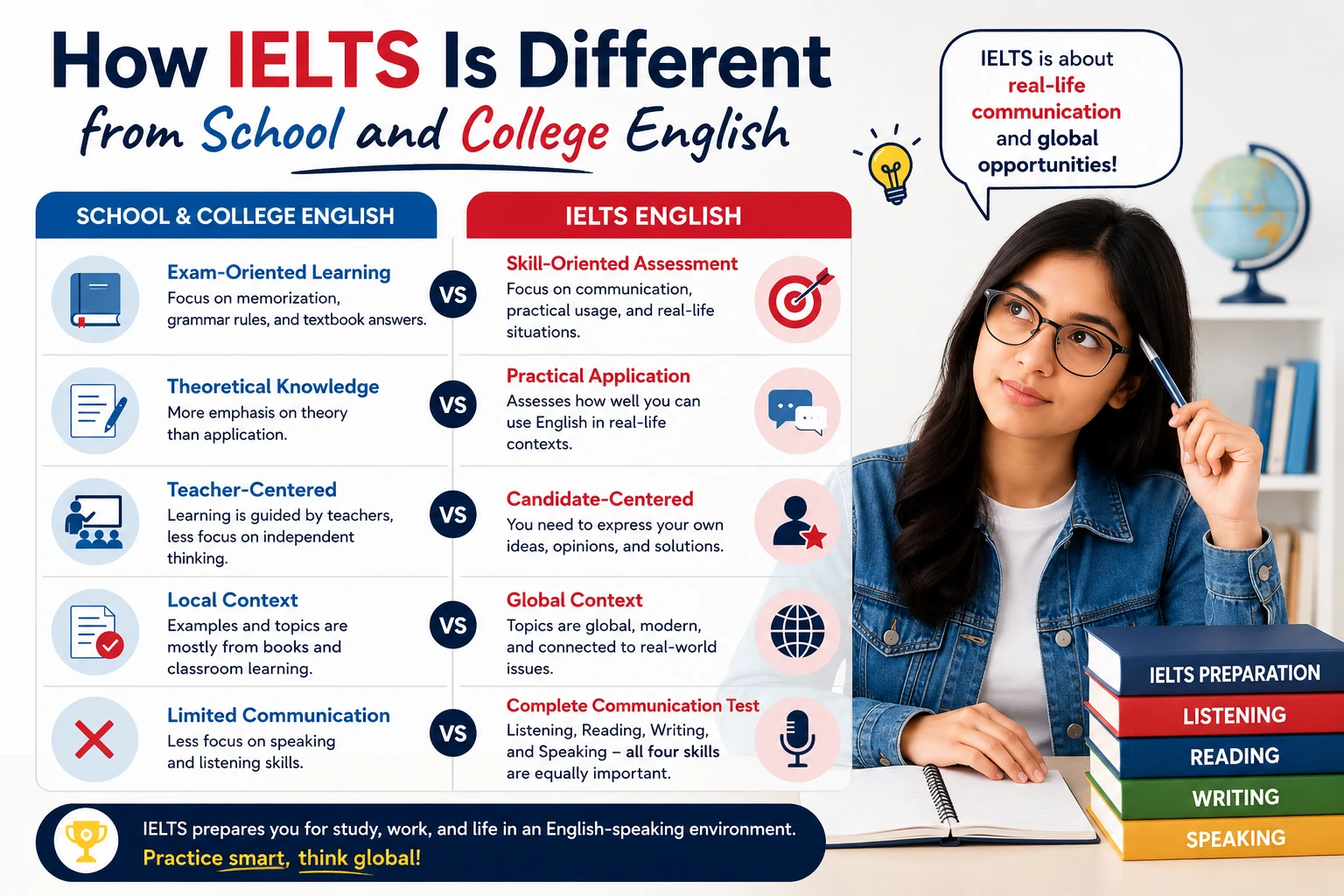
Many students believe that doing well in school or college English automatically means they will score high in IELTS. However, this is a common misunderstanding. IELTS is not a traditional academic English exam. It is a skill-based test designed to measure how well a person can use English in real-life situations. Understanding this difference is essential for effective IELTS preparation.
This blog explains how IELTS English differs from the English most students are familiar with from their academic background.
In schools and colleges, English learning focuses heavily on grammar rules, textbooks, and literature. Students often study poems, stories, and fixed grammatical concepts, and success is usually based on how well answers are memorised.
IELTS focuses on practical communication skills. Grammar is important, but only as a tool to express ideas clearly. The exam tests whether a student can understand spoken and written English and communicate thoughts effectively in speaking and writing tasks.
Academic exams usually reward students for writing answers that closely match textbook content. Creativity is often limited.
IELTS works differently. Especially in Writing Task 2 and the Speaking test, there are no fixed answers. Students are assessed on how clearly they explain ideas, how logically they organise thoughts, and how accurately they use grammar and vocabulary. As long as the response is relevant and well developed, different opinions are acceptable.
Speaking is rarely assessed formally in school or college. As a result, many students are not confident speaking English spontaneously.
IELTS Speaking is a face-to-face interview where examiners evaluate fluency, pronunciation, vocabulary, and grammatical range. Students must think and respond in real time, which requires regular speaking practice rather than memorisation.
In academic exams, students often try to impress examiners by using complex or “high-level” words, even if they are not used correctly.
IELTS values natural and accurate vocabulary. Using simple but correct words appropriately is better than forcing difficult vocabulary. Topic-related vocabulary used naturally helps improve scores, especially in Speaking and Writing.
School and college writing may allow storytelling, emotional language, or loosely organised ideas.
IELTS Writing requires a clear structure, logical flow, and task-focused answers. Students must follow the question carefully, organise ideas into proper paragraphs, and maintain a formal tone when required. Writing extra or irrelevant information can reduce scores, even if the language is good.
Most academic exams provide predictable patterns and sufficient time.
IELTS is strictly time-bound. Reading passages must be handled quickly, listening answers are heard only once, and Writing requires planning, writing, and checking within a limited time. Success depends not only on language ability but also on exam strategy.
Schools and colleges evaluate performance using marks or percentages.
IELTS uses band descriptors that assess specific skills such as coherence, lexical resource, grammatical range, and pronunciation. Improvement depends on understanding these criteria and working on weaknesses, not simply studying more content.
Many students succeed academically through memorisation, but this approach does not work in IELTS. Memorised answers, templates, and repeated phrases are easily noticed by examiners and can negatively affect scores. IELTS rewards originality, clarity, and genuine language use.
Students who prepare for IELTS using school or college methods often feel confused or stuck at the same band score. Once students understand that IELTS is a language proficiency test, their preparation becomes more focused and effective.
At Focus Education, we help students shift from academic English to IELTS-oriented English through structured training, regular practice, and personalised feedback. Our goal is not just to teach English, but to help students use English confidently and accurately in the IELTS exam.