What Is IELTS Reading?
The IELTS Reading test checks how well a candidate can understand written English. It assesses skills such as reading for main ideas, identifying specific information, understanding opinions, and recognising the writer’s purpose. The Reading module is the same in structure but different in difficulty and content for IELTS Academic and General Training.
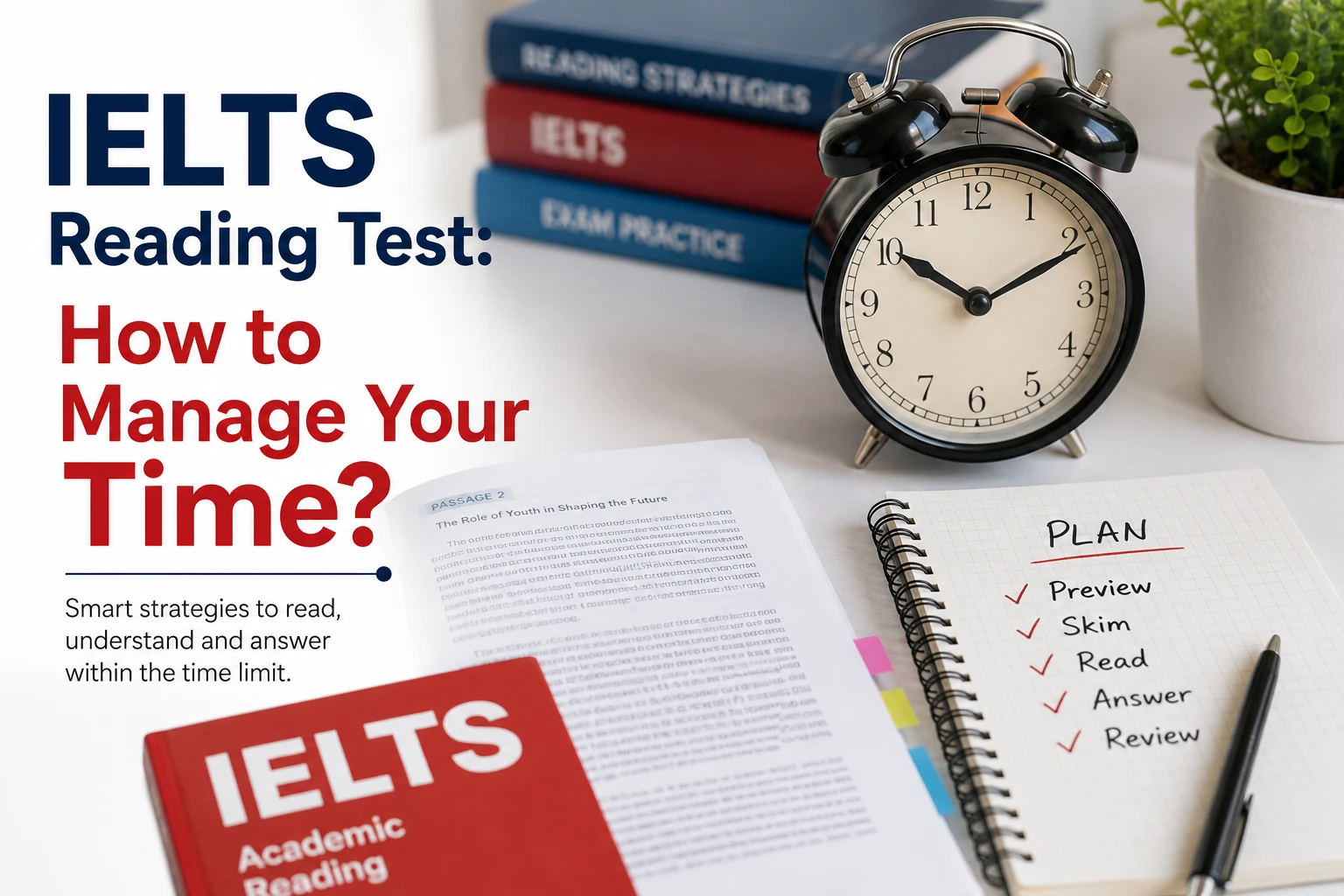
Candidates are given 60 minutes to answer 40 questions, and no extra time is provided to transfer answers to the answer sheet. This makes time management one of the biggest challenges in the IELTS Reading test.
Time Given to Each Passage
The IELTS Reading test consists of three passages, and students are expected to manage time on their own. It is always recommended to spend no more than 20 minutes on each part of the Reading test; however, if you find the first passage easy, you may finish it in a shorter time, allowing you more time to answer questions in the next two passages. The passages get harder as you move through the test, so make sure you keep enough time to tackle the final passage.
Where Are the Reading Passages Taken From?
IELTS Reading passages are taken from authentic sources such as newspapers, magazines, journals, books, and online articles. For Academic IELTS, the texts are more formal and academic in nature. For General Training, the passages are based on everyday English, workplace contexts, and general interest topics.
Common IELTS Reading Question Types
Understanding question types helps students save time and avoid confusion.
- Multiple Choice: Read the question first, scan the passage for the relevant idea, and eliminate options that clearly do not match the text.
- Identifying Information (True / False / Not Given): Check whether the statement agrees with the facts in the passage, contradicts them, or is not mentioned at all.
- Identifying a Writer’s Views / Claims (Yes / No / Not Given): Focus on the writer’s opinions rather than facts and decide whether the statement matches, contradicts, or is not stated.
- Matching Information: Scan the passage to find which paragraph contains the specific information mentioned in the question.
- Matching Headings: Read each paragraph for its main idea and choose the heading that best summarises it, not just matching keywords.
- Matching Features: Match statements to people, places, theories, or years by carefully tracking names and references in the text.
- Matching Sentence Endings: Match sentence beginnings with the correct endings by ensuring the completed sentence makes logical and grammatical sense.
- Sentence Completion: Complete sentences using words from the passage while strictly following the given word limit.
- Summary / Note / Table / Flow-chart Completion: Use information from the passage to fill gaps logically, paying attention to meaning, grammar, and word limits.
- Diagram Label Completion: Identify the correct part of the diagram by locating the description in the passage and transferring the exact wording.
- Short-Answer Questions: Answer directly using words from the passage and ensure the response fits the specified word limit.
Each type requires a slightly different approach, so familiarity is essential.
Time Management Tips for IELTS Reading
- Skimming and Scanning: Skimming helps you understand the general idea of the passage quickly, while scanning allows you to locate specific information such as names, dates, or numbers. Using these techniques correctly prevents unnecessary reading and saves valuable time.
- Mark Keywords in the Questions: Before reading the passage, underline or mentally note important words in the questions. Keywords guide your attention and help you find the relevant part of the text faster.
- Read the Questions Carefully: Many students lose marks because they misunderstand what the question is asking. Pay attention to whether the question is asking for facts, opinions, causes, or examples. A small misunderstanding can lead to choosing the wrong answer even if the information is present in the passage.
- Read the Instructions Carefully: Always read the instructions before attempting any question type. Check word limits such as “NO MORE THAN TWO WORDS,” spelling requirements, and whether answers should be taken directly from the passage. Ignoring instructions is one of the most common reasons for losing easy marks.
- Check Answers as You Go: If time permits, quickly review your answers while moving through the test. This helps identify spelling errors or incorrect choices before it is too late.
- Read the First and Last Line of Paragraphs: The first line often introduces the main idea of a paragraph, while the last line may summarise or conclude it. This strategy is especially helpful for matching headings and main idea questions.
Final Thoughts
Time management in IELTS Reading is not about reading faster, but about reading smarter. Understanding the test format, recognising question types, and applying the right strategies can significantly improve accuracy and confidence.
With guided practice and expert feedback, students can learn how to approach each passage strategically. At Focus Education, students are trained to manage time effectively while improving comprehension, helping them perform better in the IELTS Reading module.