
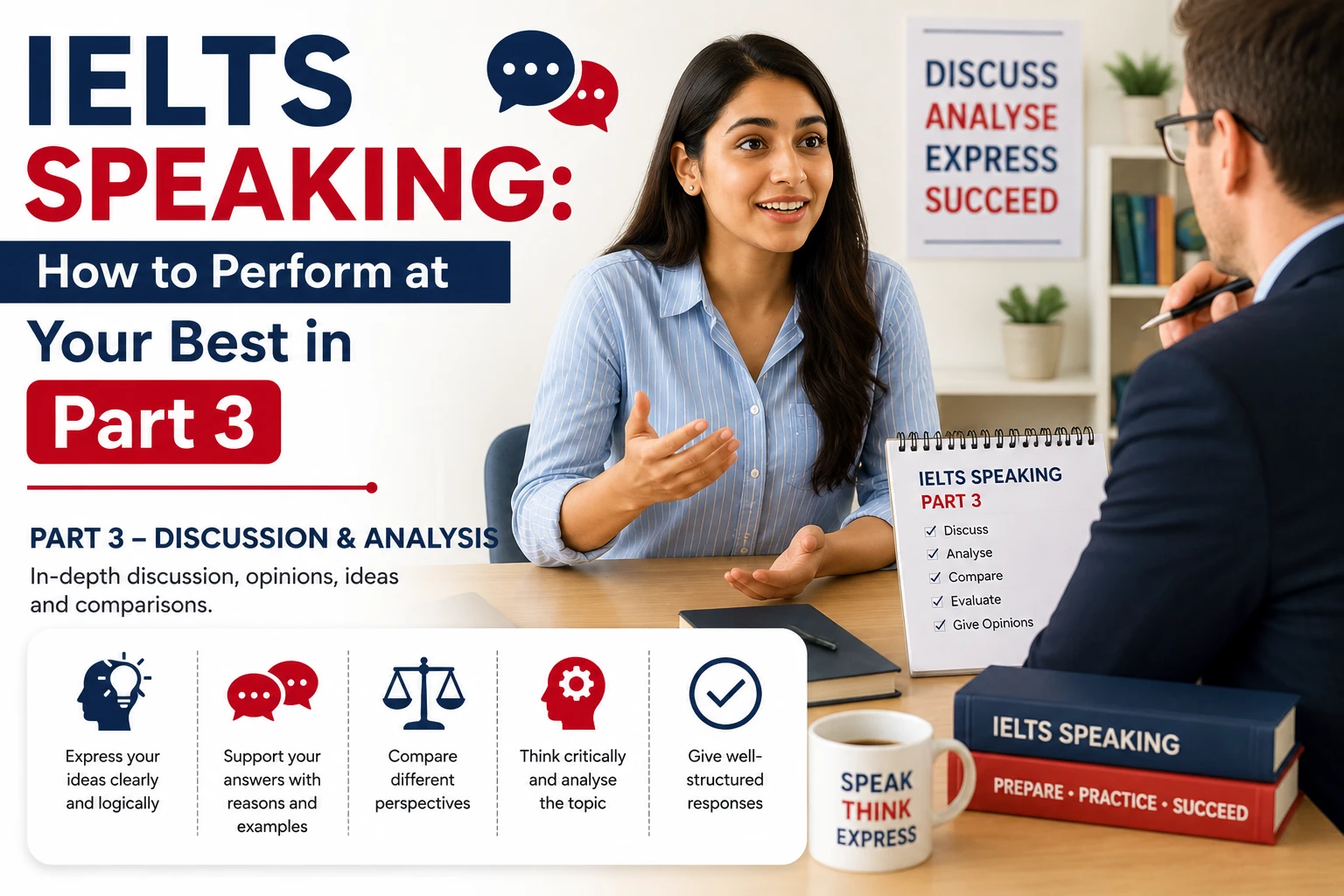
After discussing how to handle Part 1 and Part 2 of the IELTS Speaking test, it is time to understand the final stage — Speaking Part 3. This section builds directly on your cue card topic and moves into a more general, analytical discussion.
So, what can a student expect in Part 3?
Part 3 consists of follow-up questions connected to the theme of your Part 2 cue card. For example, if Part 2 asked you to “Describe a book you recently read,” then Part 3 may include broader questions such as “Do people read fewer books today?” or “How has digital media changed reading habits?” These questions require opinions, explanations, comparisons, and predictions. Topics can range across education, technology, environment, culture, society, and lifestyle.
Below are the key strategies that help you perform well in this section:
Part 3 is not about your personal life unless the examiner specifically asks for it. Your answers should focus on society, trends, behaviour, and broader viewpoints. Instead of saying, “I don’t read books,” shift your response to “Many people today prefer short online content because…”. This shows you understand the aim of Part 3: giving reasoned, general opinions. You can use the following phrases to extend the discussion in a more general way:
The list of bullet points taken from the IDP Website*
Part 3 requires structured and connected ideas. Linking words help the examiner follow your thoughts smoothly.
Useful phrases include:
Avoid overusing them, but use enough to create a clear organisation.
Students often think complex or uncommon words will improve their score. In reality, the examiner wants accurate, appropriate vocabulary. If the topic is “environment,” words like pollution, conservation, climate, sustainability, and eco-friendly are more relevant than long, unnatural words.
Appropriacy matters more than complexity.
Part 3 answers should be longer than Part 1 but still focused.
A good structure is:
This keeps your response detailed but controlled. Avoid drifting into unrelated information.
Examiners expect more grammatical flexibility in Part 3 compared to Part 1.
This includes:
Accuracy is important, but showing variety is equally valuable.
Part 3 gives you the chance to show mature, analytical vocabulary. Instead of simple words like “good” or “bad,” try “beneficial,” “harmful,” “significant,” “challenging,” or “effective.”
Again, clarity and correctness are more important than sounding complicated. Look at the mind-map image below, which shows vocabulary and phrases related to the topic ‘Famous People.’
Image taken from the IDP Website*
Because the questions are deeper, students often speed up or panic. Taking one second to think is completely acceptable. A short pause shows the examiner you are organising your ideas. Speaking too fast leads to errors, unclear pronunciation, and incomplete answers.
If you do not understand a question, it is better to clarify than guess.
You can say:
This does not affect your band score and prevents you from answering incorrectly.
Part 3 is where you demonstrate your ability to think, explain, and analyse in English. With the right strategies—structuring answers, using general ideas, maintaining clarity, and showing mature language—you can perform confidently and naturally.
Practising regularly with a trainer helps you improve the depth of your responses and understand what examiners are actually looking for.
At Focus Education, students receive guided practice, weekly speaking mocks, and personalised feedback to help them excel in all parts of the IELTS Speaking test.
If you want focused training and structured speaking practice, our IELTS classes can help you prepare effectively.