
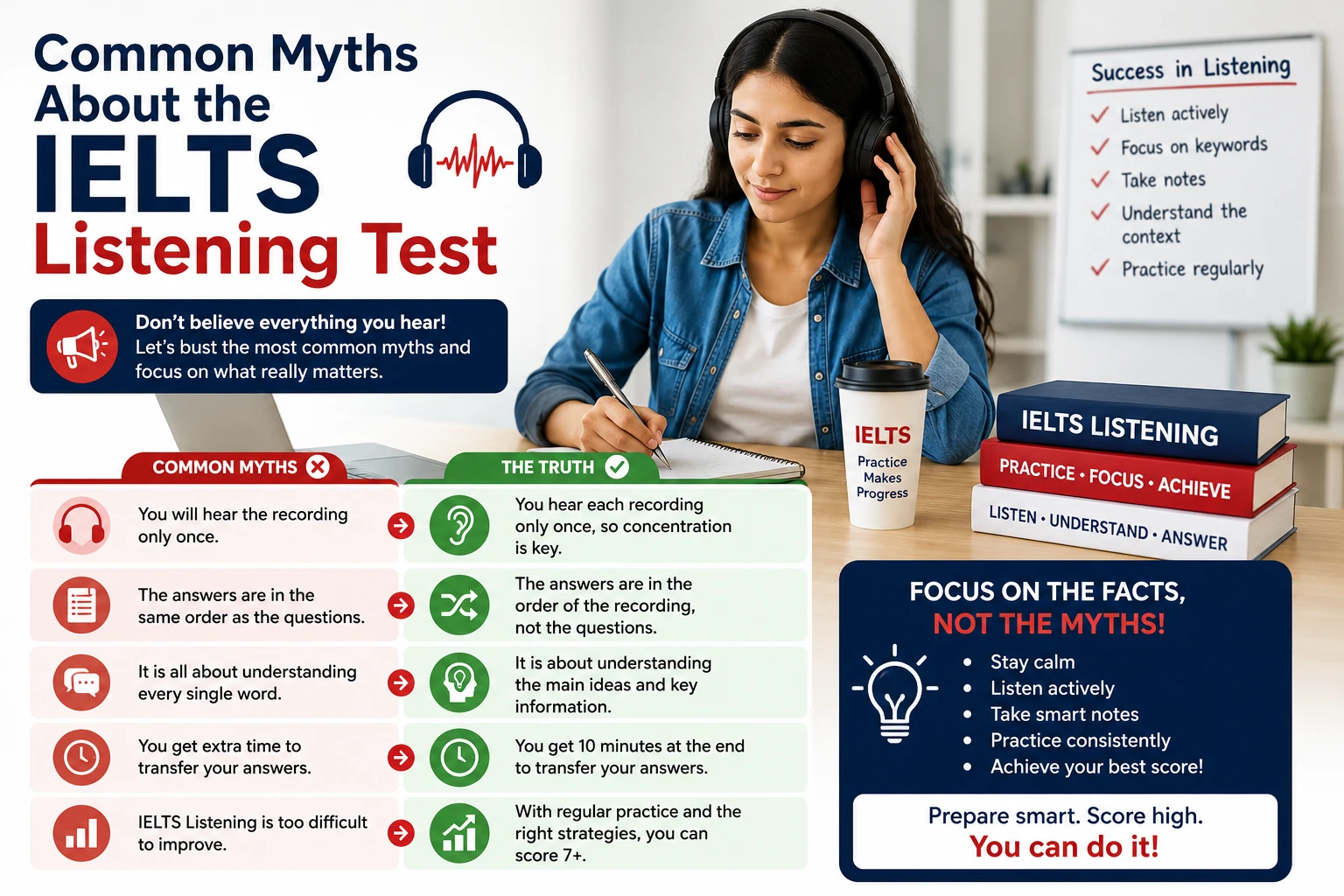
The IELTS Listening test often feels simple on the surface — you just listen and write, right? But in reality, this section tests a lot more than hearing ability. Many students lose marks because of wrong assumptions or myths that circulate among test-takers. Let’s uncover the most common ones so you can approach this section with clarity and confidence.
This is one of the biggest misconceptions. In IELTS Listening, correct spelling and grammar are essential. Even if your answer is conceptually right, a small spelling mistake can make it wrong. For example, writing enviroment instead of environment will cost you a mark. Similarly, using the wrong form of a word, like writing running instead of run, can lead to errors. Always double-check your spellings during review time.
The audio in the IELTS Listening test follows the order of the questions. That means you will hear the answers in sequence — you won’t have to go back or jump between sections. This structure helps you stay focused and move smoothly through the paper. However, the challenge lies in staying alert, as the speakers often paraphrase information or distract you with extra details.
While understanding different accents (British, Australian, Canadian, etc.) is part of the test, Listening is more about understanding meaning and identifying details. The test checks your ability to catch information, follow arguments, and recognize opinions — not just accents. Practicing with different English accents is useful, but focus more on comprehension and prediction skills.
The short time given before each section helps you guess the topic and type of answer, not the exact words. For example, if the question says “The meeting will be held on ______,” you know a day or date will fit, but not what it will be. The key is to use the preview time to identify possible answer types and underline keywords, not to fix your mind on a single answer.
You can write your answers in all capital letters if you prefer — it won’t lower your score. However, it’s not mandatory. Many students find it safer to write in capital letters to avoid issues with handwriting. Whether you use all caps or lowercase, consistency and accuracy are what matter most.
You absolutely can. In fact, note-taking is encouraged. Writing short notes, especially for multiple-choice or map-labelling questions, helps you track information as the audio progresses. The key is to jot down quickly without losing focus on the next sentence. On the computer-based test, you can use the on-screen notes or your rough sheet for this purpose.
Many students assume one mode is easier than the other. The truth is, both have the same level of difficulty. The difference lies in personal comfort. On the computer, you can type answers directly and get results faster. On paper, you can underline and circle keywords physically. It’s best to try both formats during practice and choose the one that feels more natural.
Never leave a question blank. IELTS has no negative marking, so guessing gives you a chance to earn a mark you might otherwise lose. If you miss an answer, make a logical guess based on the topic or surrounding questions. A blank answer guarantees zero; a guess at least gives you a chance.
In the Listening test, the audio plays only once, and time moves fast. On paper, you get an extra 10 minutes to transfer answers at the end, but in the computer-based test, that time is not given. You must write or type your answers as you go. Learn to multitask — listen, think, and write simultaneously — so you don’t fall behind.
The recording is played only once and never repeated. It doesn’t pause for your convenience either. That’s why it’s crucial to stay focused throughout the test. If you miss one answer, don’t panic — move on quickly. Losing focus for a few seconds can cause you to miss several questions in a row.
IELTS Listening is not about luck — it’s about awareness, preparation, and calm focus. By clearing these myths, you can approach the test more strategically and avoid common traps that many students fall for.
At Focus Education, we guide students with proven methods and practice strategies that help them build confidence in every section of the IELTS. If you want to learn practical test techniques and improve your overall score, join our next batch and start your IELTS journey the smart way.