
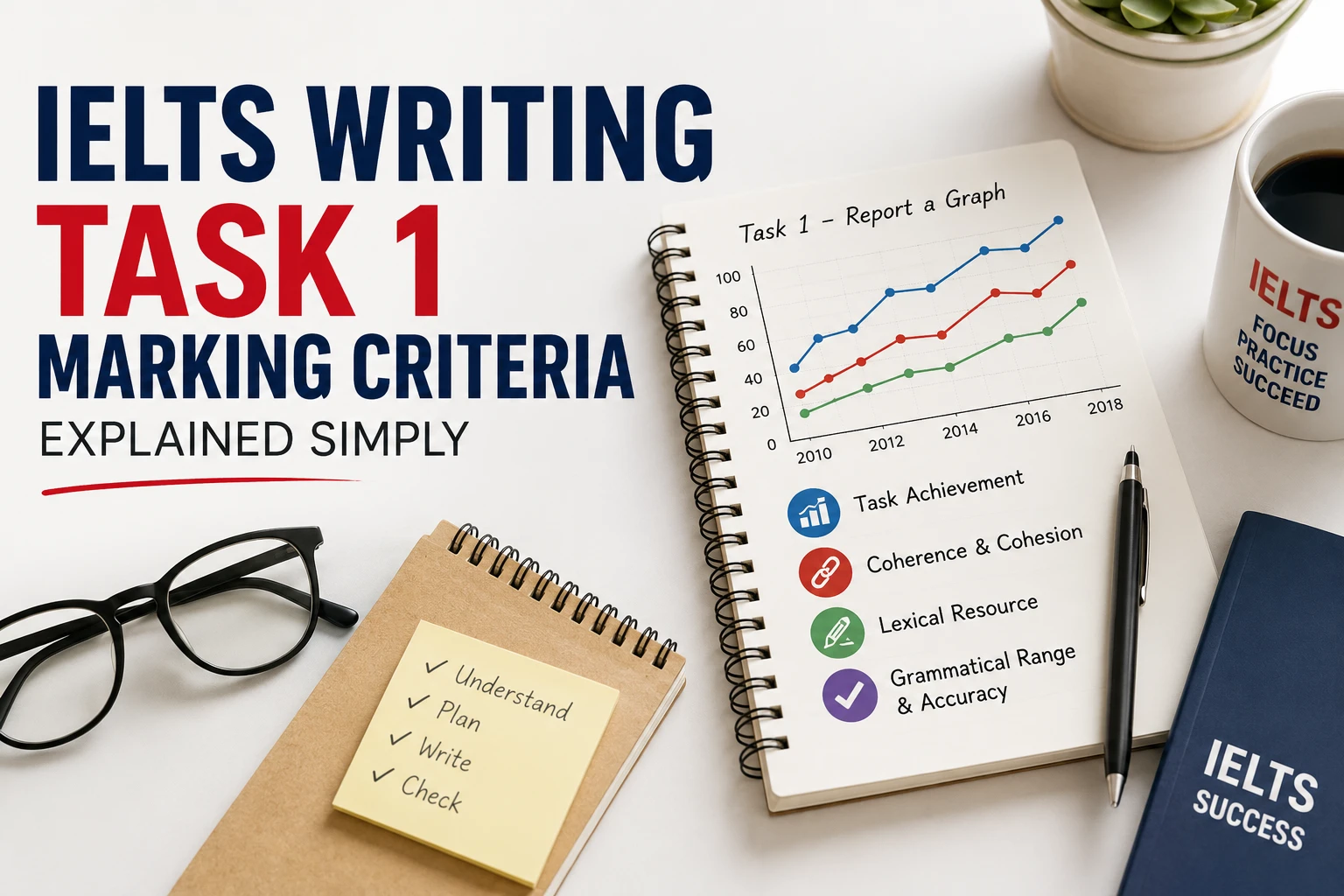
Many IELTS candidates practise Writing Task 1 by memorising formats or learning vocabulary, but still struggle to improve their band score. One major reason for this is that students often do not clearly understand how IELTS examiners actually mark Writing Task 1.
In this blog, we will break down the four official IELTS Writing Task 1 marking criteria simply and practically, so you know exactly what examiners look for and how you can score better.
In IELTS Academic, Writing Task 1 requires you to describe visual information such as a graph, chart, table, map, or process diagram. You are expected to write at least 150 words in around 20 minutes.
Your answer is not judged on opinions or creativity, but on how clearly, accurately, and logically you present the given data.
Each criterion carries equal weight, which means ignoring even one can limit your band score.
Task Achievement checks how well you have understood and answered the question.
Examiners look for:
Common mistakes students make:
To score well, your content must be relevant, complete, and accurate, not lengthy.
This criterion focuses on how well your ideas are organised and connected.
Examiners check:
Good coherence means your reader can easily follow your report without confusion.
Good cohesion means your ideas are connected naturally, not forcefully.
A common misconception is that using many linking words improves the score. In reality, overusing connectors can make your writing sound unnatural.
Lexical Resource assesses how effectively you use vocabulary to describe data.
Examiners look for:
Using “fancy” or uncommon words does not guarantee a higher band. In fact, incorrect or forced vocabulary can reduce your score.
Clear, precise, and accurate vocabulary is always better than complicated language.
This criterion checks how well you use grammar.
Examiners assess:
You do not need extremely complex grammar to score well, but you must show control and accuracy.
Frequent grammatical errors, even in simple sentences, can significantly affect your band score.
Many students focus heavily on vocabulary and grammar, but forget Task Achievement and Coherence. However, a high band score comes from balance.
For example:
Understanding the marking criteria helps you write with purpose, not guesswork.
IELTS Writing Task 1 is not about memorisation; it is about understanding what examiners expect and delivering it clearly. Once you know how your writing is evaluated, your preparation becomes more focused and effective.
At Focus Education, we train students to approach Writing Task 1 strategically by working closely with the marking criteria, analysing real band descriptors, and providing detailed feedback after every practice task.
A clear understanding of the criteria can make a noticeable difference — and the right guidance makes it easier to achieve.