
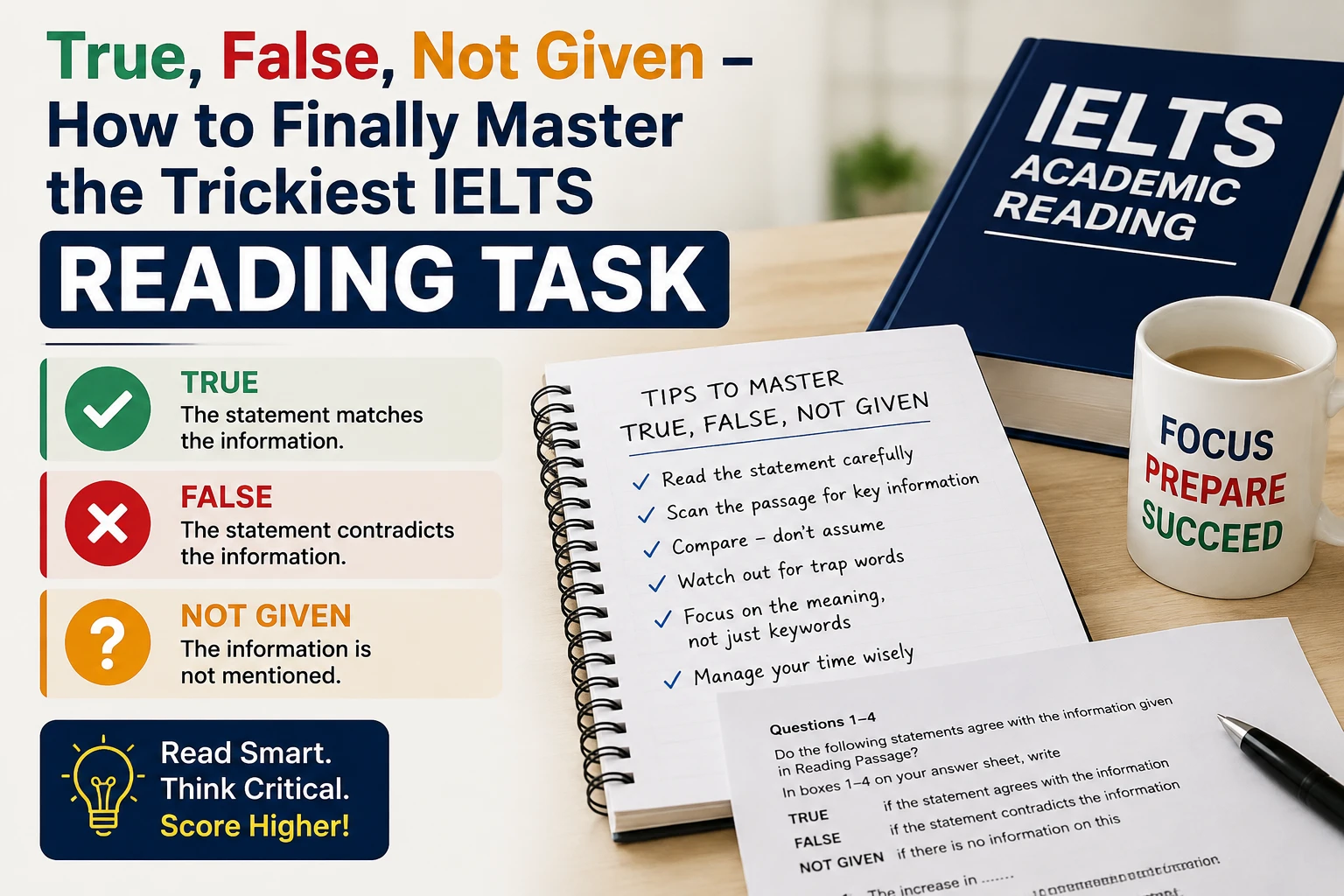
If there’s one IELTS Reading question type that confuses almost every test taker, it’s True / False / Not Given. Many students lose easy marks here just because they don’t fully understand what the test wants from them. Let’s make it simple today.
In this type of question, you’ll read a passage and then a few statements related to it. Your task is to check whether each statement agrees with the information in the passage. These questions are designed to test your reading accuracy and understanding — not your general knowledge. That means you must rely only on what’s written in the passage, not what you personally know or think is true.
Many students don’t realize these two are slightly different. Here’s how you can tell them apart easily:
| Type | Used For | What You Check |
|---|---|---|
| True / False / Not Given | Facts | Does the statement agree with factual information in the text? |
| Yes / No / Not Given | Opinions or beliefs | Does the statement agree with what the writer or speaker thinks or believes? |
So, when the passage says “Scientists believe...” or “The writer suggests...”, the question will usually use Yes / No / Not Given. When it’s about simple facts or data, it’s True / False / Not Given.
Let’s break it down simply:
Example:
Example 1: (Cambridge IELTS 15 – Reading Test 1 inspired)
Passage extract:
“Some experts believe that children learn languages faster than adults because their brains are more flexible during early development.”
| Statement | Answer | Explanation |
|---|---|---|
| Children are able to learn new languages faster as their brains are more adaptable. | TRUE | Same meaning – “more adaptable” = “more flexible.” |
| Adults can learn languages more quickly because their brains are fully developed. | FALSE | Contradicts the passage – adults are not said to be faster. |
| Most adults are not interested in learning new languages. | NOT GIVEN | Interest of adults is never mentioned. |
Example 2: (Cambridge IELTS 14 – Reading Test 2 inspired)
Passage extract:
“The railway system expanded rapidly in the 19th century, improving both travel speed and trade connections across Europe.”
| Statement | Answer | Explanation |
|---|---|---|
| The development of railways helped increase trade between European countries. | TRUE | Matches the idea of “improving trade connections.” |
| Railways reduced the need for road transport completely. | FALSE | The passage never says “completely reduced.” |
| Railways were first built in the 20th century. | FALSE | Contradicts the 19th-century detail. |
Example 3: (Cambridge IELTS 17 – Reading Test 3 inspired)
Passage extract:
“While many scientists agree that climate change affects rainfall patterns, they disagree on the extent to which it influences ocean currents.”
| Statement | Answer | Explanation |
|---|---|---|
| All scientists think climate change affects ocean currents in the same way. | FALSE | The passage clearly says they “disagree.” |
| There is general agreement that climate change has some effect on rainfall. | TRUE | Matches “many scientists agree.” |
| Scientists believe rainfall changes are caused mainly by human activity. | NOT GIVEN | Cause of rainfall change is not mentioned. |
These examples show that IELTS tests your ability to understand meaning, not matching words. Even small differences like “all scientists” vs “many scientists” can change the answer completely.
These questions become easy once you follow a clear step-by-step process.
Step 1: Locate the right area
Use keywords from the question to find where in the passage that topic is discussed. These keywords can be:
Step 2: Read carefully
Once you locate it, read that section slowly. Don’t rush! You’ll often find the meaning hidden behind paraphrasing — the same idea expressed in different words.
Step 3: Match ideas, not words
Don’t look for exact word matches. IELTS loves to use synonyms or change sentence structure to test real understanding.
Step 4: Watch for negative words and contrasts
Words like “not,” “however,” “although,” “but,” “only” can completely change meaning. Missing one small word can turn a True into a False.
You may find lists online claiming that if you see certain words like “always,” “never,” “every,” or “none,” the answer will be False or Not Given. That’s completely wrong.
The IELTS exam is designed to test meaning, not trick you with keywords. While these words can indicate extreme statements, they don’t automatically decide the answer. You still need to read the passage carefully and understand the context before choosing.
True / False / Not Given questions test how well you can understand and interpret information — not how well you can guess. If you train your eyes to notice paraphrasing, logical contrasts, and exact meaning, this section can actually become your strongest area.
At Focus Education, we don’t just teach IELTS — we train you to think like the examiner. For more such practical tips and tricks, join our IELTS coaching today! Come for admission now and get exciting rewards!