
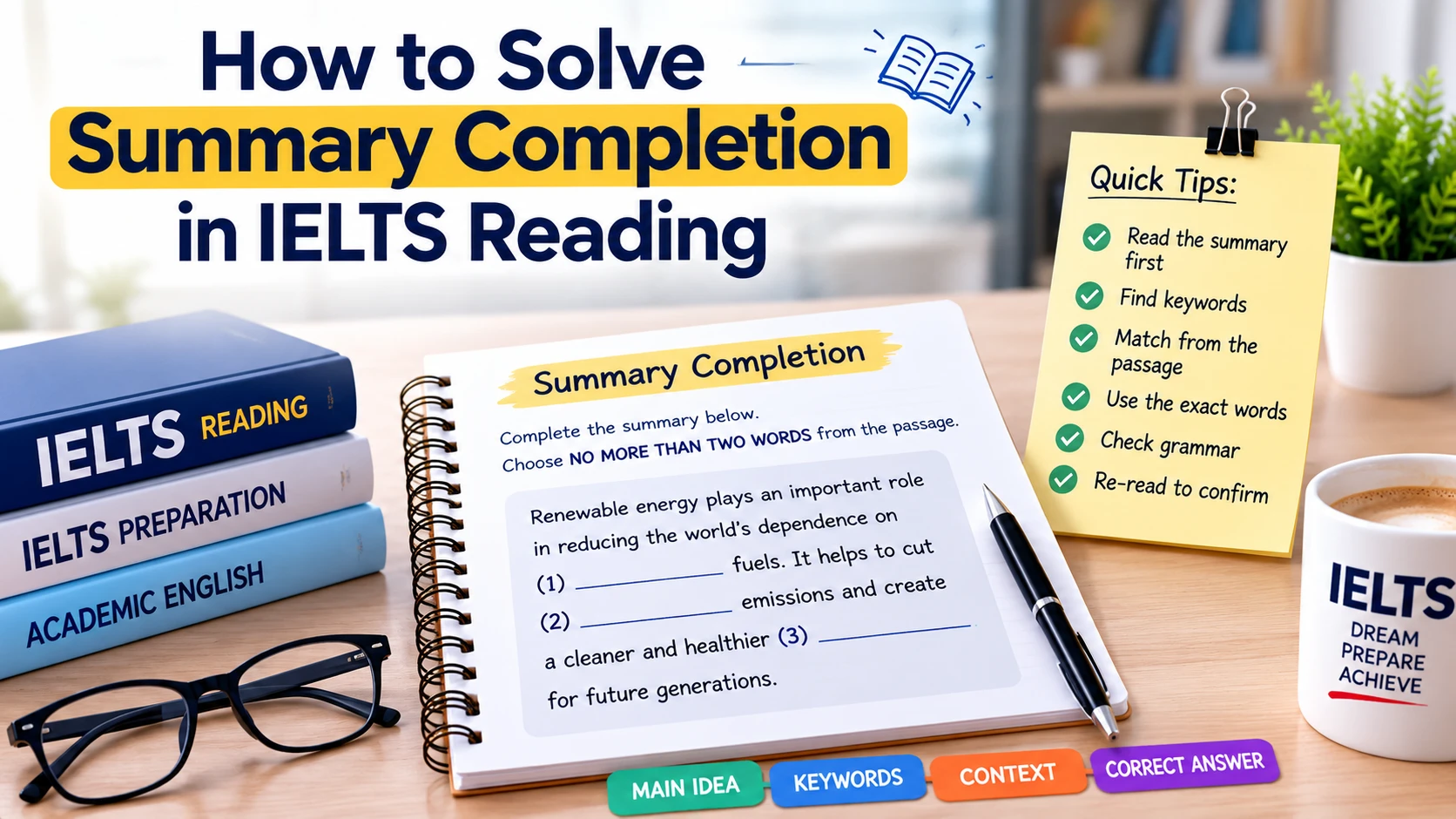
Summary completion is a common question type in the IELTS Reading test where you are given a short summary of a part of the passage, and you must fill in the missing words. The summary presents the main ideas in a concise form, but certain keywords or phrases are removed. Your task is to complete these gaps accurately so the meaning remains clear and matches the information in the text.
There are two variations of summary completion:
In IELTS Reading, you will often find that the options in matching questions use different forms of the same idea. Sometimes the words in the questions appear as synonyms or antonyms of those found in the passage, and other times they are taken directly from the text with slight changes in form.
Because of this, candidates need to build a strong vocabulary, understand word families, and learn how to identify groups of related words. This skill helps them recognise the correct information even when the wording is different.
In this blog, we will focus on the second type, where you choose the correct answer from a list.
ATTITUDES TO LANGUAGE (An extract taken from Cambridge 9, Test 3, Passage 1)
In its most general sense, prescriptivism is the view that one variety of language has an inherently higher value than others, and that this ought to be imposed on the whole of the speech community. The view is propounded especially in relation to grammar and vocabulary, and frequently with reference to pronunciation. The variety which is favoured, in this account, is usually a version of the 'standard' written language, especially as encountered in literature, or in the formal spoken language which most closely reflects this style. Adherents to this variety are said to speak or write 'correctly'; deviations from it are said to be 'incorrect!
All the main languages have been studied prescriptively, especially in the 18th-century approach to the writing of grammars and dictionaries. The aims of these early grammarians were threefold: (a) they wanted to codify the principles of their languages, to show that there was a system beneath the apparent chaos of usage, (b) they wanted a means of settling disputes over usage, and (c) they wanted to point out what they felt to be common errors, in order to 'improve' the language. The authoritarian nature of the approach is best characterised by its reliance on ‘rules' of grammar. Some usages are 'prescribed,' to be learnt and followed accurately; others are 'proscribed,' to be avoided. In this early period, there were no half-measures: usage was either right or wrong, and it was the task of the grammarian not simply to record alternatives, but to pronounce judgement upon them.
These attitudes are still with us, and they motivate a widespread concern that linguistic standards should be maintained. Nevertheless, there is an alternative point of view that is concerned less with standards than with the facts of linguistic usage. This approach is summarised in the statement that it is the task of the grammarian to describe, not prescribe, to record the facts of linguistic diversity, and not to attempt the impossible tasks of evaluating language variation or halting language change. In the second half of the 18th century, we already find advocates of this view, such as Joseph Priestiey, whose Rudiments of English Grammar (1761) insists that 'the custom of speaking is the original and only just standard of any language! Linguistic issues, it is argued, cannot be solved by logic and legislation. And this view has become the tenet of the modern linguistic approach to grammatical analysis.
Complete the summary using the list of words, A-I, below.
Write the correct letter, A-I, in boxes 9-12 on your answer sheet.
According to 9 ____ , there is only one correct form of language. Linguists who take this approach to language place great importance on grammatical 10 _____. Conversely, the view of 11 _____, such as Joseph Priestley, is that grammar should be based on 12 ____.
Before touching the passage, we first look at the summary:
According to ___, there is only one correct form of language… Linguists who take this approach… place great importance on grammatical ___… Conversely, the view of ___ such as Priestley… is that grammar should be based on ___.
From this, we note:
This prediction prepares us for what to look for in the passage.
Now we read the passage, especially the first two paragraphs, because they talk about prescriptivism and descriptivism. We do not search for single words yet.
We notice:
Understanding this overall meaning makes matching the options easier.
Summary Sentence 1
“According to ___, there is only one correct form of language.”
In the passage, this idea clearly describes prescriptivists.
Answer: H (prescriptivists)
Summary Sentence 2
“Linguists who take this approach place great importance on grammatical ___.”
Prescriptivists rely heavily on ‘rules of grammar’ in paragraph 2.
Answer: F (rules)
Summary Sentence 3
“Conversely, the view of ___ such as Joseph Priestley…”
Priestley belongs to the alternative group who believe in describing language, not prescribing it. These are descriptivists.
Answer: A (descriptivists)
Summary Sentence 4
“…is that grammar should be based on ___.”
The passage says:
“‘the custom of speaking’ is the only just standard of any language.”
This refers to popular speech.
Answer: C (popular speech)
Completed Summary (for reference)
According to prescriptivists (H), there is only one correct form of language. Linguists who take this approach to language place great importance on grammatical rules (F). Conversely, the view of descriptivists (A), such as Joseph Priestley, is that grammar should be based on popular speech (C).
Summary completion becomes much easier when you first understand what the question is asking and then read the passage for its main idea instead of matching words blindly. This approach helps you avoid common mistakes and choose options that fit the meaning, not just the vocabulary. With regular practice, your accuracy and confidence will improve naturally.
For guided reading practice and clear strategies, Focus Education provides structured support to help students perform better in IELTS Reading.