
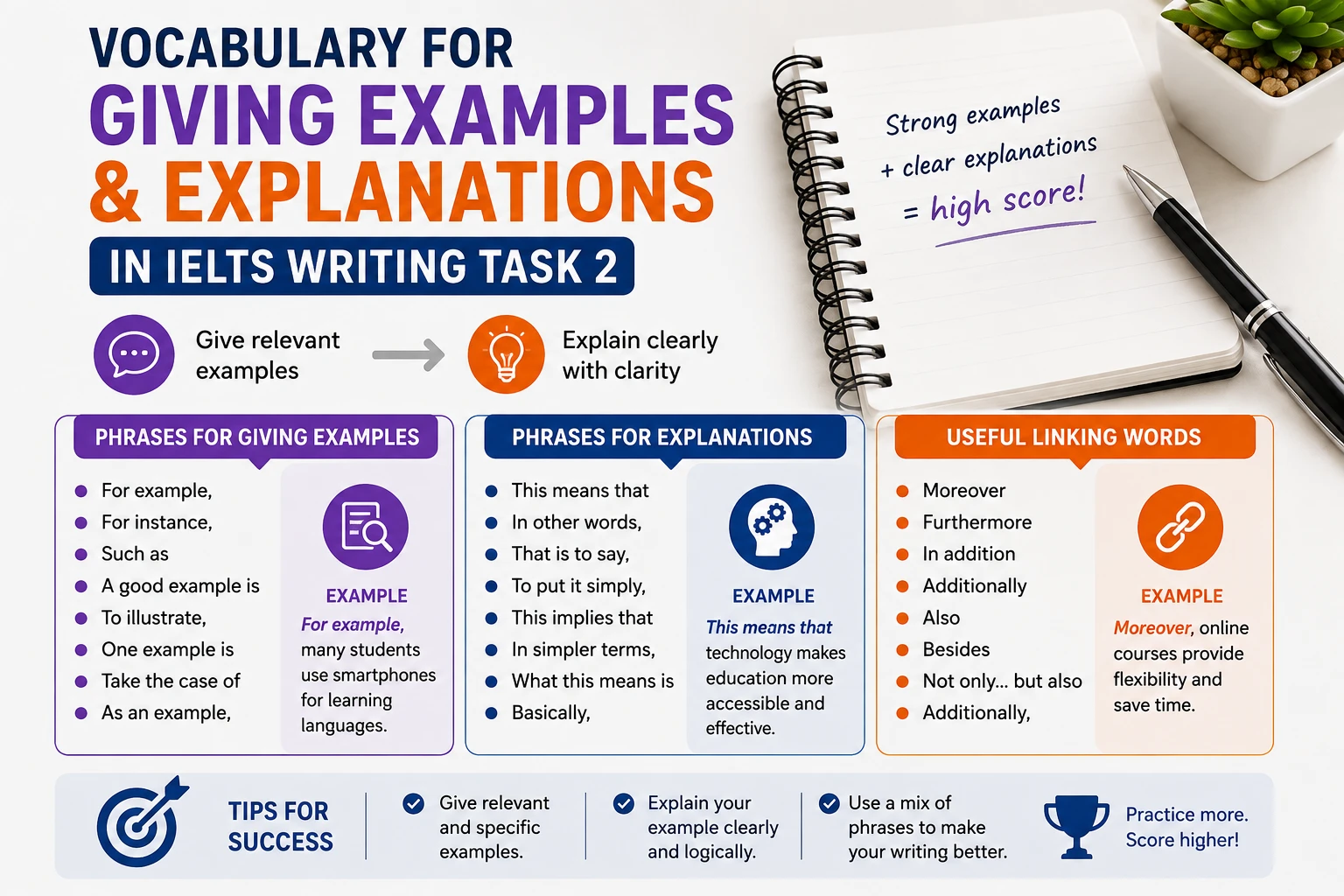
Many IELTS students believe their problem is grammar. Some think they lack ideas. However, in reality, a large number of candidates lose marks because they do not develop their ideas properly.
They write a main point. They add one short example. And then they move to the next paragraph.
The result? An essay that feels incomplete.
In IELTS Writing Task 2, strong vocabulary is not only about advanced words. It is about using the right phrases to introduce examples, explain them clearly, and connect them back to the main argument. This is what separates a Band 6 essay from a Band 7 or higher response.
The IELTS examiner evaluates your essay based on four main criteria. Three of them are directly affected by how you use examples:
If your example is short and unexplained, the examiner feels your idea is underdeveloped. Even with good grammar, your band score may remain limited.
That is why learning how to expand examples is essential.
Most students rely heavily on:
These are correct, but when used repeatedly, they reduce your lexical range.
Instead, you can rotate between more academic expressions such as:
Using varied phrases makes your writing sound more mature and controlled.
However, vocabulary alone is not enough.
This is where real band improvement happens.
Many students give an example but fail to explain why it matters. In IELTS, an example without explanation feels incomplete.
After giving your example, you can continue with phrases like:
These connectors help you link the example back to your argument. They show logical thinking, which examiners value highly.
Let us compare two short versions of the same idea.
Weak version:
Many people prefer online education. For example, students can study from home.
This paragraph feels unfinished. The example is clear, but there is no analysis.
Improved version:
Many people prefer online education. For example, students can study from home. This reduces commuting time and provides greater flexibility, making learning more convenient and cost-effective.
The second version explains the impact of studying from home. The idea is now developed. It feels complete.
This small change can significantly affect your Task Response score.
If students struggle with idea expansion, they can follow a practical four-step paragraph model:
This structure ensures that no paragraph feels rushed. It also naturally increases word count in a meaningful way, without adding unnecessary filler.
Many candidates try to memorise complicated vocabulary to impress the examiner. But IELTS writing rewards clarity over difficulty.
Instead of learning rare words, focus on:
When your examples are well-developed, your essay automatically sounds more academic. Band 7 and above essays are not necessarily filled with difficult words. They are filled with clear thinking and structured development.
Improving IELTS Writing Task 2 is not about writing more. It is about writing better.
When students learn to introduce and explain examples properly, their essays feel more complete, more persuasive, and more organised. That is when band scores begin to improve consistently.
If you want structured guidance on idea development, vocabulary building, and high-scoring writing techniques, the mentors at Focus Education provide specialised IELTS training designed to help students break through the Band 6 plateau.
Strong writing is not a talent. It is a skill that can be trained — with the right method and feedback.
Ready to upgrade your IELTS writing?
Connect with Focus Education and take your preparation to the next level.