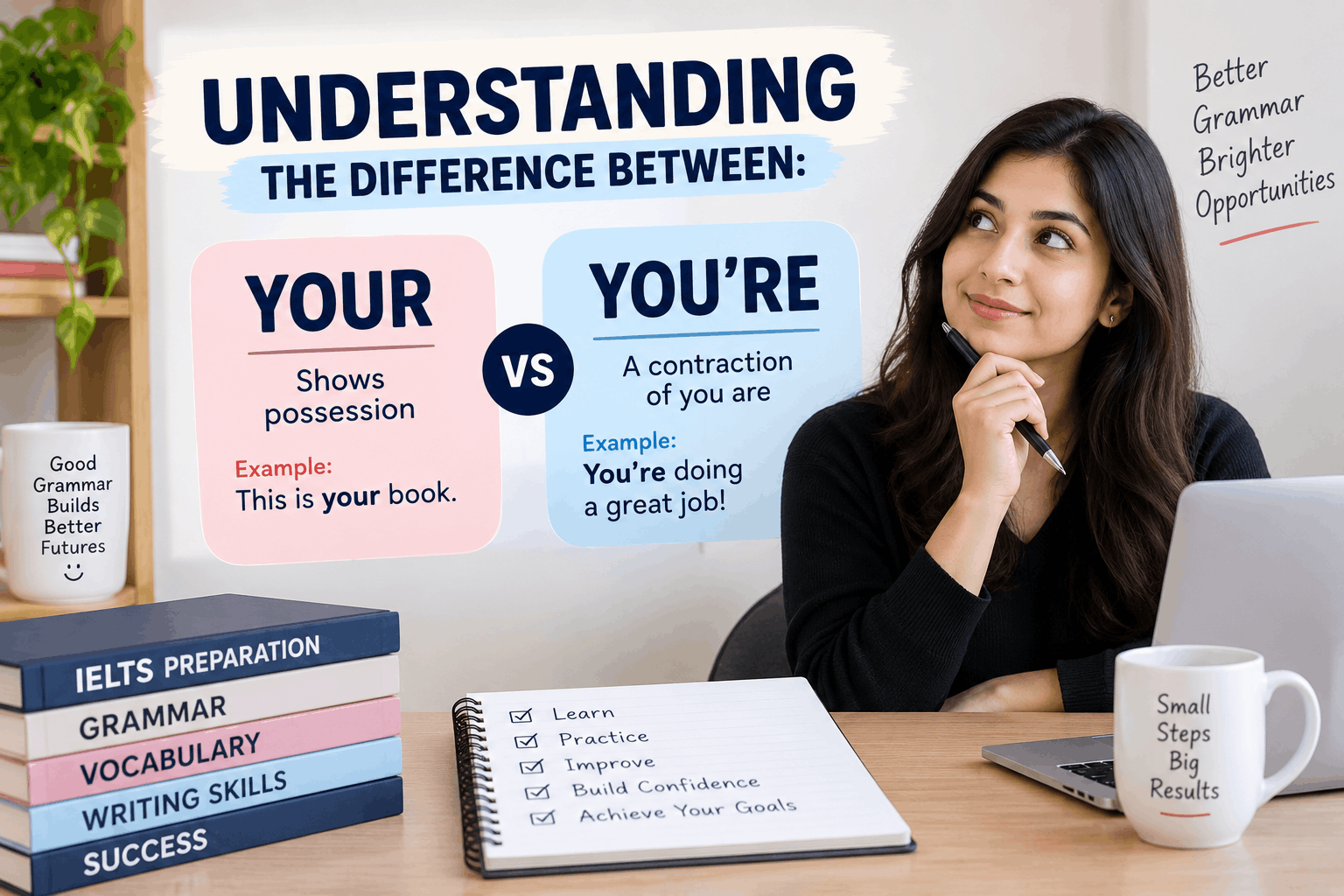
Many learners get confused between “your” and “you’re.” They look similar, sound the same, and often appear in similar sentences. Because of this, people hesitate while writing. This short guide will clear the confusion quickly so you can use both forms correctly.
Why does the confusion happen
- “Your” and “you’re” are homophones (same sound, different meaning).
- They appear in everyday English.
- Many learners rely on sound instead of meaning while writing.
Meaning of “your” and “you’re”
Your
- Shows possession or ownership.
- Always comes before a noun.
- Example idea: your bag, your class, your plan.
You’re
- Short for “you are.”
- Used to describe someone or their action.
- If you can replace it with “you are,” it is correct.
The Difference
Your:
Is a determiner: A modifying word that determines the kind of reference a noun or noun group has.
You’re:
Is a contraction: A word that commonly combines a pronoun or noun and a verb, or a verb and not, in a shorter form.
Examples of ‘Your’
- Your phone is ringing.
- I liked your idea.
- Don’t forget your appointment.
- Your teacher called.
- This is your seat.
Examples of ‘You’re’
- You’re doing a great job.
- Make sure you’re ready on time.
- You’re very kind.
- If you’re confused, ask for help.
- You’re improving every day.
Other Commonly Confused Words
- There / Their / They’re
- Its / It’s
- To / Too / Two
- Then / Than
We will discuss these pairs in upcoming blogs to help you strengthen your grammar step by step.
About Focus Education
Focus Education provides simple, clear, and practical English learning support for IELTS, PTE, and spoken English students. Follow our blogs for easy grammar explanations and effective learning tips.