
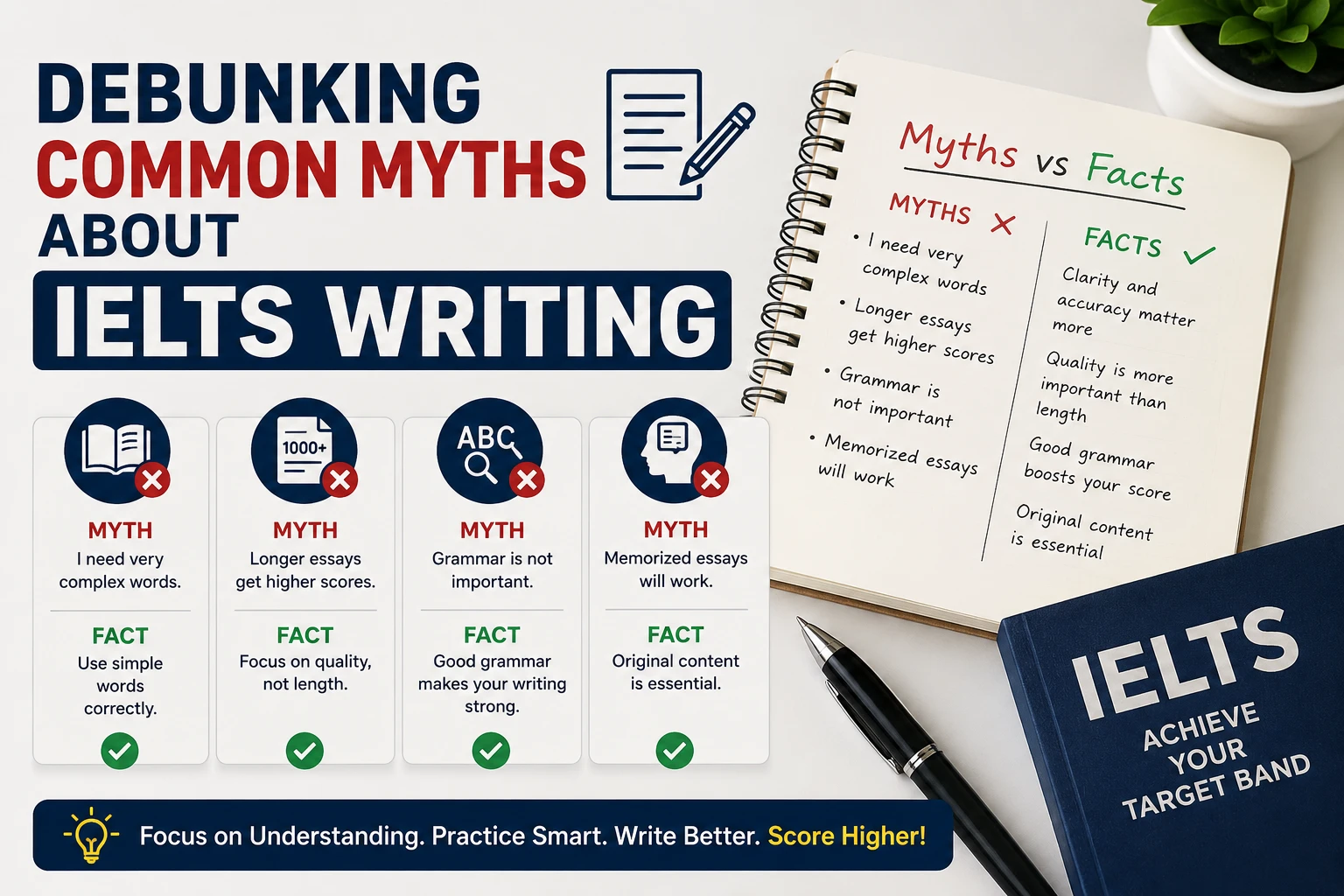
Preparing for the IELTS Writing test can be confusing. With so much advice available online and from peers, students often end up believing things that aren’t true. These myths can easily affect their performance and lower their overall band score.
At Focus Education, we often meet learners who work hard but struggle because of these misconceptions. Let’s clear up some of the most common ones and understand what truly matters in IELTS Writing.
While Task 2 carries slightly more weight in the overall writing score, Task 1 is still crucial. Many students focus only on essays and neglect Task 1, which results in an unbalanced score. Both tasks test your ability to organize ideas, present information clearly, and use correct grammar and vocabulary. Ignoring Task 1 can reduce your overall band, even if your essay is strong. A balanced approach to preparation is key.
Examiners do not reward difficult or uncommon words if they are used incorrectly. Using words just to sound impressive often leads to awkward or unclear sentences.
What truly helps is using vocabulary that is accurate, suitable for the context, and shows some range. Simplicity with precision is far better than complexity with confusion.
Linking words like however, moreover, and on the other hand are useful, but overusing them can make your writing look mechanical. Cohesion is about the smooth connection of ideas, not about inserting connectors everywhere. Natural transitions and logical flow are what examiners value, not a checklist of linking phrases.
Some students believe that switching tenses frequently can demonstrate their grammar skills. In reality, it usually causes errors and breaks the flow of writing. IELTS Writing rewards accuracy and consistency. If the question is about a general issue, stick to present tenses. If you describe a past trend or data in Task 1, use the past tense. Choose the right tense for the context, not for display.
Examiners are not judging your creativity; they assess how well you answer the question. A clear, logically developed argument is far more effective than an unusual or “interesting” one.
Even simple examples or common ideas can earn high bands if they are relevant, coherent, and well-supported. IELTS rewards clarity, not cleverness.
Templates may seem like a shortcut, but they can limit your ability to express original thoughts. Examiners can easily recognize memorized patterns, and this often lowers your score under “Task Response” and “Coherence and Cohesion.” Learning how to structure an essay is useful, but relying on the same sentences in every answer will make your writing repetitive and less natural.
Many students believe that longer essays automatically score higher. However, once you exceed 300 words, you’re more likely to make grammatical mistakes or repeat ideas. Examiners prefer essays that are concise, well-organized, and stay within the recommended word range—150 words for Task 1 and around 250 words for Task 2. Quality of expression always outweighs quantity.
The IELTS Writing test isn’t about using fancy words or lengthy essays—it’s about how effectively you communicate your ideas. Understanding what the exam truly measures can help you focus your preparation on clarity, structure, and precision.
At Focus Education, we help learners build these exact skills through practical guidance and feedback-driven writing practice. Our aim is to help every student understand how to write smarter, not just more.