Introduction
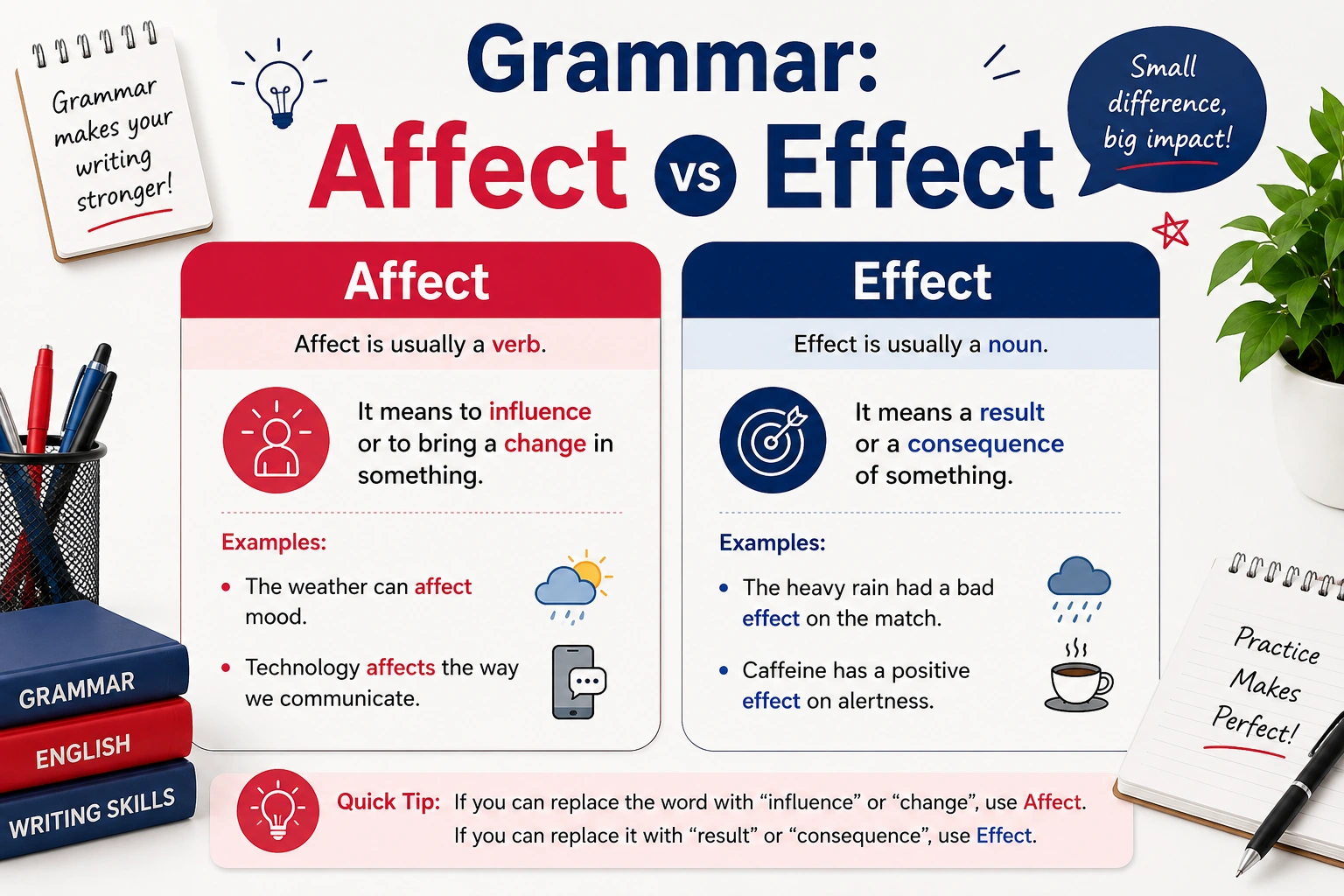
Many students confuse “affect” and “effect” because they sound similar, but their usage is different. Understanding the distinction helps you write more accurately and clearly.
Definition
- Affect: Usually a verb, meaning “to influence or make a difference to something.”
- Effect: Usually a noun, meaning “the result or outcome of a change or influence.”
Difference at a Glance
| Word |
Part of Speech |
Meaning |
Example |
Affec
t |
Verb |
To influence or change |
The weather can affect your mood. |
| Effect |
Noun |
The result of a change |
The new law had a positive effect on education. |
Synonyms
- Affect (verb): influence, impact, alter, change, modify
- Effect (noun): result, outcome, consequence, impact, repercussion
Examples
Using Affect (Verb)
- Stress can affect your concentration.
- The heavy rain will affect the match schedule.
- Smoking negatively affects lung health.
- His speech affected everyone in the audience.
- Lack of sleep affects memory and focus.
Using Effect (Noun)
- The medicine had an immediate effect on her headache.
- The new policy had a significant effect on the company’s profits.
- Exercise has a positive effect on mental health.
- The movie’s special effects were impressive.
- Pollution has a harmful effect on the environment.
Final Thoughts
Remember: Affect is usually an action (verb), and Effect is usually a thing (noun). Using them correctly will make your writing precise and professional.
Take your English skills to the next level with Focus Education. Learn the difference between tricky words like affect and effect, improve your writing, and communicate confidently. Join us today!