
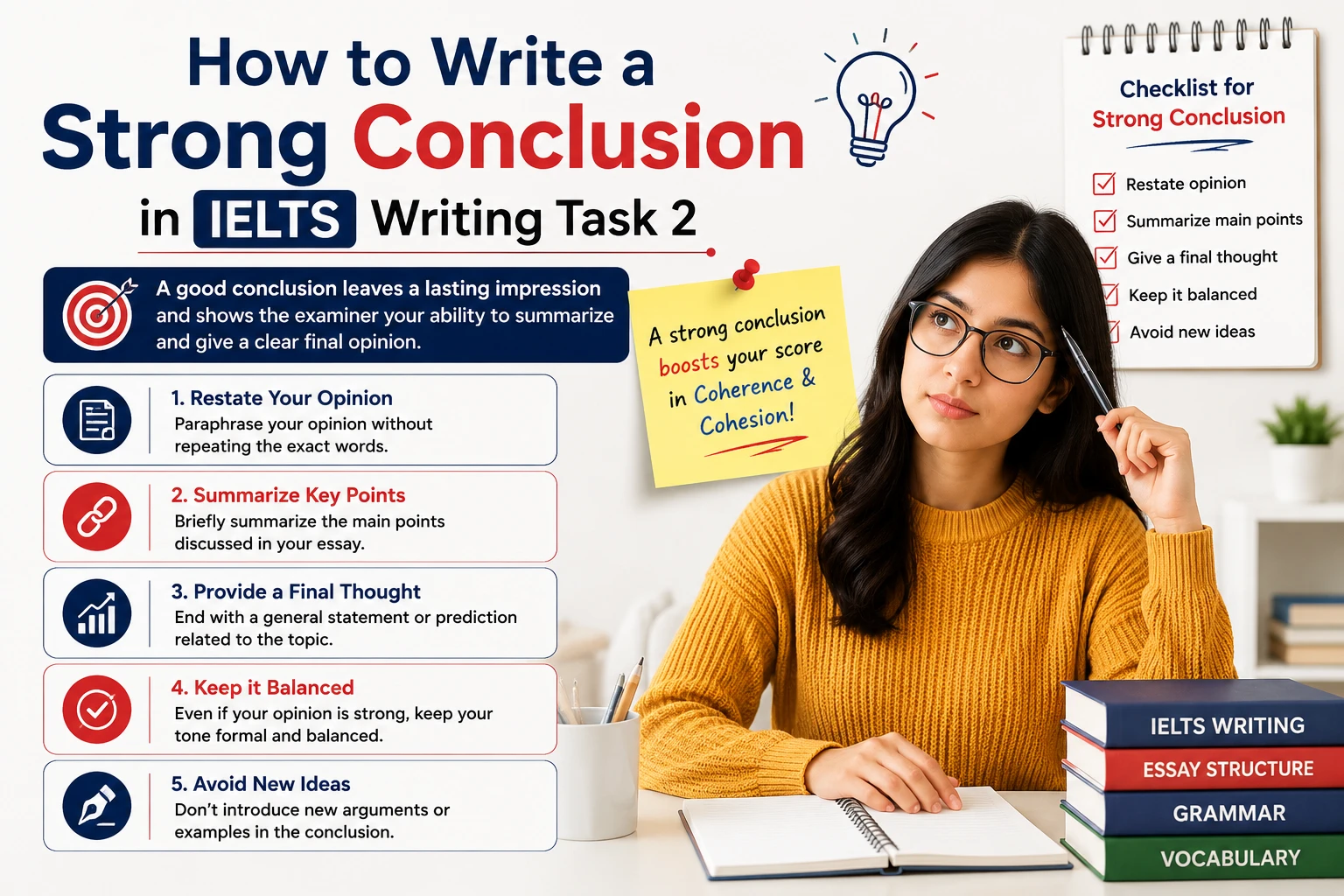
In IELTS Writing Task 2, students are required to write an essay of at least 250 words in about 40 minutes. While most students focus heavily on the introduction and body paragraphs, the conclusion is often rushed or poorly written. However, a weak conclusion can reduce your overall impression and affect your score in Task Response and Coherence & Cohesion.
In this blog, we will understand what makes a strong conclusion and how to write one effectively.
The conclusion is the final paragraph of your essay. Its purpose is to:
It should not introduce new ideas. Instead, it should briefly reinforce what you have already discussed.
A strong IELTS conclusion usually contains:
It should be clear, direct, and concise. Usually, 2–3 sentences are enough.
“Overall, this topic has many advantages and disadvantages. In conclusion, it depends on the situation.”
This is too vague. It does not clearly state the writer’s position.
Question:
“Some people believe that technology has made life more complicated than simple. To what extent do you agree or disagree?”
Strong conclusion: “In conclusion, although technology has introduced certain challenges, I strongly believe that it has made life significantly more convenient and efficient. The benefits it offers in communication and productivity clearly outweigh the drawbacks.”
Notice that:
Do not copy your introduction word for word. Instead, paraphrase it.
Introduction example: “I believe that governments should invest more in public transport than in building new roads.”
Conclusion example: “To conclude, I firmly believe that prioritising public transport is a more sustainable and effective solution than expanding road infrastructure.”
The idea is the same, but the wording is different.
Remember, this is an academic essay, not a speech.
Your conclusion should be around 40–60 words. Writing a very long conclusion wastes time and may repeat information unnecessarily.
Opinion Essay
“In conclusion, I strongly agree/disagree that… because…”
Discussion Essay
“To conclude, while both views have merit, I believe that…”
Problem–Solution Essay
“In conclusion, although this issue is serious, it can be addressed by…”
Using simple structures keeps your writing clear and organised.
A strong conclusion does not need complex vocabulary or long sentences. It needs clarity, confidence, and logical closure. If your introduction starts your argument well, your conclusion should finish it clearly and effectively.
With regular practice and proper guidance, writing strong conclusions becomes much easier. At Focus Education, we train students to structure their essays strategically so that every paragraph, including the conclusion, supports a higher band score.