
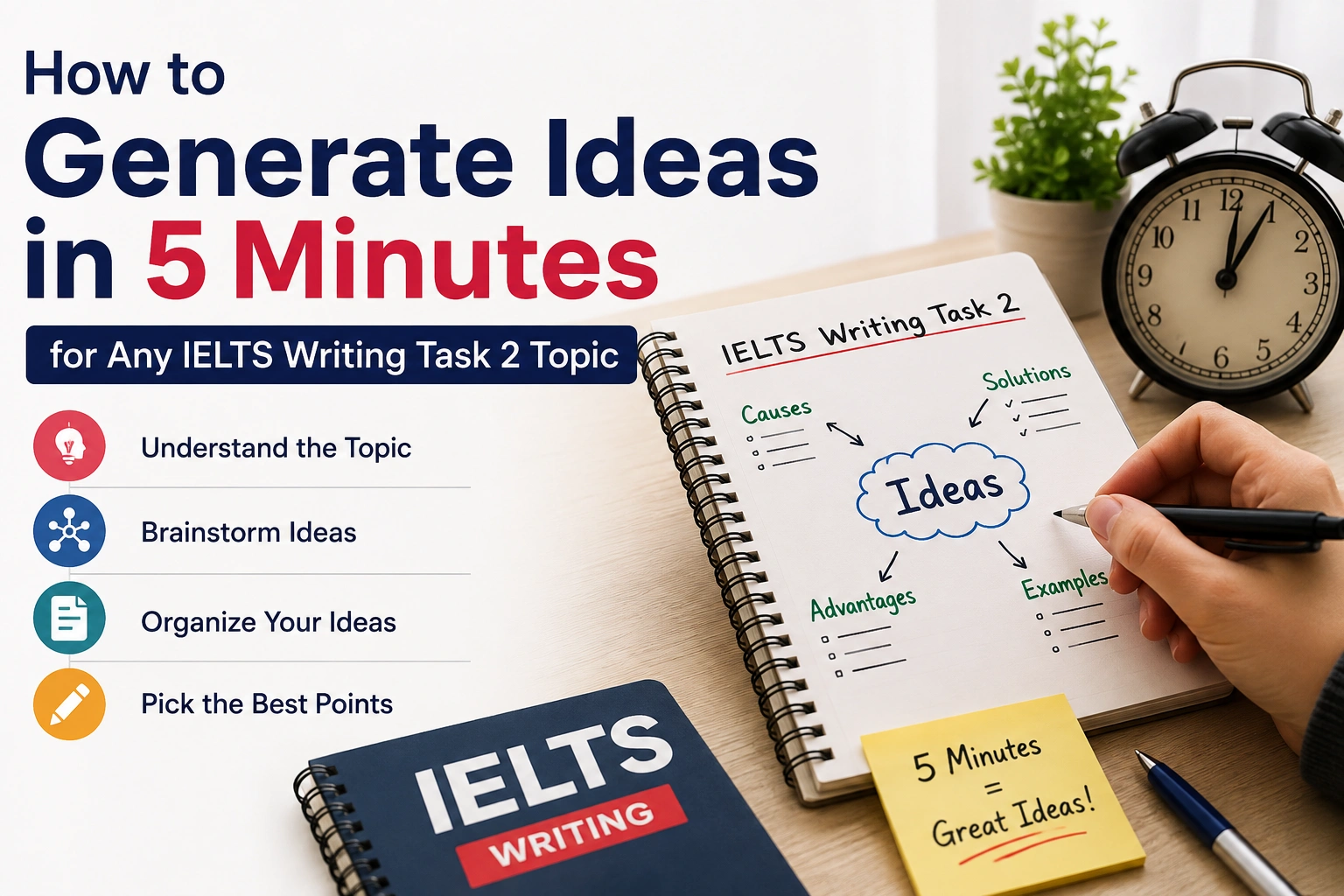
Many IELTS students struggle with Writing Task 2, not because their English is weak, but because they cannot think of ideas quickly. As soon as they read the question, they feel confused or unsure about what to write. This usually happens when students try to be too creative or intellectual. In reality, IELTS focuses on clarity, relevance, and logical development of ideas.
Before thinking of ideas, it is important to understand what the question is asking. Every Task 2 question has a topic and an instruction word, such as discuss, agree or disagree, or to what extent. Identifying these keywords helps you stay on track.
Example:
If the question says, “Discuss both views and give your opinion,” you must write about both sides first and then clearly share your opinion. Ignoring one part will reduce your score.
After choosing an idea, ask yourself why it happens or why people believe it. Then ask “why” again to go deeper. This helps you extend your answer naturally without adding irrelevant content.
Example:
If the topic is about online education, you can say it is convenient. Ask why — because students can study from home. Ask why again — because it saves travel time and allows flexible schedules.
Many students think they need expert knowledge or statistics to score well. This is not true. IELTS accepts general ideas based on daily life experiences, as long as they are explained clearly.
Example:
For a health-related topic, you can talk about poor diet, lack of exercise, or stress from work. These are common situations that examiners easily understand.
Trying to include many ideas in one paragraph often leads to a weak explanation. It is better to choose one clear idea and develop it properly using explanation and an example.
Example:
Instead of writing about education quality, teacher salary, infrastructure, and technology in one paragraph, focus only on teacher quality and explain it properly.
Planning should not take too much time. Writing short keywords or phrases is enough. You do not need full sentences while planning. Once ideas are clear, start writing immediately.
Example:
Instead of writing full lines like “Online education is beneficial because…”, simply note: flexibility – saves time – working students.
Generating ideas in five minutes is a skill that improves with regular practice and correct guidance. When students practise analysing questions and developing ideas under exam conditions, writing becomes much easier. At Focus Education, students are guided to plan smartly, write relevant content, and receive clear feedback so that Writing Task 2 feels structured and achievable.