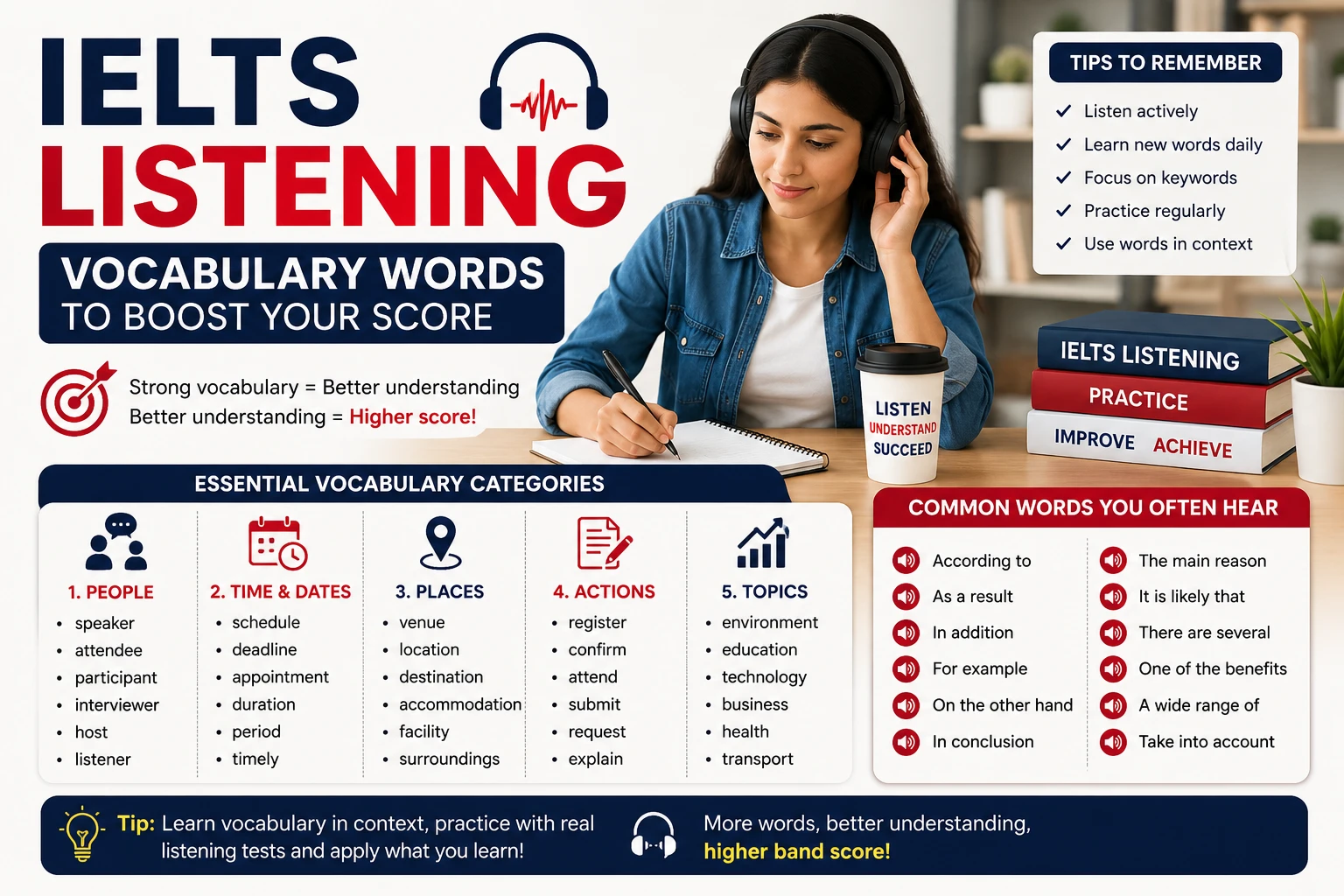
A strong vocabulary is one of the most reliable ways to increase your score in the IELTS Listening test. Most questions in Listening depend on your ability to recognise words, understand paraphrasing, and follow information even when the speaker changes the structure. Building topic-wise vocabulary helps you predict answers, avoid confusion, and listen more accurately. Below is a complete list of essential vocabulary grouped according to the types of topics that commonly appear in Parts 1 to 4.
Part 1 Vocabulary
Part 1 usually deals with everyday conversations such as bookings, enquiries, forms, and basic descriptions.
1. Days of the Week
- Monday, Tuesday, Wednesday, Thursday, Friday, Saturday, Sunday
- Weekdays, weekend, fortnight
2. Months and Seasons of the Year
- January to December
- Spring, summer, autumn, winter
- Annual, yearly, quarterly
3. Shapes
- Circle, square, rectangle, triangle, oval
- Cube, sphere, pyramid
- Straight edge, curved
4. Transportation
- Bus, coach, train, tram, metro
- Taxi, cab, shuttle, ferry
- Flight, departure, arrival, boarding pass
- Lane, traffic, roundabout, junction
5. Colours
- Red, blue, yellow, green, white, black
- Beige, navy, maroon, turquoise, grey
- Light, dark, pale, bright
6. Useful Verbs
- Book, reserve, arrange, confirm
- Borrow, lend, return
- Collect, deliver, purchase, enquire
- Locate, identify, select
7. Common Adjectives
- Cheap, expensive, affordable
- Available, suitable, convenient
- Local, modern, traditional
- Spacious, narrow, crowded
8. Numbers, Time, and Currencies
- Half past, quarter to, noon, midnight
- Per hour, per day, annually
- Dollars, pounds, euros, rupees
- Single, double, triple
Part 2 Vocabulary
Part 2 often includes descriptions of places, maps, and directions. A clear understanding of these words helps you follow the speaker’s instructions.
1. Rooms in Buildings
- Lobby, reception, corridor
- Auditorium, laboratory, cafeteria
- Storage room, basement, terrace
- Conference room, gallery
2. Place Markers
- Entrance, exit, doorway
- Staircase, escalator, lift
- Front, rear, side, corner, edge
- Ground floor, first floor, wing, block
3. Directions and Prepositions of Place
- Opposite, next to, behind, in front of
- Adjacent to, across from
- Turn left, turn right, go straight
- At the end of, near, beside, between
Part 3 Vocabulary
Part 3 usually involves discussions between students and professors, or academic conversations. These words help with more technical listening.
1. Academic Terminology
- Hypothesis, analysis, survey, findings
- Assignment, presentation, tutorial
- Data collection, research method
- Feedback, assessment, draft
2. School Subjects
- Mathematics, literature, biology, chemistry
- Geography, history, economics
- Computer science, psychology
3. University Disciplines
- Engineering, architecture, sociology
- Business management, environmental science
- Linguistics, anthropology, and medical sciences
- Law, fine arts, philosophy
4. Examinations
- Midterm, final exam, quiz
- Pass, fail, distinction
- Grade, score, marking criteria
- Retake, submit, deadline
Part 4 Vocabulary
Part 4 is always a monologue on academic or general-interest topics. These words help you follow high-level explanations.
1. Health
- Diagnosis, symptoms, treatment
- Nutrition, immunity, prevention
- Infection, disorder, recovery
- Surgery, therapy, vaccination
2. Animals and Their Habitats
- Species, mammals, reptiles
- Ecosystem, marine life, wildlife
- Forest, desert, tundra, rainforest
- Adaptation, survival, breeding
3. Continents and Countries
- Asia, Europe, Africa, Oceania
- Industries, population, migration
- Developing nations, global regions
4. Environment
- Pollution, conservation, sustainability
- Climate change, greenhouse gases
- Deforestation, renewable resources
- Erosion, biodiversity
5. Government
- Policy, regulation, legislation
- Funding, taxation, public services
- Administration, council, authority
6. Energy
- Solar, wind, hydroelectric
- Fossil fuels, natural gas, coal
- Consumption, efficiency, generation
7. General Academic Words
- Process, structure, function
- Comparison, cause, effect
- Increase, decrease, fluctuate
- Significant, moderate, minimal
Additional Categories to Strengthen Listening Vocabulary
Here are a few more high-value categories often found in Listening exams:
1. Work and Employment
- Salary, shift, contract, vacancy
- Supervisor, department, training
2. Travel and Tourism
- Itinerary, accommodation, package tour
- Reservation, cancellation, tourist attraction
3. Technology
- Software, hardware, device
- Digital, automated, network, upgrade
Final Thoughts
Improving your IELTS Listening vocabulary is not about memorising long lists but about understanding common topics and recognising how words are paraphrased in the audio. Regular practice with recordings, along with topic-wise revision, can greatly improve your accuracy and confidence.
At Focus Education, our Listening classes follow a structured method that builds vocabulary, teaches prediction skills, and trains students for real exam conditions. With guided practice and expert support, you can confidently work towards your target band.