IELTS Speaking Test
The IELTS Speaking test is designed to assess a candidate’s ability to communicate effectively in English. Unlike other sections of the exam, this test is conducted as a live interaction with a certified examiner, making it more conversational and real-life in nature. The test is the same for both IELTS Academic and General Training candidates and aims to evaluate how well a student can express ideas, opinions, and information clearly in spoken English.
What Does the IELTS Speaking Test Assess?
The Speaking test does not judge knowledge or intelligence. Instead, it focuses on how naturally and accurately a candidate can use English. Examiners assess four key areas: fluency and coherence, lexical resource (vocabulary), grammatical range and accuracy, and pronunciation. The goal is to see whether a candidate can communicate ideas smoothly, organise responses logically, and be understood without effort.
Format of the IELTS Speaking Test
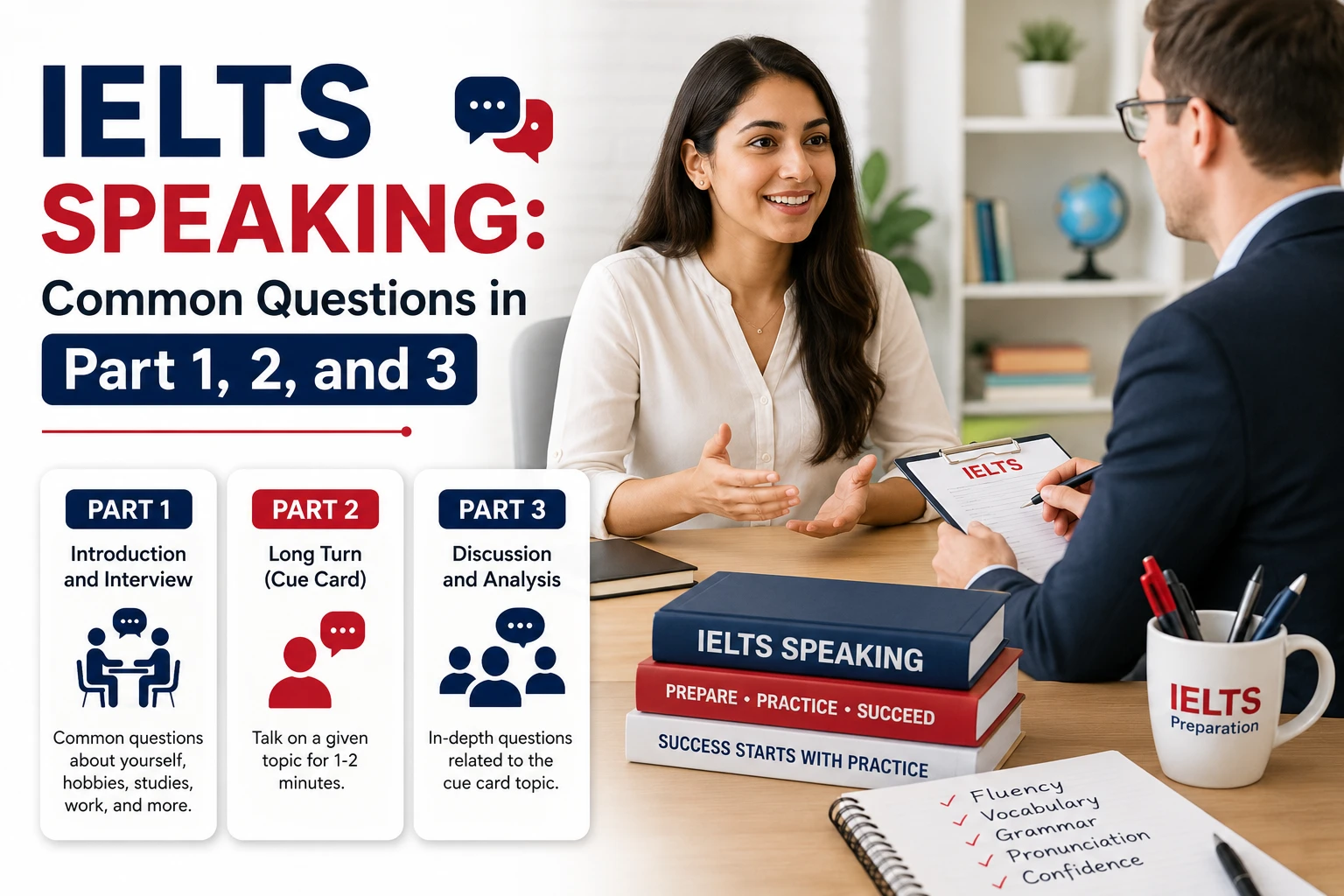
The IELTS Speaking test lasts 11 to 14 minutes and is divided into three parts, each testing different speaking skills.
- Part 1 (4–5 minutes):
This section includes general questions about familiar topics such as home, work, studies, hobbies, or daily routines. It helps the examiner understand the candidate’s basic speaking ability.
- Part 2 (3–4 minutes):
Candidates are given a cue card with a topic and one minute to prepare. They are expected to speak for up to two minutes on the given topic, followed by one or two follow-up questions.
- Part 3 (4–5 minutes):
This part involves a deeper discussion related to the Part 2 topic. Questions are more abstract and require opinions, explanations, and examples.
Latest IELTS Speaking topics (2025)
Here are some common IELTS Speaking topics that often come up in the test:
- Hometown
- Part 1:
Where are you from?
- Part 2:
Describe your hometown.
You should say:
where it is located,
what it is famous for,
and explain what you like or dislike about it.
- Part 3:
How do cities change when they become more developed?
- Work / Studies
- Part 1:
Do you work or are you a student?
- Part 2:
Describe a subject or job that you find interesting.
You should say:
what it is,
why you chose it,
and explain why it interests you.
- Part 3:
How important is job satisfaction compared to salary?
- Technology
- Part 1:
How often do you use technology in your daily life?
- Part 2:
Describe a piece of technology you use regularly.
You should say:
what it is,
how you use it,
and explain why it is important to you.
- Part 3:
Do you think technology has changed the way people communicate?
- Hobbies and Free Time
- Part 1:
What do you usually do in your free time?
- Part 2:
Describe a hobby you enjoy.
You should say:
what it is,
how long have you been doing it?
and explain why you enjoy it.
- Part 3:
Why do people need hobbies in today’s busy life?
- Travel
- Part 1:
Do you like travelling?
- Part 2:
Describe a place you have visited and liked.
You should say:
where it was,
what you did there,
and explain why you liked it.
- Part 3:
How has tourism affected local cultures?
- Food
- Part 1:
What kind of food do you like?
- Part 2:
Describe a meal you enjoyed recently.
You should say:
what the meal was,
where you had it,
and explain why it was memorable.
- Part 3:
How have people’s eating habits changed over time?
- Education
- Part 1:
Did you enjoy studying when you were in school?
- Part 2:
Describe a teacher who influenced you.
You should say:
who the teacher was,
what they taught you,
and explain how they influenced you.
- Part 3:
What qualities make a good teacher?
- Health
- Part 1:
Do you do anything to stay healthy?
- Part 2:
Describe a healthy habit you follow.
You should say:
what the habit is,
how often you do it,
and explain why it is important to you.
- Part 3:
Who should be responsible for public health: individuals or the government?
- Family
- Part 1:
Do you spend much time with your family?
- Part 2:
Describe a family member you admire.
You should say:
who the person is,
what they do,
and explain why you admire them.
- Part 3:
How have family structures changed in modern society?
- Environment
- Part 1:
Are you concerned about environmental issues?
- Part 2:
Describe an environmental problem you are aware of.
You should say:
what the problem is,
what causes it,
and explain how it affects people.
- Part 3:
What steps can governments take to protect the environment?
Why Is It Important to Practise Different Speaking Topics?
- Builds confidence for unfamiliar questions
The IELTS Speaking test can include a wide range of topics, and candidates cannot predict which one will appear. Practising different topics helps students feel more confident, even when they receive a question they have not prepared for specifically.
- Develops topic-based vocabulary naturally
Each topic comes with its own commonly used words and phrases. Regular practice across topics helps students use suitable vocabulary naturally, instead of forcing difficult words during the test.
- Improves fluency and idea development
When students practise multiple topics, they learn how to extend answers smoothly and organise ideas logically. This reduces hesitation and improves flow, especially in Speaking Parts 2 and 3.
- Strengthens paraphrasing skills
Practising varied questions helps students restate ideas in different ways. This is useful when responding to the examiner without repeating the question word for word.
- Reduces over-reliance on memorised answers
Exposure to different topics encourages spontaneous speaking. This helps students avoid memorised responses, which can sound unnatural and affect fluency scores.
Final Thoughts
The IELTS Speaking test is not about memorising answers but about developing the ability to communicate clearly across different situations and topics. Understanding the format and practising a variety of questions from Parts 1, 2, and 3 can make a significant difference to performance.
At Focus Education, students receive guided speaking practice across multiple topics with regular feedback, helping them improve fluency, structure, and confidence in a practical and exam-focused manner.