
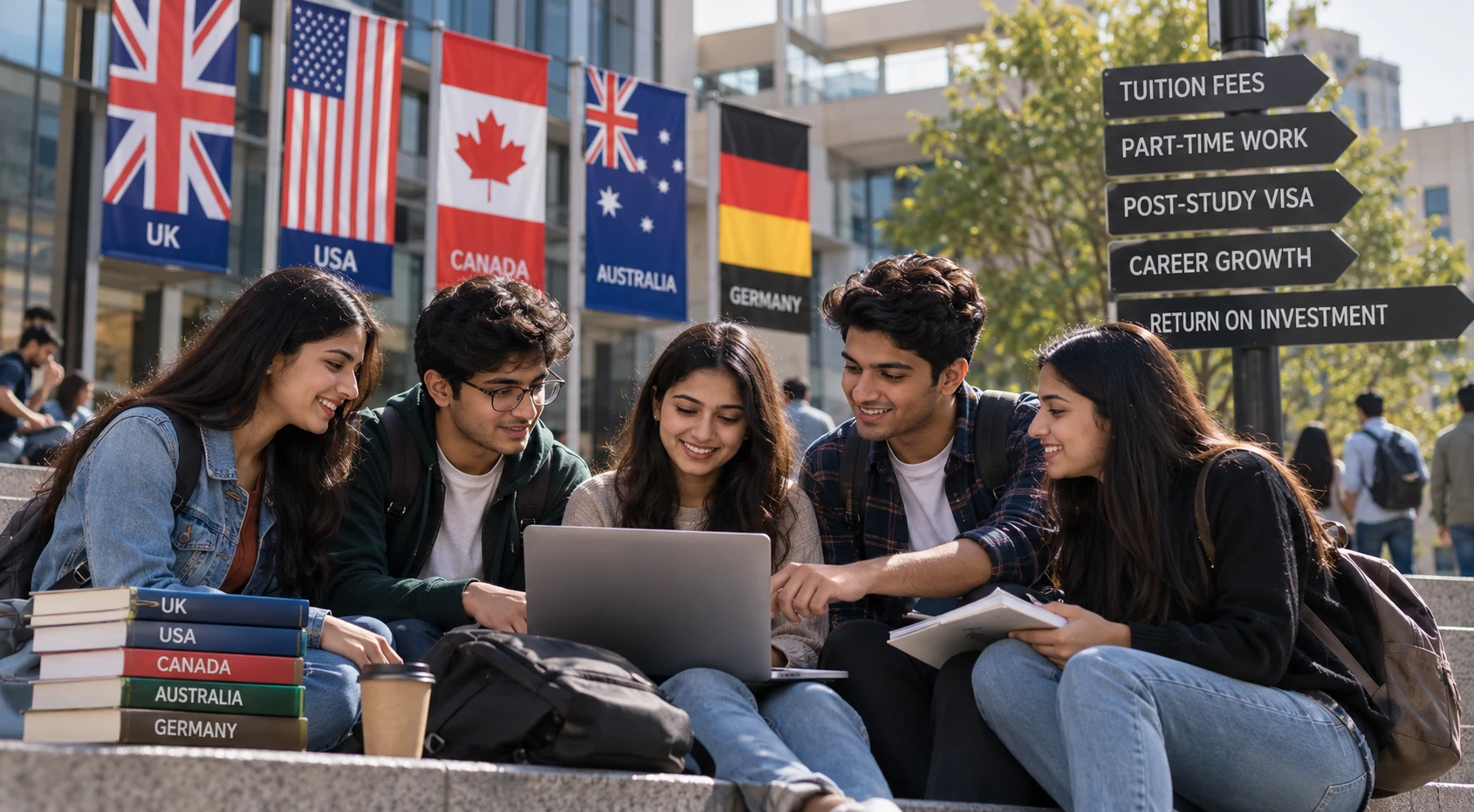
Which Country Gives the Best ROI for Indian Students in 2027? Tuition Fees, Part-Time Work & Post-Study Visa Guide (By Focus Education Ahmedabad)
Last Updated: 29 October 2026 | By Focus Education Ahmedabad
Studying abroad is one of the biggest financial and career decisions for Indian students and their families. With international tuition fees, living expenses, education loans, changing visa policies and uncertain employment opportunities, choosing the right country in 2027 requires more than comparing university rankings.
The question students increasingly need to ask is:
Which country offers the best return on investment (ROI) for Indian students in 2027?
Is Germany the smartest option because many public universities charge little or no tuition? Does a one-year master's degree make the United Kingdom more affordable? Can Canada's three-year post-graduation work permit help students recover their education investment? Or do the United States and Australia offer stronger long-term career opportunities?
The answer depends on several factors, including the total cost of education, part-time work rights, post-graduation employment, salary potential, education loan repayments and immigration eligibility.
In this detailed guide, Focus Education Ahmedabad compares the United Kingdom, United States, Canada, Australia and Germany to help students make an informed study-abroad decision for 2027.
The information reflects official policies and published cost guidance available in October 2026. Students must check for updates before applying.
Quick Answer: Which Country Offers the Best Study Abroad ROI in 2027?
Germany can offer strong cost-based ROI because many public universities charge low or no tuition, while the USA may offer significant career upside for qualifying STEM graduates. The UK can appeal to students seeking a shorter master's degree, and Canada and Australia offer valuable post-study employment opportunities for eligible graduates.
However, there is no single country that guarantees the highest financial return.
Here is a practical overview:
- Germany — Best for tuition affordability: Many public universities offer low-tuition education, but students must consider living expenses, language requirements and job opportunities.
- United Kingdom — Best for shorter master's programs: Many postgraduate degrees take one year, potentially reducing the total cost and time away from employment.
- United States — Strong potential for STEM careers: Eligible graduates can receive up to 36 months of OPT, including the STEM extension, but university costs and immigration uncertainties can be significant.
- Canada — Attractive for eligible master's graduates: A potential three-year Post-Graduation Work Permit (PGWP) provides time to gain professional experience.
- Australia — Valuable for eligible Indian graduates: Certain Indian master's graduates can receive a three-year Temporary Graduate visa, while tuition and living expenses require careful budgeting.
Focus Education's key takeaway: The best country is not necessarily the one with the highest salaries or longest visa. It is the country where your total study investment, realistic employment prospects and long-term career goals align.
1. Study Abroad ROI Comparison: UK vs USA vs Canada vs Australia vs Germany in 2027
Before choosing a destination, Indian students should compare the financial and immigration factors that directly influence their return on investment.
| Country | Tuition fees / cost benchmark | Student part-time work rights | Post-study work opportunity | ROI considerations |
|---|---|---|---|---|
| UK | £9,000–£30,000 for many international postgraduate programs | Generally 20 hours/week during term time for eligible degree-level students | 18 months for most eligible non-doctoral Graduate visa applicants from 1 January 2027 | One-year master's programs may reduce overall study duration and living costs |
| USA | University-specific; total Cost of Attendance varies considerably | Generally up to 20 hours/week on campus during sessions; off-campus work requires separate eligibility/authorization | Up to 12 months OPT, plus 24 months for qualifying STEM graduates | Potential career upside, scholarships and research funding, but significant cost variability |
| Canada | CAD 24,028 average annual international graduate tuition, per published 2026 data | Up to 24 hours/week off campus during regular terms if eligible | Up to 3 years PGWP for eligible master's graduates | Longer potential employment period, but program eligibility and job prospects matter |
| Australia | University and course-specific tuition | Up to 48 hours per fortnight during study periods for most students | Up to 3 years for eligible Indian master's graduates under Subclass 485 | Graduate work opportunities alongside substantial tuition, living and visa costs |
| Germany | Many public universities charge little or no general tuition, with exceptions | Up to 140 full or 280 half days annually, or a qualifying 20-hour weekly framework | Up to 18 months to seek qualified employment after graduating in Germany | Lower tuition can reduce financial risk; German language and employability matter |
Tuition figures represent different sources and types of benchmarks rather than identical program categories. All visa durations and working rights depend on eligibility, and no country guarantees graduate employment.
2. What Does ROI Mean for Indian Students Studying Abroad?
Return on investment measures the financial value students may gain relative to the amount they spend on their education.
However, international education ROI should be measured across the entire degree and the years following graduation.
How to Calculate Study Abroad ROI
A simplified financial ROI formula is:
ROI (%) = [(Net Financial Benefit − Total Education Investment) ÷ Total Education Investment] × 100
For this calculation, net financial benefit can represent the cumulative money saved after graduation, after deducting applicable taxes and living expenses. Do not confuse gross salary with actual savings.
What Counts as Total Education Investment?
Students should include:
- University tuition fees and mandatory charges.
- Accommodation, food and utilities.
- Health insurance and visa expenses.
- Flight tickets and local transportation.
- Academic materials and personal expenses.
- Education loan interest.
- Currency conversion costs.
- Any unpaid income or career opportunity forgone while studying.
Scholarships or confirmed financial support can reduce the student's net investment.
Example: How Long Would It Take to Recover Your Investment?
Consider a hypothetical student with:
| Factor | Illustrative amount |
|---|---|
| Total net study investment | ₹30 lakh |
| Annual take-home income after graduation | ₹28 lakh |
| Annual living and other personal expenses | ₹18 lakh |
| Annual savings available for investment recovery | ₹10 lakh |
| Simple investment recovery period | 3 years |
In this illustration, the student could recover the initial ₹30 lakh investment in approximately three years of employment if savings remain constant.
This is only a calculation example, not a prediction of salary, living expenses, tax or employment outcomes in any particular country. It excludes additional loan interest, inflation and currency movements.
A student earning a higher salary but facing significantly higher living expenses may need longer to recover the investment.
That is why choosing the highest-paying country does not automatically produce the best ROI.
3. Study in the UK in 2027: Is a One-Year Master's Degree Still Worth It?
The United Kingdom remains an important destination for Indian students considering internationally recognised postgraduate qualifications.
One of its biggest advantages is that many master's degrees can be completed in just one year.
Compared with a two-year program, this may reduce tuition exposure, accommodation expenses and time spent outside full-time employment.
UK University Tuition Fees
According to the British Council, international postgraduate tuition commonly ranges from approximately £9,000 to £30,000, depending on the university and program.
Some specialist degrees, including certain business and clinical programs, may cost more.
Cost of Living in the UK
The British Council provides indicative monthly living-cost ranges:
- London: approximately £1,300–£1,400.
- Other parts of the UK: approximately £900–£1,300.
These are spending estimates rather than guaranteed budgets.
The UK also sets financial requirements for Student visa applications. As of 29 October 2026, published maintenance amounts are £1,529 per month in London and £1,171 elsewhere, for up to nine months. A formally announced increase to £1,570 and £1,203 respectively is scheduled for 30 November 2026.
Applicants for 2027 should use the requirements effective on their actual application date.
Can Indian Students Work Part-Time in the UK?
Eligible students pursuing full-time degree-level courses with qualifying sponsors can generally work:
- Up to 20 hours per week during term time.
- Full-time during official vacation periods, subject to their visa conditions.
Employment restrictions differ for other courses and visa categories.
Students should also remember that a typical one-year postgraduate course may have dissertation periods that count as term time rather than unrestricted vacation.
UK Graduate Visa Rules From January 2027
Under the published immigration rules:
- Eligible bachelor's and master's graduates applying on or before 31 December 2026 receive two years.
- Most eligible non-doctoral graduates applying from 1 January 2027 receive 18 months.
- Qualifying doctoral graduates continue to receive three years.
The Graduate visa permits eligible graduates to work or seek employment without initial employer sponsorship, but it is not itself a permanent settlement route.
Students aiming to remain longer may need to qualify for an alternative immigration pathway, such as Skilled Worker.
UK ROI Assessment for 2027
The UK can be a financially practical choice when a student selects an appropriately priced one-year master's program, controls living expenses and has strong employment prospects.
However, the shorter Graduate visa period means students should plan their employment strategy before finishing their degree.
Best suited for: Students looking for a shorter postgraduate degree, a clearly defined specialisation and a quicker return to the job market.
Official references: British Council – Study Costs and UK Government – Graduate Visa.
4. Study in the USA in 2027: High Career Potential but Higher Financial Risk?
The United States is particularly attractive to students interested in computer science, engineering, mathematics, research and specialised postgraduate education.
Its universities offer a wide range of academic programs, research laboratories, industry partnerships and opportunities for financial assistance.
However, there is substantial variation in tuition fees and accommodation costs.
How Much Does Studying in the USA Cost?
There is no single nationwide international student tuition fee.
Students should examine each university's official Cost of Attendance (COA), which normally includes:
- Tuition and compulsory academic fees.
- Housing and meals.
- Medical insurance.
- Books, equipment and course materials.
- Transportation and personal expenditure.
A public university in a lower-cost city may have a substantially different financial profile from a private institution in an expensive metropolitan area.
Graduate students should investigate research assistantships, teaching assistantships, departmental funding and university scholarships.
Can Indian Students Work Part-Time in the USA?
Under standard F-1 rules, qualifying students generally may work on campus for up to 20 hours per week while school is in session.
More extensive working hours may be permitted during qualifying breaks.
Off-campus employment is not automatically allowed merely because the student holds an F-1 visa. It generally requires eligibility under a separate authorised category, such as qualifying practical training or another applicable employment provision.
Students must confirm arrangements with their university's designated school official before accepting employment.
USA Post-Study Work: OPT and STEM OPT
Eligible F-1 students may receive up to 12 months of post-completion Optional Practical Training related to their field of study.
Graduates with qualifying STEM degrees may also be eligible for a 24-month extension.
12 months OPT + 24 months STEM OPT = Up to 36 months of authorised practical training.
The extension is conditional. The student's degree must be on the designated STEM list, and the employer must satisfy applicable requirements, including participation in E-Verify.
Not all business or technology-related degrees automatically qualify.
Does OPT Guarantee a Long-Term US Work Visa?
No.
OPT is temporary practical training permission. Students pursuing long-term employment or permanent residence must independently meet the requirements for another immigration category.
Potential sponsorship, visa availability and selection rules introduce additional uncertainty.
USA ROI Assessment for 2027
The USA may offer attractive career potential for students with specialised technical skills, relevant professional experience and competitive university offers.
A substantial scholarship or funded graduate position can significantly improve the financial return.
Conversely, an expensive self-funded program without clear employment prospects can increase financial risk.
Best suited for: Strong academic candidates, STEM-focused students and applicants able to secure meaningful funding or afford the financial uncertainty.
Official references: EducationUSA – Finance Your Studies and USCIS – OPT.
5. Study in Canada in 2027: Is the Three-Year PGWP Worth the Investment?
Canada continues to attract students seeking internationally recognised qualifications and the opportunity to develop professional experience after graduation.
However, immigration restrictions and PGWP eligibility requirements make program selection increasingly important.
Canada Tuition Fees for International Students
According to EduCanada's published 2026 data, average annual international university tuition is approximately:
- CAD 24,028 for graduate students.
- CAD 41,746 for undergraduate students.
International college diploma programs may cost approximately CAD 16,000–25,000 annually, depending on the institution and course.
Actual university fees vary by province, subject, program and duration.
Living Expenses and Financial Requirements
For a single applicant studying outside Quebec and applying from 1 September 2026, Canada's published living-funds requirement is CAD 23,448 per year, excluding tuition and transportation.
The minimum amount required for immigration purposes is not necessarily the amount a student will actually spend.
Housing costs and personal expenses can be significantly different across Canadian cities.
Part-Time Work Rules in Canada
Eligible international students may work:
- Up to 24 hours per week off campus during regular academic terms.
- Unlimited hours off campus during qualifying scheduled study breaks.
The student must satisfy the applicable study permit and enrolment requirements.
Students should never assume that holding a Canadian study permit automatically provides unrestricted work permission.
Canada PGWP Rules for Master's Students
Under the rules available in October 2026, graduates of eligible master's degree programs may receive a three-year PGWP, even if their program lasted less than two years.
The master's program generally must meet the applicable minimum duration, and graduates must satisfy the remaining eligibility requirements.
A master's degree from an institution that does not meet the PGWP rules may not provide the expected post-study benefit.
Degree graduates are also subject to applicable language requirements.
Can Students Apply for Canadian PR After Graduation?
Potentially, but permanent residence is not automatic.
Some eligible graduates may qualify through Express Entry or provincial immigration programs after developing relevant work experience and meeting other selection criteria.
Students should assess the current eligibility requirements rather than assuming that three years of PGWP automatically results in PR.
Canada ROI Assessment for 2027
Canada may be worth considering for students admitted to eligible master's programs with manageable tuition fees and strong employment relevance.
The potential three-year post-graduation work period can provide time for professional development, but job availability and immigration eligibility remain essential.
Best suited for: Students with a realistic university budget, a PGWP-eligible program and career goals aligned with Canadian employment opportunities.
Official references: EduCanada – Education Costs and IRCC – PGWP Duration.
6. Study in Australia in 2027: Can Part-Time Work and Graduate Visas Improve ROI?
Australia is another major destination for Indian students, with international education opportunities across business, engineering, information technology, health sciences and other disciplines.
However, the total cost of living and studying should be assessed carefully.
Tuition Fees in Australia
Australian university tuition fees differ by institution, qualification level and program.
Students should compare actual course fees using official university websites and the Study Australia course search rather than relying on a single national average.
The number of years required to complete a degree is also an important cost factor.
Australia Student Living Costs
Australia's published financial-capacity rules use a minimum living-cost amount of AUD 29,710 for a primary student over 12 months.
Students must also account for applicable course fees and travel expenses.
Actual living costs can exceed this amount, particularly where accommodation is expensive.
How Many Hours Can Indian Students Work in Australia?
For most eligible international students, the Subclass 500 Student visa permits:
- Up to 48 hours per fortnight during study periods.
- Unlimited work during qualifying scheduled course breaks.
Different arrangements apply to certain research master's and doctoral students.
Students cannot simply work unlimited hours throughout the academic year.
Australia Post-Study Work Visa: Subclass 485
Australia's Temporary Graduate visa (Subclass 485) allows eligible graduates to stay temporarily after completing their studies.
Special arrangements for Indian nationals under the Australia–India Economic Cooperation and Trade Agreement provide the following published durations for qualifying graduates:
| Qualification | Post-study stay for eligible Indian nationals |
|---|---|
| Bachelor's degree, including honours | Up to 2 years |
| First-class honours bachelor's in STEM, including ICT | Up to 3 years |
| Master's degree — coursework, extended or research | Up to 3 years |
| Doctoral degree | Up to 4 years |
Eligibility is subject to visa rules, including qualification, age, English language and other requirements.
What About PR in Australia?
Australia has several skilled and employer-sponsored immigration pathways, but graduating from an Australian university does not guarantee a permanent visa.
Relevant factors can include occupation, skills assessments, English language ability, work experience and eligibility for invitation or nomination.
Australia ROI Assessment for 2027
Australia can offer an appealing combination of education and post-study employment rights for qualifying Indian students.
However, high course costs, accommodation, visa charges and employment competition can affect the actual financial return.
Best suited for: Students with a strong course-to-career plan who can budget for substantial upfront expenses.
Official references: Study Australia – Student Visa and Australian Government – Temporary Graduate Visa.
7. Study in Germany in 2027: Is It the Best Country for Affordable Education?
Germany deserves particular attention from Indian students who want to manage education costs without ignoring academic quality or long-term employment opportunities.
A major advantage is that many German public universities do not charge general tuition fees for standard bachelor's and many master's programs.
However, not every course is tuition-free.
How Much Does Studying in Germany Cost?
Tuition fees depend on the institution, federal state and academic program.
Important considerations include:
- Many public universities do not charge general tuition.
- Semester contributions are usually payable.
- Certain specialist and continuing education courses charge tuition.
- Some federal states and universities have additional fees for non-EU international students.
- Private universities generally establish their own tuition charges.
Students should verify the exact fees of their selected course rather than assuming all German universities offer free education.
Cost of Living in Germany
DAAD's published guidance indicates that student living costs commonly fall around €900–€1,200 per month, depending on the city and lifestyle.
For 2026, Germany's official study visa guidance uses at least €11,904 as the annual blocked-account benchmark where that form of financial proof is required.
The amount applicable to students applying in 2027 should be checked before making arrangements.
Part-Time Work Rules in Germany
Eligible non-EU students can generally work up to:
- 140 full working days annually, or
- 280 half working days annually.
An alternative arrangement permits qualifying work of up to 20 hours per week under the applicable framework.
Certain student assistant employment may receive different treatment.
Students must also observe their individual residence and employment conditions.
Germany's 18-Month Post-Study Job-Search Permit
Eligible graduates of German higher education institutions may apply for a residence permit allowing them to seek qualified employment for up to 18 months after completing their studies.
During this period, they may take employment while searching for an appropriate skilled role.
Once they obtain qualifying employment, they may be able to transition into an eligible skilled worker permit or EU Blue Card.
The 18-month period is not a guaranteed job offer and does not mean every graduate automatically qualifies for permanent residence.
Does Learning German Improve ROI?
German language proficiency can significantly improve practical employment opportunities in many industries.
Even where a university program is taught entirely in English, employers may expect German communication skills.
Students should assess:
- Language requirements in their profession.
- Job availability in their target city.
- Internship and industry opportunities.
- Whether professional licensing or qualification recognition is required.
Germany ROI Assessment for 2027
Germany can offer favourable cost-based ROI when a student is admitted to a low-tuition program, manages living expenses and successfully enters relevant employment.
However, studying without sufficient language preparation or a realistic employment strategy can reduce that advantage.
Best suited for: Budget-conscious students, engineering and technology applicants, research-focused graduates and students willing to develop German language skills.
Official references: DAAD – Study and Living Costs and Make it in Germany – Study Visa and Employment.
8. Can Part-Time Jobs Cover Tuition Fees While Studying Abroad?
One of the most common assumptions among Indian students is that a part-time job abroad can pay for university tuition and accommodation.
The reality is more complicated.
A part-time job may help with groceries, transportation or a portion of rent, but earnings depend on several unpredictable factors.
Factors That Affect Part-Time Income
Legal working-hour limits: Each country sets different rules depending on visa type, academic schedule and other conditions.
Job availability: Having legal permission to work does not guarantee that a suitable job will be available.
Hourly wages: Earnings vary by employer, city, type of work and applicable wage regulations.
Taxes and deductions: Gross earnings are not the same as take-home pay.
Academic workload: Students must balance employment with lectures, assignments, examinations and research.
Living expenses: Rent and transportation may absorb a large portion of income.
Why Relying Entirely on Part-Time Income Is Risky
For example, a student may plan to work every permitted hour but receive fewer shifts because of limited job openings or seasonal demand.
Students may also need time to find employment after arriving.
That can create immediate cash-flow pressure if tuition or accommodation payments depend on earnings that have not yet been received.
A safer financial strategy is to arrange funding for tuition and essential living expenses before travelling, while treating future part-time earnings as supplementary income.
9. Which Country Offers the Best ROI for Different Indian Student Profiles?
The most suitable country depends on your circumstances rather than a universal ranking.
For Students With a Limited Budget
Germany may be a strong starting point because many public university programs have limited tuition charges.
However, accommodation expenses, admission eligibility and German language requirements still need consideration.
For Students Seeking a One-Year Master's Degree
The UK offers numerous one-year postgraduate programs.
A shorter course may reduce total expenditure and help experienced professionals return to employment sooner.
For Computer Science, AI and Engineering Students
The USA may offer meaningful academic and career opportunities, particularly for graduates whose qualifications satisfy STEM OPT requirements.
Germany, Canada, Australia and the UK may also be attractive depending on industry demand, program quality and immigration eligibility.
For Students Wanting More Post-Study Job-Search Time
Eligible master's graduates in Canada and Indian master's graduates in Australia may benefit from potential three-year post-study permission.
Qualifying USA STEM graduates may also receive up to 36 months of OPT in total.
However, a longer period of work permission does not necessarily translate into a higher likelihood of employment.
For Students Interested in Long-Term Settlement
Students should investigate the actual permanent residence or settlement requirements of each destination.
Work experience, language proficiency, employer sponsorship, occupation eligibility and immigration selection rules may determine the available pathway.
No study destination should be marketed as guaranteeing PR simply because a student graduates there.
10. Scholarships and Education Loans: How Can Indian Students Improve ROI?
Scholarships and financial assistance can make a significant difference to study-abroad affordability.
Reducing the initial investment can be just as valuable as pursuing a higher salary after graduation.
Explore Country-Specific Scholarships
Depending on the program, students can research:
- UK: University scholarships, Chevening and other applicable funding programs.
- USA: Institutional scholarships, graduate assistantships, research funding and fellowships.
- Canada: University entrance awards, merit scholarships and eligible research funding.
- Australia: University scholarships and relevant government-supported funding opportunities.
- Germany: DAAD scholarships and university or foundation funding.
Eligibility, available programs, deadlines and funding amounts should be checked directly with the awarding organisation.
Compare Education Loans Carefully
Before accepting an education loan, students should examine:
- The interest rate and whether it is fixed or variable.
- The repayment moratorium.
- Interest accrued during the study period.
- Loan processing and foreign currency costs.
- Collateral and guarantor requirements.
- The repayment schedule if the graduate returns to India.
- Whether the expected post-graduation income can comfortably support the EMI.
The most affordable course is not necessarily the best option if the available financing makes repayment difficult.
11. Common Mistakes Indian Students Should Avoid in 2027
Choosing a Country Only Because of a High Salary
International salaries must be evaluated after tax, accommodation and living expenses.
Assuming Part-Time Employment Is Guaranteed
Legal work rights do not guarantee job availability or sufficient working hours.
Selecting a University Without Checking Post-Study Eligibility
Different programs at the same institution may have different implications for post-study employment permission.
Treating Immigration Pathways as Guaranteed
A student visa, graduate work permit or temporary residence permit is not the same as permanent residency.
Ignoring Currency Fluctuations
Education expenses paid in foreign currencies can change significantly when converted into Indian rupees.
Taking a Large Education Loan Without a Backup Plan
Students should prepare for delayed employment, an unexpected return to India or lower-than-expected earnings.
Choosing a Course Without Researching Employers
Review job listings, essential technical skills, professional licensing rules and credible university graduate outcomes before committing to a program.
12. How to Choose the Best ROI Country for Your 2027 Study Abroad Plans
Follow this practical process before paying your university deposit.
Step 1: Identify your academic and career goal.
Choose the subject area and professional roles you genuinely want to pursue.
Step 2: Shortlist suitable universities.
Compare accreditation, course content, duration, tuition fees and relevant industry connections.
Step 3: Calculate the complete cost.
Include tuition, living expenses, visa charges, healthcare, travel and financing expenses.
Step 4: Research scholarships and confirmed funding.
Consider net cost after secured scholarships rather than published tuition alone.
Step 5: Check permitted student employment.
Understand exactly which part-time work activities and hours are lawful.
Step 6: Examine graduate visa eligibility.
Verify the rules for your individual qualification and anticipated graduation date.
Step 7: Research the target job market.
Identify employers, location requirements and relevant graduate recruitment opportunities.
Step 8: Compare realistic financial scenarios.
Estimate the likely savings after taxes and living costs, including an unfavorable outcome where employment is delayed.
Step 9: Review long-term immigration rules.
Determine whether any available route aligns with your career goals and qualifications.
Step 10: Recheck policies before applying.
Immigration policies and financial requirements can change before 2027 or during the time students spend studying.
13. Frequently Asked Questions: Study Abroad ROI for Indian Students in 2027
Which country gives the highest ROI for Indian students in 2027?
There is no guaranteed highest-ROI country. Germany can provide strong cost advantages through low-tuition public universities, while the USA may offer attractive opportunities for qualified STEM graduates. The UK, Canada and Australia can also provide competitive outcomes depending on the course, funding and employment prospects.
Is Germany cheaper than the UK for a master's degree?
Germany can be cheaper in terms of tuition at qualifying public universities. However, many German master's programs take longer than one year, and students must compare the total cost of living and studying rather than tuition alone.
Can Indian students pay all their tuition fees through part-time jobs abroad?
Students should not rely on this. Part-time work may help with living expenses, but legal hour limits, job availability and wages can make it difficult to cover the full cost of tuition and accommodation.
Which country allows international students to work the most hours?
The answer depends on academic periods, visa category and specific circumstances. Canada generally permits eligible students up to 24 hours per week off campus during terms, Australia permits most students 48 hours per fortnight during study periods, and Germany has an annual working-day or qualifying weekly-hours framework.
Is the UK Graduate visa 18 months in 2027?
Yes. Under the rules published in October 2026, most eligible non-doctoral Graduate visa applications submitted on or after 1 January 2027 receive 18 months. Doctoral graduates remain eligible for three years.
Can Indian students work for three years after completing a master's in Canada?
Eligible master's graduates may qualify for a three-year PGWP, provided their program and personal circumstances meet all applicable requirements.
Does Australia offer a three-year post-study visa to Indian master's students?
Under the published arrangements for Indian nationals, eligible graduates of qualifying master's programs may receive a three-year stay through the relevant Temporary Graduate visa route.
Can every student in the USA get 36 months of OPT?
No. Up to 36 months is possible only where the student qualifies for the initial OPT period and the additional STEM OPT extension. Other students generally do not qualify for the extra 24 months.
Which country is best for Indian students with a budget below ₹25 lakh?
Germany may be worth investigating because of low-tuition programs at many public universities. However, an affordable plan depends on the course length, city, available savings, exchange rate and other expenses. A ₹25 lakh budget cannot be assumed sufficient for every German degree.
Is permanent residency easier in Canada or Australia?
Both countries have immigration pathways for qualifying applicants, but eligibility and selection conditions differ. PR is not guaranteed in either country simply because a graduate completed a degree or obtained a post-study work permit.
When should Indian students start planning for the 2027 intake?
Students should start researching universities, admission requirements, funding and scholarship deadlines well before the intake. Different universities may have different application schedules.
Which country is best for studying engineering in 2027?
Germany, the USA, the UK, Canada and Australia all offer engineering programs. The best choice depends on the student's specialisation, degree accreditation, finances, practical training, language proficiency and career goals.
Final Verdict: Which Country Offers the Best ROI for Indian Students in 2027?
Choosing the best study-abroad destination requires an individual financial and career assessment.
For students whose priority is reducing tuition costs, Germany deserves serious consideration, especially where a suitable public university offers low-fee education.
For students who want a shorter postgraduate qualification, the UK may offer a practical route, provided they understand the reduced Graduate visa duration.
For qualified students pursuing technical careers, the USA may provide attractive long-term professional opportunities, but funding requirements and immigration uncertainty must be evaluated carefully.
For students who value a potentially longer period of post-graduation employment, Canada and Australia may be worth considering, particularly for eligible master's degrees.
Ultimately, the best financial return comes from balancing education quality, full-course cost, employability, future earnings and the ability to manage financial risk.
The smartest study abroad decision is not simply choosing the cheapest country or the highest salary. It is choosing the right combination of education, affordability and realistic career opportunities.
Plan Your Study Abroad Journey for 2027 With Focus Education Ahmedabad
Selecting the right country, university and degree can be challenging when every destination has different admission requirements, education costs and post-study work regulations.
Focus Education Ahmedabad helps students explore international education opportunities and plan their academic journey with greater clarity.
Before making a decision, compare your shortlisted courses, total financial commitment, available scholarships and post-study career possibilities.
Start planning your 2027 study abroad journey with Focus Education Ahmedabad.
Visit www.focusedu.org to explore your study abroad options.
Official Sources and References
The following government and official education resources were used to research this article.
- UK Government – Graduate Visa
- UK Government – Student Visa Work Conditions
- British Council – Cost of Studying in the UK
- UK Government – September 2026 Immigration Rule Changes
- EducationUSA – Finance Your Studies
- USCIS – Optional Practical Training
- Immigration, Refugees and Citizenship Canada – Off-Campus Work
- IRCC Canada – PGWP
- EduCanada – International Student Costs
- IRCC – Proof of Financial Support
- Australian Government – Student Visa Subclass 500
- Australian Government – Temporary Graduate Visa Subclass 485
- DAAD – Costs of Education and Living
- Make it in Germany – Studying and Post-Graduation Employment
Editorial note: The information is based on official guidance available on 29 October 2026. Tuition fees, visas, financial thresholds, work permissions and immigration rules may change. Financial calculations are illustrative and do not guarantee employment, earnings or investment returns. Always verify current eligibility with the relevant university and immigration authority.