
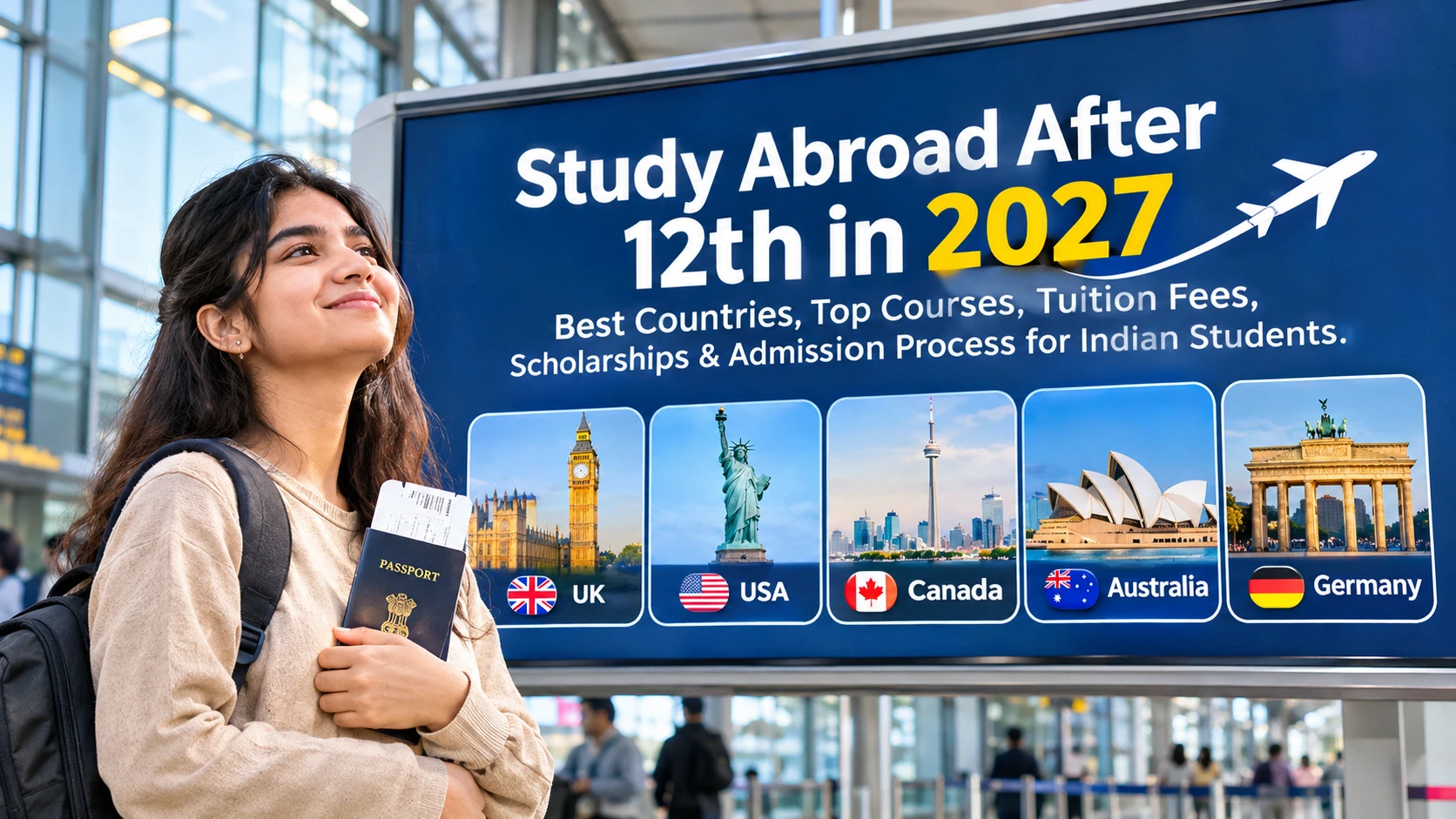
By Focus Education Global Pvt Ltd | Information reviewed: 16 November 2026 | For students planning a 2027 undergraduate intake
Quick answer: Indian students can apply to undergraduate programmes abroad after Class 12, subject to each university's academic, subject and English-language requirements. The UK, USA, Canada and Australia offer direct-entry opportunities for eligible students, while Germany may require a Studienkolleg or other recognised eligibility route. Compare total degree cost, not tuition alone, and check scholarships and application dates before choosing a country. For UK September 2027 entry, the main UCAS equal-consideration deadline is 13 January 2027; some competitive-course deadlines have already passed.
A decision about studying abroad after 12th affects much more than the next three or four years. It shapes your subject specialisation, the amount your family may need to fund, the professional experience available during your degree and your options after graduation. If you are in Class 12 now—or have recently completed CBSE, ISC or a state-board qualification—this guide explains how to approach the 2027 undergraduate admission cycle with evidence rather than marketing promises.
Fees and visa rules change. Published 2026–27 academic-year figures and university-specific 2027 fees are used below where available; they are not guarantees of the fee you will personally pay. Always verify your chosen course's official page before submitting an application or paying a deposit.
There is no single “best country” for every Indian student. The right destination depends on your intended course, academic record, language ability, budget and career plans.
| Destination | Typical bachelor's duration | Tuition benchmark for planning | What to check first |
|---|---|---|---|
| United Kingdom | Usually 3 years in England, Wales and Northern Ireland; often 4 in Scotland | British Council's broad international undergraduate guide: £11,400–£38,000/year; some programmes cost more | 2027 UCAS deadlines, subject prerequisites and funding |
| United States | Usually 4 years | 2026–27 average published tuition and fees: US$32,730 at public four-year colleges for out-of-state students, US$46,350 at private nonprofit four-year colleges | University's own international price and net scholarship cost |
| Canada | Commonly 3–4 years, depending on institution and programme | CA$42,062/year, Statistics Canada's 2026–27 national average for international undergraduate tuition | DLI, programme eligibility, study permit and housing costs |
| Australia | Commonly 3 years, with longer routes for some disciplines | Course-specific: for example, Monash Bachelor of Computer Science, A$58,940/year for 2027 | University course fee, February/July intake and student-visa evidence |
| Germany | Commonly 3 years after meeting admission eligibility | Many state-university bachelor's programmes have no tuition, but semester contributions and some state/university fees apply | Indian Class 12 eligibility, APS, Studienkolleg and teaching language |
How to read the figures: These are not directly comparable national averages. The UK figure is a broad published range, US and Canada are sector/national averages, Australia is a named university example and Germany describes the public-university fee model. None includes a full living-cost budget, flights, insurance or future annual increases. Sources: Study UK, College Board, Statistics Canada, Monash University and DAAD.
The UK is worth considering if you know the subject you want to study and prefer a focused degree structure. A typical bachelor's degree takes three years in much of the UK, although Scottish honours degrees and several professional or placement-based programmes can take longer. Popular study areas include business and management, computer science, engineering, finance, psychology, design and selected healthcare disciplines.
Admission route: Most full-time undergraduate applicants use UCAS. For 2027 entry, the standard equal-consideration deadline is 13 January 2027 at 18:00 UK time. The 15 October 2026 deadline for Oxford, Cambridge and most medicine, dentistry and veterinary programmes has already passed as of this review. Late applications can sometimes be considered, but they are not guaranteed equal consideration.
The UCAS personal statement now uses three guided questions: why you want the subject, how your studies have prepared you, and what else you have done to prepare. Relevant academic evidence matters more than generic claims about passion. UCAS personal statement guidance.
Budget and visa: Check the exact international tuition fee for your course. For student-visa maintenance evidence, current official figures are £1,529/month in London or £1,171/month outside London, for up to nine months, in addition to relevant course fees; exceptions and evidence rules apply. The UK Graduate visa is currently 18 months for eligible non-doctoral applicants applying on or after 1 January 2027, not the older blanket two-year figure. Neither student admission nor a graduate visa guarantees employment. GOV.UK finances | Graduate visa.
A US bachelor's degree usually takes four years. Students may take general-education subjects alongside their chosen major, and many universities offer opportunities for projects, undergraduate research, internships and interdisciplinary study. Consider computer science, data science, engineering, economics, business, biological sciences, design and liberal arts programmes according to your interests.
Admission route: Apply directly to institutions or through an accepted platform, such as the Common App, when the university uses it. Requirements may include school transcripts, essays, recommendation letters, proof of English ability, extracurricular information and SAT/ACT scores where required or helpful. Test-optional policies differ by institution and admission cycle; do not assume every university has the same rule. Deadlines vary substantially, and some early application deadlines fall in 2026.
Budget: The latest College Board 2026–27 benchmarks are US$32,730 in published annual tuition and fees for public four-year out-of-state students and US$46,350 at private nonprofit four-year institutions. These are sector averages, not a guaranteed international-student quote. Room, food, books, health insurance, transport and other costs raise the actual cost of attendance. Financial aid may change the net amount considerably, so request the university's international applicant budget and funding policy. EducationUSA undergraduate guide | College Board.
Canada offers universities with bachelor's programmes in computer science, business, engineering, public health-related fields, life sciences, economics and other disciplines. Some programmes include co-op or work-integrated learning, but these are programme-specific; check access, extra terms and eligibility rather than assuming every student receives a placement.
Tuition: Statistics Canada's official 2026–27 national average international undergraduate tuition is CA$42,062. This is an average, not the fee at every university or in every province. Professional disciplines and major cities can be more expensive. Statistics Canada tuition table.
Study permit: Confirm that your institution is a designated learning institution (DLI), that your programme meets your goals and that you can document sufficient funds. For applications on or after 1 September 2026, the current living-expense amount for one applicant outside Quebec is CA$23,448 for one year, excluding tuition and transportation; Quebec has separate requirements. Provincial attestation and other documentary requirements should be checked for your own situation. IRCC proof of funds.
If post-graduation work is part of your plan, verify that the specific programme meets PGWP conditions. Under current IRCC rules, eligible bachelor's graduates are exempt from the PGWP field-of-study requirement, but must still satisfy the other requirements, including applicable language and institutional rules. Policies may change by graduation. IRCC PGWP eligibility.
Australia is an option for students interested in technology, engineering, business, commerce, design, health-related programmes and environmental disciplines. Many bachelor's degrees run for three years, while honours and professional routes can extend the duration. February is a major intake, and selected courses offer a mid-year intake; always check the individual programme.
Eligibility example: For 2027 Monash Bachelor of Computer Science entry, Monash lists an indicative academic entry score of 75% for the All India Senior School Certificate (CBSE) and 70% for the Indian School Certificate (ISC), alongside subject and language requirements. This is one course's criterion—not a national minimum. Its listed 2027 international annual course fee is A$58,940. Monash course page.
Student visa: For the Subclass 500 visa, the currently published figure for a primary student's 12-month living-cost evidence is A$29,710, with course fees, travel and other applicable costs considered separately. Overseas Student Health Cover and the Genuine Student assessment are also important. Visa financial thresholds are not necessarily realistic total living budgets for every city. Australian Department of Home Affairs | Study Australia.
Germany deserves consideration for students comfortable researching language and qualification requirements carefully. Many public/state universities do not charge tuition for bachelor's degrees, but semester contributions apply. Baden-Württemberg generally charges €1,500 per semester to non-EU students at relevant state institutions, and some universities in Bavaria may charge additional tuition. Private institutions can charge substantial fees. DAAD: study and living costs.
Critical Indian Class 12 update: From winter semester 2026/27 onwards, APS India specifies a minimum overall 70% in Class 12 for the pathways it describes, irrespective of board. With Class 12 plus APS, an applicant may qualify for subject-restricted entry through Studienkolleg. With Class 12 plus APS and one successful academic year of a recognised bachelor's course, the applicant may qualify for direct subject-restricted admission in a corresponding field. These are eligibility routes, not automatic admissions. Other recognised qualifications/pathways can have different conditions. Check the APS India update and DAAD admission database.
Living costs and language: Even where tuition is zero, you still need accommodation, food, health insurance and financial proof. DAAD cites €992 per month / €11,904 annually as a financial-proof benchmark on its current guidance; confirm the amount when applying for the visa. Many undergraduate programmes are taught in German, so a recognised German-language qualification may be essential. English-taught options exist but should be checked individually. DAAD finances.
Choose a course because it fits your strengths and interests—not because it is described online as “high salary” or “guaranteed PR.” Check the entry subjects, degree accreditation, practical learning, total fees and realistic career pathways.
Potential programmes include computer science, artificial intelligence, data science, software engineering, mechanical engineering, electrical engineering, civil engineering, mathematics, physics, robotics and environmental science. Many engineering or quantitative courses require strong mathematics. Physics and chemistry prerequisites depend on the programme. A computing degree and an engineering degree are not interchangeable: compare modules and professional recognition.
Potential choices include biological sciences, biotechnology, biomedical science, nutrition, public health, psychology and selected nursing or allied-health degrees. Medicine, dentistry, veterinary medicine and regulated healthcare professions have additional admission tests, licensing, placements, duration and visa considerations. A biomedical science degree does not automatically qualify a student to practise as a doctor.
Popular options include business administration, accounting, finance, economics, international business, marketing, business analytics, supply-chain management and hospitality management. Some economics, finance and analytics programmes have mathematics prerequisites. Look for internships, project work and recognised accreditation where relevant; a generic degree title alone does not indicate career outcomes.
Explore psychology, international relations, media and communications, graphic design, animation, architecture, sociology, law-related undergraduate pathways, English, political science and creative arts. Portfolios, auditions, written work or interviews may be required. Professional law and architecture qualifications differ by country, so check whether the degree supports the profession you eventually want to practise.
Interest is growing in AI, cybersecurity, sustainability, renewable energy, health technology and digital business. But a promising subject is not enough: compare foundational teaching, employer relationships, placement quality, local labour conditions and eligibility for further study. Avoid claiming any one field guarantees a job or visa.
Use this formula to compare offers:
Total estimated degree cost = (annual tuition + annual living costs + annual insurance and academic expenses) × expected years of study + travel and visa costs − confirmed scholarships.
This is a planning model, not a university invoice. Allow for tuition changes, currency fluctuations, rent increases and extra terms. Scholarships may be one-time, renewable only if grades are maintained, or restricted to tuition. Do not treat student part-time earnings as a guaranteed way to cover fees.
For example, a course advertised with a comparatively low tuition fee may still be expensive in a high-rent city. Conversely, an expensive private university may provide a substantial scholarship or need-based award. Compare the net price shown in a written offer, the total years of study, and whether a mandatory placement year has extra charges.
Important financial-proof examples for 2027 planners: The UK currently specifies £1,529/month in London or £1,171/month outside London, up to nine months; Canada specifies CA$23,448 for one student outside Quebec per year for applications from 1 September 2026; Australia currently lists A$29,710 in 12-month living-cost evidence; Germany's DAAD guide references €11,904 annually. These amounts follow different legal rules and generally do not include all tuition and travel costs. Reconfirm them when filing your application. UK | Canada | Australia | Germany.
International undergraduate scholarships exist, but awards vary in value, nationality eligibility, course restrictions, competitiveness and deadlines. Admission to a university does not automatically mean a scholarship, even if the university offers them.
| Country | Scholarship example | What it provides or requires |
|---|---|---|
| Canada | UBC International Major Entrance Scholarship (IMES) | For eligible 2027/28 entrants, UBC currently lists CA$10,000–CA$25,000 per year; renewable subject to conditions, with automatic consideration for eligible applicants. |
| Canada | UBC International Scholars Program | Need-and-merit-based awards for exceptional undergraduate applicants with significant financial need; nomination, essays and detailed financial evidence are involved. |
| Canada | University of Toronto Lester B. Pearson Scholarship | A competitive four-year award covering tuition, books, incidental fees and residence support; school nomination required. The published 2027 entry application deadlines were in October/early November 2026 and have passed as of 16 November 2026. |
| Australia | Monash International Merit Scholarship | Current scheme offers A$15,000 annually to selected eligible international undergraduates; automatic consideration with an eligible unconditional course offer. |
| Australia | University of Melbourne international scholarships | Melbourne lists schemes for students commencing in 2027; its India page notes that eligible Indian applicants may qualify for a 20% tuition fee remission under a relevant Melbourne International Scholarship, subject to criteria. |
| UK / USA / Germany | University-specific awards or financial aid | Search each institution's international undergraduate funding page. US aid may be need-based or merit-based; many German DAAD awards target other degree levels, so avoid assuming a master's scholarship funds a bachelor's degree. |
Official scholarship information: UBC entrance awards, UBC International Scholars, University of Toronto Pearson, Monash merit scholarship, University of Melbourne and EducationUSA funding.
2027 scholarship timing alert: UBC's International Scholars page currently reports an extended deadline of 2 December 2026 at 12:00 noon Pacific Time for the September 2027 intake. If eligible, verify the exact current requirements and proceed through UBC's official application platform. Deadlines can change; the linked university page is authoritative. Do not pay unofficial agents who promise to secure scholarships.
Yes, in many cases. A recognised Class 12 qualification can support undergraduate applications, but there is no universal 60%, 70% or 75% cutoff for all countries or universities. CBSE, ISC and eligible state-board students should check each programme's qualification-specific entry requirements. A university may accept your board for one course but require a foundation route or different prerequisites for another.
Universities commonly assess a combination of the following:
For example, the University of Melbourne says it accepts a range of Indian secondary qualifications, including CBSE, ISC and selected state boards, with course-specific prerequisites. Do not assume that every state board is accepted everywhere.
List two or three subjects you would genuinely enjoy studying. For each, identify required Class 12 subjects, target qualifications, total degree duration and likely career pathways. Decide what your family can fund without depending on an unconfirmed scholarship or job.
Choose a mix of ambitious, realistic and financially manageable universities. Check official course pages for 2027 intake availability, entry scores, accreditation, English-language requirements and annual international fees. For Germany, verify APS and admission route before applying.
Check each university's accepted tests and validity rules. Start preparation early; leave time for score reporting or a retake if needed. Medicine, selective maths/engineering courses, arts and certain other degrees can have distinct assessments.
Collect school transcripts, passport, predicted or final grades, English scores, essays or personal statements, recommendation letters, portfolios if needed, and scholarship documents. Students awaiting Class 12 results may be able to apply using predicted grades and receive a conditional offer; university rules differ.
The UK usually uses UCAS for undergraduate entry; US, Canadian and Australian processes may use a mix of institution and application portals. Germany may involve the university or uni-assist. Submit separate scholarship forms where required, and monitor referee or nomination deadlines.
Read all conditions before accepting: grades, tuition deposits, scholarships, refund rules, housing, teaching location and course length. Check whether a foundation programme adds an extra year. Keep written confirmation of any funding award.
The final process differs by country: for example, a UK CAS, a Canadian study permit, an Australian CoE and Subclass 500 application, a US F-1 process or Germany's national student visa pathway. Follow official instructions for proof of funds, English tests, health checks, insurance and biometrics where applicable. No consultant can guarantee visa approval.
Confirm housing with a legitimate provider, budget for transport, attend pre-departure briefings, keep copies of critical documents and understand the rules of your student status. Avoid non-refundable arrangements until your admissions and travel position is clear.
| When | Recommended action |
|---|---|
| November–December 2026 | Prioritise still-open 2027 admissions and scholarships; confirm eligibility and complete tests, essays and references. Some early UK, US and scholarship deadlines have already passed. |
| By 13 January 2027 | Submit most UK undergraduate UCAS choices by the main equal-consideration deadline. |
| January–March 2027 | Check institution-specific US, Canada, Australia and Europe deadlines; continue funding applications and respond to document requests. |
| April–June 2027 | Compare conditional offers, submit final results when available, and evaluate the full cost and housing options. |
| June–August 2027 | Where relevant, complete financial evidence and student visa requirements for autumn entry. |
| September–October 2027 | Common UK, US and Canada university start period; exact dates differ, and other destination intakes may occur at different times. |
Important: This timeline is a planning guide, not a universal deadline calendar. The UK dates above are confirmed by UCAS. Every other institution and scholarship may have its own cutoff. February 2027 Australian entry may already be too close for some applicants, so check course and visa timelines immediately if targeting that intake.
1. What degree and professional qualification do I actually need? A course name may be similar across countries but lead to different professional recognition.
2. What is the complete cost after confirmed awards? Compare tuition, rent, health insurance, visa expenses, flights and the number of years—not just advertised annual fees.
3. Does my Class 12 board and subject combination meet direct entry? A high total score is not enough if you are missing required subjects or a recognised qualification pathway.
4. Can I build useful experience during the programme? Check genuine placement modules, lab facilities, portfolio work, internships and career-service access rather than relying only on university ranking.
5. What are the visa and employment rules as they stand today? Work limits, post-study permissions and eligibility can change during a multi-year degree. No country can promise employment or permanent residency merely because you enrol.
Yes. Many universities in the UK, USA, Canada and Australia admit eligible Indian Class 12 graduates directly into bachelor's degrees. The course, board, marks, prerequisite subjects and English requirements determine eligibility. Germany may require a Studienkolleg or another accepted qualification route.
The answer depends on your goals. The UK may suit students who prefer a focused degree, the USA those seeking academic flexibility, Canada and Australia students whose chosen programmes fit their budget and academic plans, and Germany students ready to meet its language and qualification pathways. Compare individual universities rather than choosing from a blanket ranking.
Many public universities in Germany have no undergraduate tuition, although semester contributions, living expenses and some state or university tuition fees still apply. Other countries may become affordable through scholarships or lower-cost institutions. Always compare total programme cost.
There is no single international minimum. Every university and course can set different standards. As one example, Monash's 2027 Bachelor of Computer Science lists 75% for CBSE and 70% for ISC, plus other entry requirements. APS India has a specific 70% Class 12 criterion for the German eligibility routes described in its 2026/27 update. These are not global cutoffs.
Often yes. Universities may accept predicted grades and school transcripts and later make an offer conditional on final results. Whether this is possible depends on the university and programme.
No. Universities have their own accepted English evidence and exemption policies. Some accept IELTS, TOEFL, PTE or other specified qualifications. Always check the precise requirement for your university and visa route; an admission waiver does not automatically mean every visa evidence requirement is waived.
Possible options include certain business, management, marketing, hospitality and communications degrees, depending on the institution. Economics, finance, accounting and business analytics can require mathematics. Check course-level prerequisite subjects rather than relying on broad stream labels.
Some highly competitive international undergraduate awards can cover substantial costs, including the University of Toronto's Lester B. Pearson Scholarship. Eligibility, school nomination, annual availability and deadlines apply. For the 2027 Pearson cycle, published application deadlines have already passed as of 16 November 2026. Explore other currently open awards rather than assuming a full scholarship remains available.
There is no single amount. Visa authorities consider country-specific financial evidence plus tuition, travel and sometimes additional family costs. For example, current published one-student living-cost figures are CA$23,448 for Canada outside Quebec (for applications from September 2026) and A$29,710 in Australia; neither is the full total cost. Always consult the official visa site at the time of application.
Under current UK rules, eligible bachelor's and master's graduates applying for a Graduate visa on or after 1 January 2027 receive 18 months, not two years. Doctoral qualifications have a different duration. Future rules can change before a student graduates.
Ideally start 12–18 months ahead, especially for selective US applications, competitive UK courses and major scholarships. If you are starting in November 2026, prioritise open deadlines now and keep alternatives for later intakes.
No. Admissions are decided by universities, scholarships by awarding bodies and visas by immigration authorities. Good counselling helps you assess eligibility, select courses, prepare truthful documents and meet deadlines—but cannot promise an outcome.
The best study-abroad decision is the one that works for your academic profile, your family's budget and your long-term goals. A realistic shortlist, verified scholarships, clear entry requirements and organised deadlines matter more than choosing a destination based only on a ranking or promotional claim.
Focus Education Global Pvt Ltd supports students from Ahmedabad and across India with course and university shortlisting, study abroad counselling, IELTS/PTE preparation, application documentation, scholarship guidance, financial planning and student visa preparation for the UK, USA, Canada, Australia and Europe. Guidance is tailored to the student; admissions and visas are subject to the relevant institutions and government authorities.
Want help preparing for your 2027 intake? Contact Focus Education for a personalised undergraduate study-abroad assessment.
Ahmedabad office: 2nd Floor, Manor Maxx, HL College Road, Above Starbucks, Near St Xavier's College Corner, Navrangpura, Ahmedabad, Gujarat 380009, India. Phone: +91 722 601 4488. Email: info@focusedu.org.
Editorial and source note: Figures were verified from official universities, government education/immigration portals and recognised education data sources as of 16 November 2026. The 2027 academic intake is still approaching. Tuition, awards, visa thresholds and programme deadlines may be revised; the linked original pages control. This guide provides educational information and does not guarantee admission, scholarships, employment or immigration outcomes.