
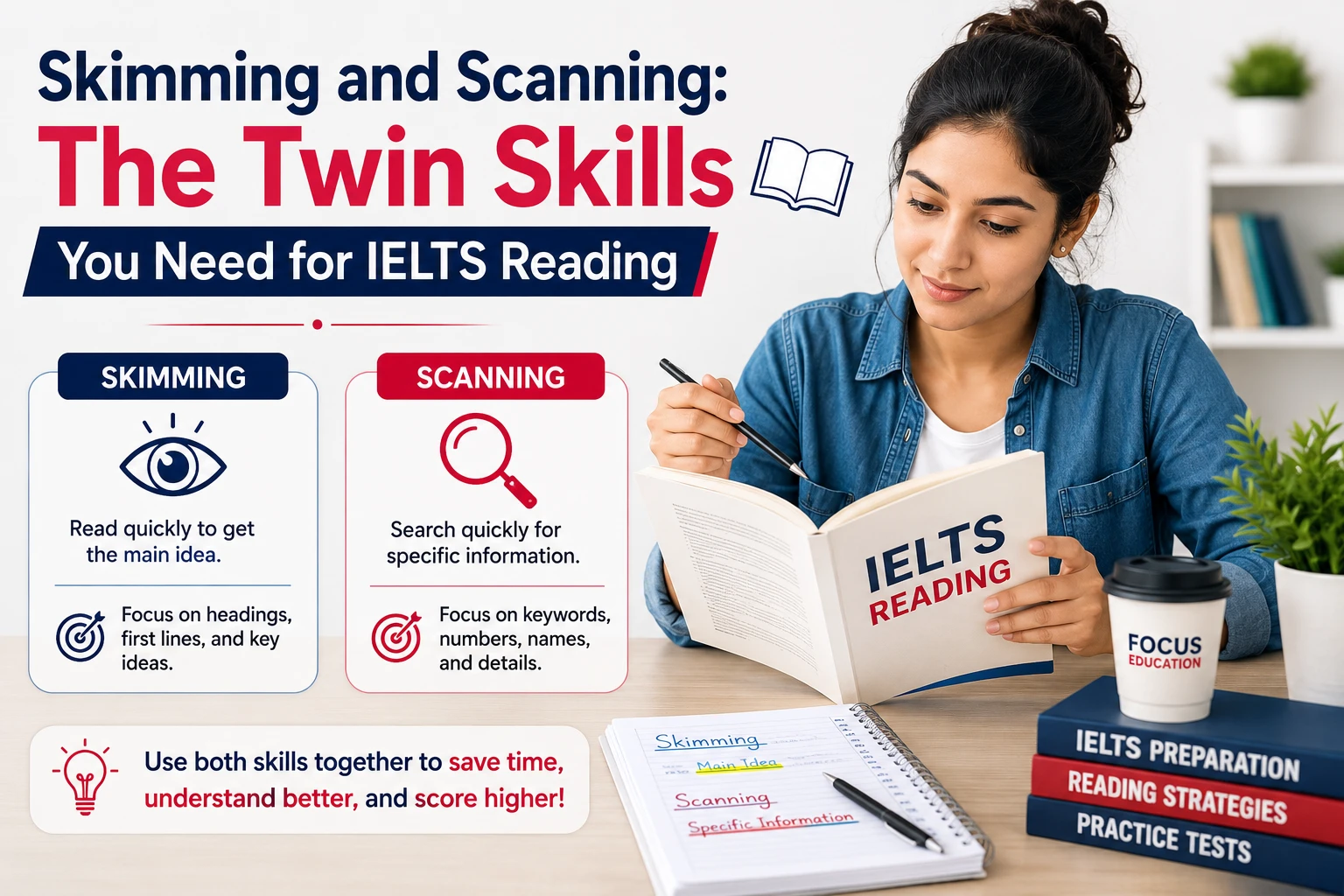
Many students believe that IELTS Reading is all about strong English. While language does play a role, the real challenge is time management. With long passages and limited time, reading every word carefully is simply not practical.
This is where two essential skills come in — skimming and scanning. If used correctly, these techniques can help you read faster, locate answers quickly, and improve your overall score.
Before learning how to use them, it is important to understand what they actually mean.
Both skills are different, but they work together. Skimming gives you a general understanding, while scanning helps you find exact answers.
The IELTS Reading test includes 3 long passages and 40 questions in 60 minutes.
If you try to read everything in detail, you will likely run out of time.
Skimming and scanning help you:
In short, they allow you to work smarter, not harder.
Skimming is your first step when you see a new passage. The goal is not to understand every detail, but to get a quick idea of the content.
Here’s how you can do it:
Example:
If a passage is about urban transport, you might quickly notice words like traffic, public transport, pollution, and infrastructure. Even without reading everything, you now understand the general theme.
This initial understanding helps you locate answers much faster later.
Once you start solving questions, scanning becomes your main tool.
Instead of reading the whole passage again, you:
Example:
Question: “In which year did the company expand internationally?”
Here, the keyword is year. You should scan for numbers like 1998, 2005, 2010, etc., instead of reading every line.
Once you find the year, read that sentence properly to confirm your answer.
One common mistake many students make is looking for exact words from the question. However, IELTS rarely uses the same wording.
Example:
Passage:
The city introduced new measures to reduce air pollution.
Question:
The government took steps to control environmental damage.
Here:
This is called paraphrasing, and recognising it is essential for both skimming and scanning.
Even when students know these techniques, they often misuse them. Here are a few mistakes to watch out for:
Avoiding these mistakes can immediately improve your performance.
Like any other skill, skimming and scanning improve with practice.
You can:
Even 20–30 minutes of focused practice daily can make a big difference over time.
Skimming and scanning are not shortcuts — they are essential strategies for success in IELTS Reading. They help you manage time, reduce stress, and improve accuracy without needing to read everything in detail.
With the right guidance and consistent practice, these skills become natural. At Focus Education, students are trained to apply these techniques effectively in real exam conditions, helping them approach the Reading section with clarity and confidence.