
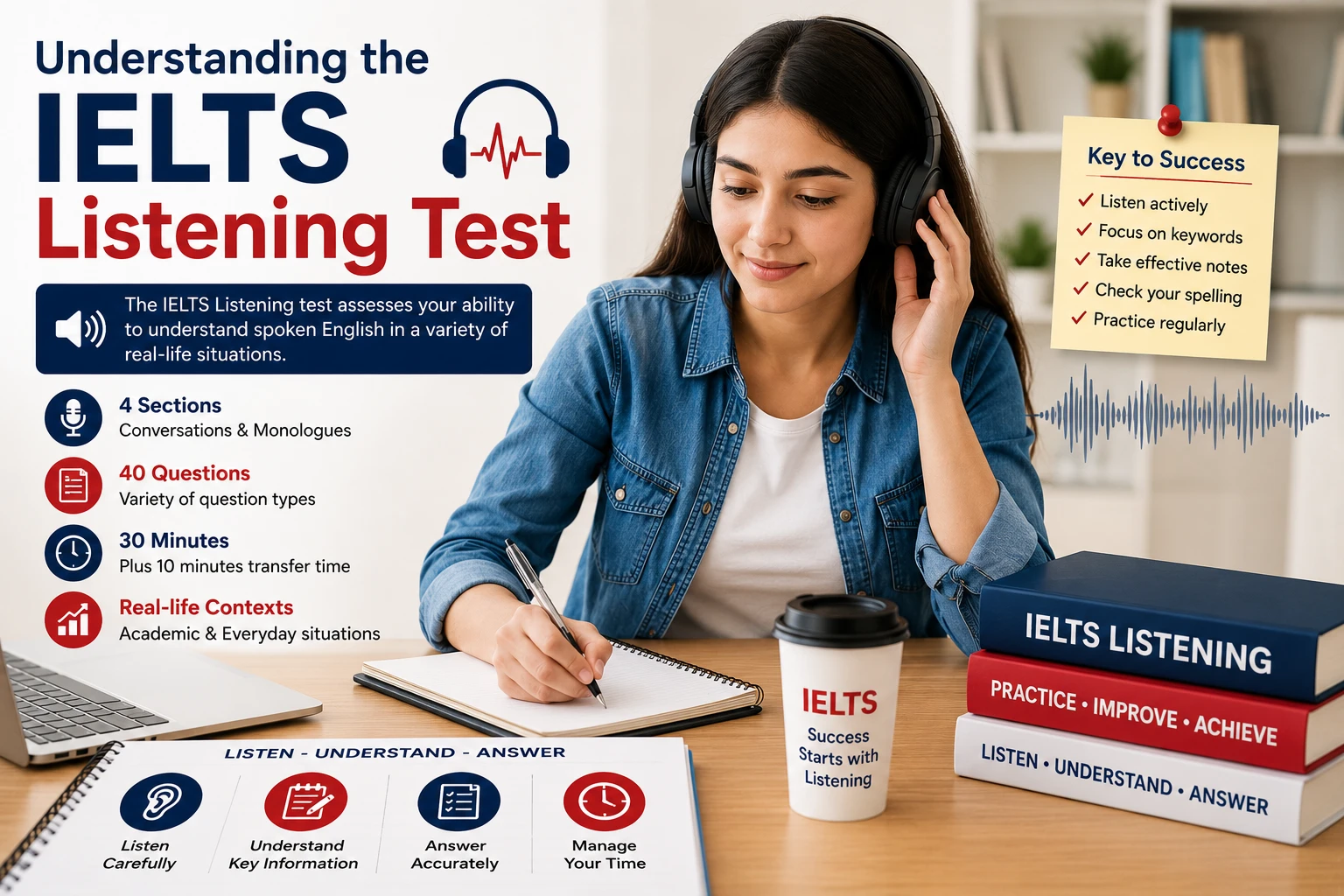
For many IELTS aspirants, the Listening module appears simple at first glance. However, a lack of clarity about the test format, scoring system, and expectations often leads to avoidable mistakes. Understanding how the IELTS Listening test is structured is the first and most important step towards improving your score. In this blog, we will explain the IELTS Listening format, clarify whether there is any difference between Academic and General Training listening, and briefly look at how band scores are calculated.
The IELTS Listening test is the same for both Academic and General Training candidates. It consists of four sections and lasts for approximately 40 minutes, including transfer time. Each section becomes progressively more difficult.
Section 1 focuses on a social or everyday situation. This could be a conversation about booking accommodation, joining a course, or enquiring about services. The language is simple and clear, making it a confidence-building start for test takers.
Section 2 is usually a monologue related to everyday contexts, such as a speech about local facilities, travel information, or events. There is no interaction here, so students must rely entirely on listening carefully.
Section 3 involves a discussion, often between two or three speakers, in an academic or training context. This section tests your ability to follow opinions, agreements, and disagreements.
Section 4 is an academic monologue, such as a lecture or talk on an educational topic. The speech is faster, the vocabulary is more advanced, and the ideas are more complex.
Across all four sections, you will answer 40 questions, and the question types may include multiple choice, form completion, sentence completion, matching, and map labelling.
One common misconception among students is that IELTS Academic Listening is harder than General Training Listening. In reality, there is no difference at all.
Both Academic and General Training candidates:
The difference between Academic and General Training IELTS exists only in the Reading and Writing modules, not in Listening or Speaking. Therefore, preparation strategies for Listening remain exactly the same, regardless of which IELTS version you are taking.
Understanding this helps students focus on skill-building rather than worrying unnecessarily about the test version.
The Listening test is marked out of 40, with each correct answer earning one mark. Your raw score is then converted into a band score ranging from Band 1 to Band 9.
For example:
Accuracy is critical in IELTS Listening. Even small errors, such as incorrect spelling, wrong plural forms, or exceeding the word limit, can cost you marks. This is why understanding instructions, spelling, and grammar is just as important as understanding the audio.
Another key point is that IELTS Listening does not penalise you for wrong answers. Therefore, it is always better to attempt every question rather than leave it blank.
Many students practice listening tests repeatedly without understanding what the test is actually assessing. IELTS Listening checks your ability to:
When students understand the format, scoring system, and expectations, they approach practice more strategically and confidently.
A strong IELTS Listening score begins with a clear understanding of the test itself. Knowing the structure of the four sections, recognising that Academic and General Listening are the same, and understanding how band scores are calculated can significantly reduce exam anxiety and improve performance.
At Focus Education, we help students build this foundation through structured practice, clear strategy, and regular feedback, ensuring they approach the IELTS Listening test with confidence and clarity.