
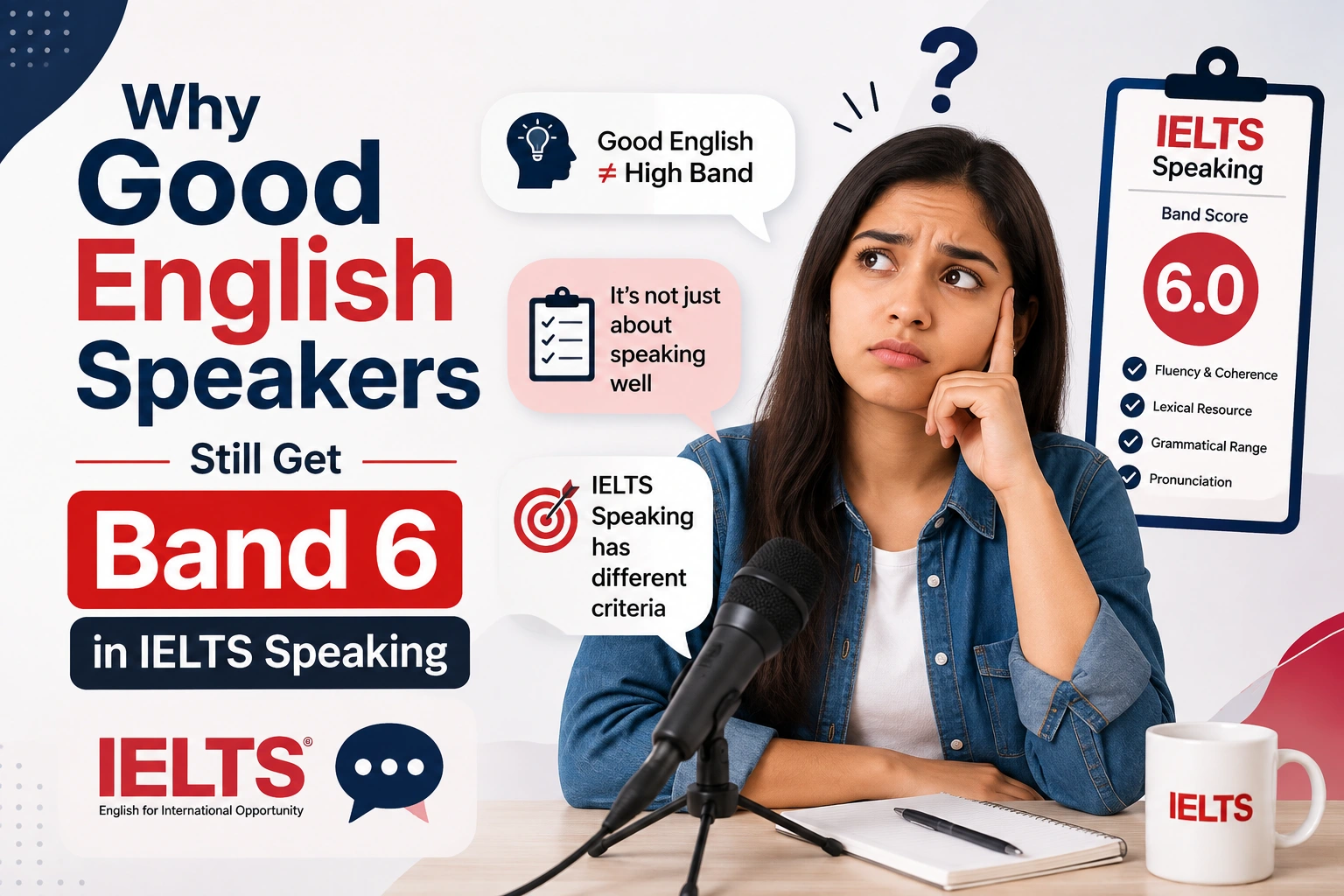
Many IELTS candidates walk into the Speaking test feeling confident. They speak English daily. They watch English shows, use English at work, and communicate comfortably. Yet, when the result arrives, the score says Band 6.
The reaction is almost always the same: “But I speak English well!”
At Focus Education, this is one of the most common concerns we hear. The truth is simple — IELTS Speaking does not test how comfortable you are in English. It tests how effectively and strategically you perform under specific band criteria.
Let us explore the hidden reasons why fluent English speakers still get stuck at Band 6.
Many students speak smoothly but do not develop their answers properly.
For example, in Part 2, a candidate may describe a person in just 60–70 seconds and then stop. Or in Part 3, they may give short opinions without explanation.
Band 7+ requires:
Fluency alone is not enough. The examiner listens for how well you build and expand your thoughts.
Good English speakers often use very casual, everyday language.
Phrases like:
These are natural in daily conversation, but overuse makes your language sound less precise.
Band 7 and above expects:
IELTS does not test friendliness. It is testing communicative competence.
Many fluent speakers rely on safe words:
This limits the Lexical Resource score.
For example:
Band 6 response: “It was very good and very interesting.”
Band 8 response: “It was genuinely fascinating and left a lasting impression on me.”
The difference is not complexity — it is precision.
Some candidates make very few grammatical mistakes, which is good. But they only use simple sentence structures:
To move beyond Band 6, students must show:
Accuracy + variety = higher band.
This is the biggest hidden reason.
Part 3 is analytical and abstract. Even confident speakers struggle here.
Common problems:
Band 7+ requires:
Many Band 6 speakers perform well in Part 1 but drop in Part 3.
Yes, structure matters even in speaking.
High-band candidates subconsciously follow a pattern:
Band 6 speakers often speak randomly. Ideas are good, but they are not organised.
The examiner should feel that your response is guided and intentional.
This is subtle but common.
Good English speakers assume: “I’ll just speak naturally.”
But IELTS Speaking is not a casual chat. It is a performance based on four clear criteria:
Without understanding these criteria, even strong speakers underperform.
It is not about sounding British or American.
It is not about using extremely difficult vocabulary.
It is not about speaking fast.
The real difference is:
Control.
Depth.
Precision.
Consistency across all three parts.
Band 7 speakers sound confident and organised. Band 6 speakers sound comfortable but slightly casual and repetitive.
That small difference costs one full band.
If you are a good English speaker but stuck at Band 6, do not feel discouraged. It does not mean your English is weak. It simply means your performance needs refinement and strategy.
With the right feedback, structured practice, and clear understanding of examiner expectations, moving from Band 6 to Band 7 is absolutely achievable.
At Focus Education, speaking preparation goes beyond mock tests. Students are trained to understand band descriptors, improve idea development, refine vocabulary naturally, and handle Part 3 discussions with confidence.
If you believe your English is good but your score does not reflect it, it may be time to prepare differently.
Connect with Focus Education and turn your speaking ability into a Band 7+ performance.