
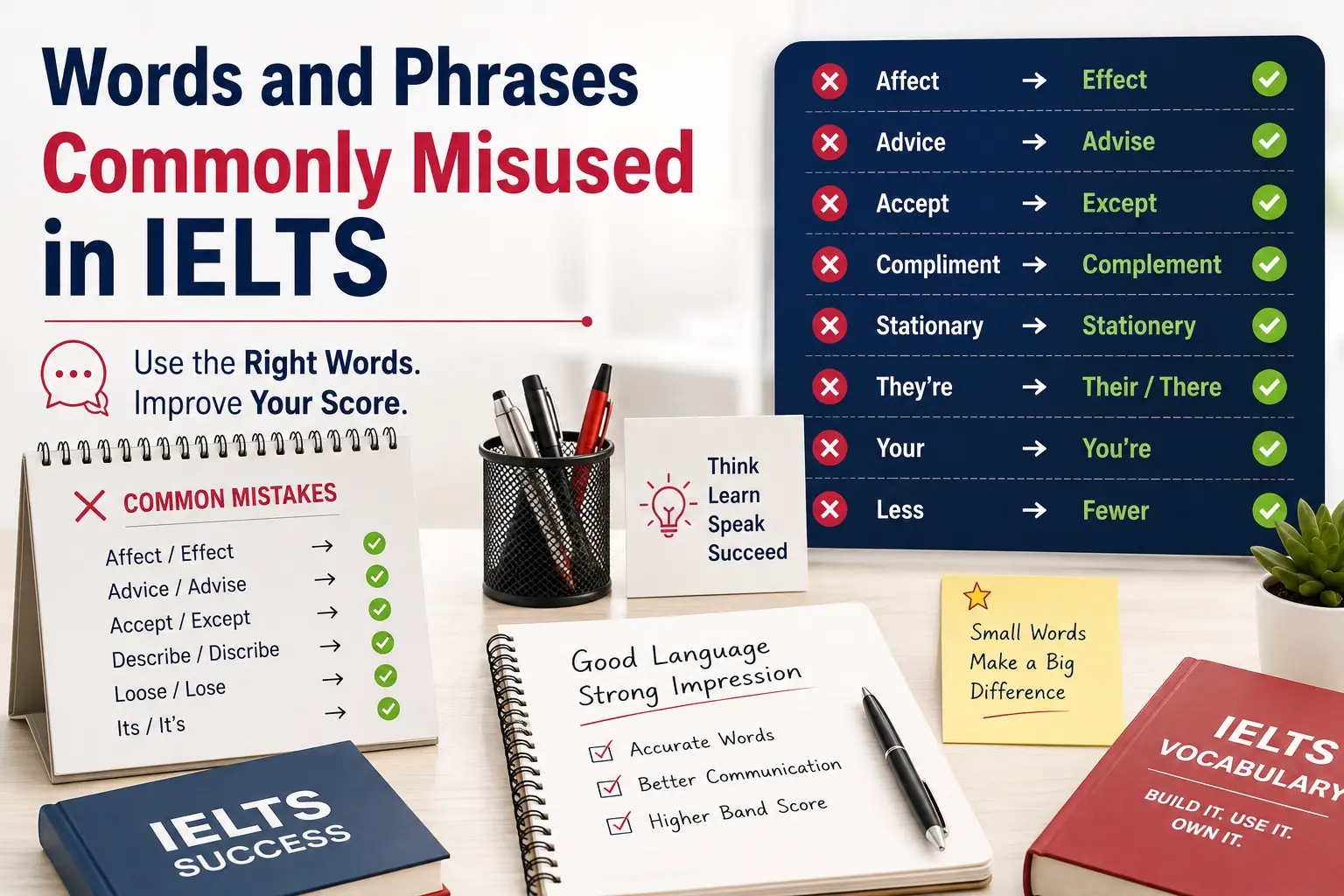
English learners often confuse words or phrases that look or sound similar — and in IELTS, this can affect both your Writing and Speaking band scores. Using the right word not only shows your accuracy but also your confidence in communication. Here are some of the most commonly misused words and phrases that every IELTS test taker should master.
Many candidates start essays with “Let’s discuss…” or “I will discuss about…”. The word discuss already means to talk about something — so avoid using about.
Correct: “This essay will discuss the effects of pollution.”
Incorrect: “This essay will discuss about the effects of pollution.”
Affect is a verb (action), and effect is a noun (result).
Example: “Pollution affects people’s health.”
Example: “The effect of pollution is serious.”
Remember: Affect = action, Effect = end result.
These three are often confused when talking about time.
TIP: Think of it this way: since = when it started, for = how long, from = between two points in time.
The correct phrase is always on the other hand, not in the other hand.
Example: “Some people prefer online education. On the other hand, many enjoy classroom learning.”
Use ‘stay’ for a short period and ‘live’ for a long-term residence.
Example: “I’m staying at my friend’s house this week.”
Example: “I live in Ahmedabad.”
You ‘go to bed’ when you lie down; you ‘sleep’ when you actually rest.
Example: “I go to bed at 11 but sleep around midnight.”
A quick trick to know what’s right: remove “you and” and see if the sentence still works.
TIP: If removing “you and” makes the sentence sound wrong, you’re using the wrong one!
“Irregardless” is incorrect. Always use regardless, meaning without considering something.
Example: “Regardless of the weather, the event continued.”
‘Good’ is an adjective; ‘well’ is usually an adverb.
Example: “She is a good teacher.”
Example: “She teaches well.”
‘Disinterested’ means neutral or impartial, while ‘uninterested’ means not interested.
Example: “A judge should be disinterested, not uninterested.”
‘Borrow’ means to take something; ‘lend’ means to give.
Example: “Can I borrow your book?”
Example: “Sure, I’ll lend it to you.”
‘Another’ means one more or an additional one: “I need another pen.”
‘Other’ refers to different things or people: “The other students are outside.”
Tip: Use another with singular countable nouns and other with plural ones or uncountable nouns.
Use between for two things, among for more than two.
Example: “The money was divided between John and Mary.”
Example: “The teacher walked among the students.”
Both mean the same, but the structure changes slightly.
Example: “In spite of the rain, they went out.”
Example: “Despite the rain, they went out.”
Never say “Despite of”.
Using English accurately isn’t just about memorizing grammar — it’s about understanding context. In IELTS, word choice can make a difference between Band 6.5 and Band 7.5, especially in Writing and Speaking.
At Focus Education, we ensure our students not only know the right words but also use them naturally. With detailed grammar sessions and speaking practice, our trainers help learners develop fluency and accuracy that truly stand out in the test.