
7 Apps You Need To Have On Your Device If You Are Planning To Study Overseas
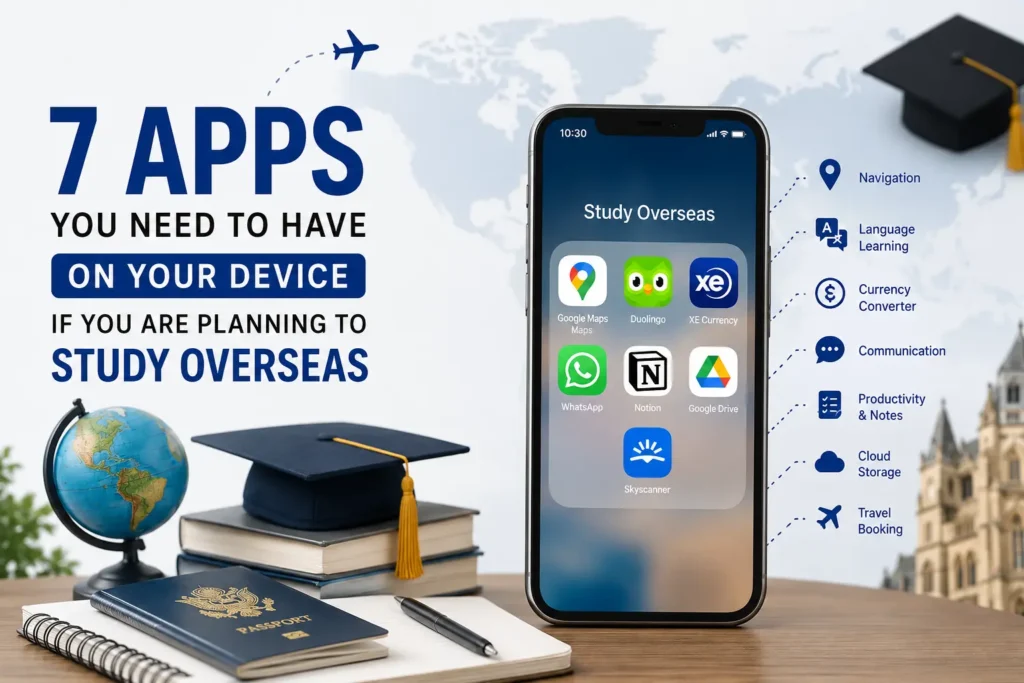
7 Apps You Need To Have On Your Device If You Are Planning To Study Overseas 7 Apps You Need To Have On Your Device If You Are Planning To Study Overseas People moving abroad for their further education is not a big deal nowadays, but do you know what is? Managing to live there and getting used to the international living standards, all the while looking after your budget! We, at Focus Education, have made a little attempt at assisting the students who are reading this article at this moment to have a little bit of clarity on how to manage the lifestyle there. Also, the fact that technology has been taking over the world, and advancements are occurring with every sunrise is evident to everyone. Through this article, you will come across some applications that may help you adjust to a foreign country. AroundMe AroundMe will help you with finding the nearest bank, hotels and restaurants, grocery stores, or anything! The application will analyze your position via your GPS and will take you to your nearest place of interest. This app just could be much more helpful than the guidance you receive from the locals and definitely will save you the hesitation you might have when asking them. XE Currency You might want to have your eyes and ears over currency fluctuations while you are not in your home country. This is a one-stop solution for such guidance and will keep you updated with all the currency trends occurring now and then as the application will report the instantaneous rates concerning the USD to the other world currencies. Wi-Fi Finder The app will practically help you to find free hotspots wherever you go, you can download the maps offline and can access the internet connectivity anywhere. The host spot connections will not be the outdated ones and only the updated ones. Moovit Waiting for e buses and trains to arrive and pick you up could be exhausting after having a long day at the campus. The app will allow you to track all the nearest public transport and will get you moving within no time. Waze Save yourself the trouble of getting stuck on the busiest roads in an uber. With this app, you can easily find easy navigation routes and will be able to travel without any hassle. On top of this, the app will keep updating you with everything that is lined up on your route. Klook Managing life in a different country can be stressful but busting stress is also important to make your international experience less tedious and more exciting. This app will update you with all the discounts going on in nearby restaurants, shops, malls, movie tickets, and many other amusements so that you can enjoy living in a different country on a student’s budget. RefMe Drafting assignments and preparing lengthy reports for your presentations will be a major part of your study-abroad student life. This app will make it easier for you as it will correct your bibliography, and the sources’ citations will not be a task for you anymore. All you are required to do is to take a snapshot of the barcode of the reference and the app will save it for you. We, at Focus Education, will always wish the best and safe living abroad for the students.
What is SELT?
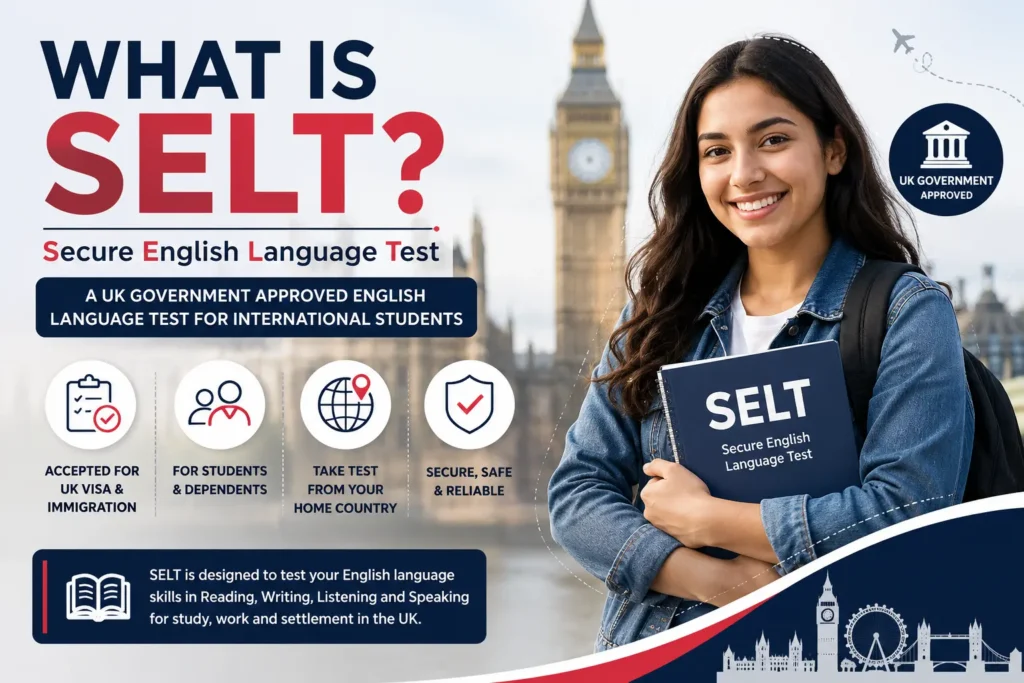
What is SELT? What is SELT? Before the panic strikes you and you begin to lose your cool about the new English proficiency test in the market, let’s get down to it. Our team, with valuable guidance from our highly qualified IELTS experts, has tried to break it down to as simple as we could have for the students. This blog will let you know about: What is SELT? What are the different types of it? Who can appear for it? How to book your test? What does the curriculum look like? The fee structures What is SELT? The term stands for Secure English Language Test and is a type of proficiency test that students or clients can apply for if they are applying for a visa and immigration in the UK. What are the different types of it? The test follows a simple pathway of the efficiency and the number of skills required by the applicant to apply for the visa. Level A (basic user) A1 and A2 sub-levels include speaking and listening assessment. The sub-levels are categorized as Beginner and Elementary, respectively. Level B (intermediate) The level is further classified as same the level A. the sub levels are called the intermediate and the super intermediate, however, there are two B1 sub-levels, as one of them is for only 2-skill testing and the exam duration lasts for 11-13 minutes while the other is for 4-skill. The B2 sub-level is strictly comprised of all the exercises, i.e., speaking, listening, reading, and writing which are supposed to be completed within 2 hours and 40 minutes which is the same as the 4-skill B1 sub-level. The exercises are computer-based and will be conducted online. Level C (proficient user) The C1 is called the advanced whereas the C2 is called the proficiency level. The proficiency of the student is tested through all 4 exercises, speaking, listening, reading, and writing. The exam might last up to a duration of 3 hours and 10 minutes. Note: The bifurcation of the test has been done as per the CEFRL (Common European Framework of Reference for Languages) norms. Who can appear for the test? Applicants who are planning to study in the UK will have to get their English proficiency tested for all 4 exercises, while people who bear a skilled person worker visa, sportsperson visa, or overseas business visa and a spouse or a dependent visa, will have to appear for 2-skill (Speaking and Listening) exercises out of 4-skill. How to book your test? The conducting bodies of the exam are PTE, IELTS, PSI Services, LanguageCert, and Trinity College London, however, for booking the exam, students might need to go through the website of the LanguageCert and search for the exam centers in few of the Indian cities such as Ahmedabad, Rajkot, Gurgaon, Chennai, Mumbai, Kolkata, and a few others. What does the curriculum look like? The exam syllabus will be pretty easy for the students and you are allowed to personalize the answers, as the content of the syllabus will include topics such as Family Friends Festivals Weather Entertainment Likes and dislikes Home Work Music Special occasions A recent personal experience School experiences Means of transportation Environment The fee structures The fee structures of the exam vary as per the number of the skills which are to be tested, and of course, the levels and sub-levels of it. SELT A1 (speaking and listening) costs £120 and so will SELT A2 (speaking and listening). SELT B1 (speaking, listening, reading, and writing) costs £140 and so will SELT B2 (speaking, listening, reading, and writing). SELT C1 and SELT C2, both of the sub-levels are for 4-skill testing, i.e., speaking, listening, reading, and writing, charge £140. We genuinely hope that this article might have soothed your senses and has helped to clear the confusion about the exam. In any case, if you go like “well. I still have some doubts”, our team at FOCUS EDUCATION GLOBAL PVT. LTD. will be happy to hear and help you get through them.
Comparing 4 Most Popular Study Abroad Destinations
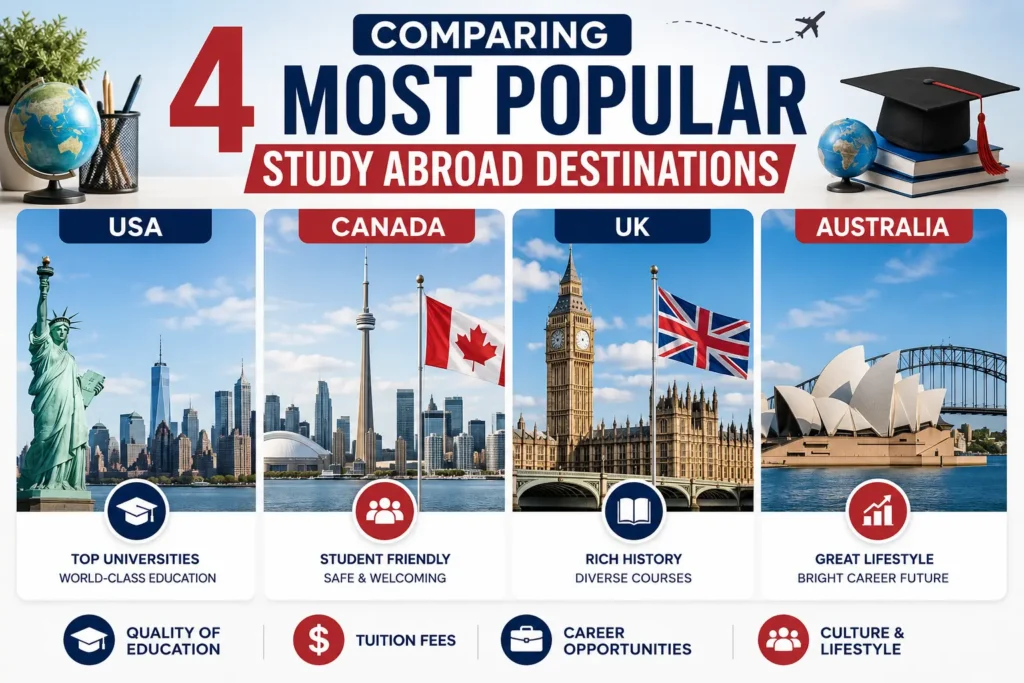
Comparing 4 Most Popular Study Abroad Destinations Comparing 4 Most Popular Study Abroad Destinations Studying abroad gives you a licence to approach high-quality education, experience new cultures, build a successful career, come across an international campus, and above all, it offers a chance to grow a global outlook. So, are you planning your study abroad journey? With many different studies abroad destinations to choose from, selecting the best country for you can be difficult. Also, you may often get this question, “How to choose the best country to study abroad in?” Every time this question pops up in your mind and makes you worried about this then read this blog, we at FOCUS EDUCATION GLOBAL PVT. LTD has tried to solve your query. As per the RedSeer report, the number of Indian students going abroad for higher education is predictable to touch the 1.8 million mark by 2024 compared to 7,70,000 back in 2019. If you are planning to study overseas here are the top study abroad destinations. We’ve broken down the location, cost of living and career opportunities in four popular destinations to make your decision-making process a little easier! With this blog, you’ll get a feel for which destination is the right choice for you. Keep reading to learn more! The United Kingdom: For international students, the UK is the second most popular destination for studies. United Kingdom’s education is recognized all over the world as they have advanced and latest financial skills. Britain has a long history of welcoming tourists, especially students, from around the globe, and is one of the most different countries in the world. Also, The United Kingdom (UK) is homegrown to the British monarchy, famous historic sights, and some of the world’s most prestigious academic institutions. The UK is home to three of the top 20 institutions in the Times Higher Education World University Rankings 2022 and had more than 65 institutions included in Shanghai Ranking’s Academic Ranking of World Universities (ARWU). Additionally, the UK provides a master’s degree of one year without compromising the quality of education, while in other countries master’s degree duration is 1 – 2 years. Cost of Living: – On Campus Housing: £300-£700 per month Off-Campus Housing: £620-£2200 per month Food: £70-£200 per month Leisure Activities: £120-£250 per month Location: – Talking about the climate condition in the UK, then it is moist, temperate, and Maritime. Normal temperatures vary between 3° C and 30°C. The most popular cities for students are London, Glasgow, Manchester and Edinburgh. Career Opportunities: There are vast career opportunities for international students in the UK. Qualified, full-time international students can work up to 20 hours per week during their study term. International students can work full-time in break periods, as well as during their academic term if it’s part of an academic work placement. The UK’s Graduate Immigration Route permits eligible students to stay in the UK and work at any skill level for up to two years. Australia: When you think of Australia, you also think about its kangaroos, outback bush, clean air and water. But Australia has much more to offer than usual it has the top universities, unbelievable nature, vibrant cities, and several oceans are just some of the reasons why many international students choose Australia to study. It has friendly, laid-back nature, an excellent education system, and a high standard of living. Studying abroad may be to some extent discouraging, but the award in terms of education and personal development can also be huge. Cost of Living: – On-Campus Housing: A$440–A$1,120 per month Off-Campus Housing: A$380–A$1,760 per month Food: A$140–A$280 per month Leisure Activities: A$80–A$150 per month Location: – Australia is one of the prime countries on Earth. Its landscapes are enormously diverse, with fluctuating climates ranging from deserts to the tropics. The most popular cities for international students in Australia are Melbourne, Sydney, Brisbane, Adelaide, and Perth. Career Opportunities: Eligible full-time international students can work up to 20 hrs per week during the study term. Also, they can work full time during their course breaks like the summer holidays. Apart from that, there are many post-study work options for international students. Canada: Canada is constantly ranked one of the best countries in the world and presently, it ranks 1st best country for quality of life. Apart from this, Canada is known for its diversity, post-study work and immigration options. if you select to study in one of the large, vibrant cities or settle on a small campus in a warm, welcoming community, your experience will be one that will shape your life. Cost of Living: On-Campus Housing: C$3000 – C$7500 per year Off-Campus Housing: C$6000 – C$9000 per year Food: C$1,000 – C$3,700 per year Leisure Activities: C$600 – C$800 per year Location: Despite being a large country, Canada has a range of climates. While some parts of the country face tougher weather conditions, Statistics Canada has found that 66% of Canadians live within 100 km of the Canada-US border which means most schools are situated in a more moderate climate. The most popular cities for students are Montreal, Toronto, Vancouver and Ottawa. Career Opportunities: International students studying in Canada don’t need a work permit to work on or off campus if they’re joined full-time at a recognized institution. Nevertheless, if students have a mandatory work placement or co-op through their study program, they will need a work permit. Eligible students can work 20 hours a week during their academic program, or full-time during the breaks in the academic year. Graduates can apply for the popular Post-Graduation Work Program (PGWP) after graduating from a Canadian post-secondary institute. The United States: The US ranks 1st in the world for attracting international students. American institutions are also known to have high academic standards, follow attentive practices to maintain quality and are well-supported to be able to offer an outstanding education to their students. The US makes up more than half of the world’s top 20 academic institutions, as per the
5 Tried and Tested Ways to Improve English

5 Things To Do When You Reach Canada 5 Things To Do When You Reach Canada 1) HOUSING As soon as you land in Canada, you’ll need a place to call home. Before you arrive, make a reservation for some temporary housing to save yourself some hassle. The majority of hotels and hostels let you book a room online, making them excellent choices for short-term lodging. You can begin investigating a more long-term solution once you have more information about the area where you intend to reside 2) PUBLIC HEALTH INSURANCE: Canadian citizens and permanent residents are eligible to apply for this. Once you’ve decided which province you’ll live in, learn what the provincial plan covers. Each province and territory has its own health insurance plan. New residents may have to wait up to three months in some provinces before becoming eligible for government health insurance. While you wait, you might get private insurance to cover your needs. For any services that your province’s public plan does not cover, you can alternatively get private insurance. Some firms in Canada additionally provide their staff with additional health insurance. 3) SOCIAL INSURANCE NUMBER (SIN NO.): To work in Canada, you must have a Social Insurance Number (SIN), which is a nine-digit number. You require it in order to participate in government program and receive benefits. One can be requested in person at a Service Canada office or by mail. To establish your identification and status, you must present an original main document, such as a permanent resident card or proof of ongoing residency. 4) CANADIAN BANK ACCOUNT: As soon as you can, you should create a Canadian bank account. Even if you don’t have a job, a permanent address, money to deposit into the account, a good credit rating or have filed for bankruptcy, you can open a personal bank account in Canada. All you have to do is visit a bank in person and show proper identification. Your bank’s teller will be able to guide you through the procedure, and many banks offer special services for immigrants to Canada. 5) CONNECT WITH YOUR COMMUNITY: Moving to a new location can be intimidating, particularly if you don’t know anyone there. Not only will making new acquaintances make you feel more at home, but it will also expand your professional network and aid in job search in Canada.
Part-Time Job Options While Studying Abroad

Part-Time Job Options While Studying Abroad Part-Time Job Options While Studying Abroad Studying abroad is a life-changing experience that offers you the opportunity to explore new cultures, make new friends, gain valuable knowledge and skills but it can also be expensive. At times students may find themselves struggling to make ends meet. The way to relieve the financial burden is to do part-time jobs while studying. In this blog, we will discuss part-time job options for students who are studying abroad and will try to solve your queries through this. Popular Countries Offering Work Opportunities While Studying Abroad? Studying abroad can be a great opportunity to gain valuable work experience while also earning some extra income. Several countries have policies that allow international students to work part-time or full-time while studying. Among the most popular destinations are the United States, Canada, Australia, and the United Kingdom, which offer a variety of part-time work options to students. Other countries that permit international students to work while studying include Germany, France, Ireland, and New Zealand. However, it is important to note that each country has its regulations and restrictions, so students should research their options carefully before committing to a program abroad. Lower Paying and Higher Paying Jobs: There are two types of Part-time Job options available for students i.e., lower-paying and higher-paying. Lower-paying jobs are typically those that do not require specialized skills or experience, such as working in a restaurant, retail store or as a customer service representative. These jobs may pay minimum pay or slightly above it. Higher-paying jobs are typically those that require specialized skills or experience, such as working as a tutor, research assistant or freelance writer. These jobs may pay significantly more than minimum payments and may also offer more flexibility in terms of scheduling and workload. It is important to note that the pay for part-time jobs will vary depending on the location and cost of living in the country you are studying in. For example, a minimum-pay job in the United States may pay significantly more than a minimum-pay job in another country. Types of Part-time Job Options for International Students On-Campus JobsMany universities have on-campus job opportunities available for students. These can include working in the library, IT department or as a student ambassador. On-campus jobs can be a good option for international students, as they are often more flexible with their schedules and can provide a good work-life balance. Retail JobsWorking in retail can be a great option for students looking for a while study abroad. Many retail positions offer flexible schedules and hours, which can be great for students who need to balance work and study. Additionally, working in retail can help students improve their communication and customer service skills. Food Service JobsMany restaurants and cafes offer job opportunities to students. Working in food service can be a great option for students who want to earn some extra money while also developing their interpersonal and customer service skills. However, it is important to note that food service jobs can be demanding and may require working on evenings and weekends. Freelance WorkFor students with specific skills, freelance work can be a great option. Freelance work can include writing, graphic designing or website development and can often be done remotely. This can be a great option for students who want to work on their terms and have more control over their schedules. TutoringTutoring allows you to utilize your academic knowledge effectively. There is always a demand for tutors, whether it be among fellow college students or younger children who need assistance with particular subjects. One can leverage the skills and assist those in need while earning a side income. It is important to note that while working part time can be a great way to supplement your income while studying abroad, it’s also important to prioritize your studies. Make sure to balance your work and study commitments, and don’t take on more than you can handle. Big Announcement for International Students Recently, we have heard the exciting news that Australia is about to extend post-study work rights for international graduates: Australia has announced exciting news for international graduates, with the extension of post-study work rights. From July 2023, international students graduating with a Bachelor’s, Master’s or Doctoral degree will be eligible for an additional 2 years of work permit in Australia, allowing them to gain valuable work or professional experience in their area of study. This is great news for those who wish to further their careers in Australia and contribute to the Australian economy. Stay tuned for further updates on the eligibility criteria and application process for this extended post-study work permit. In conclusion, there are many part-time job options available for students who are studying abroad or planning to study abroad. International students can look for part-time jobs on job portals, career centers and through personal contacts. Some universities also have job fairs where employers come to recruit students. From July 2023, international students graduating with a Bachelor’s, Master’s or Doctoral degree will be eligible for an additional 2 years of work permit in Australia. Further updates on the eligibility criteria and application process for this extended post-study work permit are expected. Lower-paying part-time job options for students studying abroad can include working in a restaurant, retail store or as a customer service representative to name a few. Higher-paying part-time job options for students studying abroad can include working as a tutor, research assistant or freelance writer. Part-time job options available to students studying internationally students abroad include on-campus jobs, retail jobs, food service jobs, freelance work and tutoring. Some Popular countries that allow international students to work part-time include the United States, Canada, Australia, and the United Kingdom.
UK Government Announces £15m Hardship Fund to Support Foreign Students

UK Government Announces £15m Hardship Fund to Support Foreign Students UK Government Announces £15m Hardship Fund to Support Foreign Students In a move to support international students, the UK government recently announced a £15m hardship fund to help students in financial difficulty. In a press release published Wednesday (January 11, 2023), the Department for Education said that the additional amount in hardship funding intends to help students cover their living and other expenses throughout their studies. Find out more in this article about How this fund is being used and what it means for those studying abroad in the UK?. Introduction to the UK Government Hardship Fund for Foreign Students As the cost of living in the UK continues to rise, many foreign students are finding it difficult to make ends meet. In an effort to help these students, the government has announced a hardship fund of £15m. This fund will provide financial assistance to those who are struggling to pay for their accommodation, food and other essential costs. The budget will firstly be allocated to universities, which will then have to allocate it to students who need it the most. Moreover, the £15 million package will bring the total sum to £276 million this academic year, from which universities can draw to support their students. The hardship fund is open to all foreign students who are enrolled at a UK university or college. To apply for the fund, students will need to provide evidence of their financial hardship. This could include; bank statements, bills and other documents that show how much money they have coming in and going out each month. The government will then assess each application on a case-by-case basis. If you’re a foreign student studying in the UK and finding it hard to make ends meet, you may be eligible for the government’s hardship fund. How to apply for the Hardship Fund To apply for the hardship fund, students need to contact the student service department at the university or college. They will decide if you qualify: You’ll need: a copy of your letter from Student Finance England showing how much student finance you’ll get documents about your finances ex: bank statements and rent details. In order to be eligible for the funding, students must be enrolled on a course at a UK university or college and face financial hardship due to the pandemic. The hardship fund will provide grants of up to £500 per student which can be used to cover essential costs such as food, accommodation, and travel. Students who receive funding from the hardship fund will not have to repay it. The online application form for the hardship fund is expected to go live in early May and applications will be considered on a case-by-case basis. The Impact of this Funding on Foreign Students in the UK The UK government has announced a new £15m hardship fund to support foreign students in the UK. It is expected that around 3,000 students will benefit from the fund. This is a much-needed lifeline for many foreign students who have been left struggling. Under the scheme, student renters who pay their energy bills directly to a domestic provider will benefit a £400 discount over six months. The government’s announcement was much-admired by the UK university sector body, Universities UK (UUK), saying that students are going through difficult times, especially those whose annual income is low. The fund will help them to stay in the UK and continue their studies. Other Support Available to Foreign Students in the UK In addition to the hardship fund, several other support mechanisms are available to foreign students in the UK. These include: The Student Loans Company: The Student Loans Company offers loans and grants to eligible students studying in the UK. For more information, visit their website or contact their Customer Services team. The British Council: The British Council offers a range of services and support for international students, including information on scholarships, visas, and financing your studies. Visit their website for more information. UKCISA: UKCISA is a national organisation that provides advice and information for international students studying in the UK. Visit their website for more information on the support they offer. Conclusion The UK government’s announcement of a £15m hardship fund to support foreign students is an important step in ensuring that international students are able to continue their studies without undue financial burden. This additional support will help ensure that no student has to sacrifice their education due to a lack of resources and allow them the opportunity to reach their potential. We hope that this fund can be expanded in the future so more international students can benefit from its support. Note: For further information, students can explore this link and contact their university. University and College hardship funds
Is Canada a Safe Country? Understanding Safety Standards and Statistics

Is Canada a Safe Country? Understanding Safety Standards and Statistics Canada is one of the world’s most culturally diverse and multicultural nations, the product of large-scale immigration. It is part of numerous major international and intergovernmental institutions or groupings including the United Nations, NATO, G7, Group of Ten, G20, Organisation for Economic Co-operation and Development (OECD), World Trade Organization (WTO), Commonwealth of Nations, Arctic Council, Organisation internationale de la Francophonie, Asia-Pacific Economic Cooperation forum, and Organization of American States. One of the safest nations on the globe is Canada and as per statistics, it stands as the 12th most peaceful country report given by GPI (Global Peace Index). Furthermore, Canada received a score of 96.7 out of 100 in the U.S. News 2021 Best Countries report for safety. Canada is placed far ahead in comparison to other top destinations the students choose for their higher studies. Safety Standards for Canada The safety standards for Canada are broadly based on below five global parameters: The Crime Rate Worker Health and Safety Housing Health and Emergency Services Perceptions of Personal Safety Crime Rate The average crime incidence in Canada is 5,856 cases annually. The ratio of criminal incidents reported to the police per 100,000 people is used to calculate this figure. As per the year 2000-2021, there were roughly 400% more homicides in the United States. Worker Health and Safety Canada maintains stringent laws that safeguard employees’ occupational health and safety at the workplace. The health and welfare of every employee, while they are at work, must be guaranteed by all businesses in the nation. The Canada Labor Code, which defends the rights of workers and employees, is used by the federal government to implement these regulations. Housing Many people take home affordability into account when evaluating a nation’s safety. Fortunately, Canada has one of the best housing systems in the entire globe. With rising investments in affordable housing programs, nearly 80% of residents have their housing requirements met by the market. The Canadian government has committed $4 billion over five years starting in 2022-23 to the Canada Mortgage and Housing Corporation to launch a new Housing Accelerator Fund in the federal budget for 2022. The government hopes to provide accessible, inclusive, and sustainable housing through these efforts. (Source: budget.canada.ca) Health and Emergency Services The healthcare system in Canada enjoys widespread acclaim. All Canadians have free access to public healthcare facilities nationwide, including those with permanent resident status. No matter where they live or what they earn, all Canadians have access to high-quality healthcare through the country’s public health insurance program. Perceptions of Personal Safety Approximately 3% of Canadian survey respondents said they felt secure walking alone in their neighbourhood after daylight hours in 2020. High global safety rankings, welcoming immigration policies, expanding settling services, and ambitious goals should give new immigrants confidence in their safety in Canada. Let your dream to study abroad became a reality with FOCUS EDUCATION GLOBAL Pvt. Ltd. If you are planning to study overseas predominantly in the UK, Canada and Australia, please get in touch with us for further assistance and queries. We are here to help you in every possible way.
5 Tried and Tested Ways to Improve English

5 Tried and Tested Ways to Improve English Improving English skills can take time and effort, but the good news is that there are many tried and tested ways to do it. Here are five effective strategies you can use to improve your English: 1. Read Extensively Reading is an outstanding way to enhance your English skills. You can read books, articles, newspapers, or any other materials whichever you like and is of interest. It is a great way to gain knowledge of the different styles of writing and see how to use words appropriately. Try to read regularly, and look up any new vocabulary words you come across. Reading extensively can help you in many ways: Build-up your Vocabulary Improve Grammar and Syntax Develop your reading comprehension skills Growth in understanding of English-speaking cultures 2. Watch English-language media Watching TV shows, movies, and videos in English is a great way to improve your listening and comprehension skills. You can also keep preparing your pronunciation by repeating what you hear. It can also be fun to immerse yourself in the English language and culture. 3. Speak and write regularly Practice speaking and writing in English as frequently as you can. Speaking and writing regularly is a crucial part of improving your English skills. It can help you to become more fluent, expand your vocabulary, improve your grammar, build confidence, and receive feedback on your language abilities. You can join language exchange programs or find a language tutor to practice with. Additionally, you can keep a journal in English to practice writing regularly. 4. Use language learning apps Language learning apps can be a valuable tool for improving your English skills, from vocabulary and grammar to listening and speaking. With a personalized approach and convenient accessibility, language learning apps can help you achieve your language learning goals and become more confident and proficient in English. There are numerous language learning apps available that can help you upgrade your English. Some popular ones include Duolingo, EngVarta, Elsa Speak, Hello English, Udemy, etc., These apps offer structured lessons and interactive activities to help you learn new vocabulary and grammar. 5. Immerse yourself in English Immersing oneself in English means surrounding oneself with the language as much as possible and it can be a powerful way to improve English skills quickly and effectively. Whether it’s through listening to English music, watching English movies and TV shows, or even finding English-speaking friends or language exchange partners. By immersing yourself in the language, you can improve your listening skills, expand your vocabulary, improve your comprehension skills, practice your pronunciation, and gain a better understanding of English-speaking cultures. You can also travel to an English-speaking country or participate in a language immersion program. Remember, improving your English skills take time and consistent effort, so be patient and keep practising. If you want to speak English the way it is spoken then join our Focus Education Spoken English Classes where English touches your mind. In our classes, you will get a complete and profound Spoken English targeted curriculum, Live classes and Doubt-solving sessions, Experienced Trainers, Audio & Visual Classes, Periodic assessments and Continuous practice in Writing and Learning. Besides, there will be a maximum of 15 students in each batch. Join the FREE DEMO and Learn the art of Spoken English at Focus Education Global Pvt. Ltd.
Who should take the IELTS Academic test?
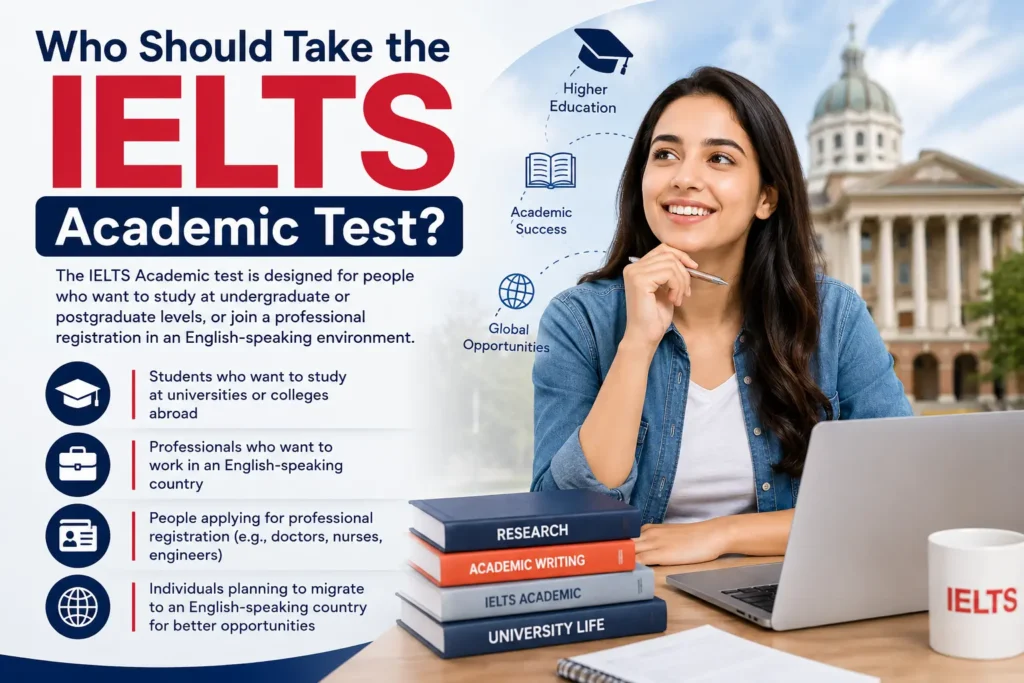
Who should take the IELTS Academic test? Have you ever questioned how that friend of yours obtained admission into their dream university abroad? To study abroad, field knowledge is paramount but other than that it is mandatory that the person should hold a good command of the English language which happens to be the universally accepted language. This can be done by taking the IELTS test i.e., “International English Language Testing System” by the person who wants to study or work abroad where English is the prime language of communication. It generally classifies candidates on the 9-band scale to recognize the proficiency level of each candidate which checks one’s ability in the English language.In addition to that, there are two categories of IELTS exams: IELTS Academic and IELTS General test. And, because of the two options, aspirants usually get perplexed about the difference between Academic and General IELTS. Both types of IELTS tests are globally recognized. So, now the question: which test is right for you? If you are planning to study for an undergraduate or postgraduate degree at a university where English is the prime language of instruction or if you need to provide proof of English language proficiency for specialized registration in a specific field, you should take the IELTS Academic test. On the contrary, if you are planning to work or immigrate to an English-speaking country, you should take the IELTS General test. IELTS Academic: IELTS Academic measures whether your level of English language proficiency is appropriate for an academic environment. It reflects features of academic language and estimates whether you’re ready to begin training or studying. Also, it features vocabulary that is familiar within an academic setting. Furthermore, you can choose whether to take IELTS Academic on paper, computer or online at home or in another suitable location. Great IELTS coaching will lead you closer to your Study Abroad Dream and if you are looking forward to Intensive Coaching for IELTS then FOCUS EDUCATION GLOBAL Pvt. Ltd. is the perfect destination for you. We have the British Council Trained faculties who assist you in every possible way. Besides, there will be a maximum of 15 students in each batch. Also, you can check your ability by taking mock tests on the premises itself. So, book your FREE DEMO SESSION with our expert coaches and make an optimum choice to achieve your academic success with us.
How to Choose the Best Country for Studying Abroad?

How to Choose the Best Country for Studying Abroad? How to Choose the Best Country for Studying Abroad? The idea of studying abroad can be mesmerizing yet challenging. Before choosing the perfect destination, one should conduct detailed research because studying abroad will be transformative, enriching and can be an extremely intimidating experience. Consequently, before selecting where to study next, students should seek professional assistance and do extensive research about it. Now at the point of selecting the country, it is crucial to weigh all of a country’s benefits and drawbacks for your education. There are many factors you need to take into account and Focus Education UK are here to guide you at each and every step. Read on to know how to choose the best countries in the world for studying abroad! Why selecting the right country is important? Selecting the right country for a study abroad program is important because the experience of studying abroad can be greatly affected by the culture and environment of the host country. Studying in a country with a different culture than yours can provide a unique learning experience, helping you gain a new perspective on the world and also providing an opportunity to learn a new language. Additionally, the cost of studying in any given country can vary drastically, so doing some research ahead of time can save you a lot of money. The ‘right’ country is the destination that will give you exactly what you’re looking for, be it lengthy course duration, research opportunities, jobs, or an easy transition to Permanent Residency. So, picking a destination that fits your needs perfectly will form your career and life abroad. Finally, depending on the country you choose, different types of visas may be required, which could affect the length of time you will be able to stay for your study abroad program. How to choose the right country? Studying abroad can be one of the most amazing experiences of your life. It offers you the opportunity to learn about different cultures, meet new people and gain a global perspective. However, choosing the right country to study in can be daunting. Here are some instructions to help you make the right decision: 1. Consider Your Academic Goals Before you start to think about which country to study in, you need to decide what you want to study. Different countries have different strengths in various fields, and you need to choose a country that offers an academic program that aligns with your goals. For instance, if you’re interested in business, you might want to consider studying in the United Kingdom or the USA. while if you’re interested in engineering, you might want to consider studying in Germany. 2. Language Barriers It is important to consider the language barrier. While it can be a great opportunity to learn a new language, it can also be challenging to study in a different language. You should ask yourself if you’re willing to put in the effort to learn a new language or if you prefer to study in a country where the language is similar to your native language. 3. Cost of Living: The cost of living fluctuates greatly from country to country. Before you choose a country, you should research the cost of living in that country, including housing, food, transportation, and other expenses. You should also consider the cost of tuition fees and scholarships. 4. Safety Safety is an important factor to consider when choosing a country to study abroad. You should research the safety record of the country and the city where you plan to study. Look for recent news articles, travel warnings, and safety statistics to get a sense of the safety level. 5. Culture Studying abroad is not just about getting an education, but also about experiencing a new culture. Consider the cultural differences between your home country and the country you’re considering. Research the customs, traditions, and social norms of the country to make sure that you’re comfortable with them. 6. Accessibility: Consider the accessibility of the country you’re considering. How easy is it to travel to and from the country? Are there direct flights from your home country? How trouble-free is it to travel within the country? You should also consider the availability of public transportation. In conclusion, choosing the right country for study abroad requires careful consideration of several factors, including academic goals, language barriers, cost of living, safety, culture, and accessibility. By doing your research and considering these factors, you can make an informed decision that will provide you the best possible study abroad experience. If you have made up your mind and selected the destination mainly the UK, Canada or Australia then must come and visit us at Focus Education Global Pvt. Ltd. Our counsellors will guide you through the facts of when you can apply to study and when you can commence your course in different destinations. They will discuss your profile in detail and will help you to map your career and personal aspirations to the right country where you can thrive in.