
How a Visa Consultancy can provide fast approval of Student Visa?

How a Visa Consultancy can provide fast approval of Student Visa? How a Visa Consultancy can provide fast approval of Student Visa? A visa is required to set foot in a foreign country such as taking permission from the government to enter the country, without an approved visa, a person can’t visit any foreign country. Therefore, this is the reason that visa consultancies are serving people in simplifying the complex activities which are involved in the visa process. If you are planning to study abroad with or without IELTS and are in the need to complete your visa requirements, we, FOCUS EDUCATION GLOBAL PVT. LTD. can assist you to get a visa in less time and without getting much stress. There are many different universities which are giving several chances for Indian students to visit the foreign land and get the best education. These are some top advantages of choosing a student visa consultancy: Immensely Experienced: There is no doubt in confessing that study abroad consultants have enormous knowledge in this field as compared with a normal person. The consultant spends a lot of time gathering information which is attached to acquiring a student visa. Visa agents are the people who know how to implement the whole process of getting an approved visa. It is always beneficial for you to hire the best visa consultants for handling the whole student visa process. Because the experienced visa agents will never let you down and will certainly provide you with an approved student visa. Save Time: Time is the most valuable asset and nobody wants to waste it. You can save plenty of your time by picking the best student visa consultant for managing all the things (to avoid waste of time). If you hire the best visa agent, then they will work on your behalf and manage all the activities which are involved in getting an approved visa. As we all know that without having proper knowledge and experience of the visa process, one can get stuck and make mistakes. That’s why hiring the best visa consultants for handling the whole visa process is a fine choice one should make. Assist from Expert Agents If you are planning to hire visa consultants then probably you are doing the right work. As we all know that there is a vast requirement of knowledge and proficiency in getting an approved student visa. The agents are trained and educated in this field and have complete knowledge of managing and handling things which are related to the visa process. That’s the reason why people hire expert visa agents that help them in handling visa procedure and provides an approved student visa. Huge Convenience You can help yourself with a wide range of benefits by choosing the Student Visa Agents. As there are many steps which need to be taken in an appropriate manner and by choosing the visa consultants, you can get the best support. The visa agents support you in handling all the visa procedure which involves several hectic and complex steps. They will help you in filling out your student visa application form, handling all the documentation work, interview preparation, and more. You just have to check the documents and sign them for going ahead smoothly rest of the work will get done by the visa consultants. Cost-Effective Prices Money is precious and should not get wasted in the needless complex visa process. Having half knowledge or no knowledge about the visa process will provide you with a massive monetary loss. You can get the most genuine student visa consultants at the best pricing structure. The consultants know the complexity attached to the whole process and act smartly for providing positive result. If you are thinking to study abroad with or without IELTS and want to get an approved visa then you must hire study abroad consultants for getting full visa assistance. So to prevent your money from loss, and get the best guidance for your process, please come and meet us at FOCUS EDUCATION GLOBAL PVT.LTD. FOCUS EDUCATION is one of the leading educational consultancy services in India. Since its inception in 2012, Focus Education with its head office in the United Kingdom has gathered enormous client satisfaction from thousands of students from different countries, who wished to pursue their higher education in the United Kingdom (with or without IELTS). We have years of professional experience in imparting consultancy services to aspiring students. Join us to make the best out of your international education experience.
Higher Education in Australia for International Students

Higher Education in Australia for International Students Higher Education in Australia for International Students Determining to study abroad is a big decision. Leaving your friends and family behind, you may get thoughts such as what and where you will study. When people think of Australia, they also think about its kangaroos, outback bush, clean air and water. But Australia has much more to offer. It has the top universities, unbelievable nature, vibrant cities and several oceans are just some of the reasons why many international students choose Australia to study. It has friendly, laid-back nature, an excellent education system and a high standard of living. Studying abroad may have its challenges, but the award in terms of education and personal development can be huge. This diversified country has a vast variety of chances for someone to study abroad. Here are some of the reasons why you could consider making Australia your studying-abroad destination Global Recognition: Graduates from Australian universities are highly sought-after due to the impressive international reputation of the Australian education system. This system is carefully structured by the government in order to maintain the high standards of education associated with the country. Australian degrees and diplomas hold inspiring reputations all around the globe because Australian study programs are constantly updated to meet the industrial requirements with input from Industrial leaders. This means the skill and knowledge that one gets will make you capable of excelling in your field with which you can build your career anywhere. Most Preferred Study Destination: Australia is presently the third most favoured destination for international students in the English-speaking world, behind the United States and the UK, where over 7,00,000 international students are currently studying. Many international students consider studying there because of the cross-culturalism, friendly people and high quality of education. The country has seven major cities – Melbourne, Sydney, Brisbane, Canberra, Adelaide, Perth, and Gold Coast, which are even recognized by the QS ranking agency as the best cities in the world for studying. Work While Studying: One of the substantial benefits of studying in Australia is that you can work while completing your study program. As an international student, you will be able to work for at least 40 hours every two weeks and you will have the same rights as everyone else has in Australia. Some of the suggested industries for international students are Retail, Hospitality, Farming and fruit picking, healthcare services, administration & clerical work and tutoring. Range in Education: Universities in Australia offer a broad variety of courses and degrees, so international students can easily find the university and fields that are right for them. Subsequently Australia’s universities are some of the top-ranked in the world, it’s no wonder that they offer a multitude of different degrees and majors. Whether a person is studying engineering or English, medicine or Mathematics, there are ample of different options and combinations to choose from when one can study in Australia. The first decision international students have to make when choosing a degree program is which university provides most to their needs and interests. It could be a good idea to contact FOCUS EDUCATION GLOBAL PVT. LTD. for your shortlisting of universities prior to see what they offer and whether you meet the eligibility requirements. Cost of Living: Living expenses and tuition costs are affordable. International students are able to work part-time while they study, allowing them to balance their living costs. There is also the possibility of scholarships, which helps to lesser the cost of studying for international students. No Language Barrier: The challenge presented by a language barrier can be quite large for an international student, affecting mostly every aspect of life, from inside the classroom to daily activities like grocery shopping or even simply reading street signs. As Australia is one of the English-speaking countries, so it will not be difficult to adjust to such an environment. Though, the slang may take a slight longer to master! If one is struggling to keep up with conversation, simply ask someone to describe the slang. One will be amazed at the variations Australians have come up with. Cross–Culturalism: Australia is a varied melting pot of cultures. The absolute number of cultures that flourish offers the chance to step outside of the usual comfort zone and experience something new, but also to feel a sense of belonging in the multicultural setting. A choice of the benefits of living in a multicultural society contains wonderful culinary offerings, public international celebrations, the chance to learn a different language and gets the opportunity to build up a network on a global scale The Significant Outdoor: Australia is famous for its diversified territory. During holidays, one can dive or snorkel on the stunning Great Barrier Reef. Bushwalking or kayaking are frequently possible within a day trip. The Outback is legendary for its wide plains and unusual animals. If you have made up your mind to study in Australia and want to know much more about it, please get in touch with FOCUS EDUCTION GLOBAL PVT. LTD. We can help you match with the right course and we will guide you to lead your way to success by our highly experienced consultant.
STEM Course In The UK

STEM Course In The UK STEM Course In The UK STEM courses are in-demand all over the world. Courses that were firstly well-known and accessible in the USA are now open in other popular study destinations as well. STEM courses offer enormous opportunities. In this blog, we will explore everything about STEM courses in the UK which is the hub of top-ranked institutions in the world for you! You might be having many questions, foremost one will be What is STEM? Why study STEM courses in the UK? STEM is a short form for Science, Technology, Engineering, and Mathematics. STEM enclose a curriculum that expands the scope of these four subjects. The demand for STEM courses has continually increased as a result of the varied range of specializations flourishing out of the large area of science. Why Study STEM courses in the UK? The UK is home to some of the most prestigious education Institutes and it is also known for its high level of education. UK proposals everything under the sun ranging from world-class facilities, experienced faculty, and sky-high placements to notable campus life and overall personality development. Universities in the UK are valued for highly practical and impeccable course curriculum that makes students employable and industry-ready. Universities in the UK are among the top 100 universities in the world and are valued for their innovation, creativity, and conducive learning environment. In top UK universities, there are very experienced faculty who have mastered the art of endorsing innovative learning and scientific way of thinking among their students. Universities in the UK are valued for offering a highly practical and flawless course curriculum that makes students employable and industry-ready. Universities in the UK are supplied with courses and degrees in science, technology, engineering and mathematics which are in sync with the dreams and aspirations of countless students. STEM graduates from UK universities have a modest edge when it comes to career opportunities and placements. If you’re considering STEM courses in the UK, and you’re likely thinking about exploring a career related to one of these four fields, then the UK is the perfect destination for it. List of STEM courses in the UK: Pharmacy Life Sciences Astronomy Data Science Aerospace Engineering Electrical Engineering Computer Science Biotechnology Civil Engineering Chemical Engineering Mechanical Engineering Physics Chemistry Mathematics Statistics Biomedical Sciences Information Technology Design and Technology Artificial Intelligence Materials Engineering Eligibility Criteria: STEM courses are enormously competitive in the UK, and it is inspiring that applicants meet the eligibility requirement to get into the courses of their choice. Different universities and courses in the UK have different entry criteria for STEM courses. Here is the list of some of the common entrance requirements for STEM courses in the UK: To be qualified for a PG degree, the aspirant must have graduated in one of the STEM subjects. Aspirants who apply for the STEM programmes offered by the UK universities must have finished their high school studies in science. Physics, chemistry, biology, and mathematics are essential for STEM admissions in the United Kingdom. Salary Package of STEM and Non-STEM Graduates: As per the survey of STEM connect report, STEM graduates are paid at least 20% more than their peers in non–STEM fields per year. To know more about the STEM courses and which suit you best according to your profile, connect with us at FOCUS EDUCATION GLOBAL PVT. LTD. to get expert guidance on universities offering globally recognised STEM degrees. At FOCUS EDUCATION we have placed many students at the best universities for STEM courses to study in the UK, with or without IELTS.
Why do employers prefer graduates with an International degree?

Why do employers prefer graduates with an International degree? Why do Employers Prefer Graduates with an International Degree? Have you too been seeing someone leaving for overseas education, every time that you refresh your Instagram or Facebook feed? Why are so many people leaving the country for educational purposes? Is this education even worth for in the future? This blog will practically discuss all such queries which can pop up in your head or can give you second thoughts about it! Beginning with talking about why so many people are opting for other countries or an international degree. We all know how abysmal the Indian education system can get; you can expect outdated information being instructed to the students and students competing unhealthily for mere grades in the class while not concentrating on their personal development. This is all because the teachers, instructors, and parents especially focus on such parameters more and believe that academic performance is the only way to make a successful career. However, this is not the case with higher education outside India. The education there maintains a balance between academics and the personal development of students which enhances their employability for their future careers. Employability? What does that mean? Why is it so important? Employability, to be put into simple words, is the ability of a person to get employed. But again, there are not many employment opportunities in India and students often end up working in not-so-fruitful jobs after completing all their necessary education. Therefore, students opt for higher qualifications. Now the Indian universities, which are reputed enough to provide quality education and guarantee that the student will benefit in true senses and that their investments for education aren’t a total waste, are very less and on top of that they conduct their entrance exams, which again burden the students. Hence, students search for their way out of this mess and choose overseas education rather studying in their home country. Universities Outside India The universities outside India, especially in countries like the UK, Canada, USA, Australia, and New Zealand are much more credible and the degrees from these nations hold recognition amongst employers. The learning in these nations is not rigid at all and definitely does not focus on just grades. Credible sources such as The Economic Times have published in their report that employers have been believing that the students with an international degree have much more enhanced technical skills and can think critically in situations and bring creative solutions to problems. This is one of the many instances of why employers, even here in India, prefer such graduates and have termed them as “Job-ready”. Even though India has been emerging as a potential market for so many businesses, these employers need solid candidates for their workforce who can lead teams and contribute to building up their company. As this is the first time that we have been talking about crucial concepts such as employability in the context of the Indian market, we also would like to highlight that the courses outside India, are much more updated, subject-centric, and make the students learn about concepts in innovative ways. Overseas Education Apart from that, exploring a totally different country and engaging with people from different cultures, and exploring them, has its perks as you get to develop a range of skills like communicating fluently, and getting to know the places around you. Undoubtedly, an overseas education sounds much more fun and exciting. However, a student must put in equal effort during his academic tenure to achieve an optimum level of employability. So, now if a second thought has already popped up in your mind about getting an international degree from a well-developed country and if you do not know where to start then come and visit us at FOCUS EDUCATION PVT. LTD. where we have helped numerous students to fulfil their dreams to study in the top universities with or without IELTS.
Reason for Australia Being Popular Destination for Higher Study
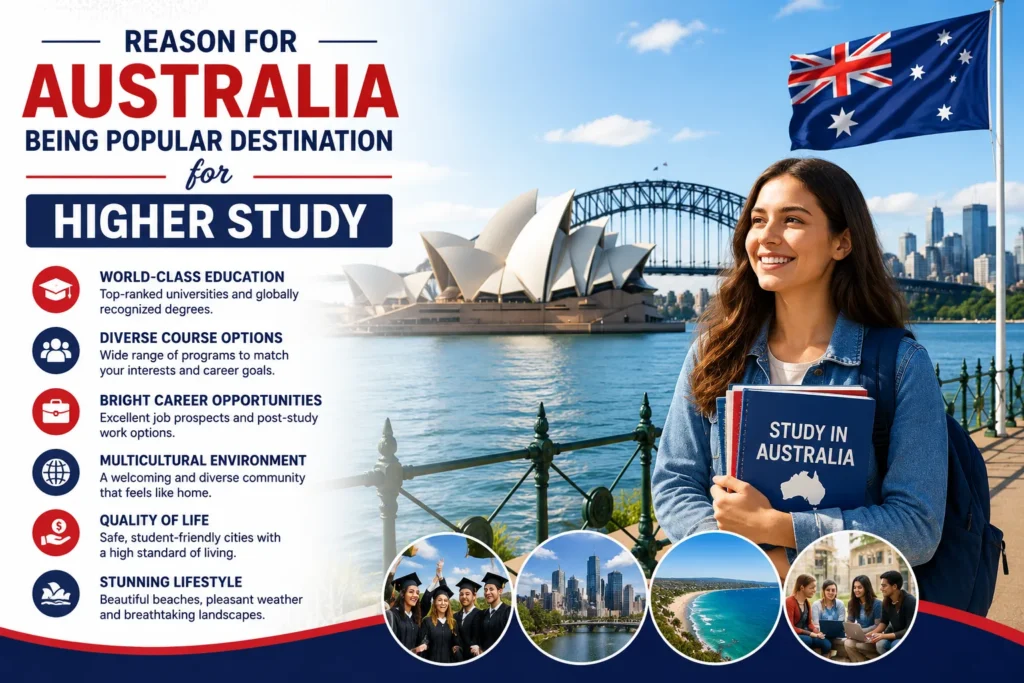
Reason for Australia Being Popular Destination for Higher Study Reason for Australia Being Popular Destination: The Education System The excellent educational system in Australia is arguably the main benefit of studying there. International students have a large selection with over 1,000 universities and 22,000 courses to choose from. Additionally, a large number of the nation’s universities rank among the top 50 globally. The Beauty and Beaches Amazing beaches, magnificent mountains, breathtaking natural settings—not to mention getting to hang out with kangaroos—are all found in Australia. While studying there, you may get the opportunity to see some of Australia’s uncommon plants and one-of-a-kind animals. Australia also values the environment, which draws many university students. Australia is an excellent place to study abroad, especially if sustainability is your field of interest professionally. Culture and Safety The cultural history of Australia is extensive. The cultural contributions of Aboriginal, Torres Strait Islander, and other native Australians are present in addition to Western influences. This combination produces a genuinely exceptional experience that allows you to discover novel life perspectives and engage in cross-cultural communication. Language Acceptability Education in Australia can be a chance to submerge yourself in the English language and Australian culture, especially if English is not your native language. If you do not know about IELTS come visit office we will guide you. Living Standards Australia routinely receives one of the top quality of life rankings. Australia is currently ranked fifth in the world in terms of factors like purchasing power, safety, healthcare, cost of living, pollution, and climate. Numerous publications rate Australia as one of the top countries in the world to study, praising its high standards of instruction, promising job opportunities, and general high degree of student contentment. Highest Paying Jobs In Australia Surgeon: $394,303 on average. Surgeons are doctors who consult with, examine, and operate on patients who have diseases, injuries, or deformities. A nurse $386,065 in pay on average. Anesthetists help surgical patients get ready for their treatment by providing pain relief, setting up the surgery, and putting in place a plan for aftercare for the patient. An economic dealer Typical pay: $275,984. To acquire and sell commodities for a profit, financial dealers examine societal trends, market conditions, and governmental restrictions as well as their clients’ financial situations. Doctor of psychiatry Typical pay: $235,558. Psychiatrists are experts in identifying and treating mental health conditions. They do this by using psychotherapy, creating treatment plans, requesting laboratory tests and assessments, prescribing medication, and checking patients into hospitals. Legal or judicial specialists Typical pay: $188,798 Once more, this is a broad phrase that encompasses a variety of jobs in the legal industry, including paralegals and administrative assistants as well as judges and attorneys of all stripes with expertise in corporate, criminal, immigration, personal injury, bankruptcy, and other legal areas. An intriguing aspect of a career in law is that you can pick the area of practice you’re interested in, and you can use your knowledge to influence legislation at the municipal, state, and federal levels as well as in court, tribunals, and royal commissions. 6.Managing Director or the CEO The typical wage is $164,896. The most senior executive role in a corporation, the chief executive officer or managing director is in charge of managing the business’s operations, structure, personnel, and resources. The creation of business plans, budgets, and strategies is under the direction of general managers, who also identify risks that may have an impact on the profitability of the firm as well as its productivity and efficiency. Engineering Supervisor $159,940 is the average wage. Depending on the organization or agency they work for, engineering managers supervise teams of engineers and are typically in charge of organizing technical operations, civil engineering, and construction projects. Budgets, scheduling, and the creation of quality and safety protocols are among the day-to-day duties, along with managing hiring, coordinating events, and communicating with another department.
Top 10 Courses To Study In Canada
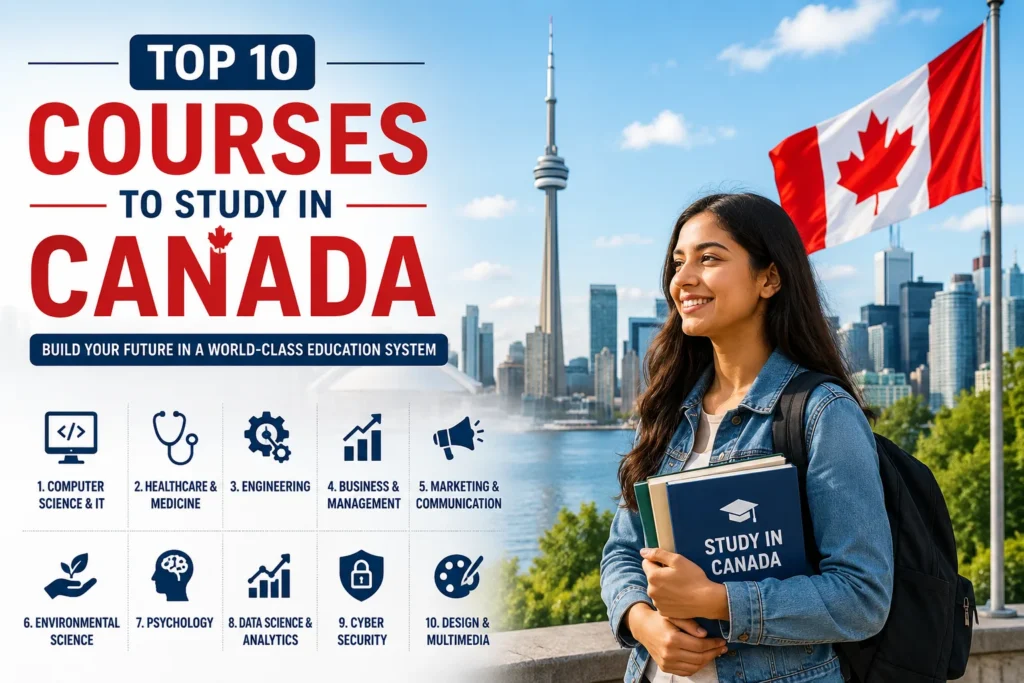
Top 10 Courses To Study In Canada Top 10 Courses To Study In Canada BUSINESS MANAGEMENT Business management is one of the most sought-after degrees in Canada due to its options for earning relevant international job experience and strong career prospects. In addition to being among the top 100 business administration schools, Canadian business education institutions are famous for their unwaveringly high academic standards. A Master of Business Administration (MBA) will broaden your professional options and expose you to a diverse corporate network, fresh ideas, and a solid understanding of the business world. ECONOMICS Economics is one of the top subjects to study in Canada. Your chances of finding employment are increased by having an economics degree from a Canadian university. It will also help you when you apply for permanent residency. HEALTH AND MEDICINE The Canadian government is giving them more attention in terms of its healthcare systems. Due to its demanding medical education curriculum, Canada is a favorite study destination for international students from all over the world. NURSING When it comes to studying nursing abroad, the medical colleges in Canada offer top-notch programs and exposure to many cultures, giving students the skills they need to become a vital part of the global medical industry. Whether you’re looking for comprehensive degree programs or a nursing certificate, Canada has a vast selection of nursing courses from which to choose. INFORMATION TECHNOLOGY (IT) AND COMPUTER SCIENCE (CS) Students from all around the world are interested in these fields. Information technology offers intriguing courses on artificial intelligence, machine learning, data science, big data, and other related topics. ENGINEERING Canada suffers from a serious scarcity of competent people, and several parts of the nation, including Toronto, are attractive locations for jobs in these sectors because of their robust manufacturing industries. The most lucrative markets for these degrees are expected to be in other Canadian cities including Montreal, Calgary, and Edmonton. Professionals in the engineering management, civil, mechanical, electrical-electronics, and chemical fields can readily find employment. HOSPITALITY The Canadian tourism and hospitality sector is in dire need of qualified people to fill management and entry- to mid-level positions in the nation’s hotels, restaurants, and resorts. Due in large part to Canada’s popularity as a tourist destination and its youthful, mobile population, these roles are in high demand. HUMAN RESOURCE AND PUBLIC RELATION Human resources and public relations are two fields in which students may obtain employment. Public relations is one of the most sought-after jobs right now. In addition, many provinces rank human resources as their most in-demand profession. The strategy for managing people within a business or organization is known as human resources (HR) management. Managers of human resources must make sure the business is conducted smoothly, effectively, and efficiently. In order to achieve organizational goals, it is important to focus on maximizing employee and employer pleasure at work. AGRICULTURE AND FORESTERY In Canada, the course “Agriculture Science and Forestry” is very popular. The primary goal of the significant scientific field of agriculture and forestry is to study plants, animals, and the settings in which they thrive. You’ll learn how to preserve the beauty of the environment, manage natural resources, grow food, and rehabilitate forests. Agriculture and forestry also deal with maintaining the mineral characteristics of the soil and rotating crops. MEDIA AND JOURNALISM Students with journalism degrees work as reporters, associate producers, associate media directors, content developers/managers, and media operations managers in major media organizations across Canada.
Higher Education in Australia

Higher Education in Australia Why Study in Australia? Australia is a well-liked study abroad location for students from throughout the world for a variety of reasons. Top institutions can be found in Australia, where students can live an interesting and economical lifestyle. Other advantages of Australia include the sea, sunshine, and scenic beauty. The desire of thousands of international students to study in Australia each year is not surprising. Seven Australian cities are among the top 100 in the world for student friendliness. Australia is the third most popular study abroad country after the US and the UK. Studying in Australia has several advantages, including world-class universities, a wide variety of course options, and opportunities for employment after graduation. Australia is home to some of the best universities in the world and has a top-notch educational system. Your prospects of obtaining job anywhere in the globe are significantly increased by an Australian degree from a reputable university. Universities in Australia have historically made research investments in almost every area of science, medicine, and technology. The Excellence in Research for Australia (ERA) programme of the Australian government recognizes and supports research activities in Australia’s higher education institutions. It has also recognized a number of important national research priorities. The evaluations are given on a five-point scale, with “World Standard,” “Above World Standard,” and “Well Above World Standard” acting as the higher markers.
Higher Education in Canada

Higher Education in Canada Higher Education in Canada Canada is one of the widely picked destinations among all international students and has much to boast of. International students from every country flock to Canada’s reputed colleges and universities to pursue courses in every discipline. Canada is becoming the largest student hub as students from all around the world seek to study in their prestigious international universities and colleges. When it comes to their culls, Canada is at the top of every student’s list. This country has many worth exploring features that will majorly help you to study comfortably in it. Why Canada is most popular destination for international students? Quality Life Simple Immigration Process Less Documentation Employment Opportunities Budget Friendly Why to choose Focus Education for your Visa? Personalized attention to all cases Expertise in our work Quick Response Evaluation of Profiles NOW STUDENTS CAN WORK AS MUCH THEY WANT TO WORK IN CANADA ON STUDY VISA.
Canada Allows International Students To Work For Limitless Hours

Canada Allows International Students To Work For Limitless Hours Canada Allows International Students To Work For Limitless Hours Instead of being restricted to 20 hours per week, post-secondary international students can work as much as they want from 15 November. The interim measures are valid until December 31, 2023. Applicants who have already applied for a study permit will be included in the new measures if approved. With an economy growing faster than employers are hiring new workers, Canada is evaluating all options to ensure it has the skills and workforce it needs to grow. “Immigration is essential to address their labor shortage. “By enabling international students to work more while they study, Canada is alleviating urgent needs in many sectors across the country, while also increasing opportunities for international students to gain valuable Canadian work experience, which can be beneficial both in the short and long term. Benefits of the New Work Policy The move aims to benefit Canadian employers and provide opportunities for international students to gain work experience in Canada. This is especially important if the goal is to move to permanent residency, which already has more than half a million international students. In Canada, the decision will give an immediate boost to the job market. The expansion of the Another measure that “will greatly benefit international students” is the lifting of the cooperative permit requirement for students in cooperatives, internships or other degree programs with a work-integrated learning component.
Gap Acceptable In Canada

Gap Acceptable In Canada Is Study Gap Acceptable in Canada? Undergraduate students should take a 2-year break from their studies, and postgraduate students should take a 5-year break. However, you should confirm with the college or university where you intend to attend. Some Canadian universities demand that students have in-depth knowledge of a particular subject. In such cases, they must present evidence to support their explanations for their study gaps. There may occasionally be a sizable study gap for students. Offering a convincing explanation for the year gap is the only way out. In Canada, the following reasons for gaps are accepted: Retake of tests due to poor results– Some students want admission in good universities but due to their weak English proficiency they had to appear for IELTS/PTE more than once which is the one reason student focus only on their English proficiency and that is considered as GAP. Unanticipated family emergency- Due to any family emergency applicant is unable to either study further or do any job so that is also acceptable by University and High Commission. Health concerns– If due to any health issue student is not able do anything further then he can tell Embassy about that along with all the medical documentation. Psychological or mental illnesses Financial Concerns: Studying abroad is expensive. Students who don’t have enough money may need some time to get the necessary finances and gather the required documentation (proof of financial stability is a mandatory document to get a Canada student visa and study in Canada). Students may take a break before beginning the application process because it can take a while. If students worked for a few months before leaving for another reason, they must present an experience certificate to the college. If you don’t have an experience certificate, a pay stub or arrangement letter will do.