
Covid-19: India Out Of UK RED Travel List on August

Covid-19: India Out Of UK RED Travel List on August 8, 2021 Covid-19: India Out Of UK RED Travel List on August 8, 2021 On Sunday India will be moved from the UK’s RED list to amber list. This will benefit tens of thousands of Indian travelling to the UK including students who will be starting their higher education in the UK for the September 2021 intake. Along with India, UAE, Qatar and Bahrain will also be considered as amber travel list of countries. What will change on August 8, 2021? Passengers will not be required to book hotel quarantine and testing package Travellers must stay home quarantine or at the place they stay for 10 days in UK Everyone must complete and submit a Passenger Locator Form at the UK airport on arrival One must carry proof of a negative COVID-19 test taken 3 days before departure Indians arriving to UK from India and has been vaccinated with Covishield, Covaxin or Sputnik V are given the option to take home quarantine for 10 days or at the place where they stay in the United Kingdom. India was added to the RED list on April 23 this year. Any passenger traveling to the UK from India had to book hotel quarantine and testing package by law at their own cost of £1750 (This amount is set to go up to £2285 after 12 th August). This move will benefit at max to the students who are travelling to the UK for their further studies as they had to bear the extra cost of hotel quarantine and testing package. If you are planning to study in the UK without IELTS feel free to contact us. Our highly experienced consultants will be happy to guide you in every way possible. Focus Education Global Pvt Ltd is a British Council Certified Agent with Head Office in the UK and it would be our pleasure to assist you with your queries related to your higher education in the UK, Canada, Australia and New Zealand. We have nearly 100% student visa success ratio in all the intakes so far, and that is our proven track record.
All You Need To Know About UK Student Visa

All You Need To Know About UK Student Visa All You Need To Know About UK Student Visa United Kingdom is popular among international scholars. The flexible course structure with and internation recognition, multicultural environment are one of the reasons to study in UK. Studying in United Kingdom enhances your carrer and enables you to reach around the world. If you wish to attend a university in UK, you will require a student visa. Here, will guide you through 7 important steps for getting a successful Student Visa. To apply for a student visa you should have following ready as an applicant Must be 18 years old Ability to Speak, read, and understand English Have sufficient and maintained fund to support yourself CAS from a licensed university in the UK 1. Find a consultant: You need an experienced consultancy service who has indepth knowledge about UK Education system and keep themselves updated with the changes. Finding right consultant can guarantee you succsess. During your assessment learn – why you should study in the UK? What course you should apply? Which University will be best according to your profile? And how they can guide you through the complete application process 2. Application and Documentation Once you have finalised all of the above you should have all the following documents ready for the application to the university for your chosen course. Copy of passport Academic Marksheets (PG, UG, Higher Secondary and Secondary Certificate) Academic transcript Degree Certificates Certificate of English proficiency – IELTS / TOEFL / PTE / Duolingo Statement of Purpose Letter of Recommendation Updated CV 3. Offer Letter and Interview Upon submitting your application with the above documents, you will be given an offer letter within 2 to 4 weeks. This offer letter may or may not have conditions which you need to fulfil. This offer letter contains details like – unique student number, fees, scholarship, start and end date of course etc. All the students have to appear for suitability or credibility interview with the University representative. An initial deposit needs to be paid before one appears for an interview. 4. Pay tuition fees and obtain your CAS letter After your successful interview with the university, you need to pay remaining tuition fees and submit your financial documents in order to receive a CAS document. This is a very important document for your visa application as your university will provide all the important information in this document. 5. Visa Documents This is an important step and most consultants does not have expertise in visa application. You will need to submit all the documents you have presented to the university along with proof of funds to support your living in the UK and medical certificate. 6. Visa Application and passport submission Your agent will book date of the appointment by paying for your visa and UK medical fees. On the appointment day you should carry all the supporting documents. The officer at the VFS will scan your document and registering your biometrics. You donot need to do much but make sure all your documents are scanned by the officer 7. Visa Outcome In general outcome of a standard visa application will take around 15 working days. But you should also be prepared for a telephonic interview with the home office. We are British Council Certified Agent and established in the UK. Focus Education Global Pvt Ltd has enrolled students for various courses and secured 100% UK Student Visa success ratio in all our recent intakes. These students have travelled to the UK on a student visa with or without IELTS and are currently studying in TEF Gold and Silver-rated universities. Most of these students were awarded scholarships up to £5000. If you wish to apply for Study in UK without IELTS With IELTS, please click here to know in detail. For all you plan to study in the UK without IELTS feel free to contact us. Our highly experienced consultants are going to be happy to guide you in every way possible.
Why one should take IELTS proficiency test?
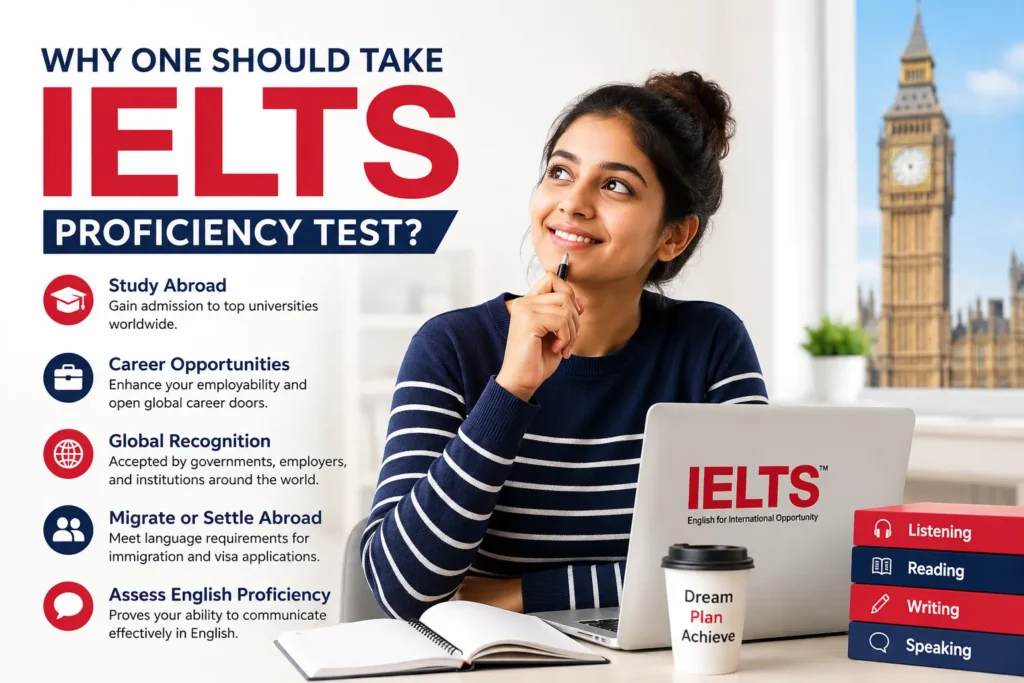
Why one should take IELTS proficiency test? Why one should take IELTS proficiency test? What is the first thing that comes to your mind while you are thinking of studying abroad? Yes, you are right!! Why IELTS? Going through this blog you will understand reasons of WHY ONE SHOULD TAKE THE IELTS PROFICIENCY TEST Let us start with “What is IELTS?” IELTS (International English Language Testing System) is worldwide popular proficiency test for people with English as their second language. IELTS is jointly owned and managed by the Cambridge English Language Assessment and IDP Education Australia (International Development Program). It is designed to assess the language ability for candidates to prove English competency to secure study, work or settlement visas in English speaking countries. You can choose between the Academic or General Training versions of the test depending on the visa type you wish to secure. The Academic IELTS is required for university or college admission, while the General Training IELTS is intended for career and immigration purposes. . IELTS is one of the most common English language tests for employment or educational possibilities; it has become ever more relevant. What is the main purpose of IELTS? IELTS is developed to provide an impartial and precise assessment of English language proficiency considering Listening, Reading, Writing and Speaking skills of an individual. Reasons that you should take IELTS Tests: The benefits of taking IELTS test are not limited to those who want to go abroad, but can be helpful in exploring better study and job opportunities in your home country too. For students who wish to pursue higher education especially in UK, Ireland, Canada, Australia, USA, Singapore and New Zealand official IELTS score is one of the most important prerequisites. Improve English Language Skills: As mentioned above the IELTS test measures language abilities in the four core communications which includes the Listening, Reading, Writing and Speaking skills. During IELTS preparation one will learn various study tips that will help to enhance their English language skills. If one takes the IELTS Academic Test, you will become more aware with the language required to study in English at the undergraduate or postgraduate level. Enormous career opportunities: Passing the IELTS exam results in an English Language Proficiency certification recognized worldwide. Numerous government agencies, universities, employers, and other institutions accept IELTS exam results and recognize the importance of the certification you receive for passing. It is accepted by over 9,000 organizations in more than 135 countries, for education, immigration and professional purposes. Needed for all steps and stages of your life: Apart from using it to get admission, the test is sometimes required for visa applications, immigration forms and job applications in Foreign Countries. Exact knowledge of English skills: By taking the IELTS test, you´ll be already for applying your English knowledge as if you were in an everyday situation with English native speakers. Your English language skills are assessed objectively. The examiners’ requirements for evaluating the English language skills are difficult for all the specific exams. Therefore the result you obtain is an accurate reflection of your English language skills. Though there is no actual failure in the test, most institutions would need to be satisfied with a score of at least 7 out of 9. Candidates who get less than that or get a low score can always repeat the IELTS exam until they will get a good score. Recognized worldwide Over 135 countries and more than 9000 organizations around the world accept IELTS as proof that it is capable of communicating well in the English language. Thus, its reputation as a good test of English proficiency ranges beyond English-speaking countries. You’re going to get certification that is widely recognized. By taking the IELTS test, you will receive a test report that is recognized and accepted by thousands of institutions around the world, including companies, universities, professional bodies and government agencies. Learn both British and American English IELTS includes both British and American English, in terms of grammar, spelling, pronunciation, and word choice. Whether you want to study in Ireland or even in another English-speaking country such as the US, UK, Canada Australia or New Zealand, IELTS gives you the opportunity to train your ear to various native English languages and the reading test involves a combination of them all. This happens because the test is designed by British, Americans, Australians and New Zealanders who try to build a realistic approach to each English language variation according to the terms used in newspapers, advertisements, books and companies in their countries. So these are the added benefits of preparing to take the IELTS exam. IELTS for visa approval: IELTS test can help you to get visa approval quickly with minimal effort by the government agencies, as you have a certificate that is universally acceptable. Providing evidence of your language skills is an important step towards obtaining a visa so that you can work abroad. English Language skills are keys to the success of a career and are considered a valuable asset for any job. If you are an applicant for a work visa, you must have either ‘competent’ English or ‘vocational’ English language skills, which means that you will have to be prepared for more than basic casual English. Your IELTS Your choice: As we are well aware about it that, Life is full of choices and making the right decision for your future is important. With IELTS, you are given choices before and after the test ensuring you are best placed for your future: You can choose between the Academics or General version of the test. You can choose between IELTS pen and paper or Computer delivered test option. You can choose to take the test for work, study, or immigration. You can choose a test date and location convenient to you, with over 1,400 test locations globally across 56 countries. Enhance Employment Prospects: A good command over English with excellent communication skills are very essential these days as 55 countries have
Study in the UK after 12th
Study in the UK after 12th Study in the UK after 12th The United Kingdom is the dream destination for higher education. The World recognised Universities in the UK, have an encouraging academic environment, the lecturers are approachable and the classrooms reflect multiculturalism. Also, the post study work experience is awesome and the graduates enter a workforce with respected and worldwide recognized qualifications. The student gets best environment both during your higher education and post your graduation. The UK has ample of choices for students wishing to study after their 12th. There are many reasons that inspire students to choose the UK as their study abroad destination. Firstly, the UK is a home to several best-rated universities, it has all a student needs to drive towards a bright career and lead a prosperous life. If you are the one, who is Planning to Study in the UK after the 12th with or without IELTS then you are on the right page. Why Study in the UK after the 12th? From student lifestyle to historic universities, the UK has been a hot spot for international students as the study hub. From music to science, engineering to films and advertising, in the UK you find everything it takes to build a fruitful career. Educational Supremacy: Few of the world’s oldest universities are in the UK and they carry a heritage of quality education. In the UK, there are over 160 higher education institutions that are known for their high quality of education. Apart from this, the universities in the UK follow an advanced teaching technique that encourage students to develop their problem-solving skills as well as to think independently. Improve English: Studying in one of the developed countries where the English language originated will definitely help to boost the command of the English Language. The students will benefit from personal exposure to the authentic British language. This even after achieving a good IELTS score, one will groom their language skills while studying in the United Kingdom. Welcoming Culture: The UK is popularly known as a multicultural country, which means people come from different cultures and backgrounds. With significant number of students come from south Asian countries, Indian students find it easy to live and adjust in new environment. Course of Choice: There are hundreds of course options available to study in the United Kingdom. You can choose to study the most updated curriculum. The options are confusing many times targeting right career path. There will be subjective courses or combination of subjects to choose. You can choose to study independent course or one with internship which will provide you valuable industry experience ahead of your actual placement. Employment: The top employers in the world highly respect graduates from British universities. They know the value and quality of education provided by these universities. Studying in a multicultural environment makes international students more adjustable and flexible to work in a diverse workplace. Apart from this, the UK also allows a post-study work visa. This means that after graduating, you can live and work in the UK for an extra 2 years. The UK has thousands of businesses, up and down the country that are looking to hire talented university graduates- one of which could be YOU. Popular course to study in the UK after the 12th: With plenty of options available to study in the UK for Indian students after the 12th, it can get hard to select the right course. Here is a stream-wise list of popular courses that you must consider studying in the UK Commerce Stream: Business Economics Law Accountancy Management Arts (Humanities) Stream: Sociology Philosophy Mass Communications Hospitality & Tourism Literature Science (Non-Medical) Stream: Engineering Computer Science Chemistry Science (Medical) Stream: Biology Biotechnology Molecular Sciences Medicine These are only a few courses that the UK has to offer. If you are not sure which of these courses is right for your career or have any other area of interest – please get in touch with FOCUS EDUCATION GLOBAL PVT LTD and get matched with the right course and we will mentor to lead your way to success by our highly experienced consultants. Being British Council Certified Agent with Head Office in the UK, we at Focus Education Global Pvt Ltd make sure that all who travels to the UK get most precise information. The UK is the most preferred country for the Higher Education and students from all over the world travel to this country on student visa to make a better career. For their preferred PG courses students can apply for the UK student visa with or without IELTS and can also travel to UK with their dependents. We Focus Education Global Pvt Ltd, are British Council Certified Agent and established in the UK; has enrolled students for various courses and secured nearly 100% UK Student Visa success in all our recent intakes. These students have travelled to the UK on a student visa with or without IELTS and are currently studying in TEF Gold and Silver-rated universities. Most of these students were awarded scholarships up to £5000 and some of them have already converted their student visas to Post Study work visas. If you are planning your higher education in the UK and wish to apply with or without IELTS then please get in touch with our experienced counsellors, who will help you achieve your dreams of studying abroad and make your future bright.
Higher Education in Canada for International Students

Higher Education in Canada for International Students Higher Education in Canada for International Students Canada is definitely a dream country for international students for their higher education. As a country, Canada has to offer a lot to these students as they can definitely achieve high-quality education with internship opportunities., This country creates a perfect opportunity for students with its liberal government policies and offers study, work and immigration in Canada. Add all this with a low cost of living and it doesn’t get any better than that! With great standard of living, Canadians enjoy a wide range of outdoor activities from biking and hiking to skiing and swimming, and they are passionate about their favorite winter sport, ice hockey. Canadians are known for their acceptance of diversity and for the same reason they have earned them the reputation of being one of the friendliest countries in the world. Students from all over the world pursue their dream of studying in Canadian and wish to seek a Permanent residency. Getting a PR is becoming difficult day by day so moving to Canada after getting a study permit is probably an easy way to settle down in Canada. Means getting work permit after study in Canada opens up many doors of opportunities Let’s learn about the requirement to study in Canada for International Students. First, we will understand Intakes in Canada: Canada has 3 different intakes September Intake (Fall Intake)This is the main intake in Canada because in this intake most institutions offer the largest number of seats available in all courses. January Intake (Winter Intake)This intake is considered as a continuation intake of fall intake. Mostly the students who missed fall intake for any reason can get admission into this winter intake. Besides very few institutions offer some courses after fall intakes. May Intake (Spring Intake)This intake is the least preferred intake by students as not many colleges or universities offer a course in this spring session, once they offer are very few. A Step-By-Step process for requirements to Study in Canada for International Students The Canadian Academic setup is quite flexible towards switching courses although it is best to compare your options beforehand and choose a major that you truly are interested in pursuing. Do your own research: It is very important to do full research by your own. Indeed, it is one of the biggest decisions of someone’s career. It is surely advised not to rush and make a false decision. One should be definite about the course to be pursued in Canada. One must include certain points in their research, like course and future scope including after study opportunities in Canada. Selecting the Universities OR Colleges: A degree or certificate with a professional institute will play a great part in building your career in Canada. One should do enough research and pen down a few universities or colleges where they want to get admissions. This selection should be done by keeping in mind their academics and other entry requirements. For an example IELTS requirements are different for different colleges and universities. With same college and universities IELTS requirements are different for various courses taught in them. So don’t just rush to get an admission by paying admission fee. You may lose the money if you are not matching their criteria for getting the offer letter. Cost: While having an idea of moving to Canada, every student has a one common question as “how much it cost to study in Canada”. This being the most important factor has every student wish to have a perfect degree to match their vision to create best of an opportunities. Cost of living, tuition fees, maintenance cost, health checkup and visa & flight tickets add to total massively. Some expenses multiply with the number of years of a particular course. The total cost may increase or decreases depending upon the college / institute and its location. Please visit or call Focus Education Pvt Ltd on +91 9898 344 644 or write us in an email (info@seagreen-horse-500205.hostingersite.com) to know approximate cost to complete your higher education in Canada. Funding Sources: With the cost you are ready to pay, you should be aware of funding sources. If you are getting that money from your parents let them know well in advance that you would need that amount of money so that they are also prepared to pay for your advance tuition fees, GIC, travel costs. Location and Campus: Another important factor is the location and campus you want to study and make your living. Let’s say if you want to live in a major city like Toronto in that case you should look for a university or college that comes under GTA Region (Greater Toronto Area). If you want to live in a quiet place, you can look for a university or college in the Waterloo region. Canada being a very big country, you can get plenty of options in nearly every part of it. We at Focus Education can provide you range of courses and campuses of your choice. Language Proficiency Test: You must have heard about IELTS (International Language Testing System) and TOEFL (Test of English as a Foreign Language) Test acceptable for Canada Student Visa. An IELTS academic is required for study process. An eligible IELTS test result can provide you plenty of location options for your preferred course. Focus Education provides best IELTS Coaching in Ahmedabad. We are offering special rates to students who wish to enroll for both IELTS coaching and admission process. Eligibility Criteria: Apart from your great academics, most colleges and universities will require you to bring of 6.5 Bands with no less than 6.0 bands in IELTS and TOEFL between 80-88. As mentioned earlier that different colleges and universities have different requirements for their courses. One should definitely look for the exact requirement to meet the goal in mind. A student for higher studies should plan in a way that he / she is able to
POST STUDY WORK VISA IN THE UK

POST STUDY WORK VISA IN THE UK POST STUDY WORK VISA IN THE UK There will be a lot of questions that arrive in your mind like what is PSW, what does it allow, what are their benefits, and how to apply for this? Do not worry, step by step this blog will help you to resolve all your queries. What is PSW? Post Study Work Visa (PSW) is a Graduate Immigration route of a UK visa. International students who enrol to study for undergraduate level and above at a UK educational institute will be benefiting from this new post-study work visa. This visa has been termed “Graduate Route”, it will allow students to look for a job, work or stay for 2 years after they graduate. Previously, PSW had been eradicated by the UK government in 2012. However, the visa has successfully been re-introduced under a new name – the Graduate Immigration Route, which opened on 1 July 2021. What Does PSW Allow: All the international students studying in the UK, getting a graduate or a master’s degree will get a work experience of 2 years in the UK through the Graduate route. This is to mention that the students completing their PhD on or after the summer, of 2021 will get to stay and work in the UK for 3 years. The Advantage to International Students of Post Study Work Visa: Opportunity to practice educational learning in the workplacePSW will open a new window for students for applying their educational learning to real-life practice at the workplace, an opportunity to convert theoretical knowledge into practical tasks. Chance to start your own business in the UKPSW visa will let students become self-employed. Students can start their own businesses in the UK and improve their entrepreneurial skills. Opportunity to gain work experiencePSW visa route will allow students to work full time at any level of the job in any company, in the UK. It is a big chance to gain work skills from companies operating in the UK. This could be a bull’s eye on the student’s professional profile to get access to the UK job market and convert to another skilled visa. Rights of working full time:The PSW work visa will permit eligible students to work, or look for work, at any level, for a period of two/three years after completion of their courses. The student will be able to earn money and get a fruitful Return on Investment in higher education. Golden chance to connect with employersGoal-oriented and ambitious students can use this chance to connect with potential employers as per their career target and eligible candidate may see them in top professions at international companies. Opportunity for networking with professionalsDuring the work period, ambitious students may use the platform to build up the network and connect with professionals from their chosen industries and develop their opportunity fields for future benefits. Potential opportunity for Tier 2 work visa by employersWhen working at the company during the PSW visa, the employer company may offer Tier 2 skilled visa if they of sponsoring rights. Even graduates will be open to seeking Tier 2 visas or another skilled job visa at other companies in the UK. Opportunity to gain transferable skillsThe UK graduates will have the opportunity to work with their chosen industries or sectors; they will gain transferable skills including effective communication, analytical, teamwork, leadership, decision-making, organisation and planning, self-awareness and other soft skills necessary to succeed in a career. Flexibility to switch to student visa again or other typesAt the end of the PSW visa, graduates will be able to switch back to a student visa or they will have the chance to switch to other visa types if they accomplish the eligibility criteria from inside the UK. Great take-away to home countryThe UK Degree and work experience will be a great takeaway for students who will return to their home country where potential employers will be benefitted from graduates’ world-class knowledge and skills to influence competitive advantage for them and for the country. Therefore, we can say that Post Study Work (PSW) work visa under the Graduate Immigration route will open many paths for international students to the UK, a top higher education destination and profitable commercial hub of the world. The UK Government lovingly welcomes international students to grab the opportunity of this Graduate route. Now, if the questions like how to apply for PSW, am I eligible or not, and how to start? Pops up in your mind then there is one stop solutions for your every query i.e., FOCUS EDUCATION PVT. LTD (UK). Meet us at Focus Education. Let our experts find the best solutions for all your query. We Focus Education Pvt. Ltd. are British Council Certified Agents and well-known in the UK. We have enrolled students for various courses and secured nearly 100% UK Student Visa success in all our intakes. These students have travelled to the UK on a student visa with or without IELTS. At Focus Education Pvt Ltd (UK), each visa application is treated with utmost importance and a personalized approach. Our consultants provide complete information on the various aspects of studying in the UK and other destinations of their choice, patiently addressing every minor concern that any student may have. So, if you are planning to go to the UK for your higher education and wish to apply with or without IELTS then kindly get in touch with our experienced counsellors. We will be happy to guide you in every way possible.
Student life at the Universities in the UK

Student life at the Universities in the UK Student life at the Universities in the UK The choice to Study in the UK with or without IELTS is far from what is taught in classrooms. The student life in universities in the UK is extremely fascinating and can be understood as follows: Academic lifestyles at the universities in the UK: The teaching techniques utilized by the universities in the UK are enormously communicative and allow for two-way communication. Besides this, being collaborating, the academic culture in the UK pushes the students to autonomously learn concepts. This succeeds the students to become self-sufficient and come up with solutions to problems by themselves. Many universities in the UK inspire the students to undertake independent research activities which enables them to expand their knowledge base Sports in the UK: When the student decides to study in the UK (with or without IELTS), the sporting activities that come along with it are enormous. The UK is Home to the English Premier League, football is really a big part of life here. Football fans of the United Kingdom are known worldwide for their love for the game. Not solely football but the United Kingdom is home to cricket, like these sporting activities have been cultured in the UK. Therefore, when studying in universities in the UK (with or without IELTS), international students will find themselves at the forefront of sporting activities. Food: Throughout the United Kingdom, there are several cultural groups who have set a base here. Due to this, the students will find various cuisines such as Asian, American and European in the country. Sharing one’s local food is an outstanding medium through which students can expand their social circle when studying in universities in the UK (with or without IELTS). Gradually, people in the UK are becoming health conscious, therefore the number of healthy eateries is on the upsurge. The student will therefore find every possible cuisine in the country. Leisure activities at universities in the UK: Popular tourist spots like London Eye, House of Parliament, Buckingham Palace, Big Ben and many more are must visits when attending universities in the UK. Contrary to popular views people in the UK are extremely sociable. The social life in the universities in the UK is extremely thrilling, there are various social groups that a student can attend that develop their various skill sets. Not only is the nightlife in the UK fascinating but there also exists a large number of historical and archaeological sites, that find their roots in passionate art lovers. Some of the colleges and universities in the UK are a few of the oldest institutions in the world. Therefore, by studying in them, student allows themselves to study in institutions that have a rich cultural heritage. A large number of cultural groups have made the United Kingdom their home, therefore discovering the various cultural traits that the country has to offer will enable one to truly explore the lifestyle when studying at universities in the UK. When studying at universities in the UK (with or without IETLS), the students will come across various carnivals that are organized round the year. These carnivals are an excellent medium for students to interact with one another and make new friends and enjoy the atmosphere the UK has to offer. The United Kingdom has many historical towns, during the course break the students should try to visit these to understand the cultural gradations of the said period. Therefore, the leisure activities in the UK can be varied for each individual, it is what each student makes it to be. It is always a bright idea to explore the local food offered. Apart from the many tourist locations in the UK itself, its closeness to other European nations is a great advantage. During course breaks, many students travel to nearby European countries. Travelling enables the student to not only strengthen the already existing social ties but also understand the historical significance of the country. Although universities in the UK were established earlier, they are extremely modern in the way they deal with the students. Clubs and Societies: Nearly all universities in the UK have numerous clubs and societies. These clubs are admirable mediums through which students can interact with people who have similar interests and thus expand their social circle. Universities in the UK have various clubs that range from sports clubs, drama clubs and many more. Besides this, many universities in the UK train their students to make a positive impact in the world and therefore have volunteering and community service clubs on their campus, which absorb in students’ values of activism. Apart from entertaining clubs of craft, baking and many more, there exist academic societies as well. Majorly universities in the UK have academic societies of a particular department that the student can contribute to develop their knowledge in the said area. Entertainment: Music, theatre, film and exhibitions are some prevalent entertainment activities when studying at universities in the UK (with or without IELTS). The United Kingdom holds several film festivals around the year which allure a large number of movie buffs. Moreover, museums, art spaces and galleries are outstanding mediums through which students can understand the history of the country. Music lovers who decide to study in the UK have with themselves numerous avenues to explore the varied music forms the country has to offer, these include pop, jazz, opera, hip-hop and many more. Hence, when students are studying in universities in the UK (with or without IELTS), they will never find themselves short of entertainment activities. To know more about the UK universities and the culture or planning to study in the UK, please get in touch with FOCUS EDUCATION GLOBAL PVT LTD. Our highly experienced consultants will be happy to guide you in every way possible. At Focus Education Global Pvt Ltd (UK), each visa application is treated with supreme importance and a personalized approach. Our consultants provide complete information on
Is It Better To Study Abroad For A Better Tomorrow?

Is It Better To Study Abroad For A Better Tomorrow? Is It Better To Study Abroad For A Better Tomorrow? Studying abroad has become a global sensation nowadays. Numerous students desire to move to different countries and continents for higher education. Many students and parents believe that getting education from a foreign country will enhance their personality as well as profile that exposes better job opportunities in the future. But why opting courses in other countries has become so popular with time? It is a fact that studying abroad has plenty of benefits – right from getting a better placement opportunity to enhancing social life. Do you still doubt whether studying abroad for a better future is the right decision or not? Well, to help you clear up your mind, we have listed a few reasons why one must study abroad for a better future. A Diverse Culture to Experience: One of the great benefits of studying abroad is that the student will have a completely diverse atmosphere to tackle and fit into it. Studying abroad, one gets opportunity to meet new people that come from different cultures and languages. Besides this, one gets chance to be self-dependent, decide on their own and get immersed in different environment. For example, foreign countries follow different cultures like appetite, have different tastes in music, love engaging in parties and many more. It will take time to prepare yourself to explore everything the host country has to offer and moving abroad helps to acclimatize with different segments easily. Upgrade your skills – grasp new language skills: Studying in a different country will help you to build up your communication skills. The student gets an opportunity to learn a new language. As we know, English is a worldwide language, yet many countries follow their language to communicate. Studying in English-speaking countries will give the student command of the English language. It might be a real challenge, but it will add an advantage to your study abroad decision. Build up Network: No matter where we stay, we come across many people of different cultures. Studying abroad will be very beneficial, it will help to connect with people from different backgrounds. One can share and grab new information about the rest of the countries and will get an opportunity to create great social life as well as also helps to build up network on a global scale. Studying abroad challenges you: As we all know that studying abroad is not like a cakewalk. There are many stages one needs to pass through to get admission to a foreign university. Therefore, applying to study abroad challenges your will and your mind. There might be a bit chance that a person can feel conscious about things before leaving the home country, but not worry about it naturally. Studying abroad helps students to push out of their comfort zone and add a whole new experience to life. And it is well said that whenever you take a step close to your dream, you will learn something new which will be worthwhile and valuable. Only getting admission is not everything, the student will have the freedom to explore a whole new place and learn new things. Top quality Education: The education system in a foreign country is way much better and more advanced than in the home country. This is the major reason why it is better to opt to study abroad for a better future. The universities abroad provide a wide range of courses for international students and taking the degrees and qualifications of higher education institutions from abroad are known around the world as high quality and world-class. Career Opportunity: Getting a degree from a world-recognised university will be surely a step ahead in career and it will be an added advantage to CV. Nowadays, big multinational companies to small firms look for candidates with good skills, international experience and top grades in education. Also, overseas education benefits in many ways which include learning a new language, leadership quality, adjusting to an in completely new environment and its culture, and a challenge to manage living cost by own. All these things will definitely help to understand life and survive in diverse situations. Henceforth, it is a great skill that many modern businesses and companies look for when hiring. Study Abroad with FOCUS EDUCATION GLOBAL PVT LTD. Have these above-mentioned points been valuable in any way? If you have made up your mind to look at the benefits, you can get in touch. At FOCUS EDUCATION GLOBAL PVT. LTD., we guide students through the admission process to the visa process. Also, we provide coaching for IELTS, so if you are planning to study abroad with or without IELTS feel free to contact us. We help students to prepare for UG and PG from different universities in countries, including the UK, Canada, Australia and many more.
CELPIP – The Canadian English Language Proficiency Index Program

CELPIP – The Canadian English Language Proficiency Index Program CELPIP – The Canadian English Language Proficiency Index Program This is a language proficiency skill test for people who opt for immigration, citizenship, and professional designation. It is an alternative exam which is in trend and follow the same structure of clearing all the four modules Listening, Reading, Writing and Speaking. There are two ways a person can opt for CELPIP. CELPIP – General This test analyzes the candidate’s proficiency in listening, reading, writing, and speaking and is exclusively meant for applicants for Immigration and citizenship. It’s exam fee is $280+ Taxes (Canadian dollars) Test timing: Listening 47–55 minutes Reading 55–60 minutes Writing 53–60 minutes Speaking 15–20 minutes CELPIP – General LS Test This test analyzes the candidate’s proficiency in listening and speaking and is exclusively meant for citizenship application and vocational entitlement. This exam conducts only in Canada. It’s exam fee is $195+ Taxes (Canadian dollar) Test timing: Listening 47–55 minutes Speaking 15–20 minutes Some interesting facts about CELPIP: This exam is technically easier than other exams. This exam is CBT- Computer delivered test. Unlike IELTS, it is about 3 hours exam in which all the four modules are covered in one go. The candidates need not to wait for speaking module. For General LS – this is 1 hour 10 minutes exam covering the 2 modules in one go. Results are quicker as the candidate can get the scores in just 3-5 business days. It has free sample tests online wherein the candidate can help himself out in understanding the pattern and types of questions. Speaking module is also computer delivered and the questions are from familiar topics with certain time limit which the candidate can see on screen. The candidate can book the exam date from the authentic CELPIP website as per the convenience. No need to wait long hours. The best part in writing is the candidates while writing get the red lines if they commit mistakes in writing wrong spellings which they can correct and thus, boost exam takers’ confidence. The best and easy exam for people who think that cracking such high-end proficient exams is not for them. Just Focus on the parts. If your dreams are big, CELPIP exam is for you!!! FOCUS EDUCATION GLOBAL PVT LTD. Have these above-mentioned points been valuable in any way? If you have made up your mind to look at the benefits, you can get in touch. At FOCUS EDUCATION GLOBAL PVT. LTD., we guide students through the admission process and the visa process. Also, we provide coaching for IELTS, so if you are planning to study abroad with or without IELTS feel free to contact us. We help students to prepare for UG and PG from different universities in countries including the UK, Canada, Australia and many more.
Best Courses to Study in UK 2024-2025: 10 Top Courses for International Students
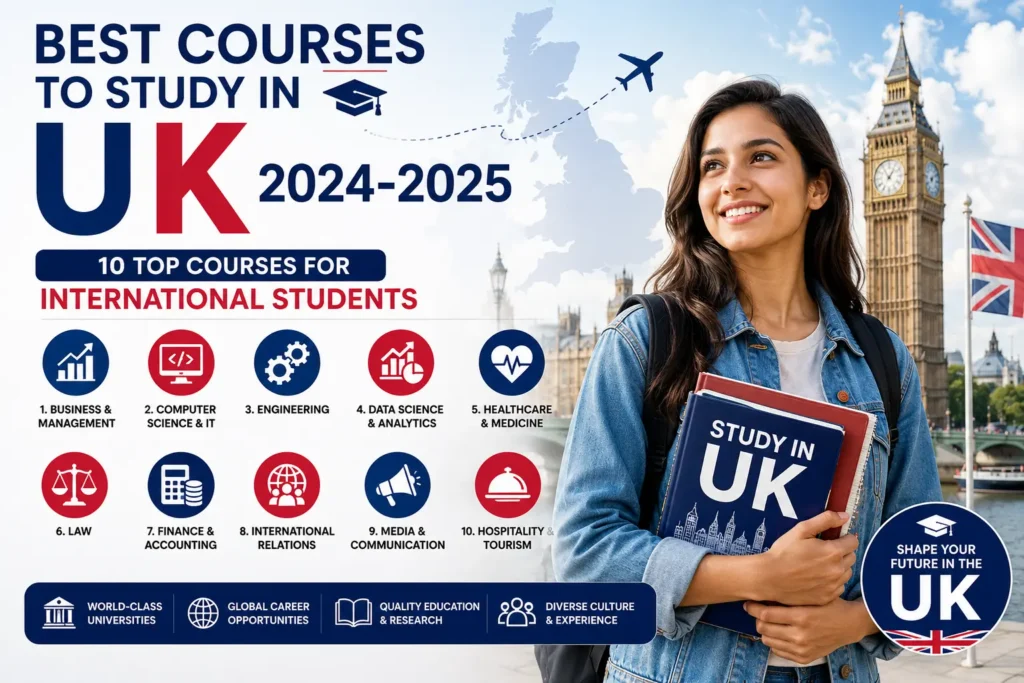
Best Courses to Study in UK 2024-2025: 10 Top Courses for International Students Best Courses to Study in UK 2024-2025: 10 Top Courses for International Students Do you wish to study in the UK? Great Choice!! Find the list of the best courses at the UK Universities. For many international students across the globe, pursuing higher education degrees from one of the prominent universities in the world is crucially important. Choosing the right course at the right university is a critical factor. Degree from a reputed university with worldwide recognition will open the way for a bright career. Among the top countries to pursue higher education, the UK is one of the best study destinations with reputed universities and top quality of education as demonstrated by the global rankings namely THE Global ranking and the QS World University Rankings. Apart from this, another reason for the UK’s to allure is the wide variety of courses and subjects for the students. Like many applicants, you too must prioritize achieving the best degrees in the UK as it can shape up your career accordingly. For example, if you choose Business Analytics, it will yield in procuring a high-paying job. Similarly, many other top courses in the UK can push your career in the right direction. Have a look at the top 10 best courses to study in UK for international students with all the necessary details that can help you to pick the right one! Business Studies and Business Analytics: Business management studies have always been one of the most favourite and top courses in the UK. This degree mainly focuses on the planning, running, and operations of an organization on an international level. This degree helps you to evaluate business and carefully calculate the growth. The students who hold this degree will not get any difficulty in getting the job of their choice. Apart from this, the demand for this degree had been gradually increasing over the last few years. One of the finest courses render in the UK is Business Analytics. The degree will permit us to evaluate companies and exactly determine once growth tangents. Business analysts benefit companies to develop and perform well by studying the details of a company. Over the past few years, there has been a marvellous increase in demand for this profession. Law: The UK is known as the hub of lawyers, specifically corporate lawyers as well as it is known as one of the best countries offering a disciplined system of law education. Legal counsel and attorneys are required by businesses all over the world to handle their legal affairs. Law courses in the UK provide an in-depth & critical understanding of the fundamentals of legal principles and practical skills and it has become very popular among international students. Additionally, the aspirant can opt for one year of professional practice at law firms in the country to polish their skills. One of the best nations having a planned system of legal education is the UK. So, if you want to learn about international law and planning to have international exposure in law, then the UK is the best option. Computer Science: Nowadays computer has become very important in almost every sector and every business firm, from start-up to multinational firm. There is not an industry out there that isn’t using data and computer technology daily and living in this digital era can change your life. Computer Science is considered to be one of the best degrees that a student can earn in the UK. Computing devices are the topic of computer science. It involves creating software, addressing issues connected to hardware, the architecture of massive computer systems, and the nature of computing. This course contains designing software, aspects of hardware, and computation. Hence, this course will furnish me with the advanced knowledge and skills that are needed in today’s rapidly advancing computing industry. Accounting and Finance: Accounting and Finance courses in the UK involve a broad curriculum that covers a wide range of subjects. The student who will opt for this course will not only have depth knowledge about finance and accounting but also will help to craft unique viewpoints and knowledge on economics, political science, sociology and mathematics. There are many specializations offered under this course that pave the way for the aspirant for getting outstanding work opportunities. The need for accountants, business specialists and financial experts is also anticipated to develop in line with economic and technological advancement. Economics: The UK has given the perfect shape of the face of modern economics that inspire both i.e. how it’s useful in practice and how it’s taught around the globe. By studying economics, you will develop the skills like problem-solving, data analysis, oral presentation skills and many more skills which are highly observed in today’s economic climate. Hence, if you want to understand in-depth how and why money makes the world go round then there is no better place than the UK to give a kick start to your career. Fashion and Interior Designing in UK: Do you know about London Fashion Week? It is really awesome. This is due to the UK’s significant inspiration on the fashion, styling and interior design industries. Art & Design courses in the UK are gaining popularity among overseas students. The UK universities have been shining in courses that is passion-based like art & design. The UK is home to the most impressive luxury fashion labels, the largest designers and the most advanced stylists. Also, Universities in the UK frequently invite professional artists for academic engagement with the students and share their unique experiences. The UK is indisputably the destination for you if you enjoy fashion or home decor! Engineering: Engineering is a subject that always owns career possibilities and the engineering institutes in the UK have gained popularity worldwide. Engineering is chosen rather than a particular specialization because it is offered in 37 streams in the UK. Whether it be software, mechanical engineering or civil engineering,