
What is Duolingo English Test (DET) and its benefits for students who wish to study in the United Kingdom?
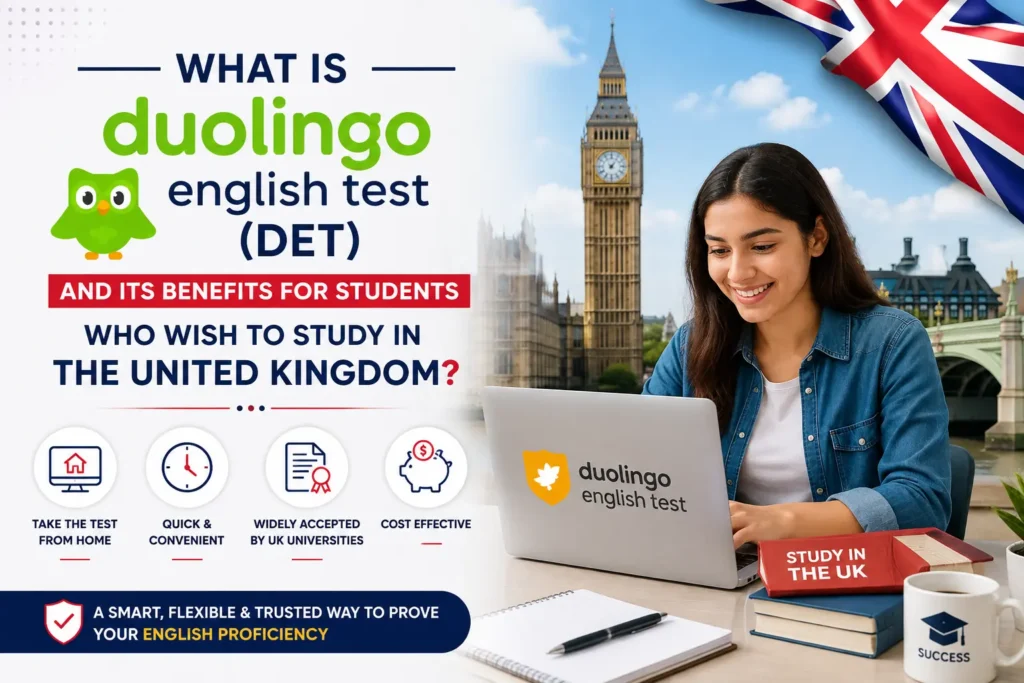
What is Duolingo English Test (DET) and its benefits for students who wish to study in the United Kingdom? What is Duolingo English Test (DET) and its benefits for students who wish to study in the United Kingdom? Though we offer option to Study in the UK without IELTS, we are getting many enquiries on the acceptance of the Duolingo English Test or DET. It is a modern language proficiency tool designed for today’s international students and institutions. It comprises of video interview and writing sample with an accessible, efficient and secure testing experience. During the current COVID-19 lockdown situation, many students who have planned to take IELTS, TOEFL and PTE tests are not able to appear for the tests. It is still not clear when these test centers will be operational. Duolingo English Test (DET) is a computer-based online English test which a student can appear from anywhere. Yes, you just need a computer or laptop with a decent internet connection. This test can be taken at your convenience. The benefit of this test is that it is less expensive, more flexible and the results are much faster. Currently, test results are being accepted by many universities and the list will grow in future. There are many benefits of Duolingo English Test (DET) You don’t have to visit the test center as it can be taken from the confort of your home Multiple mock tests can be performed before the actual test It is cost-effective as the fees are about $49 The duration of the test is 45-60 minutes Test results are given within 48 hours of completing the test It is quite easy and convenient to take the test. During the first 5 minutes, you will be introduced to the rules to be followed. Then for the next 45 minutes, you will be given a set of questions to test your Listening, Reading, Speaking and Writing skills. In the end, you will be given a topic and you need to write on a given topic within 3-5 minutes. Last 10 minutes will be a video recording of the answers given by the student on the screen. Below are the score comparisons between DET, IELTS and TOFEL Duolingo Scores TOEFL iBT IELTS Academic 10 to 25 0 1.5 to 2.5 30 to 40 1 to 8 3.0 45 to 50 9 to 19 3.5 55 to 60 20 to 31 4.0 65 to 70 32 to 43 4.5 75 to 80 44 to 55 5.0 85 to 90 56 to 67 5.5 95 to 100 68 to 79 6.0 105 to 110 80 to 91 6.5 115 to 120 92 to 102 7.0 125 to 130 103 to 112 7.5 135 to 140 113 to 118 8.0 145 to 150 119 8.5 155 to 160 120 9.0 A score of 90-115 which is CEFR B2 level will open up options for the student – some UK universities are also offering admission with additional English language courses if the desired score on Duolingo is not attained. We are a UK based British Council certified foreign education consultants and have got 100% visa success in the September 2024 and January 2025 intakes. We deal in TEF gold and silver rated universities in the UK. We also offer options to Study in the UK without IELTS. If you have any further question like – how and when you should appear for the Duolingo English Test, is it really required for you to take the test, can there be alternatives? – Pplease contact us on our India numbers; +91 997 860 2450 or our UK numbers; +44 786 122 8856 I + 44 208 004 8556. You can also mail us on info@seagreen-horse-500205.hostingersite.com
IELTS Indicator
IELTS Indicator IELTS Indicator Though we offer option to study in the UK without IELTS, there are many students out there who are planning to or were going to appear for IELTS examination. In the current scenario of COVID-19 pandemic where almost everything in the world is closed at the moment, they must be wondering “How will I take my IELTS examination?” Don’t worry!! On 22nd April 2020, IELTS launched a new online test called ‘IELTS Indicator’. It is a test which gives an indicative score of IELTS which is accepted by many universities in the UK (for September 2020 only). It is a temporary solution for an in-person IELTS test in locations where tests were suspended due to COVID-19. So let us understand everything about IELTS indicator. IELTS Indicator is a test conducted online from home on a PC. It is similar to the normal IELTS examination which includes four modules: Reading, Writing, Listening and Speaking. The test uses live IELTS questions marked by real IELTS examiners which means it will give more reliable and accurate score. All you need for the examination is a laptop or PC (no mobile devices are allowed), a good internet connection, a webcam with microphone and headphones. You will be given approximately 2 hours and 45 minutes to complete Listening, Reading and Writing tests which must be completed in one sitting (without any break). The speaking test is conducted on Zoom with an examiner one day prior or before the Listening, Reading and Writing test. The test is currently available for Academic IELTS only and the exam takes place once a week. You will receive the result online within a week of completing the test and it can easily be downloaded electronically. It is important to know that not all universities will accept the score of IELTS Indicator so please call us before booking the test to check whether you need to take the test and what all universities accepts it. We are a UK based British Council certified foreign education consultants and have got 100% visa success in the September 2019 and January 2020 intake. We deal in TEF gold and silver rated universities in the UK. We also offer options to Study in the UK without IELTS. If you have any further questions, please contact us on our India numbers +91 997 860 2450 or our UK numbers +44 786 122 8856 | +44 208 004 8556
Ultimate Guide to pass UK Credibility Interview

Ultimate Guide to pass UK Credibility Interview Ultimate Guide to pass UK Credibility Interview When you are planning to study in the UK with or without IELTS, one of the crucial aspects in this process is the credibility interview conducted by universities. If you are guided and prepared well then clearing the interview would not be a tough task. Recent changes in the immigration rules and reintroduction of Post-Study Work Permit in UK has completely changed the credibility interview procedure. Due to this new rule, every university wants to recruit only eligible and genuine students into their university. In order to verify genuineness of a student many universities have started to conduct credibility interviews. There are two types of interviews Suitability Interview There are few universities in UK which conduct suitability interview as soon the student applies at the university. The purpose of the interview is to examine whether the student has the knowledge for the program he/she is opting. This interview generally focuses on the suitability of the student for the particular course. Suitability interview is generally of shorter duration and conducted over the telephone call. Credibility Interview Credibility Interview is aimed to focus on student’s intention and genuineness. During the interview student is expected to demonstrate their English language ability is sufficient to follow their chosen course and level of study. Credibility interview is generally conducted over Skype and duration can be in the range of 20-30 minutes. There are different set of questions students will be asked, like Personal questions This part of the interview focuses on your personal details related to your family background, education history, work experience (if any), extra curriculum activities etc. Course specific questions Student should have all the information regarding the course they have opted for such as the factors which led to choosing the program, the attractive features, relation to previous education and many more Choice specific questions This sector usually focuses on the choice you have made. Be it selecting country, university, professional career etc. Now to prepare for the interview, following are the things to be studied: Read personal statement thoroughly Stay updated with finance details Gather all information regarding the university in detail (location, rankings, facilities, accommodation, accreditation) Study about your course thoroughly on the university website (course ranking, teaching methods, assessment methods, course specific facilities, fees) Stay up to date with your current or previous job details Future prospect Please note that only some interviews are conducted over the telephone whereas majority of universities conduct them over Skype/Zoom. Student should be in a quiet room with good internet connection, a webcam and a headset with microphone. We advise them to be prepared for the interview at least 15 to 30 minutes prior to the scheduled time. Having the expertise, we take pride in assisting our students to get ready to face such interviews conducted by the universities. This is an opportunity for them to ascertain their worthiness to get a seat at the institution of choice. Each interview is conducted in a manner to gauge the student’s calibre to finish the course applied for. It is in nobody’s interest if the student is not able to complete the course which they enrolled for. We hope you find this information useful. Being British Council Certified Agent as well as UK based foreign education consultant, we would be happy to assist you in any possible manner. Feel free to contact our regional office on +91 997 860 2450 OR you can also contact our head office in the UK at +44 786 122 8856 & +44 208 004 8556
Top 5 Courses to Study in the UK
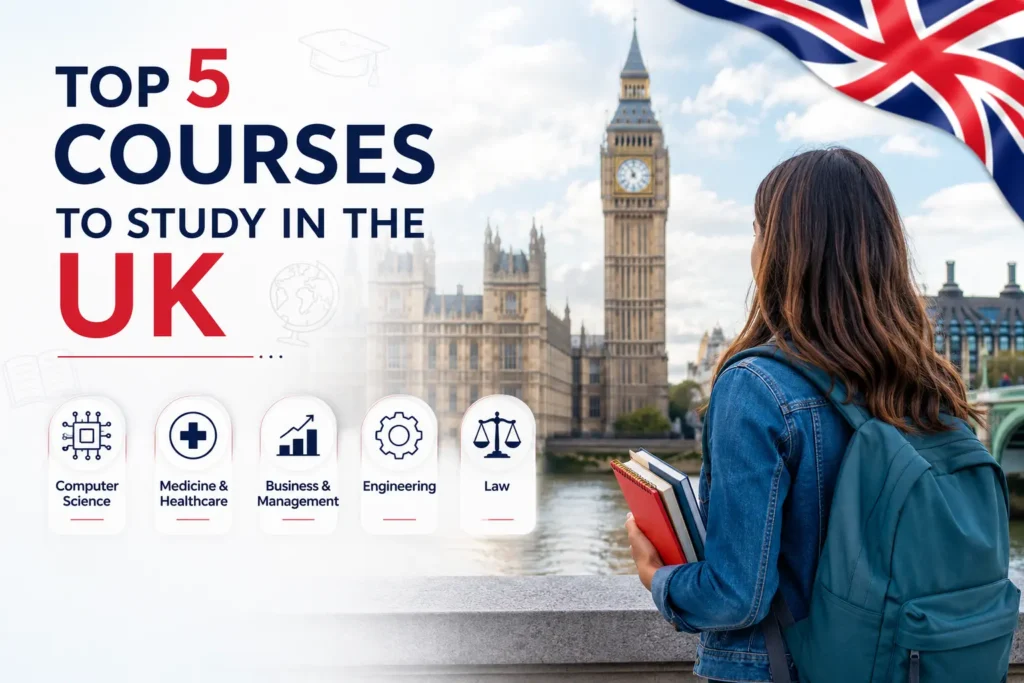
Top 5 Courses to Study in the UK Top 5 Courses to Study in the UK UK being the most popular study abroad destination for international student is also a home to some of the world’s oldest universities. UK welcomes more than 270,000 new students enrolling every year offering world class education and an excellent place for international students to live as well as study. When thinking of studying abroad, the primary concern of students is to decide stream for higher education as well as the popularity of courses! Many students often get confused between these two factors. UK universities are world renowned offering wide variety of courses and subjects for students to study from like Management, Engineering, Law, Social Studies and many more. This blog here will help you to understand some of the most popular programmes offered by universities in the UK to build a strong career path for you. BUSINESS AND MANAGEMENT This is one of the most preferred courses by international students. Business Management degree focuses on various parts of business – like administration, human resource and marketing. Business programs are usually offered along with placement, where universities assist with the industry tie-ups that they have. Also, being one of the major business hubs in the world, the UK provides business graduates with a highly productive platform to do internship and eventually land their dream jobs. One of the greatest things about this program is that it welcomes students from any field to pursue their masters. COMPUTER SCIENCE UK has an impressive ground-breaking presence on the computing platform and has earned a global reputation for IT and Computer Science innovation. In the fast-paced technology centric world, having a degree in Computer Science from UK will provide you with fundamental skills needed by the top companies. UK universities are at top for Computer Science, with many departments doing research for the world’s top companies. The opportunities for students are endless for the ones having a degree from the universities in the UK. ACCOUNTING AND FINANCE If you are someone who is interested in economics, mathematics as well as political science (which impacts businesses) then Accounting and Finance programs are for you! Accounting and Finance study from the UK will help you build your knowledge for the subject and prepare you to understand financial information. By gaining international degree from UK, you can have wide range of career options such as accountancy, chartered accountancy, banking, insurance brokering, financial advisor, financial trader, investment analyst and tax advisor. ENGINEERING Engineering is the field which attracts large number of international students from different parts of the world. UK has three among the top ten universities in the world for engineering and technology. The UK is ranked 5th in the world for innovation and they have pioneered all streams of engineering. According to an independent study by Technopolis, engineering research in the UK is the world leader in productivity and second in terms of technical excellence. Students are also allowed to tailor their program according to their interest which enables them to be creative in their respective field. Some of the top engineering programs are: Electrical Engineering Manufacturing Engineering Automobile Engineering Chemical Engineering Mechanical Engineering BIOLOGICAL SCIENCE Biological Science degree from UK would allow you to learn about the life and living organisms and also about their life cycle and environment. Students are taught foundation in biological science with different modules. UK universities are famous for their excellent laboratory facilities along with research-based learning. With an international degree in Biological Science, wide ranges of career options are available for students from Forensic Scientist to Biotechnologist, Research Scientist and many more. Apart from assisting students to get admission in the UK who either have IELTS, PTE, Duolingo, TOEFL or IELTS indicator, we also specialize in getting admission who wants to study in the UK without IELTS. Do call/visit us for more information. We hope you found this information helpful. Being British Council Certified Agent as well as UK based foreign education consultant, we would be happy to assist you in any possible manner. Feel free to contact our regional office on +91 997 860 2450 OR you can also contact our head office in the UK at +44 786 122 8856 & +44 208 004 8556 for FREE COUNSELLING!
10 Reasons Why UK Is Among The Top Education Destinations In The World?
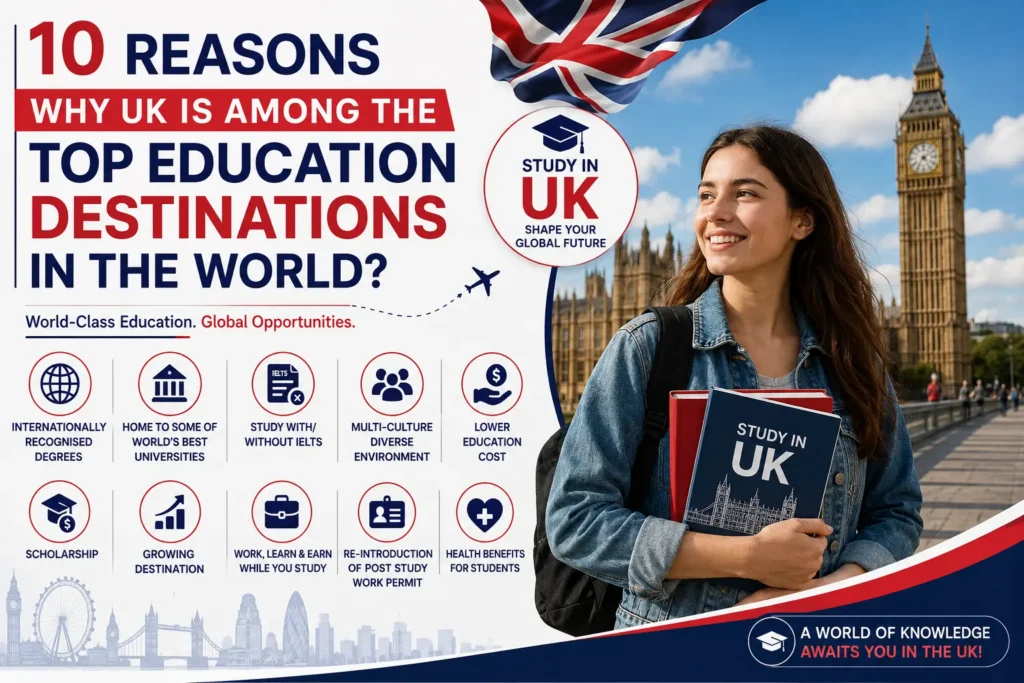
10 Reasons Why UK Is Among The Top Education Destinations In The World? 10 Reasons Why UK Is Among The Top Education Destinations In The World? The UK is one of the world’s most popular destinations to study higher education, with more than 500,000 international students enrolling each year. Going to university in the UK is a great way to expand your knowledge, meet new people, experience a new culture, and enjoy new experiences. You’ll get plenty of support at university, and a chance to experience a great student lifestyle. Whatever your interests, there’s a huge range of clubs and societies, as well as a diverse social life on offer, Also with over hundreds of years of excellence in the education sector, UK has become a top destination for studies for international students. Any student who is looking to develop his or her global experience and acquire a quality education should consider the benefits that UK universities offer on their various programs. Here are 10 Great Reasons to Consider UK as Your Study Abroad Destination. INTERNATIONALLY RECOGNISED DEGREES The United Kingdom is a popular study abroad destination among Indian students. With continuous on-going research and development conducted by professors and students in a wide range of areas, UK’s education is considered to be of highest quality. The degree from UK is held in high regard by employers all over the world. HOME TO SOME OF WORLD’S BEST UNIVERSITIES With presence of some of the world’s best universities like Cambridge, Oxford, the United Kingdom currently has six institutions in the Global University Ranking with 100% academic reputation. The academic reputation and standard of excellence is set by the older universities with recognizable names, but the tradition carries through to many of the universities and colleges throughout the UK. STUDY WITH/WITHOUT IELTS UK is the only country out of all the premium countries which offers study opportunity for international students without having to appear for IELTS. Appearing for IELTS and getting the required score can sometimes be strenuous. Under some circumstances IELTS can be waived by UK universities if the student meets required criteria. MULTI-CULTURE DIVERSE ENVIRONMENT There are very few places in the world with an extensive history along with comfort of modern world. The United Kingdom is known for its multi-culture society. With a racial, ethnic and religious jumble, the UK is very open to new traditions and cultures – a great thing for international students while study in the UK. LOWER EDUCATION COST When it comes to studying in premium counties (UK, USA, Canada, Australia), finance is an important factor to be considered. Considering them all, UK is substantially cheaper than other countries. SCHOLARSHIP If you are worried about the university fees, we recommend don’t lose your sleep over it, as most UK universities offer merit-based scholarship programs and funding opportunities to international students to support their studies and cost of living. To apply, you will need to first gain acceptance on the course of study. GROWING DESTINATION UK is one of the world’s leading destinations for international students, second only to the USA. The universities are among the best in the world, and consistently perform well in world rankings. They also have a reputation for world-class research and UK holds very high satisfaction ratio among International students. WORK, LEARN & EARN WHILE YOU STUDY Many Indian students in the UK gain work experience along with their study. A part-time job, internship or placement during vacation and volunteering are some ways to develop valuable skills that you can add to your CV. A work placement is a part of the study course for some universities, and your university may assist in providing placement. You can work part-time for up to 20 hours a week during term time and can even work full-time during your semester breaks. This will help you pay for your bills as well as gain valuable industry experience in your own field of study. While working you will get a chance to expand your knowledge, meet new people, experience a new culture, and enjoy new experiences. RE-INTRODUCTION OF POST STUDY WORK PERMIT You can now stay in the UK for 2 years (on Student route psw visa) after completing your studies there. There is no limit on the number of international students who can stay in the UK upon completion of their course. In order to work in the UK after completing your studies you have to switch to the post study work visa on which you can work for any employer. After those 2 years, you need to switch from Student route PSW visa to a Student route General Visa. HEALTH BENEFITS FOR STUDENTS As an internationals student, you’ll have access to free medical treatment while studying in the UK through the National Health Service (NHS). In order to avail this benefit, you will only have to pay an Immigration Health Surcharge (IHS) when you apply for the student visa. We hope this information was helpful to you in making the correct decision of studying in the UK. We are UK based British Council Certified Agents and it would be our pleasure to assist you in any possible manner. Study in the UK without IELTS or with IELTS, we specialize in UK and can assist you the best. For further information, please feel free to contact us on +91 997 860 2450 or you can also contact our head office in the UK on +44 786 122 8856 or +44 208 004 8556.
University of Lincoln – International Masterclass Series
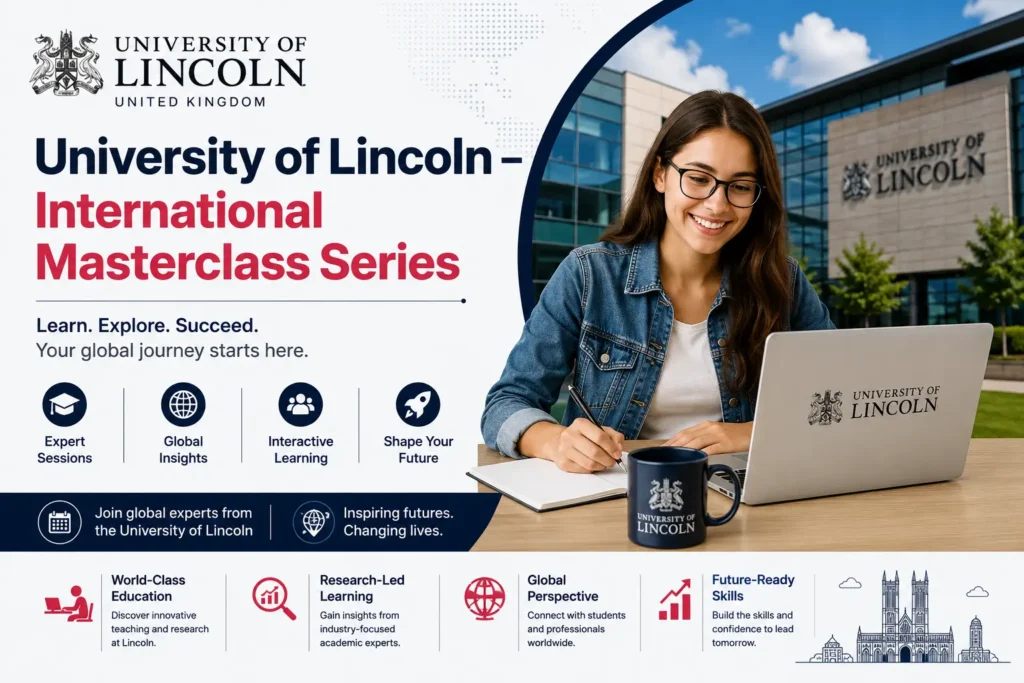
University of Lincoln – International Masterclass Series University of Lincoln – International Masterclass Series University of Lincoln, is very well known for award-winning teaching, world-leading research, and close links with industry. Situated in the heart of a beautiful and historic city, University of Lincoln is the Modern University of the Year in The Times and The Sunday Times Good University Guide 2021. To give a student an Experience of award winning teaching and learning, University of Lincoln will be conducting International Masterclass Series – a series of Free Virtual Classes. These sessions will be conducted by eminent programme leaders and they will be covering variety of subjects like Business, Arts & Social Science and College of Science. This is to focus on some of the most pressing issues and developments across the business, sciences, social sciences and arts. This International Masterclass Series is designed to help students to get an experience what it is like to study a postgraduate qualification at the University of Lincoln. Participating in this online series will give confidence to international students that they are joining a university which places the quality of the teaching experience at the heart of everything it does. Please click here and register for free to Experience the Award Winning Teaching and Learning from University of Lincoln
Top Reasons Why IELTS Coaching Is Important
Top Reasons Why IELTS Coaching Is Important Top Reasons Why IELTS Coaching Is Important Are you planning to study or settle abroad? If yes, you may have to take an IELTS exam and achieve a qualifying band score and in order to achieve a desired band score, you may need to approach a genuine IELTS coaching center where you can get effective knowledge, guidance, and practice. The International English Language Testing System (IELTS) is a popular English language proficiency test, which is accepted as a testimony to your English language proficiency for study, work and migration; mainly in countries like United Kingdom, USA, Australia, Canada, New Zealand What does an IELTS coaching center do? The IELTS coaching center helps the aspirants prepare for all four modules – Listening, Reading, Writing and Speaking – in the IELTS test. The coaching provided to them enhances their understanding of the modules and prepares them for various strategies they need to apply in the test. A complete training and test preparations also gradually develop their confidence to appear for the final test. Is IELTS Coaching required to study abroad? In most cases, yes! Any renowned educational institution in a foreign country expects that the students who enroll with them have a specific minimum IELTS score so as to ensure they would be able to comprehend the content delivered in the classes and would also be able to interact well with the teachers and the other learners during their course of study. This will ultimately help them complete their course successfully. Hence, one may need to join a good IELTS coaching center where there are proficient and experienced coaches, who provide focused coaching in a comprehensive manner, which will assure that the learners score well on the test. Why IELTS Coaching at Focus Education Global Pvt Ltd? Up to date training and teaching techniques At Focus Education, we provide training using the latest technologies, relevant course content, and efficient methodology. “Better the training, better the results.” Content covered in sequential manner All the sections of the IELTS test are explained one by one, in proper order and until the learners are not fully prepared. Making you ready for English speaking countries Coaching at Focus Education makes you ready in all the aspects of grammar, pronunciation, and fluency, which will be very much needed in your English communications while you are staying in an English speaking country. Enhance your chances of student visa or PR approval Our result oriented structure and mock rounds will improve your chances of getting a student visa or resident visa. Best knowledge from industry-leading professionals Our IELTS coaches are British Council and IPD certified. They are highly trained professionals with more than 20 years of experience in English language proficiency development and have best proven records for preparing students for the IELTS exam; and hence, indeed, they will help you develop your skills and strategies to excel in the exam. Good data for the test Good sources, data and references are provided at our centre. Thorough practice for better scores As the old saying goes, “Practice makes a man perfect”, you will have sufficient practice until you are 100% sure to take up the final test. Offering these promising features, Focus Education Pvt. Ltd. has developed a unique setup to help students acquire their desired IELTS score. Along with this, we have also made sure that the materials and coaching directly support the efforts of the students. Focus Education Global Pvt Ltd is a British Council Certified Agent with Head Office in the UK and it would be our pleasure to assist you with your queries related to your higher education in the UK, Australia, Canada, New Zealand. We have nearly 100% student visa success ratio in all the intakes so far, and that is our proven track record. Please feel free to contact us on +91 99 7860 2450, or you can also contact our head office in the UK on +44 786 122 8856 or +44 208 004 8556.
Top Reasons Why IELTS Coaching Is Important
Top Reasons Why IELTS Coaching Is Important Are you planning to study or settle abroad? If yes, you may have to take an IELTS exam and achieve a qualifying band score and in order to achieve a desired band score, you may need to approach a genuine IELTS coaching center where you can get effective knowledge, guidance, and practice. The International English Language Testing System (IELTS) is a popular English language proficiency test, which is accepted as a testimony to your English language proficiency for study, work and migration; mainly in countries like United Kingdom, USA, Australia, Canada, New Zealand What does an IELTS coaching center do? The IELTS coaching center helps the aspirants prepare for all four modules – Listening, Reading, Writing and Speaking – in the IELTS test. The coaching provided to them enhances their understanding of the modules and prepares them for various strategies they need to apply in the test. A complete training and test preparations also gradually develop their confidence to appear for the final test. Is IELTS Coaching required to study abroad? In most cases, yes! Any renowned educational institution in a foreign country expects that the students who enroll with them have a specific minimum IELTS score so as to ensure they would be able to comprehend the content delivered in the classes and would also be able to interact well with the teachers and the other learners during their course of study. This will ultimately help them complete their course successfully. Hence, one may need to join a good IELTS coaching center where there are proficient and experienced coaches, who provide focused coaching in a comprehensive manner, which will assure that the learners score well on the test. Why IELTS Coaching at Focus Education Global Pvt Ltd? Up to date training and teaching techniques At Focus Education, we provide training using the latest technologies, relevant course content, and efficient methodology. “Better the training, better the results.” Content covered in sequential manner All the sections of the IELTS test are explained one by one, in proper order and until the learners are not fully prepared. Making you ready for English speaking countries Coaching at Focus Education makes you ready in all the aspects of grammar, pronunciation, and fluency, which will be very much needed in your English communications while you are staying in an English speaking country. Enhance your chances of student visa or PR approval Our result oriented structure and mock rounds will improve your chances of getting a student visa or resident visa. Best knowledge from industry-leading professionals Our IELTS coaches are British Council and IPD certified. They are highly trained professionals with more than 20 years of experience in English language proficiency development and have best proven records for preparing students for the IELTS exam; and hence, indeed, they will help you develop your skills and strategies to excel in the exam. Good data for the test Good sources, data and references are provided at our centre. Thorough practice for better scores As the old saying goes, “Practice makes a man perfect”, you will have sufficient practice until you are 100% sure to take up the final test. Offering these promising features, Focus Education Pvt. Ltd. has developed a unique setup to help students acquire their desired IELTS score. Along with this, we have also made sure that the materials and coaching directly support the efforts of the students. Focus Education Global Pvt Ltd is a British Council Certified Agent with Head Office in the UK and it would be our pleasure to assist you with your queries related to your higher education in the UK, Australia, Canada, New Zealand. We have nearly 100% student visa success ratio in all the intakes so far, and that is our proven track record. Please feel free to contact us on +91 99 7860 2450, or you can also contact our head office in the UK on +44 786 122 8856 or +44 208 004 8556.
Planning to study in Canada? – Good Choice!!

Planning to study in Canada? – Good Choice!! Planning to Study Abroad in Canada Canada has become the ideal place for many prospective students for their higher studies. It is known as the land of Maple and Ice. Also, it’s the land of opportunities that attract international students from around the world. Well, you must be thinking what are the benefits of studying in Canada? Many !! Whether you wish to study in that country or settle, the community is always welcoming. GLOBALLY RECOGNIZED DEGREE After getting a degree from the Canadian University, you are always ahead of your peers. It’s like getting an equivalent degree from the United States or Commonwealth countries. One can apply to his dream company with the degree that he holds. CULTURAL BLENDING Facing difficulty while coordinating with people from a different culture? Well, not anymore. In Canada, you will find people from different cultures and backgrounds, and studying with them will make it easier for you to understand their culture and faith. Also, you will make a good network across the world which will help you in your future. QUALITY OF LIFE One can adapt to the Canadian lifestyle really easily. Also, Canada enjoys a high standard of living. It ranks above average in many aspects of quality of life- housing, health status, personal security, social connections and so on. So not just the degree, but you can get to enjoy the best quality of life along with your studies. BILINGUAL COUNTRY Studying abroad always has the advantage of making your communication skills stronger along with your English proficiency. What if you will get a chance to be fluent with not only a single language but two? English and French both are the official languages in Canada; therefore, you can seize the opportunity to learn some French too. BUDGET-FRIENDLY Studying in a foreign country becomes a tough task when it comes to cost. When it comes to Canada, the cost of living and tuition fees are reasonable. You can acquire a world-class education with international exposure at the right cost. ENVIRONMENT- SAFE PEACEFUL FRIENDLY Any international student can enjoy the same right as any Canadian. According to Global Peace index 2020, Canada is ranked the sixth peaceful country across the globe. It makes the international students feel safe and study in peace. It has the lively environment which will help you to connect with people by keeping your homesickness away. FLEXIBILITY OF COURSE AND IT’S TEACHING STYLE In Canada, one can get a bachelor’s degree of 3 to 4 years and a Master’s degree of one year to 3 years. The atmosphere in the classroom is open and friendly making students comfortable to interact with their professors smoothly. The programs are organized with traditional lectures along with practical activities like workshops, group work, assignments, etc. WORK OPPORTUNITIES- EARN WHILE YOU LEARN Along with a degree, getting international work experience is like icing on the cake. You can earn while you learn or you can learn and then earn; the choice is completely yours. IMMIGRATION OPPORTUNITIES How about getting international work experience along with an international degree? Interesting, right? As per Canada’s Post-Graduation Work Permit Program (PWPP), students are allowed to work in Canada up to three years after getting a degree. And later if you wish, you can apply for permanent residency too. To conclude, Canada consists of all the ingredients that one needs for his successful career- Language efficiency, recognized degree, networking, the standard of living and so on. So, if you wish to work with your dream company, get a Canadian degree and get set go. Focus Education Global Pvt Ltd is a British Council Certified Agent with Head Office in the UK and it would be our pleasure to assist you with your queries related to your higher education in the UK, Australia, Canada, New Zealand. We have nearly 100% student visa success ratio in all the intakes so far, and that is our proven track record. Please feel free to contact us on +91 99 7860 2450 or +91 9898 344644, or you can also contact our head office in the UK on +44 786 122 8856 or +44 208 004 8556.
Top 10 Subjects For International Student In The UK
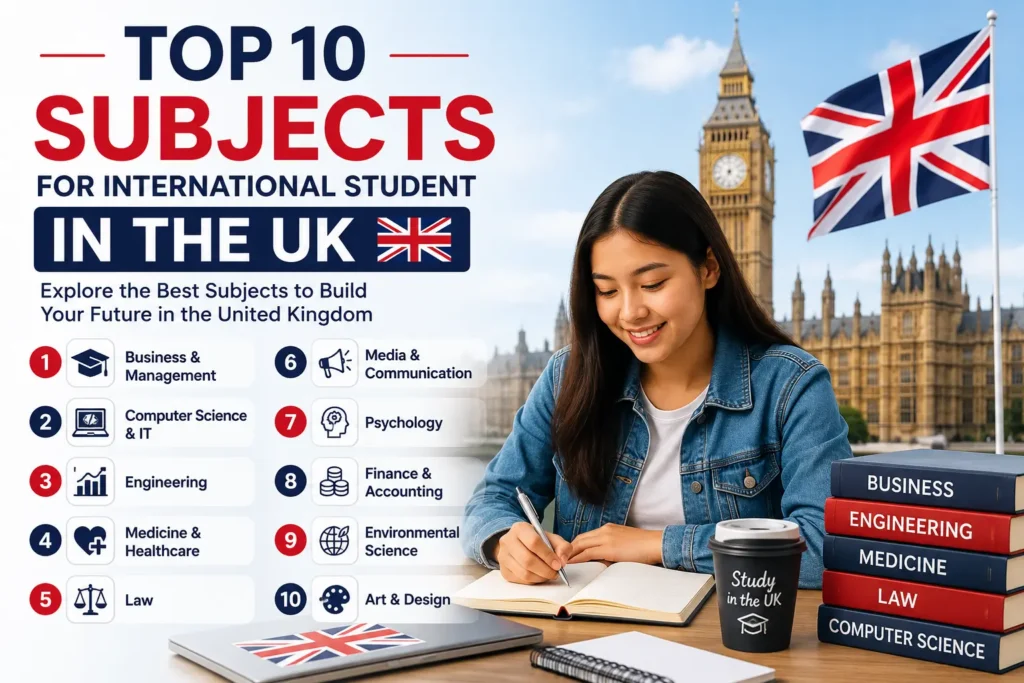
Top 10 Subjects For International Student In The UK Top 10 Subjects For International Student In The UK The Universities in the UK has a lot to offer to an International Student. One can complete his / her further education choosing the best international course in the UK with or without IELTS. Hundreds of thousands of students choose UK for their higher education. Not only the universities but its courses / subjects are popular amongst the Undergraduate and Post-graduate students. Universities are offering admission to international students with or without IELTS. It is easy for most international student to study, work and settle in the UK. With a diversified population and a reputation for prestigious schooling, the United Kingdom is a natural location for international students to flock to. And for undergraduate and post-graduation students worldwide seeking an English-language education, what place can be better to gain their degree from a country that invented the language? Top Subjects To Study In The UK Business Studies (First year international students – 22,000) This is the most preferred choice of international students in the UK. As per the QS World University rankings, 7 institutions from the United Kingdom who teach Business Management course are in top 100. As per the research 71% of the international business graduates are employed within the first 6 months of completion of their program. Management Studies (First year international students – 17,750) A Business Management degree can help to set you career in all most any industry. A university in the UK can offer you Management course with or without placement. You can choose to do specialization in Marketing, Finance, Human resource management, Logistics etc. In the UK, a Management Studies graduate can yield an average starting professional salary of £22,000 and a non-professional salary of £18,000. Finance (First year international students – 14,250) The United Kingdom is known to be the financial hub of the world. UK handles more foreign exchange of $2.73 Trillion compared to $2.41 Trillion of combined share of New York, Hong Kong, Tokyo and Singapore. This makes it the world’s most open and linked financial center. Getting a finance degree means to learn to hand or acquire of money and funds. One will learn to involve and perform in personal finance, corporate or public finance. A degree in finance can lead a graduate getting dream job for life. General Business and Management (First year international students – 12,000) This course is the best value for money by taking one year MBA program. A student can get a jump start in their career in just one year. UK offers this degree with a lot of variation. One can learn and acquire from world-class teachers with industry links and give them real-life practical experience. A student can enroll to study Business Management in any filed, whether it be global supply chain management, project management, marine operations management, classical music business etc. Law (First year international students – 11,500) It is challenging to Studying LAW but finally a student will find it worth. There are plenty of benefits as they bring multiple job options for a graduate. Most of the UK Law courses will give students an opportunity of 1 year of professional placement. An international student can study various LAW courses like … LLB– Bachelor of Law Graduate LLB– Fast track LLB leading to a postgraduate degree in law LLM– Master of Law. GDL–Graduate Diploma in Law LPC– Law Practice Course. Computer Science (First year international students – 10,350) The future is all about computers and artificial intelligence. For the same reasons international students are opting for a career in the computer related courses. More than 250 institutes have this degree in their prospect and of various computer/IT related courses you can enroll to. This will give a graduate a firm opportunity which will be spread across all career sectors. Economics (First year international students – 8,450) United Kingdom has always made economic contributions to the world for ages. One can have world-class economics from day one. If you wish to study best of Economy then UK is one at the top destination. 3 out of 10 in World’s top University to Study Economics are in the UK and they are London School of Economics and Political (Ranked 5th), The University of Oxford (Ranked 9th) and University of Cambridge (Ranked 10th). Marketing (First year international students – 8,300) The core of success of any business is Marketing. Apart from the studying Marketing in the UK, a student can also make global contacts which can bring potential clients in the future. One can be well versed with communication and presentation skills during the academic stints. You can benefit by a whopping employment rate of 99% after course completion. Accounting (First year international students – 7,900) It is a fact that in recent years number of international students have increased in applying for this course. You will expose yourself to the accounting and finance by studying in rich and diverse potential market. The UK has many strong accounting and financial bodies which lead world to the development in many ways. A strong hold in the accounting practices will definitely lead to definite success in grabbing a fruitful career. Art and Design (First year international students – 7,850) Art or Design student will have multiple option for their career. Art, design, music holds an important part in the British culture. These also contribute to a lot in the economy. One will learn functional and useful skills that will prepare a student to future careers in the filed of arts. International student can study these courses at universities like University of Greenwich, University of Lincoln, Northumbria University, Ulster University, University of East London, Kingston University, Middlesex University and many more. Click here to see the complete list of universities in the UK for your Higher education with or without IELTS If the students meet certain criteria and in under specific circumstances, British Universities can waive IELTS for