
MythBusters for Ireland

MythBusters for Ireland MythBusters for Ireland Ireland is a country with a cosmopolitan culture, stunning scenery, and extensive history. It is not surprising that it has grown in popularity as a destination for overseas studies. Nevertheless, there are still a few false beliefs and myths about studying in Ireland. Together, we will eliminate these illusions and explore the truth about what it’s truly like to pursue your education on this stunning island. Language Barrier : In Irish institutions, English is the main language of instruction even though Irish Gaelic is the other official language. For the majority of overseas students, this removes linguistic obstacles, guaranteeing a seamless and fulfilling educational experience. Despite what many people think, Ireland offers a wide variety of academic options. The nation offers a broad range of programs designed to satisfy the interests and professional goals of overseas students, spanning from the arts to STEM fields. High Cost of Living : While some cities like Dublin may have a higher cost of living compared to other European cities, Ireland offers a range of affordable options for students. University accommodations, student housing, and shared apartments can provide more budget-friendly choices. Additionally, many students find that part-time work and cost-effective living strategies help manage expenses without too much strain. Restricted Employment Opportunities : Ireland has a vibrant job market with numerous opportunities for international students to gain work experience. Students are allowed to work part-time during the academic year and full-time during holidays. Universities often have career services to help students find suitable job placements. Ireland offers several professional opportunities for recent overseas graduates because of its strong economy and booming IT sector. Numerous international companies with numerous professional advancement chances can be found around the nation. Industries such as hospitality, retail, and customer service frequently hire students, and internships can offer valuable professional experience. Lack of Cultural Diversity : Ireland is becoming increasingly diverse, with students and professionals from around the world contributing to a rich cultural tapestry. Major cities, in particular, are melting pots of different cultures, cuisines, and traditions. International students often find themselves surrounded by a diverse community, which enhances their overall experience and broadens their cultural perspectives. International Students Are Isolated and Have Difficulty Making Friends : Irish people are known for their friendliness and hospitality. Universities and colleges actively foster inclusive environments where international students can connect with their peers through various social activities, clubs, and societies. Many institutions have dedicated international student offices that organise events and offer support to help students build connections and feel at home. Studying in Ireland is Extremely Expensive : While tuition fees in Ireland may seem high at first glance, they are often competitive compared to other English-speaking countries. Additionally, many universities offer scholarships, grants, and financial aid specifically for international students. Considering the quality of education, affordable living options, and the opportunity to work while studying, the investment in an Irish education can be quite worthwhile. International students find Ireland to be a warm and rewarding place to study. We intend to provide a more accurate understanding of what students anticipate when studying in Ireland by dispelling these stereotypes. Ireland is still a great option for students looking to advance both academically and personally because of its welcoming atmosphere, exciting culture, and top-notch education. if you are considering an Ireland student visa to jumpstart a new chapter in your professional life then you must visit us at Focus Education Global Pvt. Ltd. We facilitate the admissions process and the transition to become overseas students.
Navigating Work Opportunities As An International Student In Canada : A Comprehensive Guide
Navigating Work Opportunities As An International Student In Canada : A Comprehensive Guide Navigating Work Opportunities As An International Student In Canada : A Comprehensive Guide Being an international student in Canada, you can benefit from a range of opportunities to gain valuable work experience while earning money through part-time jobs. However, you need to cover the tuition and living expenses before arriving. There are numerous ways to balance studying and working in Canada. Even the government of Canada has allotted some hours per week for international students to work without needing a work visa. This not only helps financially but also allows you to build connections and lay the foundation for future success. For a comprehensive guide and essential tips on studying and working in Canada, be sure to read through the entire blog. FINDING JOBS IN CANADA AS AN INTERNATIONAL STUDENT: 4 STEPS GUIDE Being an international student eligible to work in Canada, navigating the job market can seem daunting. However, with the right approach, you can secure employment that fits in skills and schedule. As a Canadian study permit holder, you might be allowed to work on or off campus without needing a separate work visa. Here are 4 practical steps to help you find a job in Canada: Step 1: Updated Resume that meets Canadian Standards Step 2: Enhanced Networking Skills Step 3: Utilizing Job Service Websites Step 4: Gaining experience through Internships and Volunteering ON-CAMPUS JOB REQUIREMENTS: Canada allows you to work on campus without acquiring a work permit while pursuing your studies if you meet the following requirements: Requirement 1: Valid Study Permit To work on campus, you must possess a valid study permit issued by the Canadian government which allows you to study in Canada. Requirement 2: Full-Time Student Status To be eligible to work on campus, you must be a full-time student at a recognized public institution in Canada. Being a full-time student means you must be enrolled in a program of study that meets the institution’s criteria for full-time enrolment. Requirement 3: Social Insurance Number (SIN) It is essential to have a Social Insurance Number (SIN) to legally work in Canada. SIN is a unique number issued by the government which allows to work and receive benefits in the country. It is vital to apply for a SIN as soon as you arrive in Canada and before starting an on-campus job. OFF-CAMPUS JOB REQUIREMENTS: You can work off-campus without a work permit while pursuing your studies if you meet the following requirements: You should have a valid study permit. You must be a full-time student at a post-secondary public university/college and work records. Some programs may require additional documents like police clearance certificates or medical exams so it is advisable to stay organized. Your course should last at least eight months. The work hours should not exceed the given limit by the government. There is a requirement for co-op and internship to be a part of certain study programs. In this case, you will need a work permit to be able to work and study in Canada. ADVICE FOR STUDENTS INTERESTED IN WORKING IN THE CANADA: Most of the international students might be interested in working while studying in Canada. It is better to get advice on what you should and should not do when it comes to working in Canada as a student. The below list will help you search for a job and application. DO’s Utilizing Powerful Verbs and Impactful Language: Leverage strong action verbs and assertive language to enhance the effectiveness of the application letter and resume. Articulate Canadian Experiences with Exactness: Provide detailed and accurate descriptions of experiences and qualifications related to Canada. Ensure CV Contains References: Include references on the CV, as this is especially vital for international candidates. Clarify Uncertainties Promptly: Don’t hesitate to ask for clarification if unsure about any questions or details. Demonstrate Achievements with Specific Examples: Showcase achievements with clear and concrete examples. Be Proactive and Inquisitive During Interviews: Actively participate in interviews by asking insightful questions and engaging with the interviewer. DON’Ts Stand By Until Invited for a Canadian Application Interview: Remain patient and wait until formally invited for an interview in Canada. Avoid Misrepresenting Information on Resume: Never include false information on a resume, as future employers will invariably uncover the truth. Refrain from Criticizing Previous Employers: Do not make negative comments about former employers; maintain a professional demeanour. Maintain Composure and Stick to the Facts: Avoid exaggeration and remain composed; focus on presenting factual and relevant information. In conclusion, navigating work opportunities as an international student in Canada opens doors to invaluable experiences and connections. Understanding regulations, preparing a polished resume, and leveraging networking can help you balance work and study effectively, setting a strong foundation for your future career. Focus Education is here to support you throughout this journey, offering expert advice on study permits, and career development. Let us help you make the most of your time in Canada. Contact us today to learn how we can assist you in achieving your academic and professional goals.
Unlock Your Future : How to Apply for UK Student Visa Without An IELTS Score
Unlock Your Future : How to Apply for UK Student Visa Without An IELTS Score How To Apply UK Student Visa Without An IELTS Are you dreaming of studying in the UK but feeling constrained by the IELTS requirement? You’re not alone! Many aspiring international students share this concern. Fortunately, there’s good news: you can still pursue your academic ambitions in the UK without needing an IELTS score. The UK is home to some of the world’s most esteemed universities, offering a rich tapestry of cultures and a vibrant student life that provides numerous opportunities for personal and professional growth. In this comprehensive guide, we will walk you through the steps to successfully navigate the application process for a UK student visa without relying on IELTS. The UK stands out as a prime destination for higher education due to its high academic standards, diverse cultural experiences, and the chance to engage with global networks. Studying here provides access to cutting-edge research opportunities, highly qualified faculty, and a student community that fosters collaboration and innovation. Moreover, students looking to study at the UK universities without IELTS are seeing an opportunity as the institutions are recognizing the need for flexibility in English proficiency assessments, allowing students to showcase their language skills through various alternative means. This progressive approach makes studying in the UK more accessible to a broader range of international students. Step 1: Find UK Universities That Accept Alternative Proofs of English Proficiency The first step on your journey is to identify UK universities that accept alternatives to IELTS for proving English proficiency. Thankfully, numerous institutions are open to various forms of evidence that demonstrate your English language skills. Here are some viable alternatives to consider: Medium of Instruction (MOI) Certificate: If your education at Bachelor’s level was taught in English, obtaining an MOI certificate from your institution can serve as sufficient proof of your language proficiency. This document states that your academic instruction was delivered in English, which many universities accept. Alternative English Proficiency Tests: Besides IELTS, tests such as the TOEFL (Test of English as a Foreign Language), PTE (Pearson Test of English), Duolingo English Test, LanguageCert, are increasingly accepted by UK universities. These tests assess your reading, writing, listening, and speaking abilities and provide a solid alternative to IELTS for demonstrating your English language competence. Tip: It is essential to research universities that explicitly mention these alternatives on their admission websites. This will save you time and effort in the application process and help you find institutions that align with your academic goals. Step 2: Gather Your Required Documents Once you have identified the universities you want to apply to, the next step is to gather the necessary documentation for your application. Here’s a detailed checklist to ensure you have everything covered when applying for UK admission without IELTS: Medium of Instruction (MOI) Certificate: Confirm that your previous studies were conducted in English and obtain an official certificate from your school or university. Alternative Test Scores: If you have taken any accepted English proficiency tests, such as TOEFL, PTE or Duolingo, include those scores in your application. Make sure they meet the minimum requirements set by the universities you are applying to. Academic Records: Prepare and organize your academic transcripts, diplomas, and certificates. These documents will help showcase your educational qualifications and achievements. Personal Statement: Craft a compelling personal statement that outlines your motivation for studying in the UK, your academic and career aspirations, and how the program you are applying for aligns with your goals. This is your chance to present yourself authentically and passionately to the admissions committee. Step 3: Submit Your Visa Application With your documentation ready, you can confidently proceed to submit your application for a UK student visa without the need for an IELTS score. Here’s what you need to include in your visa application: A Valid Passport: Ensure your passport is current and has at least six months of validity beyond your planned stay in the UK. Confirmation of Acceptance for Studies (CAS): Once you receive an offer from a UK university, you will be issued a CAS, which is essential for your visa application. This document contains your details and information about your course. Proof of Financial Stability: You must demonstrate that you have sufficient funds to support yourself during your studies in the UK. This typically involves showing bank statements or other financial documents that meet the UKVI (UK Visas and Immigration) requirements. Health Surcharge Payment Receipt: As part of your visa application, you will need to pay the immigration health surcharge, which grants you access to the UK’s National Health Service (NHS). Be sure to keep the receipt, as it will be required for your application. Step 4: Prepare for Success with English Proficiency Coaching While you may not need IELTS to secure your place in a UK university, developing your English language skills remains crucial for your academic success. Here are some effective ways to improve your proficiency: Online Coaching: Look for reputable online coaching that focuses on enhancing your English skills. These platforms often offer tailored courses designed to boost your language capabilities. One-on-One Coaching: Personalized coaching sessions can provide you with direct feedback on your speaking and writing skills. This individualized attention can help you overcome specific challenges and build your confidence in using English. Conclusion: Your Path to Studying in the UK Awaits! Embarking on your journey to study in the UK without an IELTS score is entirely achievable with the right preparation and mindset. By researching UK universities that accept alternative proofs of English proficiency, gathering your essential documents, and exploring other English language tests, you can take significant paces toward realizing your study abroad dreams. For comprehensive guidance on the entire UK visa process, including support for IELTS preparation and spoken English coaching, do visit Focus Education Pvt Ltd. We offer valuable resources and expert advice to help you navigate the complexities of studying in the UK and ensure you are well-prepared
Your Ultimate Guide to Securing An Ireland Student Visa : Essential Documents and Financial Checklist

Your Ultimate Guide to Securing An Ireland Student Visa : Essential Documents and Financial Checklist For many international students, studying in Ireland is their ideal scenario. Ireland provides an exceptional chance for both intellectual and personal development because of its globally recognized educational institutions and dynamic culture. However, obtaining a student visa is an essential step in the process before you pack your bags and travel to the Emerald Isle. This thorough guide will help you ensure that you have all the necessary paperwork and funds needed for an Ireland student visa. Mandatory Documents for an Ireland Student Visa Cover Letter: Your visa application should include a cover letter explaining your travel intent. This letter should outline your reasons for studying in Ireland, your choice of course, and your future plans. Passport: Ensure your original passport is valid for at least 6 months beyond your intended departure date from Ireland. All previous passports should also be submitted with your application. AVATS Online Application: Complete the AVATS (Visa/Preclearance Application Facility) Online Application form. Make sure to fill out all sections thoroughly and print the overview page for submission. VFS Appointment Validation: For your VFS appointment, you’ll need to present an online fee payment receipt. This is proof that you’ve paid the necessary visa application fee. Application Forms: Fill in the details in the respective visa forms. Completed Student Visa Application: Ensure every section is filled out accurately. Supplementary Student Application Form: This form provides additional details that support your visa application. Photograph: Provide 6-8 recent (within the last six months) passport-sized colour photos (35x45mm) with a white background and dark clothes. Acceptance Letter: Submit an acceptance letter from an Irish school, college, or university confirming your admission. English Language Test Scores: Include proof of your English proficiency through test scores from IELTS, TOEFL, Duolingo or PTE. Statement of Purpose (SOP): Write a detailed SOP explaining why you chose your course and institution, your academic and career goals, and how studying in Ireland fits into your future plans. Intent to Return: Confirm your intention to return to your country of permanent residence after completing your studies. Resume/Curriculum Vitae (CV): Your CV should detail your educational background, work experience, and any relevant skills or achievements. Educational Documents Include copies of: 10th and 12th Standard Mark Sheets Diploma/Bachelor’s/Master’s Degree Documents: This should encompass individual semester mark sheets, a consolidated mark sheet, a provisional certificate, and a degree certificate. Discrepancies Explanation: If there are any discrepancies in your educational records, provide a clear explanation. Job Experience: Document any relevant job experience that supports your application. Evidence of Course Fees PaymentShow proof that you have paid the full course fees or at least the minimum required (as asked by your respective institute). Financial Proof: Provide evidence of sufficient funds (€10,000) to cover your initial stay in Ireland. Private Medical Insurance/ Health Insurance: To guarantee that you will be medically covered during your visit, you must provide proof of your medical insurance. This is often a requirement to cover potential health issues during your time in Ireland. Police Clearance Certificate: Submit a certificate demonstrating your clean criminal record. Miscellaneous Letters: Include any additional letters required based on your profile. Checklist of Financial Resources Education Loan Documents Sanction Letter: Proof of your education loan approval. Letter of Disbursement: Documentation showing that funds have been disbursed for your education. Bank Statements Recent Statements: Provide the most recent bank statements for all your accounts, in some cases source of funds is also required. Balance Confirmation Certificate: Get a certificate in euros for each bank account and any fixed or recurring deposits, including the deposit and maturity dates. Provident Fund Statements Employees’ Provident Fund (EPF) / Public Provident Fund (PPF) / Central Provident Fund: Provide the latest statements for these accounts. Income Tax Returns: Submit the income tax returns (ITR) or Form 16 from all your sponsors for the last three years. Salary Slips: If your sponsor is employed, include the last three months’ salary slips. Affidavit of Support: Provide an affidavit of support from all sponsors, accompanied by a government-issued identity card. Conclusion Securing an Ireland student visa requires careful preparation and attention to detail. By gathering all the necessary documents and financial resources listed above, you’ll be well on your way to obtaining your visa and embarking on your academic journey in Ireland. Ensure that every document is accurate and up-to-date to avoid any delays or complications in your application process. If you need personalized assistance throughout the application process, Focus Education is here to help. Our team of experienced visa consultants guides students through the complexities of visa applications and ensures that every aspect of your submission is handled with precision. From gathering the right documentation to providing expert advice on meeting visa requirements, Focus Education is dedicated to making your transition to studying in Ireland as smooth and stress-free as possible. Contact us today to start your journey with confidence and ease. Good luck with your visa application and enjoy your studies in Ireland!
EXPLORE TOP 5 ACADEMIC PROGRAMS IN IRELAND
Explore Top 5 Academic Programs in Ireland Ireland has long been celebrated for its commitment to academic rigor and innovation, boasting institutions that are globally recognized for their outstanding programs. In this blog, we will guide you through the premier academic offerings that define Ireland’s educational landscape, offering detailed insights into what makes these programs stand out. From pioneering research opportunities and cutting-edge facilities to distinguished faculty and dynamic student experiences, join us as we uncover the best academic programs that are shaping the future of education in Ireland. Whether you are a prospective student seeking the perfect program or an academic enthusiast eager to learn more, this guide is designed to provide you with a comprehensive overview of the leading programs that are making waves both locally and internationally. 1. Pharmaceutical: Scope in Ireland Community Pharmacy: Community chemists play a critical role in providing the general public with primary healthcare. They manage medication, give wellness and health advice, and are essential in promoting health and preventing disease. Ireland has many pharmacies, hence there is always a need for qualified pharmacists in this industry. Hospital Pharmacy: To guarantee the safe and efficient administration of pharmaceuticals, hospital chemists collaborate closely with medical teams. They work on developing therapy regimens, conducting clinical trials, and providing care for patients. Hospital pharmacy positions are becoming more common due to the ageing population and the growth of healthcare facilities. Industrial Pharmacy: Pharmaceutical product creation, production, and regulation are the responsibilities of industrial chemists. Opportunities in the pharmaceutical industry abound due to Ireland’s status as a hub for big international corporations like Pfizer, Johnson & Johnson, and GlaxoSmithKline. Regulatory Affairs: Pharmacists working in this field make sure pharmaceutical goods adhere to all applicable laws and rules. To negotiate the complicated world of medication approval and compliance, they collaborate with governmental organisations and trade associations. Academic and Research Roles: Through teaching and scientific discovery, chemists in academic contexts advance the field through education and research. For anybody with an interest in these fields, Ireland’s universities and research facilities provide a wealth of opportunities. 2. Information Systems: Scope in Ireland IT Management: Oversee IT departments or projects within organizations, ensuring that technology aligns with business goals. Roles might include IT Manager, IT Director, or Chief Information Officer (CIO). Systems Analysis and Design: Work on understanding business needs and designing IT solutions to meet those needs. This can include roles like Systems Analyst, Business Analyst, or Solutions Architect. Software Development: Develop and maintain software applications tailored to specific business requirements. Careers in this area include Software Developer, Application Developer, and Programmer. Database Management: Design, implement, and manage databases to store and retrieve business data efficiently. Potential roles include Database Administrator, Aata Analyst, or Data Scientist. Cybersecurity: Focus on protecting information systems from security threats and breaches. Careers in cybersecurity include Security Analyst, Security Consultant, and Cybersecurity Manager. IT Consultancy: Provide expert advice to organizations on how to optimize their IT infrastructure and processes. This includes roles like IT Consultant or Business Technology Consultant. Project Management: Manage IT projects from inception to completion, ensuring they are delivered on time and within budget. This could be as a Project Manager or a Program Manager in an IT context. Network Administration: Design, implement, and manage an organization’s network infrastructure. Roles include Network Administrator, Network Engineer, or Network Architect. Cloud Computing: Work with cloud technologies to develop, manage, and optimize cloud-based solutions. Careers in this area might include Cloud Engineer, Cloud Consultant, or Cloud Solutions Architect. User Experience (UX) and User Interface (UI) Design: Focus on creating user-friendly software and systems, improving usability and customer satisfaction. Roles include UX Designer, UI Designer, or UX Researcher. Data Analytics and Business Intelligence: Analyse large datasets to extract valuable insights that inform business decisions. Roles include Data Analyst, Business Intelligence Analyst, or Data Scientist. IT Support and Services: Provide technical support and solutions to end-users and organizations. This includes roles like IT Support Specialist, Help Desk Technician, or Technical Support Manager. Education and Training: Teach information systems or related subjects at academic institutions or provide training for businesses and individuals. Startups and Entrepreneurship: Use your knowledge to start your own tech company or work in startups that are innovating in the tech space. 3. Artificial Intelligence: Scope in Ireland Data Scientist: To examine massive databases and derive insightful information, data scientists employ AI and machine learning techniques. They are employed in a variety of sectors, including e- commerce, healthcare, and banking. Machine Learning Engineer: Engineers that specialise in machine learning create and apply AI models and algorithms. The applications of artificial intelligence that they develop include natural language processing, picture recognition, and recommendation systems. AI Researcher: You can work in AI research if you have a solid academic background. Opportunities to participate in cutting-edge AI research projects are available at universities and research facilities. AI Developer: AI developers design tools and software with AI capabilities. They might be working on chatbots, virtual assistants, or specially designed AI programs for companies. AI Ethics and Compliance Specialist: As ethical AI gains more attention, there is a need for professionals who can guarantee that AI systems are created and applied in an ethical and responsible manner. 4. Environmental Engineering: Scope in Ireland Energy Sector: Work with utilities, renewable energy companies, or energy consultancy firms. Roles could include energy analyst, renewable energy engineer, or power systems engineer. Electrical Grid Management: Positions in managing and optimizing electrical grids, ensuring efficient distribution and integration of renewable sources. Power Plant Operations: Opportunities in the design, operation, and maintenance of power plants, including traditional and renewable energy sources. Research and Development: Engage in innovative projects related to energy efficiency, new energy technologies, or grid improvements. Consultancy and Advisory Roles: Provide expertise to businesses or government bodies on energy systems, sustainability practices, and regulatory compliance. Project Management: Oversee the implementation of energy projects, from construction and commissioning to operational phases. Education and Training: Teaching roles or developing training programs related to power engineering and
France – A Destination for Higher Education
France – A Destination for Higher Education Why an aspirant of studying abroad should prefer France? It is evidently observed among the news over the global affairs that the ties of India with France have bloomed not only in defence sector with the acquisition of Rafale Jets, but also the warm-hearted commitment of French President Emmanuel Macron to welcome 30,000 students from India in upcoming years. The central location of France in Europe has given it the name of Gateway to Europe, alongside Strasbourg having the Parliament of European Union and Paris having the headquarter of UNESCO, International Energy Agency (IEA) as well as Organization for Economic Co-operation & Development, would unequivocally ensure the fact that many key roles as a nation in Europe and World are being played by France, where the educational credential delivery has also been prioritized for international students. Why an aspirant of studying abroad should prefer France? Benefits of the Schengen Visa: The country’s central location in Europe makes it easy for international students to explore neighbouring countries, enabled by the Schengen visa, which allows travel to neighbouring European countries namely Switzerland, Germany, Spain, Italy, and Belgium. Students in France can travel to 20+ countries of European Union without permission. Research-Intensive Courses with Affordable Tuition: France is the home to some premium universities which are in Top-100 Global Universities, namely Sorbonne University, Montpellier University and Institut Polytechnique de Paris, known for research- driven master degree programs in number of fields with an affordable tuition ranging from EUR 10,000 to 15,000. CAF allowance: CAF stands for “Caisse des Allocations Familiales”, French for Family Allowances Fund. It is a state welfare agency, provided by the French government to give financial help to people living in France, including international students. Among CAF’s allowances is the housing allowance, which nearly every student in France is entitled and the amount of aid depends on where you live and the cost of accommodation. Support services and amenities: CROUS (French abbreviation for the Regional Centres of University and School Works) provides various services to students, including housing assistance, scholarships, and subsidised meals at university restaurants. While the meals are not entirely free, they are usually more affordable for students. Some local organisations or charities may provide support to individuals facing financial difficulties by providing food and groceries for free or at subsidised rates. Students can also support themselves by working part-time for up to 20 hours a week. IELTS/TOEFL/PTE not mandatory: The scores of standardised English proficiency tests namely IELTS, TOEFL or PTE are not mandatory in several French institutions. There are an ample number of programmes offered in English, and the language proficiency is determined on the assumption that the student has already undergone sufficient English language education in his/her home country. On the other hand, some institutions may opt for interviews, writing samples, or other ways of assessment. Scholarships: In France, many students qualify for stipends or scholarships (known as bourses), which can cover their food and rent to a substantial extent. The amount varies based on family income, family size, and the university’s distance from the place of accommodation. There are various scholarships available for Indian students to study in France such as the Charpak Scholarship, offered by the Embassy of France in India to pursue Bachelor’s, Master’s or exchange programmes in France, including some with a sizeable amount of the total fees being covered. Moreover, several institutions offer their own scholarships to students taking their academic merit and other achievements into consideration. Diverse range of courses: Being an influential Western nation, France is known for its top-class institutions and internationally recognised academic programmes, including many with triple accreditation. Most of the students who opt for France choose Management, Fashion, Creative Arts, Hospitality and Tourism. There are also top-rated courses in scientific disciplines, including Artificial Intelligence, Data Analytics, Renewable Energy, Aviation and Aerospace Technology. Multicultural learning environment: French cities and towns are multicultural hubs with diverse populations. Students have the opportunity to engage with people from various ethnicities, religions, and nationalities, both on and off-campus, giving them opportunity to connect with peers, professionals, and academics hailing from different parts of the world. This promotes a cross-cultural understanding and boosts self-confidence to work in any socio-cultural setting, along with opening doors to diverse perspectives on life. Moreover, diversity in faculty members brings in insightful academic discussions that further enriches the learning experience of students. Befriend the French language: Even if a student gets enrolled in a course taught in English, studying in France exposes him/her to the French language for day-to-day activities with the local population. Getting yourself acquainted with the French language means you can connect with a major part of the globe, whether it is for employment or business of further studies. French is one of the six official languages of the United Nations and the third most popular language for business communications. Friendly and welcoming people: French culture places a strong emphasis on hospitality and social interactions, along with cherishing politeness and courtesy. People often appreciate spending time with friends and family, and social interactions are an integral part of daily life. Moreover, France has a strong café culture where people often gather in public spaces for conversations, coffee, and relaxation. This contributes to a sense of community and approachability. are highly valued in French society. Even though this is the case in general, interpersonal interactions can be highly subjective too, depending on circumstantial factors. Stay back up to two years after studies: The French government allows international students who have completed their studies in France for stay-back for up to two years for seeking employment or gaining professional experience. After completing their studies, international students in France are eligible to apply for a temporary residence permit for job seeking. This permit is typically valid for up to one year, during which graduates can search for employment in their field of study. If a job is secured during this period, the student can transition to a
Why take IELTS With the British Council?
Why take IELTS With the British Council? Why take IELTS With the British Council? The British Council is a globally recognised organisation with a strong reputation for excellence in education and language assessment. Their involvement in IELTS underscores their commitment to maintaining high standards in language testing. When you take your IELTS with the British Council, you’re participating in a test that is highly respected and widely accepted by universities, employers, and governments around the world. 1. Global Recognition and Reputation When it comes to taking an international English language test for higher studies abroad, you have several options, but choosing the British Council can offer a host of benefits. As one of the co-owners of the IELTS test, alongside IDP and Cambridge University Press & Assessment, the British Council brings a wealth of experience and resources to the table. Here’s why you might want to consider taking the IELTS with the British Council. 2. Comprehensive Preparation Resources One of the key advantages of choosing the British Council is the wealth of IELTS preparation resources they offer. From free IELTS practice tests and sample questions to comprehensive IELTS study materials and practice books, their resources are designed to help you succeed. They also offer personalized IELTS Training to cater to different learning styles and needs. 3. High-Quality Test Centres The British Council operates IELTS test centres in many locations globally, each adhering to rigorous standards to ensure a fair and reliable testing experience. Their test centres are equipped with state-of-the-art facilities and technology to make sure that everything runs smoothly on test day. The centres are known for their professionalism and commitment to creating a comfortable environment for test-takers. 4. Expertise in English Language Teaching With over 80 years of experience in teaching English worldwide, the British Council brings a depth of knowledge and expertise to the IELTS testing process. Their educators and examiners are highly trained and have a deep understanding of language assessment. This expertise ensures that the test is conducted with the utmost integrity and that the results accurately reflect your English proficiency. 5. Support Throughout Your IELTS Journey Taking an important exam like IELTS can be stressful, but the British Council is there to support you every step of the way. From providing clear instructions and guidance on IELTS exam registration to offering customer support and answering your queries, they are committed to making your experience as smooth as possible. They also offer services such as test date transfers and extra support for candidates with special needs. 6. Post-Test Services After you’ve taken the test, the British Council provides a range of post-test services to help you with your results. You can access your test scores online, request additional copies of your Test Report Form, and even appeal your scores if necessary. Their efficient processing and transparent procedures ensure that you have access to your results when you need them. 7. Fair and Transparent Testing The British Council is dedicated to maintaining the highest standards of fairness and transparency in its testing procedures. They follow strict protocols to ensure that all candidates are assessed in a consistent manner, and their testing practices are regularly reviewed and updated to meet the latest standards and requirements. 8. Opportunities for Personal and Professional Growth By taking IELTS with the British Council, you’re not just taking a test; you’re opening doors to new opportunities. Whether you’re aiming to study at a prestigious university, seeking employment in an English-speaking country, or looking to improve your overall language skills, the British Council’s comprehensive approach to IELTS preparation and testing can help you achieve your goals. Conclusion Choosing to take IELTS with the British Council means opting for a testing experience that is supported by a globally recognized organization known for its excellence in English language education. With top-notch IELTS preparation resources, high-quality IELTS test centres, and expert support, the British Council offers a thorough and supportive path to achieving your English language goals. Whether you’re looking to further your education, advance your career, or simply improve your language skills, the British Council’s commitment to excellence can help you succeed in your IELTS journey. At Focus Education, we proudly serve as a British Council-certified agent, providing you with expert guidance and support for your IELTS journey. Our certification ensures you receive the highest quality service, including seamless IELTS exam registration, personalized preparation, and access to exclusive resources. Trust us to help you navigate the IELTS process with ease and confidence. “`
Why Choose SDS Over Non-SDS Visa Category In Canada : A Comprehensive Guide

Why Choose SDS Over Non-SDS Visa Category In Canada : A Comprehensive Guide Why Choose SDS Over NON-SDS Visa Category In Canada : A Comprehensive Guide For international students aiming to study in Canada, understanding the differences between the SDS (Student Direct Stream) and NON-SDS (Non-Student Direct Stream) visa categories is crucial. Both are visa categories and offer opportunities to study in Canada, but they come with different requirements and processing times. This blog will help clarify these distinctions to aid prospective students in navigating the Canadian visa process effectively by choosing SDS category. What is SDS? SDS stands for Student Direct Stream, a program designed to expedite the study permit application process for students from certain countries. This streamlined pathway aims to support the Canadian government’s goal of attracting international students by making the visa application process more efficient. Key characteristics of the SDS category include: Purpose: To facilitate faster processing of study permit applications for eligible international students. Eligibility: Available to students from specific countries, including China, India, the Philippines, Vietnam, and Pakistan. REQUIREMENTS: Proof of Acceptance: Must be accepted into a designated learning institution (DLI) in Canada. Proof of Funds: Requires proof of sufficient funds to cover tuition fees and living expenses. A guaranteed investment certificate (GIC) of CAD 20,635 is commonly used. Language Proficiency: Proof of English or French language proficiency through standardized tests (e.g., IELTS, TOEFL). Medical Exam: May need to undergo a medical examination depending on the country of residence. Processing Time: Generally, faster compared to the NON-SDS stream, aiming to process applications in a few weeks. What is NON-SDS? When an overseas student applies for a study permit but is not eligible for the SDS program, the method known as NON-SDS is used. Students from nations not on the SDS list or those who do not match the program’s specific requirements can take this path. Following are the attributes of the NON-SDS category: Goal: Gives students a way to apply for a study permit in the event that they don’t fit the requirements for SDS. Eligibility: Available to students worldwide, even those who are not SDS eligible. CONDITIONS: Acceptance Proof: Need to be admitted to a Canadian designated learning institution (DLI). Proof of Funds: Documents such as bank statements or affidavits attest to the applicant’s ability to pay for living expenses and tuition. Language competency: Although requirements may differ, proof of competency in either English or French may be needed. Medical Exam: Depending on the applicant’s country of residence, a medical examination may be necessary. Processing Time: Since the application and supporting materials are reviewed in greater depth, this process usually takes longer than the SDS process. IMPORTANT DISTINCTIONS BETWEEN SDS AND NON-SDS VISA TYPES 1. Time Spent Processing: SDS: Designed to process applications more quickly, with a goal of finishing them in a few weeks. Non-SDS: Generally, requires more time; processing durations vary based on application characteristics and place of origin. 2. Eligibility Criteria: SDS: Has particular requirements for eligibility, such as language proficiency and evidence of money through a GIC. Non-SDS: More accommodating when it comes to qualifying, but may need more substantial proof of both language and financial soundness. 3. Nations: SDS: Only open to students from the following nations: Pakistan, China, India, the Philippines, and Vietnam. Non-SDS: Not limited by the SDS list, and open to students from any nation. 4. Documentation SDS: Condensed paperwork with a GIC as evidence of funds. NON-SDS: May need more thorough records, such as bank statements and more evidence of a stable financial situation. Why It’s Important to Understand the Difference Application Approach: Knowing if you can apply for SDS or if you have to go through the NON-SDS process will help you prepare the required documentation and organise your application. Processing Expectations: Knowing the approximate processing times will help you plan your studies and journey to Canada. Documentation Preparation: Make sure you are aware of the specific requirements for each stream as they can impact the outcome of your application. When applying for a Canadian visa, choosing between the SDS (Student Direct Stream) and Non-SDS options can significantly impact the application process. Here are the key advantages of applying through the SDS route compared to the non-SDS route: Faster Processing Time Simplified Documentation Higher Chances of Approval Focus on Financial Readiness Specific for Certain Countries In summary, the SDS stream offers a faster, more streamlined process with simplified documentation and potentially higher chances of approval, provided you meet the specific requirements. The non-SDS route, while more flexible in terms of eligibility, often involves a longer processing time and more detailed documentation. Please contact Focus Education and the team here will be happy to assist on your dream to study in Canada. “`
Bridging The Gap : How Skill Programs Are Addressing Canada’s Labour Shortages

Bridging The Gap : How Skill Programs Are Addressing Canada’s Labour Shortages Justin Trudeau, the Prime Minister of Canada on 26th August 2024 announced that the country will be reducing the number of low-wage, temporary foreign workers in Canada. Yes, we know this news must have had an impact on you but we have got you covered. This blog will help you out with all the questions that are popping in your head and getting you all tensed. We will help you guide you through it. Navigating the Canadian immigration system can be complex, especially when considering options for working and studying in the country. For many international students and workers, the choice between applying for a Labour Market Impact Assessment (LMIA) or a study permit can be pivotal. While LMIAs are a pathway to work permits and permanent residency, they come with specific challenges and requirements. In contrast, obtaining a study permit offers a more streamlined approach with its own set of benefits. This blog explores why international students might prefer a study permit over the LMIA process and how it can serve as a strategic advantage for their future in Canada. Canada’s labour market is at a crossroads. While the economy continues to grow, several key sectors are grappling with severe labour shortages. From healthcare to technology, businesses are struggling to find skilled workers to fill critical roles. In response, skill development programs have emerged as a crucial solution, helping to bridge the gap between available talent and industry needs. This blog explores how these programs are addressing labour shortages and shaping the future of Canada’s workforce. Canada is facing significant labour shortages in several high-demand sectors like: Healthcare: There is an acute need for nurses, doctors, and allied health professionals, driven by an aging population and increased healthcare demands. Technology: The tech sector is experiencing a shortage of software developers, data analysts, and cybersecurity experts. Trades: Skilled trades such as electricians, plumbers, and carpenters are in high demand due to ongoing infrastructure projects and renovation needs. Transportation: Truck drivers and logistics professionals are essential for managing the growing volume of goods and e-commerce. Salary: In Canada salary can vary based on factors such as location, level of experience, and specific role. For international students who have completed their studies and are working in these fields, the average to maximum salaries can be outlined as follows: Nursing: Average Salary: Around CAD 90,000 to CAD 110,000 per year. Maximum Salary: Can reach up to CAD 130,000 or more, depending on location and experience. Healthcare: Average Salary: CAD 70,000 to CAD 85,000 per year. Maximum Salary: Can exceed CAD 100,000 per year in specialized or high-demand roles. Information Technology and Computer Science: Average Salary: CAD 85,000 to CAD 100,000 per year. Maximum Salary: Can reach CAD 130,000 to CAD 150,000 per year, depending on expertise and experience. Skilled Trades & Transportation: Average Salary: CAD 50,000 to CAD 70,000 per year, varying by trade and experience. Maximum Salary: Can exceed CAD 80,000 per year, especially in specialized trades or high-demand regions. What qualification do you need to apply in these courses: Nursing: For Post-Diploma or Post-Graduate Nursing Programs- Completion of a relevant undergraduate degree in Nursing. For Bachelor of Science in Nursing- Completion of high school education with specific courses in subjects like biology, chemistry, and mathematics. Healthcare: Master’s Programs in Healthcare: – Completion of a relevant undergraduate degree, such as a Bachelor’s degree in Health Sciences or a related field. Advanced Diploma or Post-Graduate Certificates- Completion of a relevant undergraduate degree, such as a Bachelor’s degree in a related field (e.g., Health Sciences, Biomedical Sciences). Skilled Trades: Certificate Programs/ Diploma- Completion of high school education with a good academic record. In India, this is generally the Higher Secondary Certificate (HSC) or Class 12 board exams. While not always mandatory, having a background in subjects like mathematics and science can be beneficial. Post Graduate Certificate/ Diploma- A diploma or an associate degree in a related field, depending on the specific trade. In India, a relevant diploma or technical education from an accredited institution can be considered. Well, there are factors contributing to the shortages. These shortages are influenced by various factors: Aging Workforce: Many skilled workers are retiring, leaving a gap that younger workers have yet to fill. Technological Advancements: Rapid changes in technology require workers to continually update their skills. ∙Regional Disparities: Some areas face more severe shortages due to geographical and economic factors. 1. Healthcare Programs aimed at addressing healthcare shortages include: Accelerated Nursing Programs: Designed to fast-track the training of new nurses. Medical Training Initiatives: Focused on increasing the number of qualified doctors and allied health professionals. 2. Technology To meet tech sector demands, programs include: Coding Bootcamps: Intensive training in programming languages and software development. Data Science Courses: Specialized training in data analysis and management. 3. Trades Training programs for trades professionals include: Apprenticeships: Combine on-the-job training with classroom instruction. Vocational Training: Practical programs focused on skills needed in trades such as electrical work and plumbing. Relevance: Ensuring programs stay aligned with industry needs is a continuous challenge. Few other courses to look for Healthcare and Nursing: Nursing (Registered Nurse, Practical Nurse) Medical Laboratory Technology Pharmacy Technician Occupational Therapy Assistant Personal Support Worker (PSW) Information Technology and Computer Science: Software Development Cybersecurity Data Science and Analytics Network Administration Artificial Intelligence and Machine Learning Skilled Trades: Electrical Engineering Technology Plumbing and Heating Carpentry and Construction Welding and Fabrication Automotive Technology Engineering: Civil Engineering Mechanical Engineering Electrical Engineering Environmental Engineering Business and Finance: Accounting Financial Planning Business Administration Human Resources Management Education and Early Childhood: Early Childhood Education Special Education Adult Education and Training Green Technologies and Sustainability: Renewable Energy Technology Environmental Science Sustainable Agriculture Hospitality and Culinary Arts: Hospitality Management Culinary Arts Event Planning These fields are in high demand across Canada, and pursuing relevant courses can increase your chances of finding employment in sectors that are crucial to the country’s economy. Many institutions offer
Cultural Adjustment : Common Challenges Faced By International Students in The USA
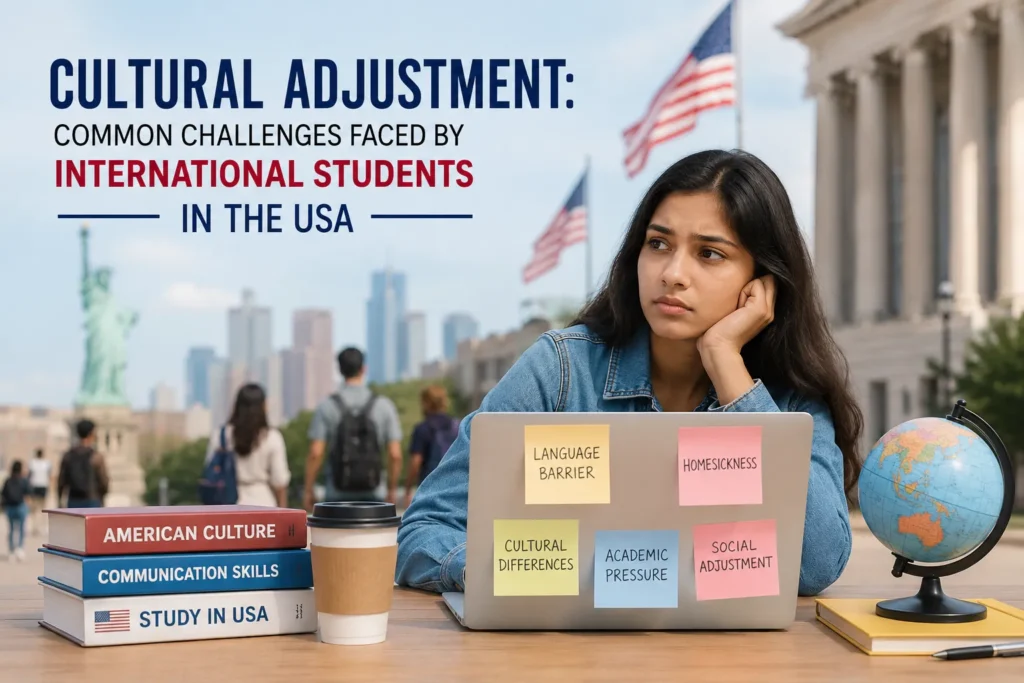
Cultural Adjustment : Common Challenges Faced By International Students in The USA Cultural Adjustment : Common Challenges Faced By International Students in The USA Moving to the United States for studies is an exciting opportunity filled with new experiences and potential. However, international students often face a range of challenges as they adjust to their new environment. Understanding these common hurdles and knowing how to address them can significantly ease the transition. In this blog, we’ll explore the typical challenges international students face in the USA and provide practical tips for overcoming them. 1. Language Barriers Challenge: Even if you’re proficient in English, adapting to different accents, slang, and colloquialisms can be daunting. Misunderstandings or difficulties in communication can affect both academic performance and social interactions. Solution: To improve your language skills, immerse yourself in English-speaking environments. Engage in campus activities, join conversation clubs, and utilize language learning apps. Don’t hesitate to seek help from campus language resources or tutors. Practising with native speakers and actively listening to media in English can also boost your confidence. 2. Understanding Cultural Norms Challenge: Different cultural practices and social norms can be confusing. From classroom etiquette to everyday interactions, what’s considered polite or appropriate can vary widely. Solution: Take the time to observe and learn about American social norms and academic expectations. Attend orientation sessions, participate in cultural workshops, and engage with local students to gain insight. Be open to asking questions and learning from your experiences. Understanding and respecting cultural differences will enhance your ability to navigate social situations effectively. 3. Academic Adjustments Challenge: The American education system may differ significantly from what you’re accustomed to. This includes different grading systems, teaching styles, and expectations for student participation. Solution: Familiarize yourself with the academic system by attending orientation and reading the student handbook. Don’t hesitate to ask professors or academic advisors for clarification on expectations and grading criteria. Joining study groups and attending office hours can also provide additional support and insights into academic success. 4. Building a Social Network Challenge: Making friends and establishing a social network in a new country can be challenging. The feeling of isolation or homesickness is common among international students. Solution: Actively participate in campus clubs, organizations, and social events. These activities are great opportunities to meet people with similar interests. Additionally, consider joining international student groups or associations; they can offer support and a sense of community. Engaging in extracurricular activities and volunteering can also help you build connections and integrate more fully into campus life. 5. Managing Homesickness Challenge: Being away from home for an extended period can lead to feelings of homesickness and loneliness. Solution: Stay connected with family and friends through regular video calls and social media. Create a routine that includes activities you enjoy to keep your mind engaged and positive. Explore local communities and landmarks to make your new environment feel more like home. Seeking support from campus counselling services can also help manage feelings of homesickness and anxiety. 6. Financial Adjustments Challenge: Navigating financial responsibilities and managing a budget in a new country can be overwhelming. Solution: Develop a budget that includes all your expenses and stick to it. Look into campus resources for financial advice, such as workshops or counselling services. Consider on-campus job opportunities or internships that can provide both income and valuable experience. Understanding the cost of living in your new city and making informed financial decisions can help alleviate stress. 7. Navigating Healthcare Systems Challenge: Understanding and accessing healthcare services in the US can be complex, especially if you are unfamiliar with the healthcare system. Solution: Learn about the health insurance plan provided by your institution and understand how to use it. Familiarize yourself with local healthcare providers and services. Campus health centres often provide resources and guidance for students. Don’t hesitate to ask for help if you’re unsure about the healthcare process or need assistance. Conclusion Cultural adjustment is a significant part of the international student experience, but with the right strategies and support, it can be navigated successfully. Embrace the challenges as opportunities for growth and learning. Remember, you are not alone—many international students face similar hurdles, and there are numerous resources available to support you through this transition. By actively engaging with your new environment and seeking help when needed, you can make the most of your time in the USA and turn these challenges into rewarding experiences. If you’re planning to study in the USA then visit Focus Education. Our consultancy specializes in guiding international students through every step of their journey, from “`