
Top Myths About the PTE Exam – Busted!

A Week Before IELTS: What You Should Focus On Preparing for the PTE Academic exam? Chances are, you’ve already heard conflicting opinions from friends, YouTube videos, or online forums. But let’s get real — not everything you hear is true. In this blog, we’ll bust the most common myths about the PTE exam that mislead thousands of test-takers every year. Whether you’re targeting a 65+, a 79+, or even a 90, this post will give you clarity, confidence, and facts that actually matter. Myth #1: “PTE Is Easier Than IELTS or TOEFL” The Truth: No exam is easier — only different. PTE, IELTS, and TOEFL all test the same core English skills, but in different formats. PTE is entirely computer-based and scored by AI, which reduces human bias. That’s often mistaken for being “easy.” But make no mistake, PTE is highly technical and requires a deep understanding of task types, structure, and strategy. Pro Tip: Choose the exam that matches your strengths. If you’re tech-savvy and prefer typing over handwriting, PTE might be a better fit. Myth #2: “You Need a Native English Accent to Score in Speaking” The Truth: Accent doesn’t matter — clarity does. PTE’s AI scoring system evaluates pronunciation, oral fluency, and content, not your accent. In fact, trying to fake a foreign accent can actually hurt your fluency and clarity. Pro Tip: Speak naturally, clearly, and confidently. Focus on stress, intonation, and avoiding long pauses. Myth #3: “You Can’t Prepare for PTE – It’s Just Common English” The Truth: PTE is a skills-based, strategic exam. PTE isn’t just about knowing English; it’s about how you use English in an academic and time-pressured context. Each question type (like “Repeat Sentence” or “Summarize Written Text”) has a scoring algorithm behind it. Random practice won’t work. You need targeted training. Pro Tip: Learn the scoring logic of each task. Preparation is not optional; it’s your biggest advantage. Myth #4: “Templates Guarantee High Scores in Writing & Speaking” The Truth: Templates are tools, not magic tricks. Yes, templates can help structure your answers, especially under time pressure. But if overused or copied from generic sources, your responses can lack relevance, originality, and even get flagged by the scoring system. Pro Tip: Build flexible templates that can be adapted to the question prompt. Inject your own ideas to stay on-topic. Myth #5: “Listening is Just About Understanding Words” The Truth: It’s about comprehension and memory. Tasks like “Highlight Incorrect Words” or “Summarize Spoken Text” require you to listen actively, retain information, and respond precisely, all within seconds. You’re not just tested on what you hear, but how well you understand, process, and reproduce it. Pro Tip: Practice with academic podcasts and test simulations. Improve both your listening speed and note-taking accuracy. Myth #6: “You Can’t Retake PTE Quickly After a Bad Score” The Truth: You can rebook as soon as you get your results. Unlike IELTS, where retakes may take time, PTE allows you to book another test right away, often within 24 to 48 hours of receiving your score. There’s no mandatory waiting period. Pro Tip: Use your score report to identify weak sections and adjust your prep before rebooking. Final Takeaway: Don’t Let Myths Shape Your Strategy, Let Data Do That When it comes to the PTE exam, facts beat opinions every time. Falling for common myths can lead to wasted effort, poor strategy, and avoidable mistakes. ✅ Instead, focus on: Understanding the PTE exam structure Practising smart, not just hard Using data-driven tools to improve Staying consistent and calm under pressure 👋 Need Help with PTE Preparation? Whether you’re self-studying or looking for expert guidance, the key is to start with the right strategy. Don’t let myths slow you down; base your prep on facts, feedback, and focus. Explore top-rated mock tests Get AI-evaluated practice feedback Learn proven hacks to boost your score Start your PTE success journey today! 🎓 Join Focus Education – Your Trusted Partner for PTE Success At Focus Education, we don’t just prepare you for the PTE exam; we train you to excel. With personalised coaching, mock tests, expert feedback, and proven strategies, we help you unlock your target score, whether it’s 65+, 79+, or 90. Our experienced mentors understand the exam inside and out and tailor your preparation to suit your strengths, goals, and timeline. Join successful candidates who’ve turned their dreams into reality with Focus Education. Ready to achieve your dream PTE score? Contact us today or visit our office to book your free demo session!
Repeat Sentence in PTE: Tips for Better Retention and Accuracy
Repeat Sentence in PTE: Tips for Better Retention and Accuracy The Repeat Sentence task in the PTE Academic (Pearson Test of English) is a challenging yet crucial part of the PTE speaking section. In this task, you are required to listen to a sentence and then repeat it exactly as you heard it. It’s not just about remembering the words but also about pronunciation, intonation, and fluency. Mastering this task can significantly impact your overall PTE score. In this blog, we’ll provide you with valuable PTE tips to improve your retention and accuracy in the Repeat Sentence task, giving you the tools to perform confidently on test day. What is the Repeat Sentence Task in PTE? In the PTE speaking section, the Repeat Sentence task assesses your ability to listen, retain, and reproduce spoken English accurately. You will hear a sentence played once, and you must repeat it exactly. The sentence may include common or academic vocabulary, and you need to match the speaker’s tone, stress, and rhythm. The task tests your: Listening comprehension: Your ability to understand what’s being said. Memory retention: Your ability to recall the sentence after listening. Pronunciation and fluency: Your ability to accurately reproduce the sentence with proper intonation and stress. Tips for Better Retention in the PTE Repeat Sentence Task: Retention is key to success in the Repeat Sentence task. The better you can remember the sentence, the more accurately you’ll be able to repeat it. Here are some PTE tips to improve your retention: 1. Focus on Key Words and Structure: While listening to the sentence, focus on key words, such as nouns, verbs, and adjectives, as they convey the main meaning. Also, pay attention to how the sentence is structured. This will help you recall the sentence more easily. 2. Practice Active Listening: Active listening involves fully concentrating on what is being said. You can improve this skill by listening to English-language podcasts, TED Talks, or news reports. Try to repeat sentences you hear from these resources. This exercise will train your brain to process and retain spoken information, mimicking the Repeat Sentence task’s requirements. 3. Use Visualisation Techniques: Visualising the sentence can help enhance your ability to recall it. When you hear a sentence, try to picture the sentence being “written” in your mind. Associating keywords with mental images or stories can also improve retention. 4. Break Down Complex Sentences: For longer or more complex sentences, it’s helpful to break them down into smaller chunks. Listen to the sentence once, then repeat each part slowly. Afterwards, try to combine the segments and say the full sentence. This technique will help improve your retention of longer sentences. Tips for Better Accuracy in the PTE Repeat Sentence Task Accuracy in the Repeat Sentence task goes beyond memory; it requires correct pronunciation, rhythm, and word order. Here are four quick tips to boost your accuracy: 1. Focus on Intonation and Stress: Mimic the speaker’s tone, rhythm, and emphasis. Stressing the right words helps your speech sound natural and improves your score. 2. Improve Pronunciation: Practice difficult sounds and record yourself to compare with native speakers. Use speech recognition tools for instant feedback and correction. 3. Maintain a Natural Pace: Avoid speaking too fast or too slow. Match the speaker’s speed and aim for smooth, fluent delivery without long pauses. 4. Practice with Real PTE Sentences: Use PTE-style materials regularly. Record your attempts, listen back, and self-correct. The more realistic your practice, the better your accuracy. Common Mistakes to Avoid in the PTE Repeat Sentence Task To ensure success in the Repeat Sentence task, avoid the following common mistakes: Overthinking: Don’t worry if you don’t remember every word. Focus on repeating the most important parts of the sentence accurately and keep going. Hesitation: Pauses or long silences can negatively affect your fluency score. Try to maintain a steady rhythm and avoid rushing or stumbling. Incorrect stress or intonation: Misplacing the stress or tone can change the meaning of the sentence. Pay attention to how the sentence is phrased and practice mimicking the speaker’s voice. Using Technology for Better PTE Preparation There are several online platforms and apps designed to help you practice the Repeat Sentence task. Many of these tools offer PTE-style exercises and provide instant feedback on your performance. Regular use of these tools can significantly improve your listening, speaking, and pronunciation skills. Apps like Elsa Speak or Speechling are great for working on pronunciation. They allow you to listen to native speakers and repeat sentences to improve your accuracy. Conclusion: Mastering the Repeat Sentence task in the PTE Academic exam requires a combination of skills: listening, retention, pronunciation, and fluency. By following the tips above and consistently practising, you can significantly improve your performance in this task and boost your overall PTE score. If you’re looking for expert guidance in preparing for the PTE Repeat Sentence task, look no further than Focus Education. Our experienced tutors offer tailored lessons that focus on improving both retention and accuracy, helping you build the skills you need to succeed in the PTE speaking section. Join Focus Education today and take the first step towards achieving your target PTE score. We provide personalised coaching, practice materials, and strategies that will ensure you’re fully prepared for your PTE exam.
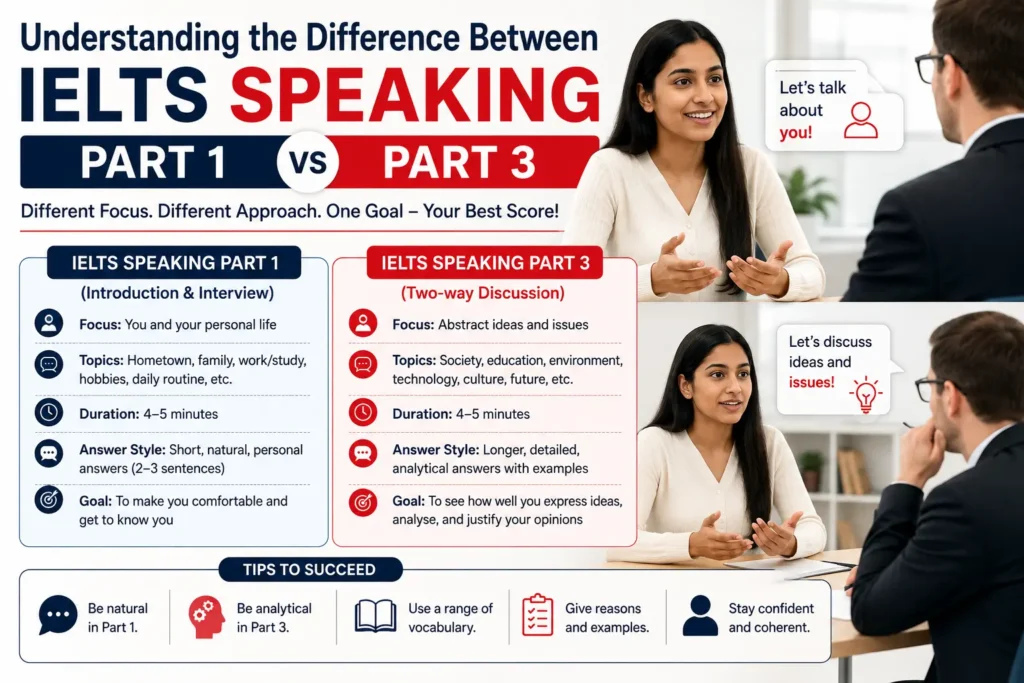
Understanding the Difference Between IELTS Speaking Part 1 and Part 3
Understanding the Difference Between IELTS Speaking Part 1 and Part 3 Many IELTS test-takers believe that the Speaking test is just a short chat with the examiner. While it may look like that on the surface, each part of the IELTS Speaking test is designed to assess a different skill. Part 1 and Part 3, in particular, differ in the type of questions as well as in the kind of answers expected. Knowing how to adjust your language and approach between these two parts can make a major difference in your band score. The structure of the IELTS Speaking test The Speaking test has three parts: Part 1: Introduction and basic questions Part 2: Cue card (you speak on a given topic for 1–2 minutes) Part 3: Discussion based on the cue card topic While Part 2 acts as a bridge between the two, Part 1 and Part 3 stand at opposite ends in terms of tone, depth, and complexity. Part 1: Simple, direct, and personal Part 1 feels like a warm-up. The examiner usually asks questions related to you, your life, and your daily experiences. Topics often include your hometown, hobbies, work, studies, food, travel, or friends. The main aim here is to check your ability to communicate naturally in familiar situations. Therefore, your answers should be short, crisp, and conversational. For example: Question: Do you enjoy cooking? Answer: Yes, I do. I’m not an expert, but I like trying new recipes on weekends. Notice how the answer is brief and natural. You don’t need to sound too formal or give long, structured responses. It’s perfectly fine to use fillers like “Well…” or “Actually…” occasionally, as long as your tone stays friendly and fluent. In short, Part 1 is about being yourself — showing that you can handle everyday English without hesitation. Part 3: Detailed, thoughtful, and formal By the time you reach Part 3, the examiner expects more depth in your language. The questions are linked directly or indirectly to your Part 2 cue card topic. For instance, if your cue card was about “a time you helped someone,” Part 3 might include questions like: Do you think people are becoming less helpful nowadays? How can schools encourage students to help others? Here, the examiner is testing your ability to discuss abstract ideas, express opinions, and justify them logically. So, your answers must be more detailed and structured. Example: Question: Do you think people are becoming less helpful nowadays? Answer: I think so, yes. Many people are too busy with their own schedules, and technology has made social interactions more limited. However, when real help is needed, most people still step forward. This kind of answer reflects reasoning, balance, and vocabulary variety — all of which help raise your band score. Key differences between Part 1 and Part 3 While both parts assess your speaking ability, they do so at different levels. Purpose: Part 1 checks natural fluency; Part 3 tests analytical thinking. Question type: Part 1 is personal and factual; Part 3 is general and opinion-based. Connection: Part 1 questions are independent; Part 3 follows the theme of Part 2. Answer length: Part 1 = short and clear; Part 3 = longer and more reasoned. Language tone: Part 1 = conversational; Part 3 = slightly formal. Understanding these differences helps you adjust your speaking style automatically. Why adapting your tone matters In Part 1, using overly formal words or long sentences can sound unnatural. The examiner wants to see spontaneity, not memorized vocabulary. On the other hand, in Part 3, staying too casual might make your answers appear shallow. You need to balance natural fluency with analytical depth — that’s the skill advanced speakers display. Why guided practice is essential Many candidates struggle not because their English is weak, but because they don’t recognise these shifts in tone and structure between the parts. Knowing what to say is one thing, but knowing how to say it in the right way takes trained observation and correction. At Focus Education, we train students to handle every part of the IELTS Speaking test strategically. Our trainers conduct mock speaking sessions, give instant feedback, and help students develop confidence in both conversational and academic English. Whether you’re aiming to polish fluency or strengthen coherence and vocabulary, guided sessions make a visible difference. Understanding the difference between Part 1 and Part 3 is not just about scoring well — it’s about learning to communicate in a way that fits the situation. And with expert direction, you can master both with ease.
How Many Hours Should You Study Daily for IELTS?
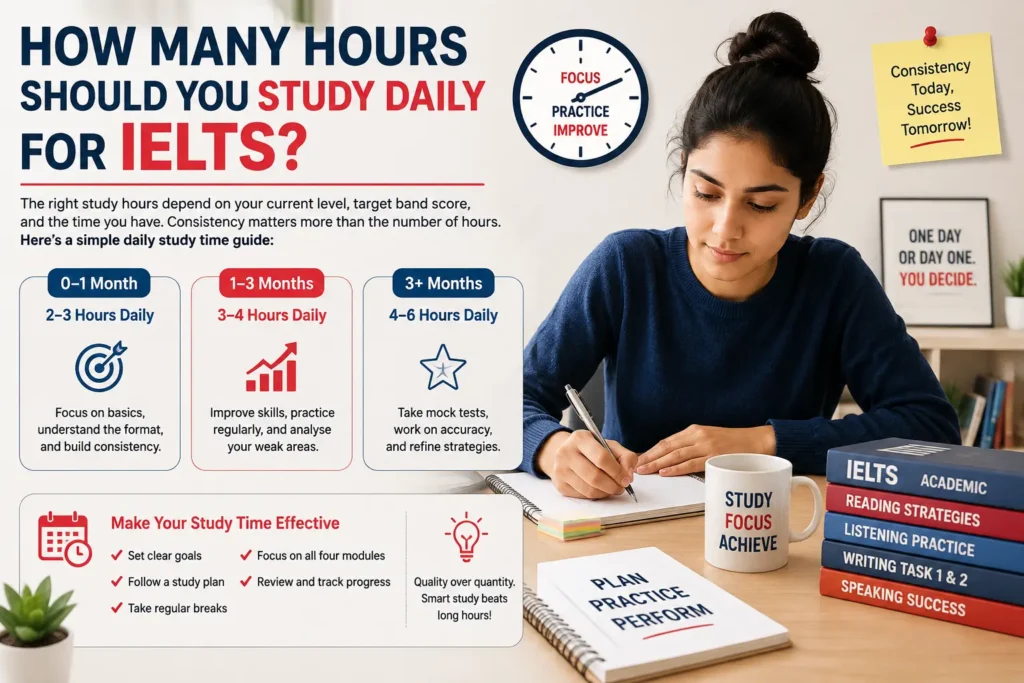
How Many Hours Should You Study Daily for IELTS? One of the most common questions students ask is: how many hours per day should I study for IELTS? There is no single correct answer because study time depends on several personal factors. What matters far more than a fixed hourly target is the quality and focus of those hours. Below are the key factors to consider and practical study plans that suit different timelines and starting levels. 1. Factors that determine daily study time Your current English level, target band, available weeks until the test, and whether you are studying full-time or part-time are the main factors. A student already at band 6, aiming for band 7, requires less daily effort than a beginner aiming for band 7. Similarly, if the test date is one month away, daily hours must be higher than for a test scheduled in six months. Work and college commitments also reduce available time, so plans must be realistic. 2. What quality study looks like (not just hours) It’s possible to study many hours with little improvement if the work is unfocused. Effective study includes deliberate practice, frequent feedback, and periodic mock tests. Each study hour should have a clear purpose (for example, targeted grammar work, timed essay practice, or focused speaking drills). Balance active practice (speaking, writing, timed tests) with passive learning (reading articles, listening to podcasts) so every hour moves you forward. Daily study components (recommended split) Listening practice: 30–45 minutes (active listening + notes) Reading practice: 30–45 minutes (skimming, scanning, timed passages) Writing practice: 45–60 minutes (task-based; review and edit) Speaking practice: 30–45 minutes (record, review, or trainer session) Vocabulary/grammar & review: 20–30 minutes Weekly full mock test: 2–3 hours (simulate exam conditions) These are flexible guidelines; shorter, focused sessions beat long, unfocused hours. 3. Sample study plans by timeline and level Intensive (4–6 hours/day) — For those with 4–6 weeks before the test or needing a fast band increase. Focus on daily mock tests, targeted weak-area drills, and expert feedback. This plan is demanding and requires strong discipline. Balanced (2–3 hours/day) — Ideal for students with 8–12 weeks. Split sessions across skills and include one full mock test weekly. This plan balances progress with sustainable pacing. Long-term (1–1.5 hours/day) — Best for busy students with 4–6 months to prepare or for gradual improvement. Emphasise consistency, vocabulary growth, and monthly full tests. Over months, small daily gains add up significantly. Adjust these plans based on progress: if mock scores stall, increase focused hours or get professional feedback. 4. How to use limited time well If only one hour is available, split it into short, focused tasks: 20 minutes of a timed reading passage, 20 minutes of speaking practice (record and self-evaluate), and 20 minutes of vocabulary revision. Use a timer, work in 25–40 minute-blocks with short breaks, and keep a log of mistakes to revisit. Quality beats quantity — an hour of targeted practice is far more effective than three hours of passive study. 5. Avoiding burnout and tracking progress Intense study without rest leads to fatigue and diminishing returns. Schedule at least one rest day weekly and short sleep-friendly routines. Track progress with regular full mocks and note improvements in timing, accuracy, and confidence. If improvements slow, consider changing strategy rather than just increasing hours. Why guided training speeds up results Self-study can take candidates far, but personalised guidance compresses learning time. Trainers identify recurring errors, suggest better study splits, and provide precise feedback on speaking and writing. At Focus Education, students receive structured study plans, weekly mock tests, and targeted feedback from certified trainers. This helps convert study hours into measurable band improvement and avoids wasted effort. If you want a customised study plan based on your current level and target band, Focus Education can prepare one and run a diagnostic mock to set realistic daily-hour targets. Start with a plan that fits your life and improve it with guided practice — consistent, focused hours will take you to your target score.
How to Prepare for Your IELTS on Computer (Academic)
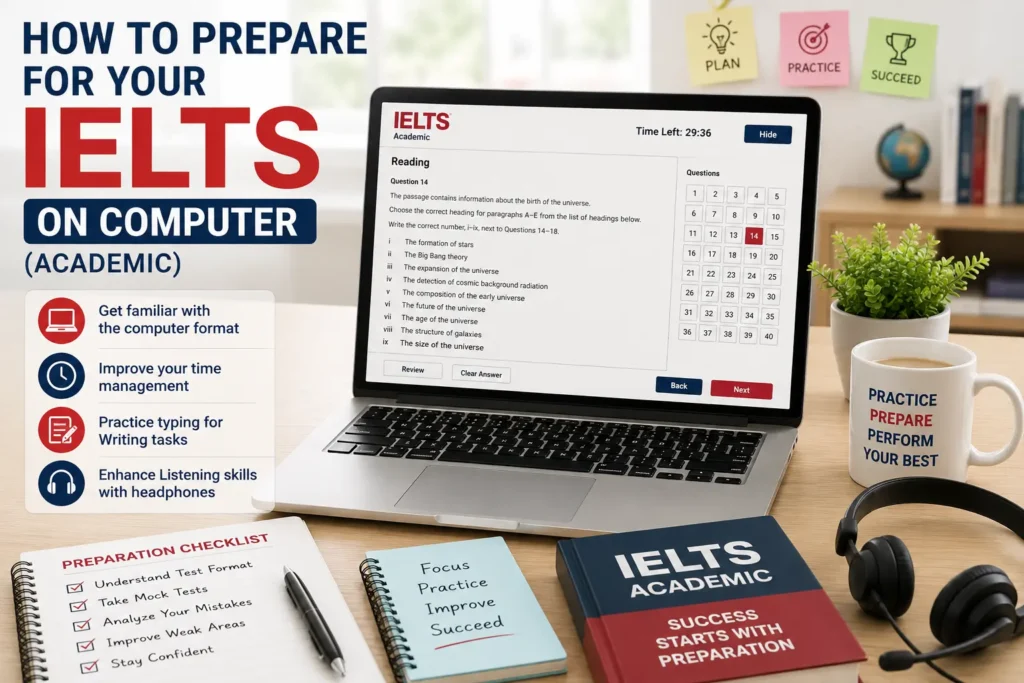
How to Prepare for Your IELTS on Computer (Academic) The IELTS on Computer test is now chosen by thousands of students who want a faster, more convenient test experience. Although the format is the same as IELTS on Paper, preparing for it requires a slightly different approach. Here’s how you can prepare effectively for IELTS on a Computer (Academic) with simple, practical steps. 1. Know What’s Different – and What’s Not: The biggest myth about IELTS on Computer is that it’s easier or harder than the paper test. That’s not true. The test content, timing, and scoring criteria are exactly the same. The only difference lies in how you take it. You’ll read, type, and listen using a computer instead of paper and pen. Here’s a quick comparison: Skill Paper-based Computer-based Listenin g Answers written on paper Answers typed on screen Reading Passages printed Passages appear on screen Writing Handwritten Typed using a keyboard Speakin g Face-to-face Face-to-face (same as paper) Apart from the faster results within 3–5 days, IELTS on Computer also offers more test date options and smaller, quieter test rooms — a real advantage for those who get nervous in large exam halls. 2. Practice on the Computer from the Beginning If you’ve decided to take the test on a computer, make sure you practice that way too. Reading long texts on a screen feels different from paper. You might scroll too fast or lose your place. The best way to get used to this is by regularly doing practice tests on a screen. Many official websites and online platforms provide sample computer-based IELTS tests. This helps you build comfort with scrolling, highlighting, and switching between questions — just like in the real exam. 3. Improve Your Typing Speed and Accuracy Writing tasks are fully typed, so being a slow or inaccurate typist can affect your performance. Aim for a typing speed of 35–40 words per minute with minimal errors. To get better: Type short essays every day. Focus on proper spelling and punctuation. Learn simple shortcuts like Ctrl + C, Ctrl + V, and Ctrl + Z for editing. A smooth typing rhythm allows you to focus on your ideas instead of your fingers. 4. Proofread Your Work Typing makes editing easier, but it can also make you careless. Always leave 2–3 minutes at the end of each writing task to proofread. Read your essay slowly and check: Missing articles (a, an, the) Verb tenses Plural forms Sentence punctuation Proofreading is a small habit that can help you avoid losing marks unnecessarily. 5. Watch Out for Typos One common mistake students make in computer-based IELTS is ignoring typing errors. Spelling mistakes, even small ones, can lower your band score — especially in Writing and Reading. The computer does not have auto-correct, so if you type enviroment instead of environment, it counts as wrong. During practice, train yourself to pause for a second after each paragraph and quickly check for such errors. 6. Master the On-Screen Tools IELTS on Computer provides built-in tools to make your work easier. You can: Highlight key information in Reading or Listening. Make quick notes to remind yourself of important points. Copy and paste text while organizing your essay. Switch between questions without wasting time. These small tools can save time and improve focus — but only if you use them confidently. Try using them during your practice sessions so they feel natural on test day. 7. Manage Time Smartly (Especially in Listening) In the computer-based IELTS Listening test, you do not get extra time to transfer answers at the end. You must type answers directly as you listen. This means you should: Keep your eyes on both the audio and the screen. Check spellings as you type. Use the short pauses in the recording to prepare for upcoming questions. Good listening practice with real test recordings helps you get comfortable with this faster pace. Final Thoughts Preparing for IELTS on Computer (Academic) is about building comfort with the format as much as improving English skills. Practice regularly on screen, focus on accurate typing, and learn to use the tools efficiently. At Focus Education, we help students prepare in real test-like conditions, guiding them through both the content and the format with practical strategies. With the right preparation, you can walk into your test centre confident and ready to perform at your best.
Words and Phrases Commonly Misused in IELTS
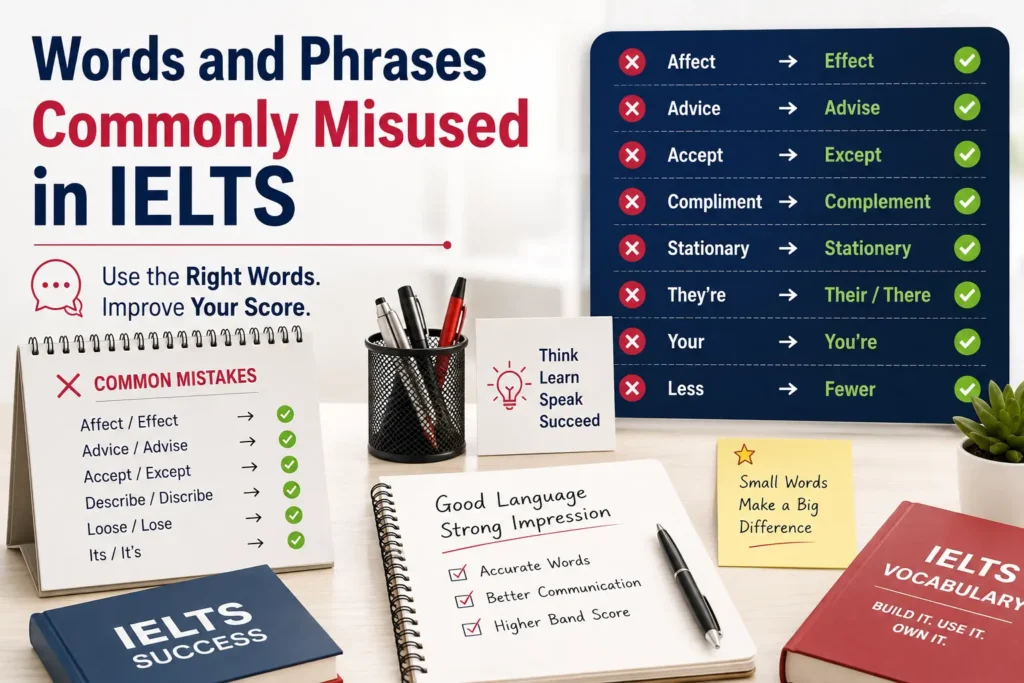
Words and Phrases Commonly Misused in IELTS English learners often confuse words or phrases that look or sound similar — and in IELTS, this can affect both your Writing and Speaking band scores. Using the right word not only shows your accuracy but also your confidence in communication. Here are some of the most commonly misused words and phrases that every IELTS test taker should master. 1. Discuss: Many candidates start essays with “Let’s discuss…” or “I will discuss about…”. The word discuss already means to talk about something — so avoid using about. Correct: “This essay will discuss the effects of pollution.” Incorrect: “This essay will discuss about the effects of pollution.” 2. Affect vs Effect Affect is a verb (action), and effect is a noun (result). Example: “Pollution affects people’s health.” Example: “The effect of pollution is serious.” Remember: Affect = action, Effect = end result. 3. Since vs For vs From These three are often confused when talking about time. Since shows the starting point of an action: “I’ve lived here since 2015.” For shows the duration: “I’ve lived here for eight years.” From indicates the starting point, but it usually comes with to/till/until: “I’ll be away from Monday to Friday.” TIP: Think of it this way: since = when it started, for = how long, from = between two points in time. 4. In the other hand vs On the other hand The correct phrase is always on the other hand, not in the other hand. Example: “Some people prefer online education. On the other hand, many enjoy classroom learning.” 5. Stay vs Live Use ‘stay’ for a short period and ‘live’ for a long-term residence. Example: “I’m staying at my friend’s house this week.” Example: “I live in Ahmedabad.” 6. Go to bed vs Sleep You ‘go to bed’ when you lie down; you ‘sleep’ when you actually rest. Example: “I go to bed at 11 but sleep around midnight.” 7. You and Me vs You and I A quick trick to know what’s right: remove “you and” and see if the sentence still works. “You and I are going out.” (Correct, because “I am going out” makes sense.) “She called you and me.” (Correct, because “She called me” is right.) TIP: If removing “you and” makes the sentence sound wrong, you’re using the wrong one! 8. Irregardless vs Regardless “Irregardless” is incorrect. Always use regardless, meaning without considering something. Example: “Regardless of the weather, the event continued.” 9. Good vs Well ‘Good’ is an adjective; ‘well’ is usually an adverb. Example: “She is a good teacher.” Example: “She teaches well.” 10. Disinterested vs Uninterested ‘Disinterested’ means neutral or impartial, while ‘uninterested’ means not interested. Example: “A judge should be disinterested, not uninterested.” 11. Borrow vs Lend ‘Borrow’ means to take something; ‘lend’ means to give. Example: “Can I borrow your book?” Example: “Sure, I’ll lend it to you.” 12. Another vs Other ‘Another’ means one more or an additional one: “I need another pen.” ‘Other’ refers to different things or people: “The other students are outside.” Tip: Use another with singular countable nouns and other with plural ones or uncountable nouns. 13. Sometimes vs Sometime vs Some Time Sometimes = occasionally: “I sometimes go jogging.” Sometime = at an unspecified time: “Let’s meet sometime next week.” Some time = a period of time: “It took me some time to finish.” 14. Between vs Among Use between for two things, among for more than two. Example: “The money was divided between John and Mary.” Example: “The teacher walked among the students.” 15. In spite of vs Despite Both mean the same, but the structure changes slightly. Example: “In spite of the rain, they went out.” Example: “Despite the rain, they went out.” Never say “Despite of”. Final Thoughts Using English accurately isn’t just about memorizing grammar — it’s about understanding context. In IELTS, word choice can make a difference between Band 6.5 and Band 7.5, especially in Writing and Speaking. At Focus Education, we ensure our students not only know the right words but also use them naturally. With detailed grammar sessions and speaking practice, our trainers help learners develop fluency and accuracy that truly stand out in the test.
IELTS Speaking for Indians: Common Mistakes Examiners NoticeImmediately

IELTS Speaking for Indians: Common Mistakes Examiners Notice Immediately For many Indian IELTS aspirants, the Speaking test feels like the most unpredictable part of the exam. Unlike Reading or Writing, you can’t plan your answers or check them twice. The examiner judges you on the spot — not just for your vocabulary and grammar, but also for your fluency, pronunciation, and natural communication. While Indian students are often strong in grammar and content, there are some typical mistakes that affect their scores. Let’s look at what they are and how you can avoid them. 1. Memorized Answers: One of the biggest red flags for IELTS examiners is when candidates recite memorized responses. Even if your sentences are grammatically perfect, they sound robotic and rehearsed. The examiner can immediately tell that you’ve practiced a script. Instead of memorizing, focus on learning how to express ideas naturally. Practice paraphrasing — saying the same thing in different ways. This shows flexibility and confidence in your spoken English. 2. Overuse of Linking Words: Using connectors like “moreover,” “furthermore,” and “on the other hand” can help organize your speech. But when they appear in every sentence, your answer sounds unnatural. Spoken English is less formal than writing. It’s okay to use simpler phrases like “also,” “but,” or “for example” in the Speaking test. Remember — the goal is fluency, not formality. 3. Forced Idioms and Unnecessary Expressions: A common myth among students is that using idioms automatically boosts their score. However, forcing idioms that don’t fit the context often makes your speech awkward. Everyday English rarely includes idioms like “once in a blue moon” or “raining cats and dogs.” It’s better to use natural, conversational phrases that suit the topic — that’s what the examiner wants to hear. 4. Incorrect Use of Articles: Many Indian learners struggle with “a,” “an,” and “the.” For instance, saying “I have a habit of listening to the music” instead of “listening to music.” This may sound like a small error, but repeated mistakes can lower your grammar score. Listening carefully to native content — podcasts, news, or interviews — can help you develop a better sense of article usage. 5. Translating from the Mother Tongue: Students often think in their native language and then translate word-for-word into English. The problem is, sentence structures differ between languages. This leads to awkward syntax, like “My all friends are going there” instead of “All my friends are going there.” Instead, train your mind to think in English — even simple thoughts during the day can improve your fluency and naturalness. 6. Not Paying Attention to Pronunciation: Many Indian speakers focus more on grammar and vocabulary and forget that pronunciation plays a major role in the IELTS Speaking test. Clear pronunciation doesn’t mean having a foreign accent; it means your words are easily understood. Work on stress, rhythm, and sounds like ‘v’ vs ‘w’ or ‘t’ vs ‘th’. A few focused pronunciation drills daily can make a noticeable difference. 7. Speaking in a Flat Tone: Even when students speak correctly, their speech can sound flat or monotone. English relies heavily on intonation — the rise and fall of your voice to express meaning and emotion. Practicing with English shows, podcasts, or mock interviews can help you learn how to sound more engaging and confident. 8. Unbalanced Answers: In Part 1, students often give one-word replies like “Yes” or “No.” In contrast, in Part 3, they sometimes go into unnecessary details. A good rule is: Part 1 → short, clear, personal answers (2–3 sentences) Part 2 → well-structured 2-minute talk Part 3 → longer, analytical answers with examples Knowing how much to speak is just as important as what to say. Why Training Matters? While self-practice helps, most students don’t notice the mistakes they keep repeating — like pronunciation slips, forced phrasing, or overuse of connectors. That’s where guided feedback makes a real difference. At Focus Education, students attend two speaking sessions every week, each lasting an hour, to strengthen fluency and confidence. Additionally, every Friday, a full speaking mock test is conducted with a detailed band score explanation so learners know exactly where they stand and what to improve. If you’re aiming for a 7+ in IELTS Speaking, remember — it’s not just about English knowledge, it’s about how naturally and clearly you communicate. With the right guidance and consistent practice, Focus Education helps you perform your best when it truly counts.
A Week Before IELTS: What You Should Focus On
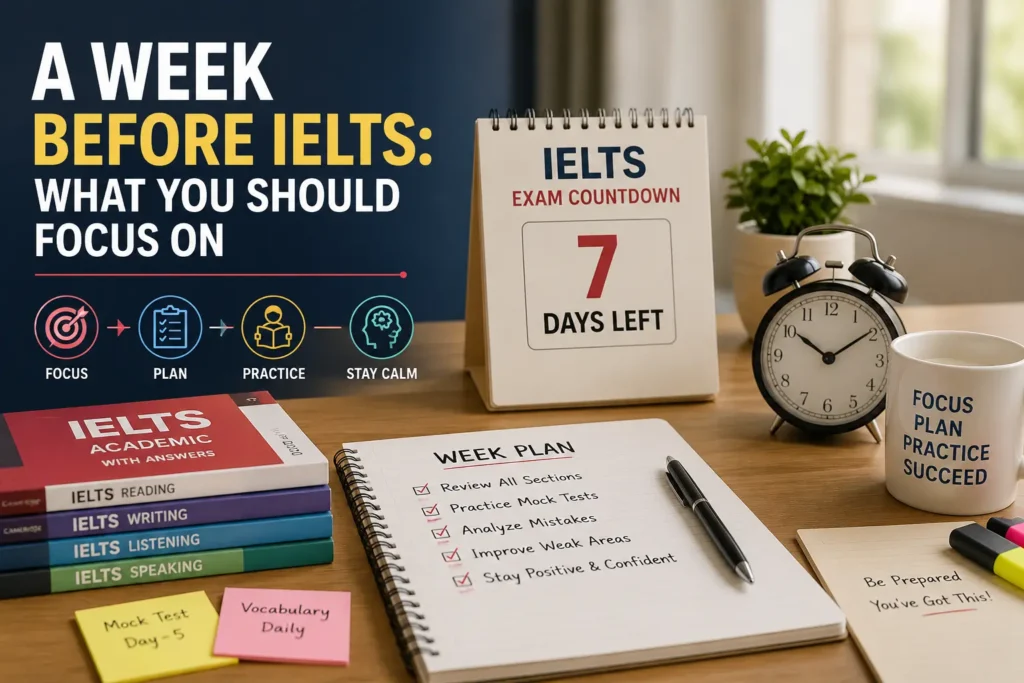
A Week Before IELTS: What You Should Focus On The final week before your IELTS exam plays a major role in how confidently you perform on test day. Instead of learning new concepts, this is the time to revise smartly, practise under real test conditions, and understand exactly what the exam expects from you. Below is a focused list of what every student should do in the last seven days. Understand the question types in Listening and Reading IELTS Listening and Reading have several question types, such as sentence completion, matching information, MCQs, and True/False/Not Given. When you know the pattern of each type, you avoid confusion during the test. It also helps you select the right strategy, like skimming or scanning. Understanding formats saves time and increases accuracy. Understand the format of Writing Task 1 and Writing Task 2 Writing Task 1 requires you to describe visual information, while Task 2 asks you to write an essay. Each task has its own structure, tone, and scoring method. When you clearly know what to include in each paragraph, you write faster and with more confidence. Proper format helps you meet the examiner’s expectations. Learn the ideal length of answers in Speaking Part 1, 2, and 3 In Part 1, answers should be short and natural, about one or two sentences. In Part 2, you must speak for one to two minutes using a clear structure. In Part 3, you need to give more detailed, thoughtful answers. Knowing how much to speak helps you manage time and avoid underdeveloped or overly long responses. Take mock tests and get them evaluated by professional trainers Mock tests show your real performance level and help you practise under exam-like pressure. But the most important step is getting them evaluated by trained professionals. Trainers can identify your repeated mistakes, suggest corrections, and guide you with personalised feedback. This improves your score faster than self-study alone. Make a list of linking devices Linking devices help you connect ideas smoothly in Writing and Speaking. Words like however, therefore, on the other hand, and in contrast make your answers more organised. When you have a list ready, you can revise it quickly before the exam. Good linking improves coherence and cohesion, which directly affects your band score. Prepare a list of common idioms for Speaking Idioms can make your answers sound natural and fluent when used correctly. Simple idioms like a piece of cake or in the long run work best because they are easy to understand. You do not need very advanced idioms. A small, useful list revised daily helps you use them naturally during the test. 7. Practise speaking with trainers to receive guided feedback Speaking practice with a trained professional helps you improve fluency, grammar, and pronunciation at the same time. Trainers can correct you instantly and show you how to develop answers without going off-topic. Regular feedback builds confidence and reduces hesitation. This is especially helpful for students who feel nervous. 8. Review your weak points regularly Every student has certain areas that need improvement, such as grammar errors, slow reading, or gaps in listening. The last week is the perfect time to identify and work on them. Focused improvement gives quicker results than practising everything randomly. A clear list of weaknesses saves time and energy. 9. Practise time management for all modules IELTS is a strict, time-bound exam. Even strong students lose marks because they cannot complete tasks on time. Practising with a timer helps you learn exactly how much time to give each question. Time management reduces panic and improves accuracy in all four modules. 10. Focus on accuracy instead of difficult vocabulary Many students try to use very advanced words but end up using them incorrectly. It is better to speak and write clearly with correct grammar and everyday vocabulary. Accuracy creates a stronger impression than forced complexity. This approach improves your score and keeps your answers natural. FINAL THOUGHTS: Preparing in a structured way during the final week can improve your performance in every IELTS section. At Focus Education, we help students with guided practice, detailed feedback, and personalised strategies to achieve their desired band score. With expert trainers and regular evaluations, you can enter the exam fully prepared and confident.
Common IELTS Listening Traps That Lower Your Score
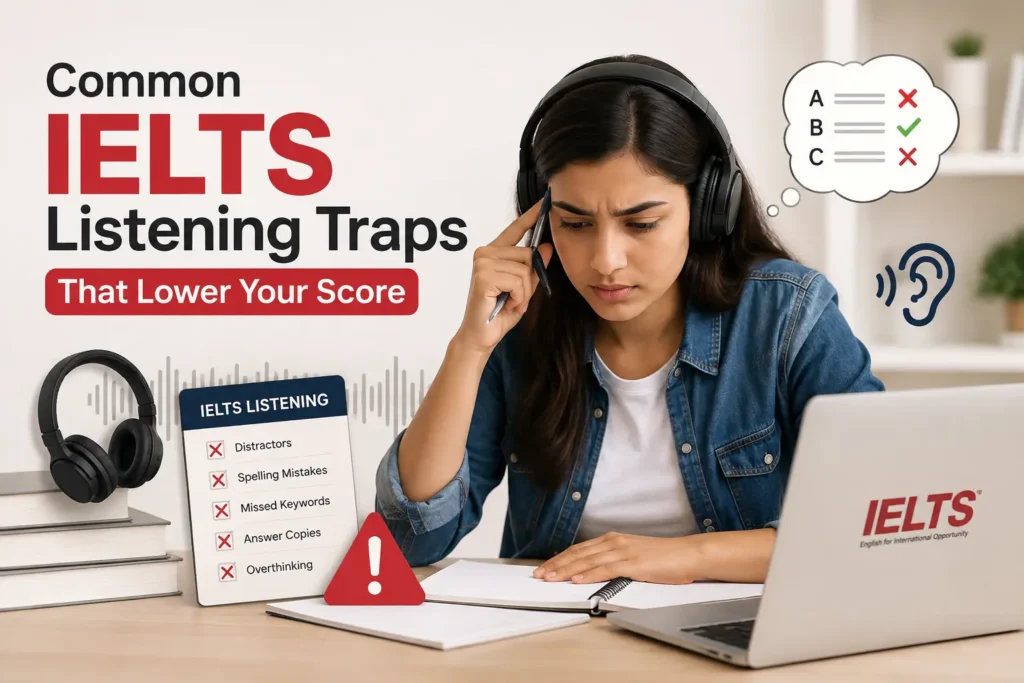
Common IELTS Listening Traps That Lower Your Score The IELTS Listening test may seem straightforward — you listen to recordings and answer questions — but anyone who has taken it knows how tricky it can be. The test isn’t just about hearing English words; it’s about understanding, interpreting, and identifying information accurately, even when the speaker changes their mind or uses distractors. These hidden challenges often cause students to lose marks without realizing why. Let’s look at the 10 most common traps that students fall into during the IELTS Listening test and how you can avoid them. 1. Changing Answers Mid-Sentence One of the most common tricks in IELTS listening is when a speaker says something and then corrects themselves. “The meeting is on Monday — oh no, sorry, it’s actually on Tuesday.” If you write “Monday,” you lose the mark. Always wait till the speaker finishes the idea before writing your answer. 2. Similar-Sounding Words Words like thirteen and thirty, ship and sheep, won and one often confuse test-takers. IELTS uses these pairs intentionally to check your concentration. Practice listening for stress and intonation differences so you can identify the correct one. 3. Synonym and Paraphrase Confusion The recording rarely uses the exact words from the question. For instance, the question might say “job,” but the audio could mention “occupation” or “work.” Always focus on meaning, not just words. This skill comes only with consistent listening and vocabulary practice. 4. Distractors and Red Herrings Sometimes, multiple pieces of information are given, but only one is correct. The speaker might describe several options before confirming the right one. Stay alert and avoid jumping to conclusions too early. 5. Speed and Accent Variations You might hear different English accents — British, Australian, Canadian, or even neutral international tones. Add to that the fast pace of speech, and it’s easy to miss keywords. The best strategy is to familiarize yourself with multiple accents by listening to podcasts, BBC, or Australian radio before your exam. 6. Overlooking Word Limits Every IELTS listening question specifies a word limit, such as “NO MORE THAN TWO WORDS.” Writing three words instead of two — even if the answer is correct — leads to zero marks. Always read instructions carefully before you start each section. 7. Losing Focus After Missing One Answer If you miss an answer, don’t panic. Many students lose two or three more answers while worrying about the one they missed. Move on quickly and try to catch the next response. You can guess later when transferring answers to the answer sheet. 8. Incorrect Spelling and Plurals A single missing ‘s’ can cost you a mark. For example, if the correct answer is “apples” and you write “apple,” it’s incorrect. Always check spelling and singular/plural forms when transferring your answers. 9. Ignoring Predictive Listening Before the audio starts, you get time to read the questions. This is your golden chance to predict the type of information (a number, date, name, or place) you’re about to hear. Students who skip this step often feel lost when the audio begins. 10. Not Reviewing During Transfer Time At the end, you get 10 minutes to transfer answers to the answer sheet. Many students treat this as “break time.” It isn’t. Use it to double-check spelling, grammar, and word count to avoid careless errors. How to Beat These Traps Overcoming these traps isn’t about luck — it’s about developing active listening strategies. Practice under real test conditions, listen to various English sources, and always review your mistakes. At Focus Education, we help students train with real IELTS recordings, timed practice sessions, and expert feedback to identify their weak points. Our listening classes are designed to build attention, accuracy, and confidence, ensuring you never fall for these common IELTS traps again. In short, IELTS Listening is more about strategy than just understanding English. Once you learn how the test tries to mislead you, you can stay two steps ahead — and that’s exactly what smart preparation with Focus Education helps you achieve.
UNLOCKING OPPORTUNITIES: MASTERING YOUR STUDIES ABROAD WITH ANEDUCATION LOAN

UNLOCKING OPPORTUNITIES: MASTERING YOUR STUDIES ABROAD WITH AN EDUCATION LOAN Picture yourself immersing in a new culture, engaging in research at world-class institutions, and strolling through vibrant university campuses abroad. The dream of studying in a foreign country opens doors to personal growth and academic success. However, the cost of international education often becomes a major hurdle. This is where the magic of education loans comes into play, acting as your gateway to achieving your dream. In this blog, we will guide you through maximising the potential of an education loan to fund your overseas studies wisely. Why Study Abroad? Pursuing education overseas offers unparalleled exposure, allowing students to experience diverse cultures, global perspectives, and new learning methodologies. The benefits range from expanding your network internationally to gaining skills that are highly valued by employers worldwide. However, the price tag attached to this experience often turns potential students away. Education loans can be the bridge to making these dreams a reality. STEP 1: RESEARCH AND BUDGETING Before applying for a loan, the foundation of your financial planning lies in thorough research. Consider factors such as tuition, living expenses, travel, accommodation, and study material. Create a comprehensive budget that accounts for all potential costs while keeping future repayments in mind. Being realistic about the total expense will help you determine the appropriate loan amount without over-borrowing. Pro Tip: Research universities and programs that align with your career goals and offer a good return on investment. This ensures you gain maximum value for the money you spend. STEP 2: CHOOSING THE RIGHT LOAN OPTION Education loans come in various forms, from government-backed schemes to private lenders and institutional loans. Each option comes with different interest rates, repayment plans, and eligibility criteria. Compare them carefully and choose the one that fits your financial circumstances. Remember to factor in loan tenures, grace periods, and repayment flexibility. Types of Loans: Government Loans: These often have lower interest rates and favourable terms for students. Private Loans: Offered by banks and financial institutions, these might have higher rates but provide flexibility for students with specific needs. Institutional Loans and Scholarships: Many universities offer financial aid to international students through merit-based or need-based scholarships. STEP 3: STRENGTHEN YOUR LOAN APPLICATION A solid loan application increases your chances of securing favourable terms. Lenders often assess your financial profile, academic performance, and future earning potential. Make sure your credit history is clean, provide accurate financial documentation, and, if possible, have a co-signer with a good credit score. This can lower the interest rate and improve your approval chances. STEP 4: FINANCIAL DISCIPLINE DURING STUDIES Once you secure your loan, it is essential to manage your finances wisely throughout your studies. Stick to the budget you created, avoid unnecessary expenses, and seek out part-time work or internships to ease the financial burden. This will not only help with living expenses but also build valuable work experience. Pro Tip: Research student discounts, free activities, and ways to save on housing or transportation. Many countries offer benefits specifically designed to support international students. STEP 5: PLAN YOUR LOAN REPAYMENT STRATEGY Once you graduate, it is crucial to have a repayment plan in place. Many loans come with a grace period after graduation, but planning will make the transition smoother. Consider income-driven repayment plans, refinancing options, or loan consolidation to make repayment more manageable. Paying off your loan early can reduce interest costs and improve your financial future. STEP 6: EXPLORE SCHOLARSHIPS AND GRANTS While education loans are one way to fund your studies, don’t forget to explore scholarships and grants that could ease the financial burden. Many scholarships are available based on merit, field of study, nationality, or even extracurricular achievements. Research thoroughly and apply early to maximize your chances. SECURING YOUR FUTURE WITH SOUND FINANCIAL MANAGEMENT The experience of studying abroad can be life-changing, but managing your financial health is equally important. Once you transition from being a student to a professional, prioritizing your loan repayments will set you up for a secure financial future. Whether through early repayment or income-driven plans, tackling your loan wisely will lead to financial freedom sooner than expected. CONCLUSION The dream of studying abroad is within reach, and education loans can be the key to unlocking this incredible opportunity. However, it’s essential to handle these loans responsibly. By researching thoroughly, budgeting wisely, and staying financially disciplined, you can use your education loan as a stepping stone to personal and academic growth, and ultimately, success. Dream it. Plan it. Live it! As you embark on this exciting journey to study abroad, remember that Focus Education Pvt Ltd is here to support you every step of the way. From securing your student visa to guiding you on your educational path, our team is dedicated to helping you unlock your full potential. Visit us today to learn more about how we can assist you in making your dreams a reality. Your adventure awaits—let's make it happen together!