
Bridge to Success: Cultural Adaptation Guide for International Students
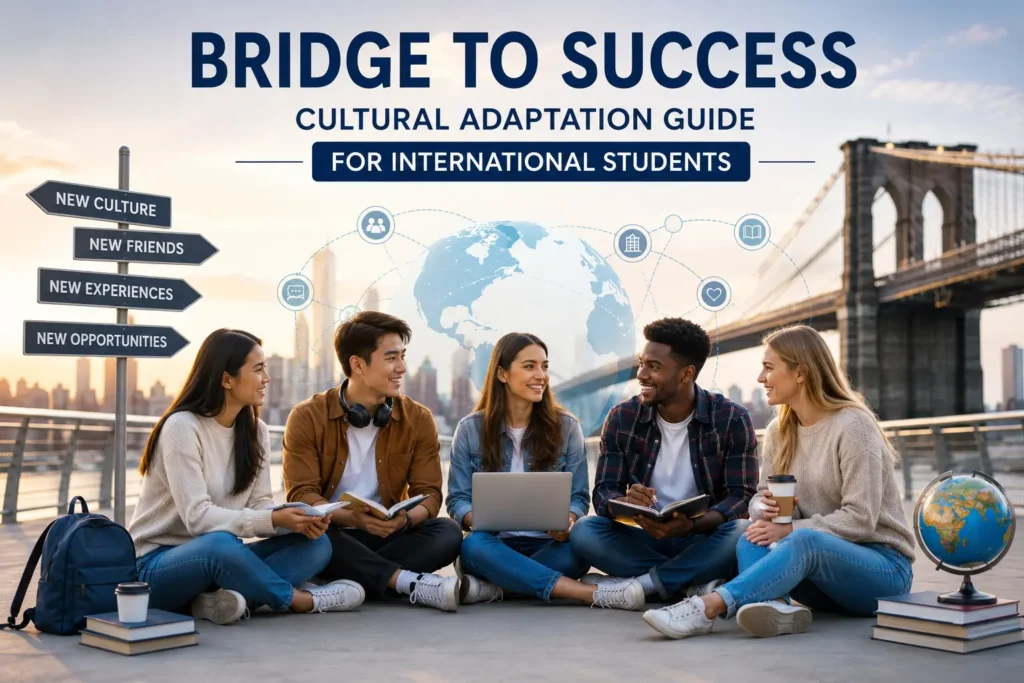
Bridge to Success: Cultural Adaptation Guide for International Students Bridge to Success: Cultural Adaptation Guide for International Students Beginning a journey as an international student is not just about attending classes; it’s a universal experience that involves adapting to a new culture, language, and ways of life. This guide aims to serve as a bridge, helping international students smoothly transition into their new academic and social environments. 1. Accept Cultural Diversity: One of the most inspiring aspects of studying abroad is the opportunity to immerse yourself in a diverse cultural environment. Accept the differences around you, be it in language, customs, or traditions. Attend local events, engage with peers, and open your mind to new outlooks. This cultural exchange will not only broaden your horizons but also foster meaningful connections. 2. Build a Support Network: Experiencing a sense of homesickness is a prevalent struggle for students studying abroad. To counter this, actively seek out a support network. Join international student organizations, attend orientation events, and connect with fellow students. Building a community of like-minded individuals will provide a sense of belonging and make your transition more enjoyable. 3. Language Proficiency Matters: Effective communication is the key to success in a new environment. Work on improving your language skills, both academically and socially. Attend language classes, practice with local students, and take advantage of language exchange programs. Expertise in the local language will not only enhance the academic experience but also make daily life more manageable. 4. Understand Academic Expectations: Every educational system has its own set of rules and expectations. Familiarize yourself with the academic culture of your host country, including teaching styles, grading systems, and class participation expectations. This knowledge will help the student to navigate the educational landscape with confidence and shine in their studies. 5. Adapt Study Habits: Cultural adjustments frequently extend to studying habits. Be approachable to adjust your learning approach. Understand how classes are conducted, the importance of independent research, and the value placed on group projects. Adaptation in your study methods will contribute to your academic success. 6. Explore and Appreciate Local Cuisine: Food is an integral part of any culture, and exploring local cuisine can be a delightful adventure. Indulge beyond your comfort zone and try different dishes. Not only will you discover new flavours, but sharing meals with locals is also an excellent way to build up connections and gain insights into their way of life. Studying abroad as an international student is a life-changing experience. By embracing cultural diversity, building a support network, honing language skills, understanding academic expectations, adapting study habits, and exploring local cuisine, you’ll not only survive but thrive in your new academic and cultural environment. Consider this guide as your bridge to success, helping you navigate the exciting challenges that lie ahead. To learn more about the study opportunities in countries like the UK, USA, Canada, and Australia, and to delve deeper into their cultures, visit us at Focus Education. Our experienced counsellors offer free counselling sessions to help you embark on your dream academic journey. Your dream destination awaits you!
Exploring the World of Academic Transcripts for Studying Abroad
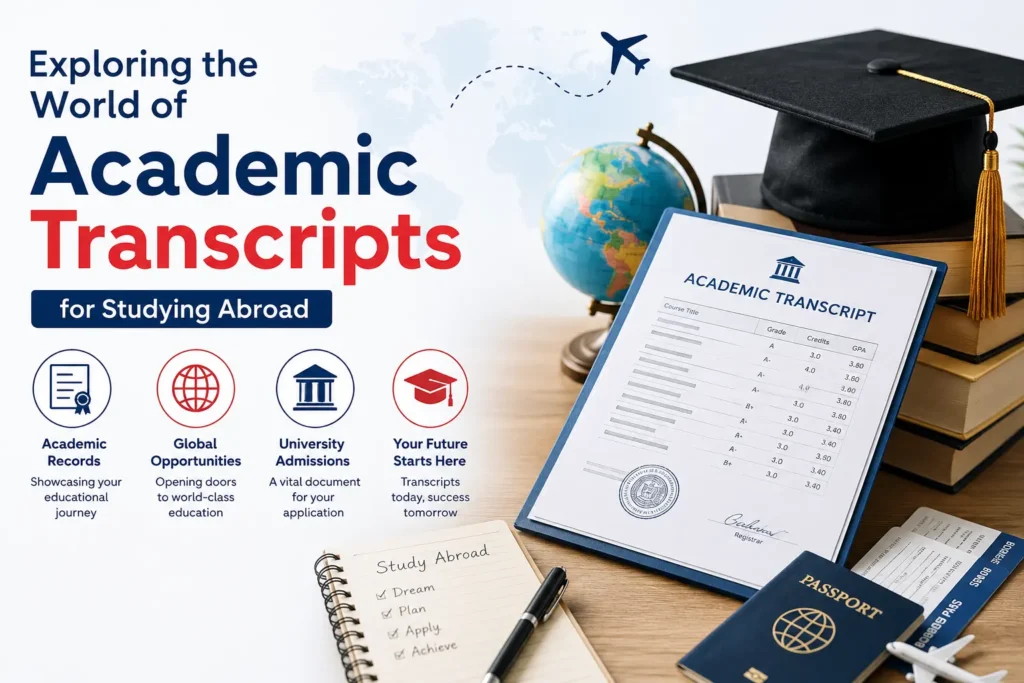
Exploring the World of Academic Transcripts for Studying Abroad Exploring the World of Academic Transcripts for Studying Abroad Studying abroad is an exciting prospect, but getting there means sorting through a ton of paperwork. Transcripts of academic work are among the most crucial documents. Transcripts often likened to report cards in the educational system, provide a comprehensive overview of academic background by emphasizing the courses one has taken and their performance in them. In this article, we go over the importance of academic transcripts for studying abroad and offer tips on how to make sure that one meets all the essentials to fulfil the dream of attending a university or college abroad. A successful foreign education attempt requires an understanding of the significance of academic transcripts, whether you’re a parent assisting with the process or a student getting ready to study abroad. What Exactly are Academic Transcripts? In simple terms, academic transcripts are similar to educational report cards. They are official documents that detail the subjects you studied and the corresponding grades or marks you achieved during your time in school or college. These transcripts play a pivotal role in your educational record and are frequently required when applying for jobs or pursuing further education. Components of an Academic Transcript: A typical academic transcript contains essential information to capture your academic journey: Course Names: A comprehensive list of all the courses or subjects undertaken during your academic program. Grades: The points assigned to each course. Credit Hours: The total amount of hours that each course is worth. GPA (Grade Point Average): The average of all of your course grades is your cumulative GPA. Institutional Information: Specifics regarding the college or school, such as its accreditation, name, and address. Dates: The completion deadlines for the program as a whole or for each course. Degree Details: Provide details about your degree, such as a Bachelor’s or Master’s degree, if relevant. Understanding Transcript of Records (ToR) A Transcript of Records (ToR) is a comprehensive document summarizing a student’s academic achievements in a specific educational program. Widely used in European and international academic contexts, the ToR includes crucial details such as course names, grades, credit hours, and cumulative GPA. Serving as an official record, ToRs are invaluable when transferring between institutions, applying for further education, or seeking employment, especially in the realm of international education recognition and mobility. Distinguishing Between Educational Documents: Transcripts, marksheets, certificates, diplomas, and degrees each serve distinct purposes. Here’s a quick overview: Document Purpose Key Characteristics Transcripts Comprehensive academic record Lists all courses, grades, credit hours, and GPA Marksheet Summarizes performance in a specific term Focuses on grades/marks for individual courses. Certificate Acknowledges completion of a short program Represents specific skills or knowledge acquisition. Diploma Indicates completion of a program Awarded for shorter programs, vocational or academic. Degree Represents academic program completion Signifies significant knowledge and academic achievement. The Significance of Academic Transcripts: Academic transcripts are extremely important for several reasons, acting as silent yet effective guardians of your educational journey. Educational History: They help with the evaluation of academic performance by providing a thorough record of all the courses you have completed and the grades you have received. Verification of Qualifications: Transcripts offer concrete proof of acquired credentials, including degrees or diplomas, which are necessary for employment applications or further education endeavors. Transferability: Make it easier for academic credits to be evaluated when transferring between universities, both locally and abroad. Employment: During the recruiting process, a lot of businesses ask to see transcripts in order to confirm the educational background and qualifications of a candidate. Financial Aid and Scholarships: Necessary when requesting financial assistance, assisting in determining eligibility for scholarships and aid. Licensing and Certification: Transcripts may be needed to prove that a student has completed the requisite curriculum in order to be employed in some professions that require licensing or certification. Academic Recognition: Awarded with honors, prizes, or scholarships in recognition of exceptional academic achievement. Personal Development: Examining transcripts enables students to evaluate their academic performance and pinpoint areas in which they need to grow. For comprehensive guidance on the documentation involved in applying to foreign universities, connect with international education experts at Focus Education. As it will assist you in navigating the admission process and realizing your aspirations for studying abroad.
Understanding IELTS Reading: Strategies for Success
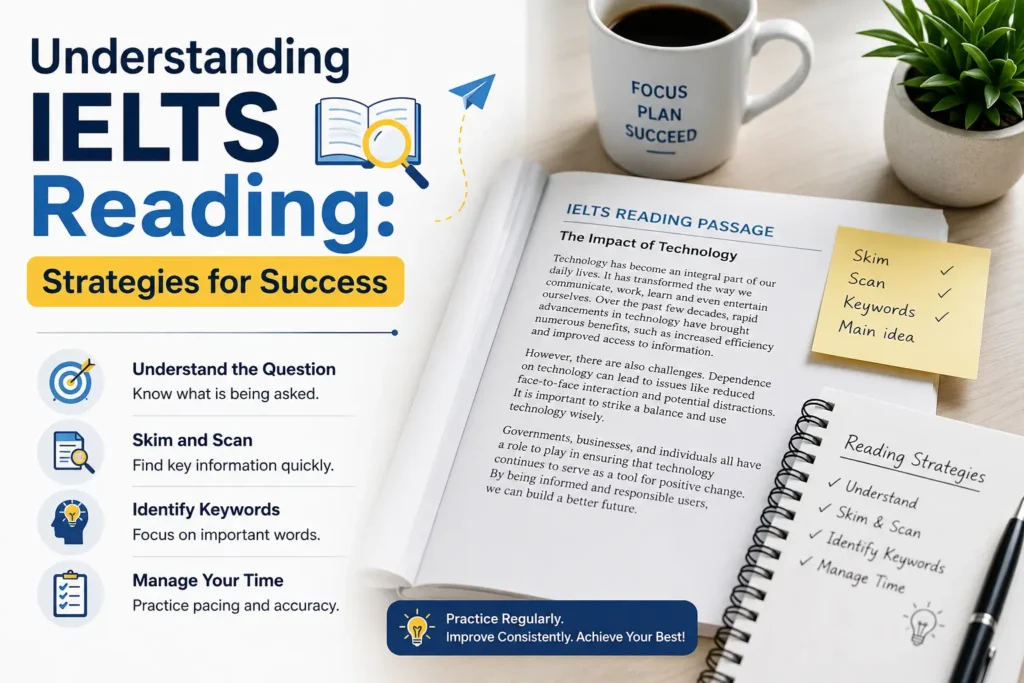
Understanding IELTS Reading: Strategies for Success Understanding IELTS Reading: Strategies for Success The International English Language Testing System (IELTS) is a globally recognized English language proficiency test that measures your ability to communicate effectively in English. One of the key components of the IELTS exam is the Reading section, which measures the ability to understand and interpret written information. To succeed in the IELTS Reading test, it is crucial to develop effective strategies and enhance your reading skills. In this blog, we will discover some tips that help you understand and excel in the IELTS Reading section. 1. Familiarize Yourself with the Test Format: Before starting your IELTS preparation, it is essential to understand the format of the Reading test. The IELTS Reading section contains three passages, each with a set of questions. The passages are taken from various sources, such as newspapers, magazines, or books. Being familiar with the test format will give you a clear idea of what to expect on exam day. 2. Skim and Scan Techniques: Time management is the most important in the IELTS Reading test. Develop the habit of quickly skimming through the passages to get a general sense of the content. Furthermore, practice scanning for specific information by looking for keywords or phrases that relate to the questions. Skimming and scanning will help you to find related details efficiently. 3. Underline Key Information: As you read the passages, underline or highlight key information. This could include main ideas, supporting details, or any data that looks important. This practice will not only help to stay focused but also make it easier to find answers when you refer back to the text. 4. Predict Answers: Before reading the questions, try to predict possible answers based on your understanding of the passage. This proactive approach can guide your reading and make it easier to identify correct answers. Pay attention to the context and the tone of the passage to make accurate predictions. 5. Vocabulary Enhancement: The IELTS Reading test often includes complex vocabulary. To enhance your understanding, work on expanding your vocabulary. Make a habit of noting down unfamiliar words and phrases, and practice using them in sentences. This will not only improve your comprehension but also aid in answering vocabulary-related questions. 6. Practice Regularly: Like any other skill, reading proficiency improves with practice. Set aside dedicated time for regular reading practice. Choose a variety of texts, including academic articles, newspapers, and magazines, to expose yourself to different writing styles and topics. 7. Time Management: The IELTS Reading test has a strict time limit, so effective time management is crucial. Practice answering questions within the allocated time for each passage. Develop a strategy for quickly moving on from a question if you find it challenging and returning to it later if time permits. 8. Simulate Exam Conditions: To familiarize yourself with the pressure of the actual exam, simulate test conditions during your practice sessions. Set a timer, adhere to the time limits, and eliminate distractions. This will help you build confidence and perform better on the actual test day. Achieving mastery in the IELTS Reading section is a step-by-step journey that demands ongoing dedication and regular practice. By integrating these tactics into your preparation regimen, you can elevate your reading abilities and boost your likelihood of excelling on the IELTS exam. Maintain composure, utilize time effectively, and adopt a strategic approach to each passage. If you are eager to enroll in an IELTS class that guarantees progress toward your target score, do not hesitate to visit Focus Education today and partake in a complimentary Demo class to kickstart your journey to success.
Mastering IELTS Speaking: An Ultimate Guide to Success

Mastering IELTS Speaking: An Ultimate Guide to Success Mastering IELTS Speaking: An Ultimate Guide to Success If you are gearing up to take the IELTS exam, mastering the speaking section is very important for overall success. Here we will guide you through important tips and strategies that will help you confidently navigate the IELTS Speaking test. Important Tips and Strategies Understand the Format: The IELTS Speaking test contains three parts, each serving a specific purpose. Familiarize yourself with the format: Part 1: Introduction and Interview Part 2: Long Turn Part 3: Discussion Knowing what to expect in each section will help to reduce nervousness and improve your performance. Practice Regularly: Practice makes a man perfect, which stands true for the IELTS Speaking test. Engage in regular speaking practice with a study partner or through online platforms. Record yourself to identify areas of improvement, such as pronunciation, fluency, and vocabulary usage. Expand Your Vocabulary: Enhance your vocabulary to express ideas more precisely. Work on incorporating a variety of words into your responses, showcasing your ability to describe thoughts effectively. Reading extensively and noting down unfamiliar words will contribute to your vocabulary growth. Work on Pronunciation: Clear pronunciation is essential for effective communication. Practice pronouncing challenging words, and consider using online resources or language exchange programs to receive feedback. Focus on intonation and stress patterns to sound more natural and confident. Time Management: Efficient time management is required to succeed in the IELTS Speaking test. Practice responding to questions within the allocated time for each section. This will help you develop the ability to organize your thoughts quickly and present them coherently. Familiarize Yourself with Common Topics: IELTS speaking topics frequently revolve around everyday experiences, personal opinions, and global issues. Stay updated on current events and practice discussing various topics. This will enable you to respond confidently to a wide range of questions during the test. Seek Feedback: Constructive feedback is invaluable in your journey to mastering IELTS Speaking. Share your practice sessions with teachers, language exchange partners, or online communities. Feedback will help you identify strengths and weaknesses and refine your speaking skills. Be Mindful of Non-verbal Communication: Remember that communication involves more than just words. Be attentive to your body language, facial expressions, and gestures. Maintain eye contact and use suitable gestures to enhance your overall communication skills. Stay Calm and Confident: On the day of the test, nervousness is natural, but maintaining calm is crucial. Take deep breaths, listen carefully to questions, and respond with confidence. Remember that the examiner is there to assess your language skills, not to threaten you. Achieving proficiency in the IELTS Speaking test necessitates commitment, consistent practice, and a strategic methodology. Familiarise yourself with the format, engage in regular practice, enhance your vocabulary, and actively seek constructive feedback to ensure thorough preparation for showcasing your language skills on the test day. Join us at Focus Education for a Free Demo session if you are eager to excel in the IELTS and master the skills required.
Key Visa Changes in 2023: Essential Information for International Students planning to study in the United States

Guide for Canadian Student Visa Guide for Canadian Student Visa For many international students, starting an educational journey in Canada is a highly desired goal. However, getting a student visa to Canada is a difficult process that frequently involves unanticipated difficulties. This extensive guide will cover the specific steps needed to obtain a student visa for Canada, by explaining the differences between a Regular Study Permit and the Student Direct Stream, outline the qualities of a strong applicant, and clarifying the top 10 reasons that could result in the denial of an application for a student visa to Canada. The Journey to a Canada Visa Obtaining a Canada student visa is a meticulous, multi-step process that necessitates careful planning and observance of specific guidelines. The key steps include: 1. Acceptance into a Designated Learning Institute (DLI): Prospective students must first be admitted to a DLI before submitting an application for a student visa to study in Canada. 2. Gather Necessary Documents: Candidates must gather a complete set of supporting documentation, which may include a DLI acceptance letter, evidence of financial stability, language competency exam results, and other records. 3. Create a GC Key Account: As part of the online application process, applicants are required to create a GC Key account to access the Canadian government’s online services. 4. Submit the Online Application: Using the Immigration, Refugees, and Citizenship Canada (IRCC) website, applicants must submit their online visa application, paying careful attention to accuracy and completeness. 5. Biometrics and Medical Examination: Applicants may undergo biometric data collection and a medical examination as part of the visa application process. 6. Wait for Processing: After submission, applications undergo a thorough review process, and applicants must patiently await a decision. Student Direct Stream vs. Regular Study Permit Prospective international students must comprehend the differences between the Regular Study Permit and the Student Direct Stream (SDS). 1. Student Direct Stream (SDS): SDS is an expedited processing system available to students from select countries, streamlining the visa application process with faster turnaround times. Applicants must fulfil certain requirements, such as financial requirements and language competency, in order to be eligible for SDS. 2. Regular Study Permit: The Regular Study Permit is the standard application process, which may take longer than SDS but remains a viable option for students who do not meet the criteria for the expedited stream. Profile of a Successful Candidate A successful candidate for a Canada student visa often possesses the following attributes: 1. Admission to a Designated Learning Institution (DLI): Successful candidates have to secure admission to a recognized DLI, demonstrating their commitment to pursuing quality education. 2. Sufficient Financial Resources: Demonstrating the ability to cover tuition fees, living expenses, and other related costs is vital. This involves presenting clear and comprehensive financial documents, including bank statements, sponsorship letters, and other necessary details. 3. Language Proficiency: Meeting language proficiency requirements, typically through tests like IELTS, PTE or TOEFL, is crucial for a candidate’s academic success in a Canadian institution. 4. Clear Intent and Purpose: A compelling Statement of Purpose outlining the candidate’s educational and career goals, along with their intent to return to their home country after studies, strengthens their application. 5. Observance of Visa Regulations: Candidates have a better chance of being approved if they carefully follow the instructions for applying for a visa and provide accurate information. Top 10 Reasons for Rejection of Canada Student Visa Applications 1. Insufficient Financial Proof: The inability to demonstrate sufficient financial capacity is a common reason for rejection. Comprehensive and accurate financial documents are crucial. 2. Lack of Genuine Intent: Visa officers examine statements of purpose and interviews to assess the sincerity of intentions. A clear educational and career plan is essential. 3. Inadequate Documentation: The error of required documents can lead to delays or rejection. Applicants should carefully review and accurately complete the document checklist. 4. Low Language Proficiency: Meeting language proficiency requirements is paramount. Adequate preparation for language proficiency tests is crucial for success. 5. Criminal Record: Applicants with a criminal record may face challenges. Providing comprehensive information and evidence of rehabilitation is essential. 6. Medical Inadmissibility: Failing to meet health standards or posing a risk to public health may result in rejection. Professional guidance and comprehensive medical documentation are advised. 7. Unstable Political Situation: Applicants from politically unstable regions may face increased scrutiny. Providing context and emphasizing a commitment to Canadian laws is crucial. 8. Misrepresentation: Providing false information is a serious offense. Transparency and honesty throughout the application process are essential. 9. Academic Ineligibility: Failing to meet academic requirements is a common reason for rejection. Applicants should carefully review and meet or exceed the academic prerequisites. 10. Overstay History: Individuals with a history of overstaying visas may be deemed high-risk. Providing a detailed explanation, evidence of compliance, and a plan for adherence to Canadian visa regulations is essential. Conclusion Navigating the process of securing a student visa for Canada requires careful planning and deep comprehension of the nuts and bolts. By familiarizing themselves with the essentials of the application process, prospective students can address potential pitfalls and enhance their chances of securing a Canada student visa. To ensure a successful academic journey in Canada, candidates must carefully evaluate the profile of a successful candidate and precisely address the top 10 causes for rejection, regardless of which option they choose—the Regular Study Permit or the Student Direct Stream. Embarking on your academic journey in Canada is a strategic move towards a future-ready career. As you contemplate this academic endeavor, consider the multifaceted advantages that Canada presents, ensuring a well-rounded and rewarding path into the dynamic realm of your academic journey. Feel free to get in touch with Focus Education team for any further queries.
Strategies for Scoring High in IELTS Listening
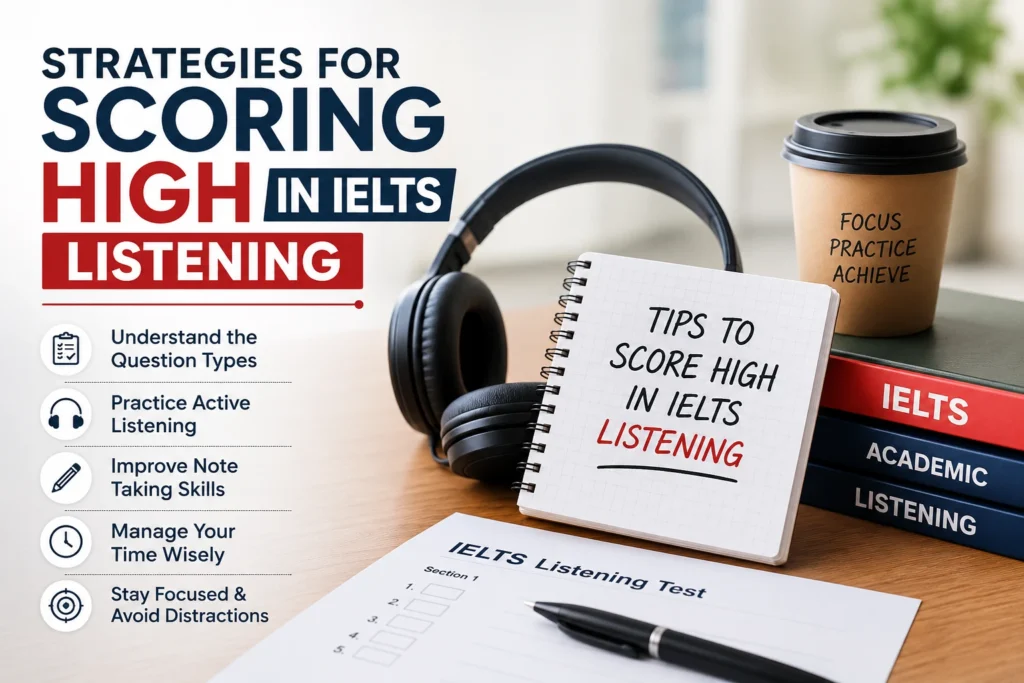
Strategies for Scoring High in IELTS Listening Strategies for Scoring High in IELTS Listening IELTS is a widely recognized and accepted English proficiency test for those looking to study or work in English-speaking countries. Among its four sections, the IELTS Listening test can be particularly challenging for many candidates. However, with the right strategies and preparation, you can remarkably improve your chances of scoring high in this section. Here, we will explore fruitful techniques to enhance IELTS Listening performance. Strategies for Scoring High in IELTS Listening 1. Develop your Listening Skills: Improving overall listening skills is the basis for success in the IELTS Listening test. Engage in regular practice by listening to a range of English materials, such as podcasts, news broadcasts, and academic lectures. This will help you become familiar with different accents, tones, and speech patterns. 2. Familiarize Yourself with Different Accents: IELTS Listening passages frequently feature a range of accents, including British, American, Canadian, Australian, and others. Make sure to expose yourself to these accents during your preparation. Listen to audio materials from different English-speaking regions to become comfortable with diverse pronunciations and speech styles. 3. Practice with Authentic IELTS Listening Materials: Familiarize yourself with the format and difficulty level of the IELTS Listening test by practicing with authentic materials. Use past IELTS test papers and official practice materials to simulate the test environment. This will help you become familiar with the types of questions and the pace of the test. 4. Develop Time Management Skills: Time management is vital in the IELTS Listening test, where you must answer 40 questions in about 30 minutes. Practice answering questions under timed conditions to enhance your time management efficiency during the test. Prioritize questions based on difficulty and move on if you find a particular question challenging to avoid losing time. 5. Focus on Predictive Listening: Develop the skill of predictive listening to anticipate information before it is explicitly given. Listen to context clues, keywords, and transitions in the audio passages. This will enable you to stay ahead of the speaker and increase your chances of accurately answering questions. 6. Use Highlighting and Underlining: You can take notes and highlight relevant information during the test. Develop a system for quickly identifying key details in the audio passages. This can be particularly helpful when answering multiple-choice questions or completing sentence and summary completion tasks. 7. Avoid Letting One Mistake Derail You: It is essential to maintain composure if you miss a question. Do not let one mistake affect your performance on the remaining questions. Stay focused and move on to the next task with a positive mindset. Scoring high on the IELTS Listening test requires enhanced listening skills, familiarity with the test format, and effective time management. Incorporating these strategies into your preparation routine can enhance your performance and increase your chances of achieving the desired score. Remember, consistent practice and exposure to diverse English materials will significantly contribute to your success in the IELTS Listening section. If you aspire to excel in all four components, we invite you to join FOCUS EDUCATION, where you can avail a demo session followed by enrolment on coaching.
Guide for Canadian Student Visa
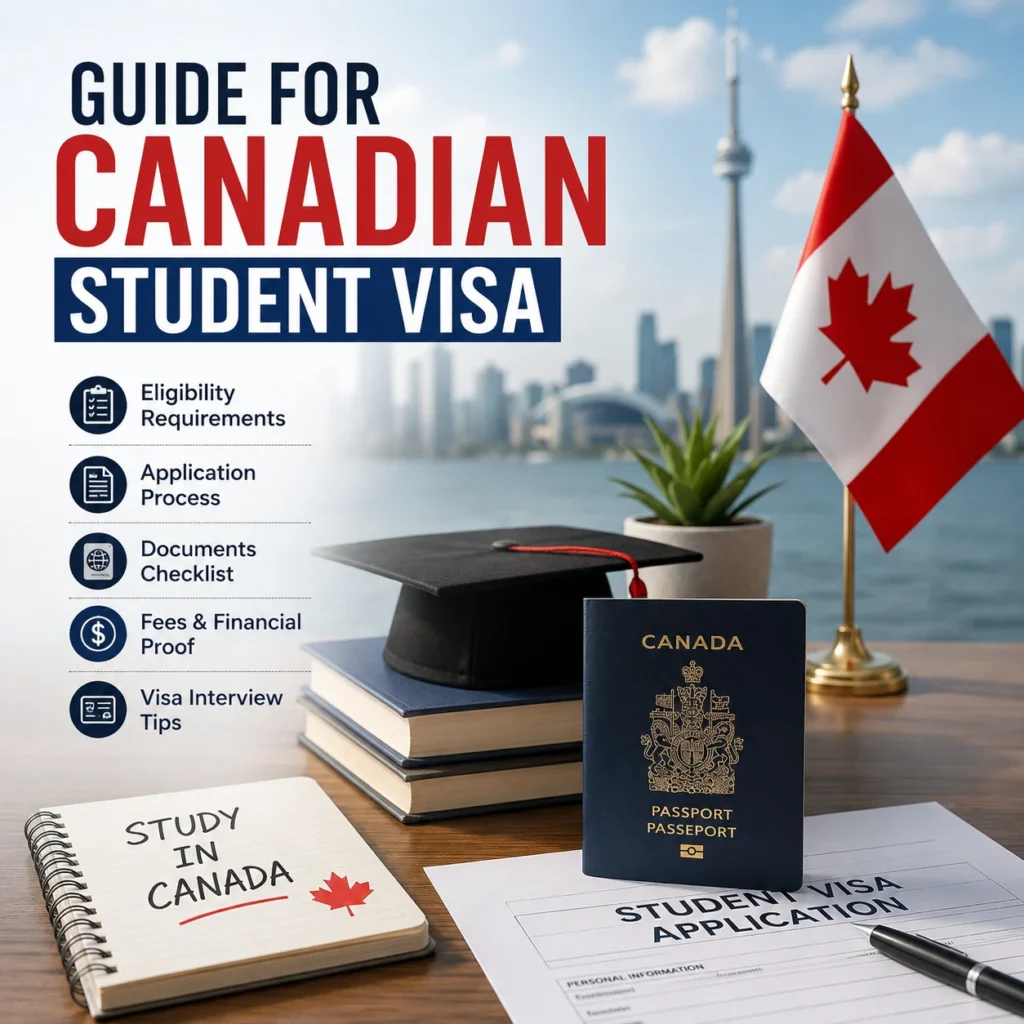
Guide for Canadian Student Visa Guide for Canadian Student Visa For many international students, starting an educational journey in Canada is a highly desired goal. However, getting a student visa to Canada is a difficult process that frequently involves unanticipated difficulties. This extensive guide will cover the specific steps needed to obtain a student visa for Canada, by explaining the differences between a Regular Study Permit and the Student Direct Stream, outline the qualities of a strong applicant, and clarifying the top 10 reasons that could result in the denial of an application for a student visa to Canada. The Journey to a Canada Visa Obtaining a Canada student visa is a meticulous, multi-step process that necessitates careful planning and observance of specific guidelines. The key steps include: 1. Acceptance into a Designated Learning Institute (DLI): Prospective students must first be admitted to a DLI before submitting an application for a student visa to study in Canada. 2. Gather Necessary Documents: Candidates must gather a complete set of supporting documentation, which may include a DLI acceptance letter, evidence of financial stability, language competency exam results, and other records. 3. Create a GC Key Account: As part of the online application process, applicants are required to create a GC Key account to access the Canadian government’s online services. 4. Submit the Online Application: Using the Immigration, Refugees, and Citizenship Canada (IRCC) website, applicants must submit their online visa application, paying careful attention to accuracy and completeness. 5. Biometrics and Medical Examination: Applicants may undergo biometric data collection and a medical examination as part of the visa application process. 6. Wait for Processing: After submission, applications undergo a thorough review process, and applicants must patiently await a decision. Student Direct Stream vs. Regular Study Permit Prospective international students must comprehend the differences between the Regular Study Permit and the Student Direct Stream (SDS). 1. Student Direct Stream (SDS): SDS is an expedited processing system available to students from select countries, streamlining the visa application process with faster turnaround times. Applicants must fulfil certain requirements, such as financial requirements and language competency, in order to be eligible for SDS. 2. Regular Study Permit: The Regular Study Permit is the standard application process, which may take longer than SDS but remains a viable option for students who do not meet the criteria for the expedited stream. Profile of a Successful Candidate A successful candidate for a Canada student visa often possesses the following attributes: 1. Admission to a Designated Learning Institution (DLI): Successful candidates have to secure admission to a recognized DLI, demonstrating their commitment to pursuing quality education. 2. Sufficient Financial Resources: Demonstrating the ability to cover tuition fees, living expenses, and other related costs is vital. This involves presenting clear and comprehensive financial documents, including bank statements, sponsorship letters, and other necessary details. 3. Language Proficiency: Meeting language proficiency requirements, typically through tests like IELTS, PTE or TOEFL, is crucial for a candidate’s academic success in a Canadian institution. 4. Clear Intent and Purpose: A compelling Statement of Purpose outlining the candidate’s educational and career goals, along with their intent to return to their home country after studies, strengthens their application. 5. Observance of Visa Regulations: Candidates have a better chance of being approved if they carefully follow the instructions for applying for a visa and provide accurate information. Top 10 Reasons for Rejection of Canada Student Visa Applications 1. Insufficient Financial Proof: The inability to demonstrate sufficient financial capacity is a common reason for rejection. Comprehensive and accurate financial documents are crucial. 2. Lack of Genuine Intent: Visa officers examine statements of purpose and interviews to assess the sincerity of intentions. A clear educational and career plan is essential. 3. Inadequate Documentation: The error of required documents can lead to delays or rejection. Applicants should carefully review and accurately complete the document checklist. 4. Low Language Proficiency: Meeting language proficiency requirements is paramount. Adequate preparation for language proficiency tests is crucial for success. 5. Criminal Record: Applicants with a criminal record may face challenges. Providing comprehensive information and evidence of rehabilitation is essential. 6. Medical Inadmissibility: Failing to meet health standards or posing a risk to public health may result in rejection. Professional guidance and comprehensive medical documentation are advised. 7. Unstable Political Situation: Applicants from politically unstable regions may face increased scrutiny. Providing context and emphasizing a commitment to Canadian laws is crucial. 8. Misrepresentation: Providing false information is a serious offense. Transparency and honesty throughout the application process are essential. 9. Academic Ineligibility: Failing to meet academic requirements is a common reason for rejection. Applicants should carefully review and meet or exceed the academic prerequisites. 10. Overstay History: Individuals with a history of overstaying visas may be deemed high-risk. Providing a detailed explanation, evidence of compliance, and a plan for adherence to Canadian visa regulations is essential. Conclusion Navigating the process of securing a student visa for Canada requires careful planning and deep comprehension of the nuts and bolts. By familiarizing themselves with the essentials of the application process, prospective students can address potential pitfalls and enhance their chances of securing a Canada student visa. To ensure a successful academic journey in Canada, candidates must carefully evaluate the profile of a successful candidate and precisely address the top 10 causes for rejection, regardless of which option they choose—the Regular Study Permit or the Student Direct Stream. Embarking on your academic journey in Canada is a strategic move towards a future-ready career. As you contemplate this academic endeavor, consider the multifaceted advantages that Canada presents, ensuring a well-rounded and rewarding path into the dynamic realm of your academic journey. Feel free to get in touch with Focus Education team for any further queries.
10 Financial Planning Tips & Tricks for Studying Aboard.

10 Financial Planning Tips & Tricks for Studying Aboard. 10 Financial Planning Tips & Tricks for Studying Aboard. Budgeting while studying abroad can be challenging for an international student but with proper planning and insights, one can ensure that their finances cover essential expenses and even leave some spare money for emergencies. Staring on a journey overseas is a wonderful opportunity, but it also presents a unique set of difficulties, particularly when it comes to handling money while living abroad. Effective money management is essential to guarantee a seamless and pleasurable experience, from currency conversion to budgeting and comprehending local banking systems. In this article, we will cover important financial topics that will be helpful for anyone living or planning to go overseas. 1. Research and Planning: Before one sets foot in a new country, it’s imperative to research and plan their finances accordingly. One needs to understand local currency and become familiarized with the currency used as well as the exchange rate. It is also important to keep track of fluctuations to optimize currency exchange timings. 2. Create a Budget: One should estimate their daily, weekly, and monthly expenses. Also, it is necessary to consider accommodation, transportation, food, and entertainment expenses so a realistic budget can help one to control their spending. 3. Get yourself a Local Bank Account: Prioritize obtaining a local bank account as it is the initial financial step when settling in a new country. Consider opening a bank account with an international presence as it can reduce transaction fees and provide easier access to funds. A tip over here: try to find out about the transaction fees and choose a card with minimal or no fees. 4. Bear in mind the necessity of budgeting: Budgeting is very important and one needs to evaluate their financial status and create a rational budget that includes necessities like study material, utilities, groceries, data fees, transportation, and travel each month. Also, it is wise to get money for unanticipated events or emergencies. 5. Smart Approach: Though studying abroad can be costly, through strategic planning it can be managed more easily. It is advisable to differentiate between your needs and wants by creating a priority list. One can also explore the ways to save and use money wisely. So for that, one should cut down on daily expenses with smart and straightforward tactics such as: Sharing accommodation. Acquiring student discount cards. Opting for used books or digital copies. Joining a library. Shopping during sales. Purchases from the community store. 6. Uphold Lifestyle: Consider getting a job to support lifestyle. In some countries, students are allowed to work up to 20 hours a week during term-time and full-time during term breaks. One of the factors to be considered while searching for a job is to check whether one can work with a student visa or not. 7. Currency Exchange: Before exchanging money, it is necessary to compare rates from different sources, including banks, currency exchange offices, and ATMs. Moreover, one should use ATMs wisely as they often offer better exchange rates however must be cautious of transaction fees. It is recommended to withdraw larger amounts to minimize the frequency of withdrawals. 8. Emergency Fund and Insurance: Maintaining emergency funds will provide a financial buffer for unexpected expenses. Additionally, investing in comprehensive travel insurance will help to cover health emergencies, trip cancellations, and lost or stolen belongings – it will be beneficial as it ensures that one is financially protected in unforeseen circumstances. 9. Take advantage of the Student Card: Obtaining a student card early will support student status as it can open doors to discounts in shops, restaurants, movie theatres, transportation, and various cultural events. Also, one should have a look at numerous websites that offer noteworthy discounts on events and shopping. 10. Learn to Cook: Why not? Buy fresh ingredients to cook at home. Trust us, one can easily save about 30% – 50% of the food budget with this! If there is a time shortage, one can cook in large portions and save it in the fridge; reheat and have it later so they don’t have to cook daily. Living abroad can be challenging in terms of spending money, but if managed well it is surely worth it! Studying in nations like the UK, US, Canada, and Australia, will give endless opportunities to study, work, and upgrade your lifestyle. If you looking forward to studying at a university overseas, get in touch with international education experts at Focus Education, who will help with the course and university selection and end-to-end admission process.
Unlocking Opportunities: Top 10 Benefits of Pursuing Higher Education in the UK for Indian Students

Unlocking Opportunities: Top 10 Benefits of Pursuing Higher Education in the UK for Indian Students Top 10 Benefits of Pursuing Higher Education in the UK for Indian Students Embarking on a journey of higher education in a foreign country is a dream that many Indian students aspire to achieve. Among the innumerable options, the United Kingdom stands out as one of the most appealing destinations, offering a plethora of benefits that can significantly shape the academic and personal growth of students. In this comprehensive blog, you can explore the top 10 advantages for Indian students who choose to pursue their higher education in the UK. 1. World-Renowned Academic Excellence: The UK is home to some of the world’s most prestigious universities known for their academic excellence standards. Renowned for their academic rigor and extensive research opportunities, these institutions provide a globally recognized and respected education, ensuring a well-rounded educational experience for Indian students. 2. Diverse Range of Courses: One of the key attractions for Indian students in the UK is the diverse array of courses available. UK universities offer a wide range of courses across various disciplines like humanities, science, business, or technology. Along with that, from traditional fields like engineering and medicine to emerging areas like artificial intelligence and sustainable energy, the UK offers a course for every passion which allows the student to tailor their education to their career goals and personal interests. 3. Cultural Diversity And Global Networking: The multicultural environment in the UK serves as a melting pot of cultures, which provides Indian students with a unique opportunity to interact with people from around the world. This exposure not only helps in building a global network but also fosters an understanding of different cultures; a crucial skill in today’s interconnected world. As students will get a chance to interact with people across the world, it can be invaluable for their future career and personal development. 4. Shorter Duration Of Courses: A notable advantage of the UK education system is the relatively shorter duration of courses compared to the other countries. For instance, undergraduate degrees typically take up to three years to complete, and postgraduate programs last one year. This structure not only saves students time but also reduces financial burdens. 5. Placements/Work Opportunities (During & After Studies): The UK government allows international students to work up to 20 hours per week during term time and full-time during vacations. Additionally, it also offers numerous internship and work placement opportunities. Apart from this, the UK government has implemented favorable post-study work visa policies, that allow the students to stay and work in the UK after completing their studies. 6. Apply With/ Without* Ielts: Planning to study in the UK without IELTS? No worries, many top-ranked UK universities are accepting students without an IELTS score. There are other ways to prove English proficiency, such as a score of 60% or above in higher secondary education in English language is acceptable by some of the universities after having telephonic or personal interviews to assess English language proficiency for admission. Almost all schools in India are English medium so this criterion becomes very useful for those who want to study in the UK without IELTS. 7. Scholarships And Financial Support: To ease the financial burden of studying abroad, numerous scholarships and financial aid options are available specifically for Indian students in the UK. The important criteria are a good academic score, chosen subject, and level. It can also be gained through extracurricular activities and volunteering as these are the factors of advantages. 8. Strong Indian Community: The UK hosts a large Indian community that provides a comforting sense of familiarity and cultural connection for Indian students. This community support is instrumental in helping students transition smoothly into a new environment and combat homesickness. 9. English Language Proficiency: Being immersed in an English-speaking environment enhances language skills. With English as the primary language of instruction, studying in the UK provides Indian students with the opportunity to enhance their language proficiency. It is not only a pursuit of academic aids but also significantly enhances employability in the global job market. 10. Quality Of Life: The UK is known for its high quality of life, healthcare system, and safety. It provides the benefit of well-developed infrastructure, public services, and multicultural society. It also has a rich history and cultural heritage, that also provides the chance to explore historical landmarks, museums, and cultural events, offering a well-rounded educational experience. Hence, living in the UK exposes students to a rich cultural tapestry as it delivers opportunities to experience diverse lifestyles, traditions, and perspectives fostering a global outlook. For those dreaming of studying in the UK, the path to studying abroad may seem challenging, but it does not have to be navigated alone. Focus Education stands ready to provide expert guidance and support tailored to unique aspirants and needs. With Focus Education, students can confidently start their UK education journey, armed with the knowledge and guidance needed for success. So, what are you waiting for; scheduling a free counselling session at Focus Education is the first step towards realizing academic and career success in the UK. The UK education dream is within reach—booking a free counselling session with Focus Education will open the door to a journey of academic excellence and personal growth!
Mastering the Art of Studying and Exploring Abroad

Mastering the Art of Studying and Exploring Abroad Mastering the Art of Studying and Exploring Abroad To begin a journey of studying abroad is an exciting and enriching experience that offers not only academic growth but also personal development. However, finding the right balance between studies and exploration can be challenging. Here we will explore some important tips to help you make the most of your time abroad without compromising your academic commitments. 1. Create a Realistic Schedule: Start by making a realistic and flexible study schedule that considers your class timings, assignments, and exams. Allocate dedicated time for studying and stick to your schedule as much as possible. This will help you stay organized and manage your time effectively. 2. Prioritize Your Academic Responsibilities: Recognize the importance of academic responsibilities and prioritize them. Stay on top of assignments, readings, and exams to avoid last-minute stress. By keeping a proactive approach to your studies, you can free up time for exploration without sacrificing your academic performance. 3. Utilize Productive Study Spaces: Discover local libraries, quiet cafes, or study spaces on campus. Finding the right atmosphere for focused studying will enhance your productivity. Resist the temptation to study in crowded spots, as they may be distracting. Create a study routine that aligns with your surroundings. 4. Embrace Technology: Leverage technology to your advantage. Use productivity apps, online calendars, and reminders to stay organized. Many educational resources are available online, allowing to access study materials from anywhere. Stay connected with professors and classmates through virtual platforms for collective projects. 5. Engage in Cultural Experiences: While academics are a priority, exploring the local culture is an important aspect of studying abroad. Plan your outings and cultural experiences around your study schedule. Attend local events, try new food, and immerse yourself in the community. Strike a balance between academic responsibilities and the cultural richness of your host country. 6. Build a Support System: Surround yourself with a helpful network of friends, classmates, and mentors. Share your experiences and challenges with them. This network can provide valuable insights, advice, and emotional support, making it easier for you to manage the demands of both studying and exploring. 7. Set Realistic Goals: Establish achievable goals for both your academic and personal endeavours. Break down larger tasks into smaller, manageable steps. This approach will help you stay focused, and motivated, and prevent feeling overwhelmed. No matter how small, celebrate your achievements to maintain a positive mindset. 8. Embrace Flexibility: Be open to adjusting your plans and adapting to unexpected situations. Flexibility is key when exploring a new environment. Unexpected opportunities may arise, and being adaptable will allow you to seize them without jeopardizing your academic success. Studying abroad is a unique opportunity for personal and academic growth. At Focus Education Global Pvt. Ltd., we understand the significance of this experience and are committed to supporting you throughout your international education adventure. Our expert guidance will help you navigate the intricate process of studying abroad, providing valuable insights to enhance your academic and personal growth. As you delve into this enriching chapter of your educational journey, the collaboration with Focus Education Global Pvt. Ltd. ensures that you not only strike a balance between your studies and exploration but also receive tailored assistance to make the most of your overseas education experience. Remember, finding the perfect equilibrium may take time, and our dedicated team is here to guide you every step of the way. With patience and perseverance, you can create a fulfilling and successful study abroad experience with the expert assistance of Focus Education Global Pvt. Ltd.