
How to Improve Coherence Without Overusing Linking Words
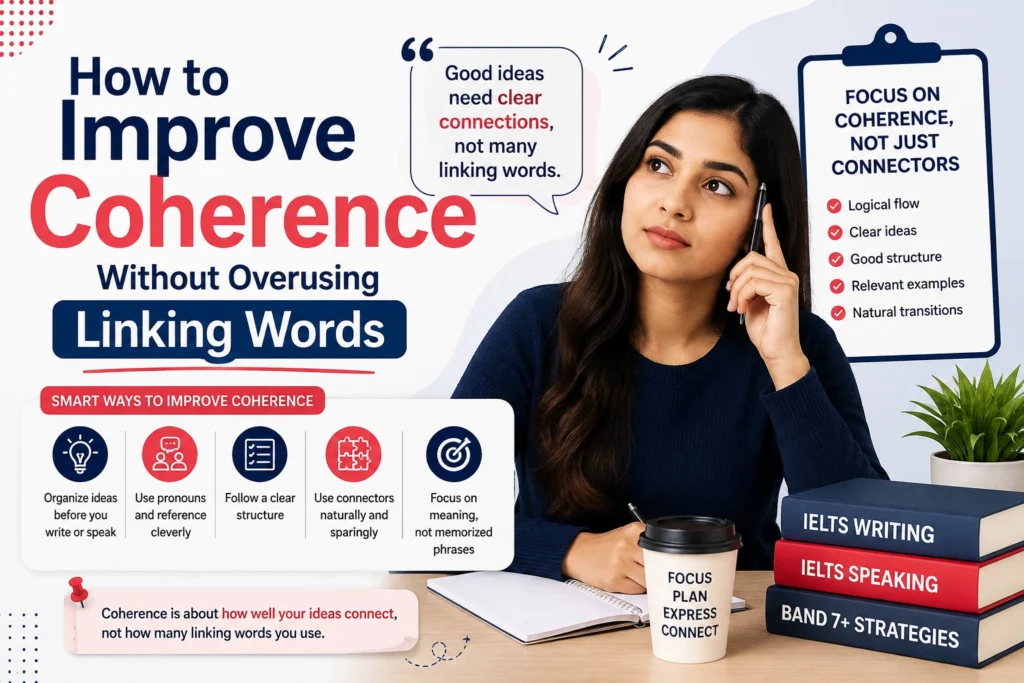
How to Improve Coherence Without Overusing Linking Words Many IELTS students believe that using more linking words automatically improves their writing. As a result, essays often look like this: “Firstly… Moreover… Furthermore… In addition… On the other hand, …” While linking words are important, overusing them can make your writing sound mechanical and unnatural. In some cases, it even reduces your score in Coherence and Cohesion. Therefore, we help students to understand that coherence is not about adding more connectors — it is about making ideas flow logically and smoothly. What Is Coherence in IELTS Writing? Coherence means that your ideas are logically connected and easy to follow. The examiner should not feel confused while reading your essay. A coherent paragraph: Has one clear main idea Develops that idea step by step Connects sentences naturally Linking words can support coherence, but they are not the only solution. Why Overusing Linking Words Is a Problem Many students try to impress the examiner by adding connectors in every sentence. This creates two issues: The writing feels repetitive and forced The natural flow of ideas is lost Example: Firstly, technology is useful. Moreover, it helps communication. Furthermore, it saves time. In addition, it improves efficiency. This does not sound natural. It feels like a list, not a developed idea. How to Improve Coherence the Right Way 1. Focus on Idea Development Instead of adding more linking words, focus on expanding your idea clearly. Weak: Technology is useful. Moreover, it helps communication. Better: Technology is useful because it improves communication. People can now connect instantly through messages and video calls, which makes interaction faster and more convenient. Here, coherence comes from explanation — not connectors. 2. Use Pronouns and Referencing You do not always need to repeat the same noun. Use pronouns to maintain flow. Example: Many people prefer online education. This approach allows them to study from home. Words like: this these it such methods help connect sentences smoothly. 3. Maintain a Clear Paragraph Structure Each paragraph should follow a logical pattern: Topic sentence Explanation Example Further explanation When your structure is clear, coherence improves automatically — without extra linking words. 4. Use Linking Words Selectively Linking words are still useful, but they should be used only where necessary. Instead of adding them everywhere, use them to: Show contrast (however, on the other hand) Add important points (in addition, moreover — occasionally) Show results (therefore, as a result) Quality matters more than quantity. 5. Read Your Writing Like a Reader After writing, ask yourself: Does this paragraph feel smooth? Are ideas connected logically? Am I repeating the same connectors? If the answer feels “forced,” simplify your sentences. Final Thought In IELTS Writing, coherence is not created by filling your essay with linking words. It is built through clear thinking, logical structure, and smooth connections between ideas. Students who focus only on connectors often sound mechanical. In contrast, those who focus on idea development sound natural and score higher. At Focus Education, students are trained to improve coherence through structured writing techniques rather than memorised linking phrases. With the right guidance, it becomes easier to write essays that flow naturally and meet the expectations of the IELTS examiner. If you want to improve your Writing Task 2 score without sounding repetitive, Focus Education can help you develop the right approach and achieve your target band score.
Why Good English Speakers Still Get Band 6 in IELTSSpeaking
Why Good English Speakers Still Get Band 6 in IELTS Speaking Many IELTS candidates walk into the Speaking test feeling confident. They speak English daily. They watch English shows, use English at work, and communicate comfortably. Yet, when the result arrives, the score says Band 6. The reaction is almost always the same: “But I speak English well!” At Focus Education, this is one of the most common concerns we hear. The truth is simple — IELTS Speaking does not test how comfortable you are in English. It tests how effectively and strategically you perform under specific band criteria. Let us explore the hidden reasons why fluent English speakers still get stuck at Band 6. 1. Fluency Without Development Many students speak smoothly but do not develop their answers properly. For example, in Part 2, a candidate may describe a person in just 60–70 seconds and then stop. Or in Part 3, they may give short opinions without explanation. Band 7+ requires: Extending ideas naturally Adding explanations Giving examples Showing depth in discussion Fluency alone is not enough. The examiner listens for how well you build and expand your thoughts. 2. Informal Speaking Style Good English speakers often use very casual, everyday language. Phrases like: “You know” “Like” “Stuff like that” “Things and all” These are natural in daily conversation, but overuse makes your language sound less precise. Band 7 and above expects: Controlled vocabulary Clear expression Fewer fillers More structured responses IELTS does not test friendliness. It is testing communicative competence. 3. Repetitive Vocabulary Many fluent speakers rely on safe words: “Good” “Nice” “Very” “A lot” “Big” This limits the Lexical Resource score. For example: Band 6 response: “It was very good and very interesting.” Band 8 response: “It was genuinely fascinating and left a lasting impression on me.” The difference is not complexity — it is precision. 4. Grammar That Is Accurate but Simple Some candidates make very few grammatical mistakes, which is good. But they only use simple sentence structures: “I like it because it is useful.” “It is important for society.” To move beyond Band 6, students must show: Complex sentences Conditional forms Comparisons Relative clauses Natural linking of ideas Accuracy + variety = higher band. 5. Weak Performance in Part 3 This is the biggest hidden reason. Part 3 is analytical and abstract. Even confident speakers struggle here. Common problems: Giving short answers Repeating Part 2 ideas Avoiding deeper discussion Saying “I have never thought about it” too often Band 7+ requires: Discussion, not conversation Explanation of causes and effects Balanced viewpoints Logical development Many Band 6 speakers perform well in Part 1 but drop in Part 3. 6. Lack of Structure While Speaking Yes, structure matters even in speaking. High-band candidates subconsciously follow a pattern: Direct answer Explanation Example Result or conclusion Band 6 speakers often speak randomly. Ideas are good, but they are not organised. The examiner should feel that your response is guided and intentional. 7. Overconfidence Without Strategy This is subtle but common. Good English speakers assume: “I’ll just speak naturally.” But IELTS Speaking is not a casual chat. It is a performance based on four clear criteria: Fluency and Coherence Lexical Resource Grammatical Range and Accuracy Pronunciation Without understanding these criteria, even strong speakers underperform. The Real Difference Between Band 6 and Band 7 It is not about sounding British or American. It is not about using extremely difficult vocabulary. It is not about speaking fast. The real difference is: Control. Depth. Precision. Consistency across all three parts. Band 7 speakers sound confident and organised. Band 6 speakers sound comfortable but slightly casual and repetitive. That small difference costs one full band. Final Thoughts If you are a good English speaker but stuck at Band 6, do not feel discouraged. It does not mean your English is weak. It simply means your performance needs refinement and strategy. With the right feedback, structured practice, and clear understanding of examiner expectations, moving from Band 6 to Band 7 is absolutely achievable. At Focus Education, speaking preparation goes beyond mock tests. Students are trained to understand band descriptors, improve idea development, refine vocabulary naturally, and handle Part 3 discussions with confidence. If you believe your English is good but your score does not reflect it, it may be time to prepare differently. Connect with Focus Education and turn your speaking ability into a Band 7+ performance.
Common Myths About IELTS That Students Still Believe
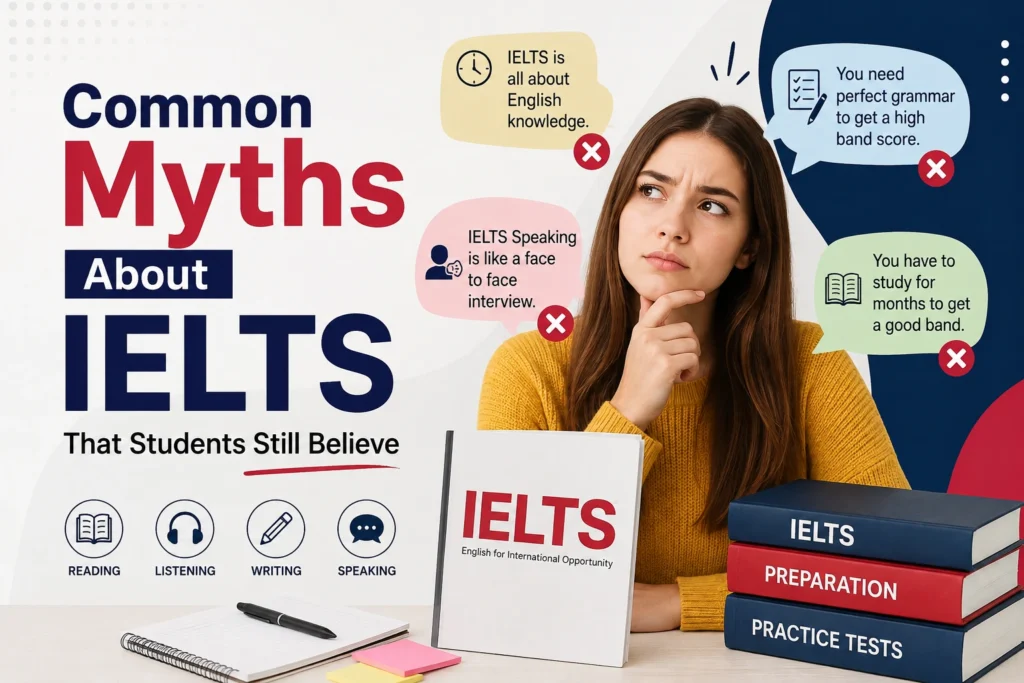
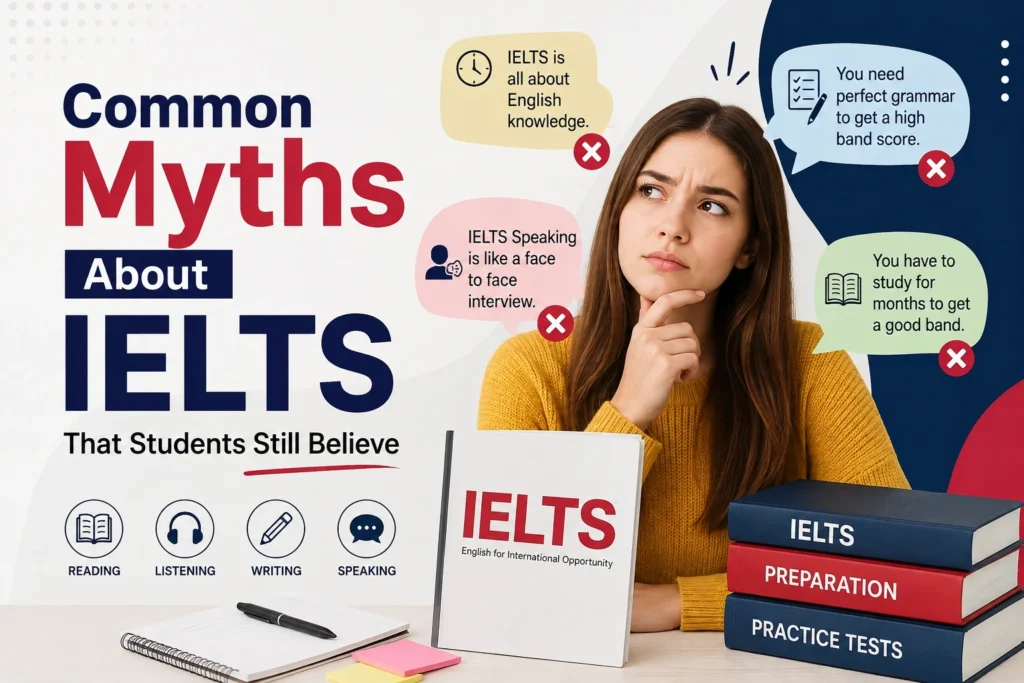
Common Myths About IELTS That Students Still Believe IELTS is one of the most widely taken English proficiency tests, yet there is a surprising amount of confusion around it. Many students begin their preparation with assumptions that are simply not true. These myths not only create unnecessary stress but also lead to poor preparation strategies. Clearing these misconceptions is the first step toward effective preparation. Myth 1: You Need Very Advanced English to Score Well Many students believe that IELTS requires extremely high-level English or “native-like” fluency. Reality: IELTS does not expect perfection. A Band 7 or 8 score requires: Clear communication Good control of grammar Appropriate vocabulary You do not need to use very difficult words or complex sentences all the time. In fact, simple and accurate English often performs better. Myth 2: Using Difficult Vocabulary Guarantees a High Score Students often memorise uncommon words to impress the examiner. Reality: Examiners focus on: Correct usage Natural expression Flexibility in language Using a difficult word incorrectly can reduce your score. It is always better to use simple words accurately than complex words incorrectly. Myth 3: Speaking Fast Means Better Fluency Some students try to speak quickly in the Speaking test to sound fluent. Reality: Fluency is not about speed. It is about: Speaking smoothly Avoiding long pauses Organising ideas clearly Speaking too fast can actually lead to mistakes and reduce clarity. Myth 4: You Must Write Very Long Answers Many candidates believe that writing more words will increase their band score. Reality: IELTS requires: Task 1: At least 150 words Task 2: At least 250 words Writing more than necessary does not improve your score. In fact, it can lead to: More mistakes Poor time management Quality matters more than quantity. Myth 5: Memorised Templates Help in Writing Students often rely on fixed templates for introductions and conclusions. Reality: Examiners can easily identify memorised content. Overusing templates: Reduces flexibility Sounds unnatural May limit your score It is better to understand the structure than to memorise sentences. Myth 6: IELTS Is Designed to Trick Students Some students feel that IELTS questions are intentionally confusing. Reality: IELTS is a standardised test. It is designed to: Assess language ability Test understanding and application Most mistakes happen due to a lack of strategy, not because the test is “tricky.” Myth 7: You Can Improve Just by Practising More Tests Many students solve multiple mock tests but see no improvement. Reality: Practice alone is not enough. Improvement comes from: Understanding mistakes Getting feedback Learning strategies Without analysis, practice becomes repetitive rather than productive. Myth 8: Grammar Must Be Perfect to Get a High Band Students often worry about making even small grammar mistakes. Reality: IELTS does not require perfect grammar. Instead, it looks for: Good control Variety in sentence structures Ability to communicate clearly Small errors are acceptable as long as they do not affect understanding. Final Thought Believing in IELTS myths can slow down your progress and create unnecessary pressure. When students understand what the test actually requires, their preparation becomes more focused and effective. Success in IELTS is not about tricks or shortcuts. It is about clarity, strategy, and consistent practice. For reliable guidance and structured preparation, Focus Education helps students move beyond confusion and build the skills needed to achieve their target band score.
Skimming and Scanning: The Twin Skills You Need for IELTS Reading
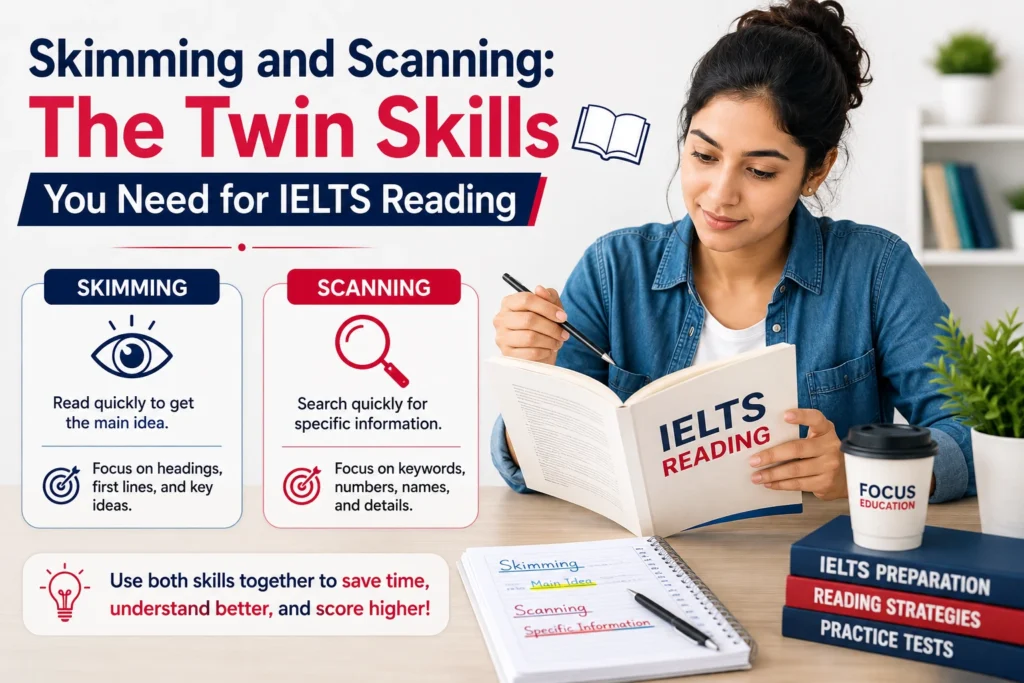
Skimming and Scanning: The Twin Skills You Need for IELTS Reading Many students believe that IELTS Reading is all about strong English. While language does play a role, the real challenge is time management. With long passages and limited time, reading every word carefully is simply not practical. This is where two essential skills come in — skimming and scanning. If used correctly, these techniques can help you read faster, locate answers quickly, and improve your overall score. What Are Skimming and Scanning? Before learning how to use them, it is important to understand what they actually mean. Skimming is reading quickly to understand the main idea of a passage. Scanning is looking for specific information like names, dates, or keywords. Both skills are different, but they work together. Skimming gives you a general understanding, while scanning helps you find exact answers. Why These Skills Are Important for IELTS The IELTS Reading test includes 3 long passages and 40 questions in 60 minutes. If you try to read everything in detail, you will likely run out of time. Skimming and scanning help you: Save time Avoid unnecessary reading Focus only on relevant information Improve accuracy by reducing confusion In short, they allow you to work smarter, not harder. How to Skim Effectively Skimming is your first step when you see a new passage. The goal is not to understand every detail, but to get a quick idea of the content. Here’s how you can do it: Read the title of the passage carefully Focus on the first sentence of each paragraph Notice repeated words or key topics Pay attention to names, dates, and headings Example: If a passage is about urban transport, you might quickly notice words like traffic, public transport, pollution, and infrastructure. Even without reading everything, you now understand the general theme. This initial understanding helps you locate answers much faster later. How to Scan for Answers Once you start solving questions, scanning becomes your main tool. Instead of reading the whole passage again, you: Identify keywords in the question Look for those keywords (or similar words) in the passage Read only the relevant part carefully Example: Question: “In which year did the company expand internationally?” Here, the keyword is year. You should scan for numbers like 1998, 2005, 2010, etc., instead of reading every line. Once you find the year, read that sentence properly to confirm your answer. Understand the Role of Paraphrasing One common mistake many students make is looking for exact words from the question. However, IELTS rarely uses the same wording. Example: Passage: The city introduced new measures to reduce air pollution. Question: The government took steps to control environmental damage. Here: introduced new measures = took steps reduce air pollution = control environmental damage This is called paraphrasing, and recognising it is essential for both skimming and scanning. Common Mistakes to Avoid Even when students know these techniques, they often misuse them. Here are a few mistakes to watch out for: Skimming too fast and missing the main idea Scanning without understanding the question properly Looking for exact words instead of meaning Reading the entire passage again for every question Ignoring keywords like names, dates, and numbers Avoiding these mistakes can immediately improve your performance. How to Practice These Skills Like any other skill, skimming and scanning improve with practice. You can: Take timed reading tests regularly Practice finding keywords quickly Train yourself to read in phrases, not word by word Review your mistakes to understand where you lost time Even 20–30 minutes of focused practice daily can make a big difference over time. Final Thoughts Skimming and scanning are not shortcuts — they are essential strategies for success in IELTS Reading. They help you manage time, reduce stress, and improve accuracy without needing to read everything in detail. With the right guidance and consistent practice, these skills become natural. At Focus Education, students are trained to apply these techniques effectively in real exam conditions, helping them approach the Reading section with clarity and confidence.
Prepositions in IELTS: Common Errors and Fixes
Prepositions in IELTS: Common Errors and Fixes Prepositions are small words, but they create big problems for IELTS students. Words like in, on, at, for, to, and of seem simple, yet even students with good English often use them incorrectly. Students may have strong ideas and vocabulary, but incorrect prepositions affect their Grammar score in both Writing and Speaking. The challenge is not understanding prepositions — it is using them naturally and accurately. Why Prepositions Are Difficult Prepositions do not always follow clear rules. In many cases, they depend on fixed combinations rather than logic. For example: We say interested in, not interested on We say depend on, not depend to Because of this, students often translate directly from their native language, which leads to errors. Common Preposition Mistakes (With Fixes) Let us look at some frequent mistakes IELTS students make and how to correct them. 1. “Discuss About” ❌ Incorrect: We discussed about the problem. Correct: We discussed the problem. Why? “Discuss” does not need a preposition. Adding about is unnecessary. 2. “Explain About” ❌ Incorrect: He explained about the process. Correct: He explained the process. Fix: Use explain something, not explain about something. 3. “Married With” ❌ Incorrect: She is married with a doctor. Correct: She is married to a doctor. 4. “Responsible Of” ❌ Incorrect: He is responsible of the project. Correct: He is responsible for the project. 5. “Good In” vs “Good At” Incorrect: She is good in English. Correct: She is good at English. 6. “On the Internet” vs “In the Internet” Incorrect: I saw it in the internet. Correct: I saw it on the internet. 7. “Different Than” ❌ (IELTS Preferred) Incorrect (in IELTS context): This is different than that. Correct: This is different from that. Prepositions in Time: A Common Confusion Students often mix in, on, and at when talking about time. At → exact time→ at 5 PM On → days and dates→ on Monday, on 15th June In → months, years, long periods→ in 2020, in July Example: Incorrect: The meeting is in Monday. Correct: The meeting is on Monday. Prepositions in Writing Task 1 Prepositions are especially important in Task 1 when describing data. Example: Incorrect: The number increased from 50 to 100 in 2010. Correct: The number increased from 50 to 100 in 2010. (The year is correct, but students often confuse with “at” or “on”) Another example: Incorrect: Sales increased of 20%. Correct: Sales increased by 20%. How to Improve Preposition Accuracy Improving prepositions is not about memorising long rules. It requires awareness and practice. Learn common verb + preposition combinations Notice prepositions while reading or listening Avoid direct translation from your native language Revise common IELTS mistakes regularly Practice using them in sentences, not in isolation Consistency is more important than perfection. Final Thought Prepositions may seem small, but they play an important role in your IELTS performance. Frequent errors can lower your grammar score, even if your ideas are strong. The goal is not to learn every rule, but to become familiar with common patterns and avoid repeated mistakes. For structured grammar improvement and practical IELTS training, Focus Education can help you build accuracy and confidence step by step.
How to Read Listening Questions Effectively
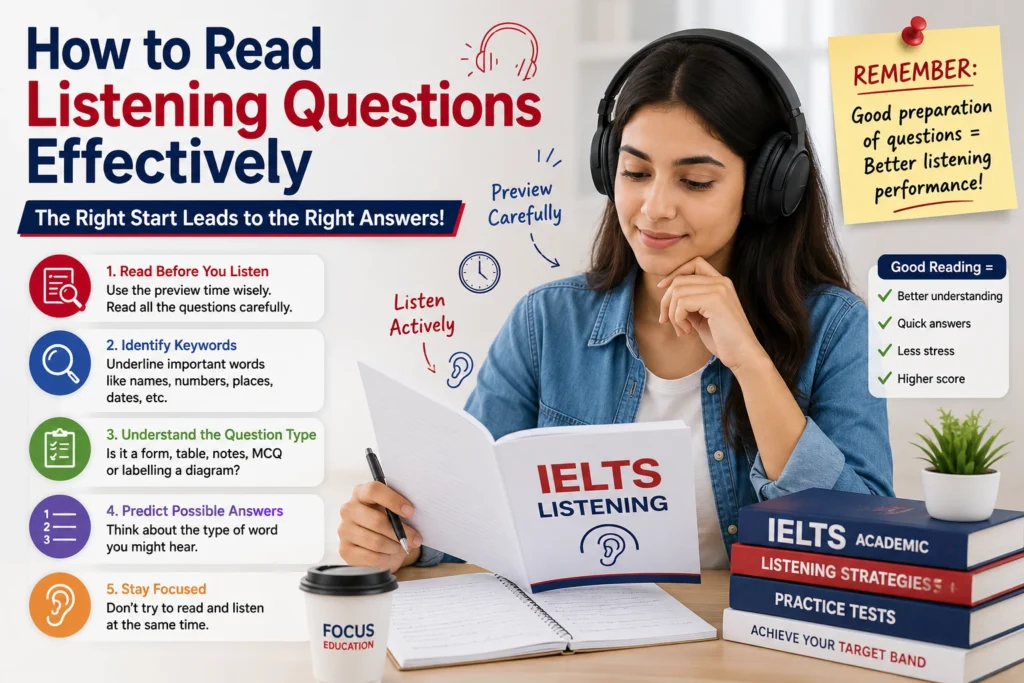
How to Read Listening Questions Effectively Listening is often one of the most challenging sections in tests like IELTS or PTE. Many students struggle not because they cannot understand English, but because they do not read and interpret the questions properly. Knowing how to read listening questions effectively can give you a clear advantage and improve your accuracy. Let’s explore how. 1. Read Before You Listen Always skim through the questions before the audio starts. This allows you to know what to listen for—names, numbers, dates, opinions, or specific facts. Example: If a question asks, “What time does the seminar start?” you know to listen for a time-related answer instead of getting distracted by other details. 2. Highlight Keywords Identify the main words that carry the question’s meaning. These can be nouns, names, numbers, or descriptive terms. Example: In “What solution does the speaker suggest for traffic congestion?”, the keywords are solution and traffic congestion. Focusing on these will guide your listening. 3. Understand Question Types Different question types need slightly different approaches. Here are some examples: Multiple-choice: Listen carefully for options that sound similar. Example: “Which of the following is the speaker’s favourite type of music? A) Jazz B) Classical C) Rock — keywords are favourite and music type. Fill-in-the-blank: Predict the type of answer needed. Example: “The speaker will arrive at ___ p.m.” — you know the answer must be a time. Matching: Pay attention to names, places, or categories. Example: Match speakers to their professions: “Anna → ___, Mark → ___, John → ___” — keywords are the names. Map/diagram labelling: Visualize locations while reading. Example: “Label the library, cafeteria, and gym on the campus map” — note keywords and directions. 4. Predict Possible Answers After reading the questions, try to guess the kind of answer that might appear. Prediction makes it easier to catch the correct information. Example: For “Why do people prefer online shopping?” Your prediction could be convenience, variety, or lower prices. 5. Watch for Tricky Words Words like not, except, mainly, or usually can change the meaning completely. Example: “Which of the following is NOT a benefit of exercise?” — you need to find the negative option, not the positive ones. 6. Recognize Synonyms and Paraphrasing Test audios rarely repeat the exact words from the question. Look for synonyms or paraphrases. Example: Question: “What method does the speaker recommend for reducing energy consumption?” Audio: “Using energy-efficient appliances can lower your electricity bills.” Match: method → using, reducing → lower, energy consumption → electricity bills. 7. Manage Your Time Don’t spend too long on one question. Scan quickly, listen, answer, and move on. Prediction and keyword recognition help you stay focused and manage time effectively. Final Thoughts Reading listening questions effectively is a skill that improves accuracy and confidence. Skim questions first, highlight keywords, understand question types, predict answers, watch for tricky words, and recognize paraphrasing. With regular practice, these strategies will make the listening section much easier to handle. If you want structured practice and personalized tips for listening and other IELTS modules, Focus Education can guide you step by step. Our experienced trainers provide mock tests, feedback, and strategies to boost your confidence and help you achieve your target band. Start your journey with Focus Education and make every listening task count.
Why Learning Difficult Words Won’t Improve Your IELTS Score
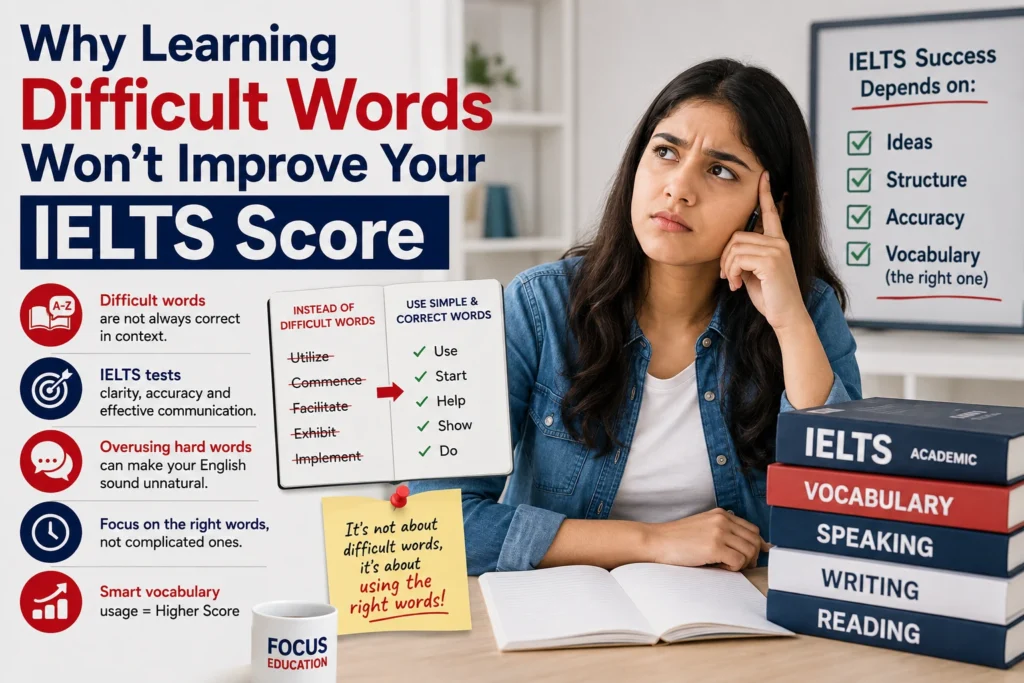
Why Learning Difficult Words Won’t Improve Your IELTS Score Many IELTS students believe that using difficult or uncommon words is the key to a high band score. As a result, they spend hours memorising long vocabulary lists, hoping to impress the examiner. However, this approach often leads to the opposite result. Students try to use advanced words, but their writing and speaking become unnatural, forced, and sometimes incorrect. The reality is simple — IELTS does not reward difficulty. It rewards accuracy, clarity, and natural usage. What IELTS Examiners Actually Look For In both Writing and Speaking, vocabulary is assessed under Lexical Resource. This does not mean “use the hardest words possible.” Examiners look for: Correct word usage Ability to paraphrase Range of vocabulary Natural and flexible language If a word is advanced but used incorrectly, it reduces your score rather than improving it. The Problem with Memorising Difficult Words Many students learn words like: ameliorate plethora ubiquitous But the issue is not the word itself — it is the usage. Example: Unnatural sentence: “This policy will ameliorate the plethora of problems in society.” This sounds forced and unclear. Natural version: “This policy will improve many problems in society.” The second sentence is simpler but clearer. Clarity always scores better than complexity. Why Simple Vocabulary Works Better Simple words are: Easier to use correctly More natural in communication Less risky in the exam Example: Basic but effective: “Many people find it difficult to balance work and personal life.” Forced version: “A large number of individuals encounter difficulties in maintaining equilibrium between professional and personal domains.” The second sentence is not wrong, but it feels unnatural and overly complicated. What You Should Focus on Instead Instead of memorising difficult words, focus on using common words effectively. 1. Learn Word Families Understanding different forms of a word improves flexibility. Example: develop → development → developing This helps in both Writing and Speaking. 2. Improve Paraphrasing Skills You do not need complex words to paraphrase. Example: “important” → “essential” “problem” → “issue” This shows range without sounding unnatural. 3. Focus on Collocations Some words naturally go together. Examples: make a decision (not do a decision) heavy traffic (not strong traffic) Correct combinations improve your accuracy. 4. Avoid Repetition Instead of using the same word again and again, use simple alternatives. Example: good → beneficial, useful, effective bad → harmful, negative, serious This improves your vocabulary score without making your language complex. The Real Difference Between Band 6 and Band 7 The difference is not about using “big words.” Band 6: Limited range Some repetition Occasional incorrect usage Band 7: Good control over common vocabulary Some flexibility and variation Mostly accurate usage The focus is always on control, not difficulty. Final Thought In IELTS, vocabulary is not about how impressive your words sound. It is about how effectively you use them. Simple, clear, and natural language will always perform better than complex but incorrect expressions. Students who focus on clarity, paraphrasing, and correct usage see faster improvement in their scores. For structured vocabulary building and practical IELTS strategies, Focus Education helps students develop language that is accurate, natural, and exam-ready.
Phrasal Verbs for IELTS Speaking: How to Use Them Naturally

Phrasal Verbs for IELTS Speaking: How to Use Them Naturally Many IELTS students believe that using advanced vocabulary means memorising difficult or uncommon words. However, in the Speaking test, what actually makes your English sound natural and fluent is the correct use of everyday expressions — especially phrasal verbs. Phrasal verbs are extremely common in spoken English. When used correctly, they can help you sound more natural and improve your Lexical Resource score. But the key is to use them naturally, not forcefully. What Are Phrasal Verbs? A phrasal verb is a combination of a verb + preposition or an adverb, which creates a new meaning. Examples: give up (stop doing something) look after (take care of) run into (meet unexpectedly) These meanings are often different from the original verb, which is why students find them confusing. Why Are They Important for IELTS Speaking? In the IELTS Speaking test, examiners look for: Natural use of vocabulary Flexibility in language Ability to express ideas clearly Phrasal verbs help you achieve all three — but only when used appropriately. Example: Basic sentence: “I stopped playing cricket.” Improved sentence: “I gave up playing cricket a few years ago.” The second sentence sounds more natural and conversational. 10 Useful Phrasal Verbs for IELTS Speaking Here are some common and easy-to-use phrasal verbs with examples: Give up (stop doing something) → I gave up junk food last year to improve my health. Look after (take care of) → I look after my younger brother when my parents are busy. Run into (meet by chance) → I ran into an old friend at a shopping mall recently. Find out (discover information) → I found out about this course through social media. Carry on (continue) → Even when I feel tired, I carry on studying. Bring up (mention a topic) → He brought up an interesting point during the discussion. Cut down on (reduce) → I am trying to cut down on screen time. Get along with (have a good relationship) → I get along well with my classmates. Take up (start a new activity) → I recently took up reading as a hobby. Work out (exercise / solve a problem) → I work out regularly to stay fit. How to Use Them Naturally Many students make the mistake of forcing phrasal verbs into every sentence. This can sound unnatural. Keep these points in mind: Use them only when they fit the context Do not replace every verb with a phrasal verb Focus on clarity first, then style Practice using them in common Speaking topics Example: Unnatural: “I consumed less sugar to improve my health.” Natural: “I cut down on sugar to improve my health.” Both are correct, but the second sounds more conversational. Common Mistakes to Avoid Using incorrect combinations (e.g., do up smoking instead of give up smoking) Misplacing objects in separable phrasal verbs Overusing phrasal verbs just to sound advanced Remember, the goal is natural communication, not complexity. Final Thought Phrasal verbs are a simple yet powerful way to improve your IELTS Speaking performance. They make your English sound more fluent, relaxed, and real. However, their effectiveness depends on how naturally you use them. Start with a few common phrasal verbs, practise them in daily conversations, and gradually include them in your Speaking answers. At Focus Education, students are trained to use vocabulary in a practical and natural way, especially for the Speaking test. With guided practice and real exam strategies, you can build confidence and improve your fluency step by step. If you want to sound more natural and score higher in IELTS Speaking, Focus Education can help you get there.
How Overthinking Destroys Your IELTS Reading Score
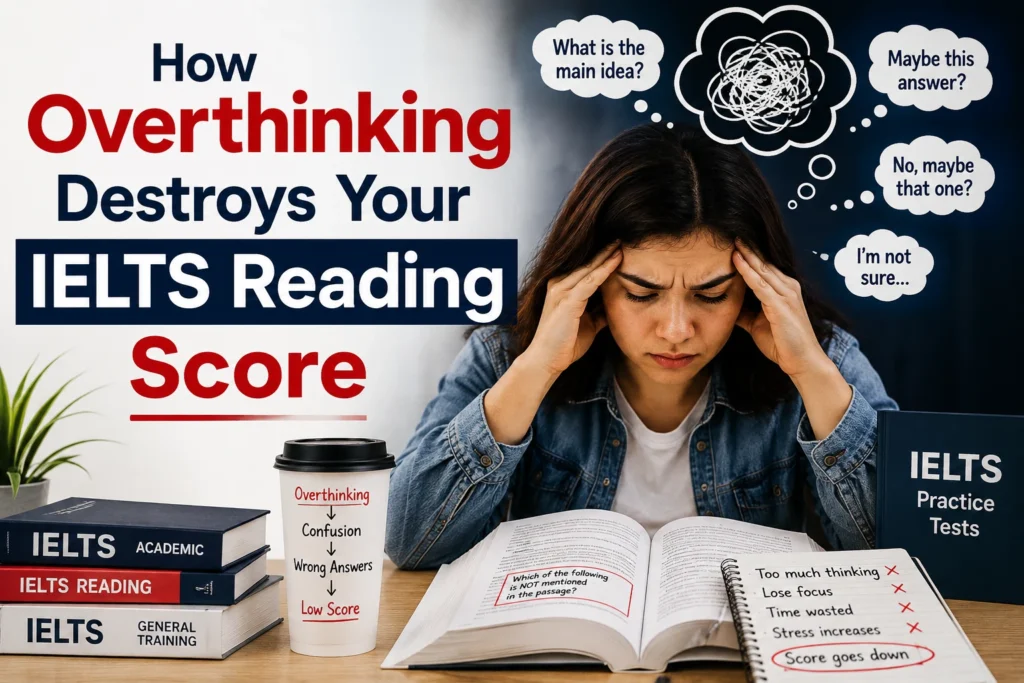
How Overthinking Destroys Your IELTS Reading Score Many IELTS students believe their main problem in Reading is vocabulary. Some think it is time management. Others blame difficult passages. However, in many cases, the real issue is much simpler — overthinking. At Focus Education, we often meet students who understand the passage quite well, yet their scores remain stuck at Band 6 or 6.5. The reason is not a lack of ability. It is the habit of analysing every sentence too deeply and doubting every answer. IELTS Reading is not a test of intelligence. It is a test of accuracy under pressure. And overthinking directly affects that accuracy. What Does Overthinking Look Like in IELTS Reading? Overthinking usually appears in the following ways: Reading the same paragraph again and again, even after finding the answer Changing the correct answer at the last minute Trying to “interpret” the writer’s hidden meaning instead of focusing on clear evidence Assuming the question is tricky even when it is straightforward Searching for complicated logic when the answer is directly paraphrased The IELTS exam does not reward over-analysis. It rewards clear identification of information. Why Overthinking Happens There are three main reasons students overthink: Fear of making mistakes Lack of trust in their first logical answer Previous experience of getting “tricked” in mock tests When students believe that the test is designed to confuse them, they begin to doubt simple answers. This doubt slows them down and reduces confidence. How Overthinking Damages Your Score Overthinking creates three serious problems: It wastes time, leaving you rushed in Passage 3 It increases answer changes, which often turn correct answers into wrong ones It raises anxiety levels, reducing concentration In many cases, a student’s first answer is correct. The second answer, chosen after five minutes of over-analysis, is wrong. How to Control Overthinking You cannot eliminate thinking, but you can discipline it. Always underline keywords in the question first Find direct evidence in the passage before choosing an answer Do not change an answer unless you find clear proof it is wrong Set a strict time limit per passage Train yourself to trust evidence, not feelings Remember, IELTS Reading is evidence-based. If the information matches clearly, it is likely correct. Final Thought Strong English does not guarantee a high Reading score. Controlled thinking does. When you stop trying to outsmart the test and start focusing on a structured strategy, your accuracy improves naturally. If you feel that overthinking is affecting your score, structured training can make a real difference. At Focus Education, we help students build clarity, speed, and confidence through guided Reading strategies. Book a session with Focus Education and start improving your IELTS Reading the smart way.
How to Generate Ideas in 5 Minutes for Any IELTS Writing Task 2 Topic
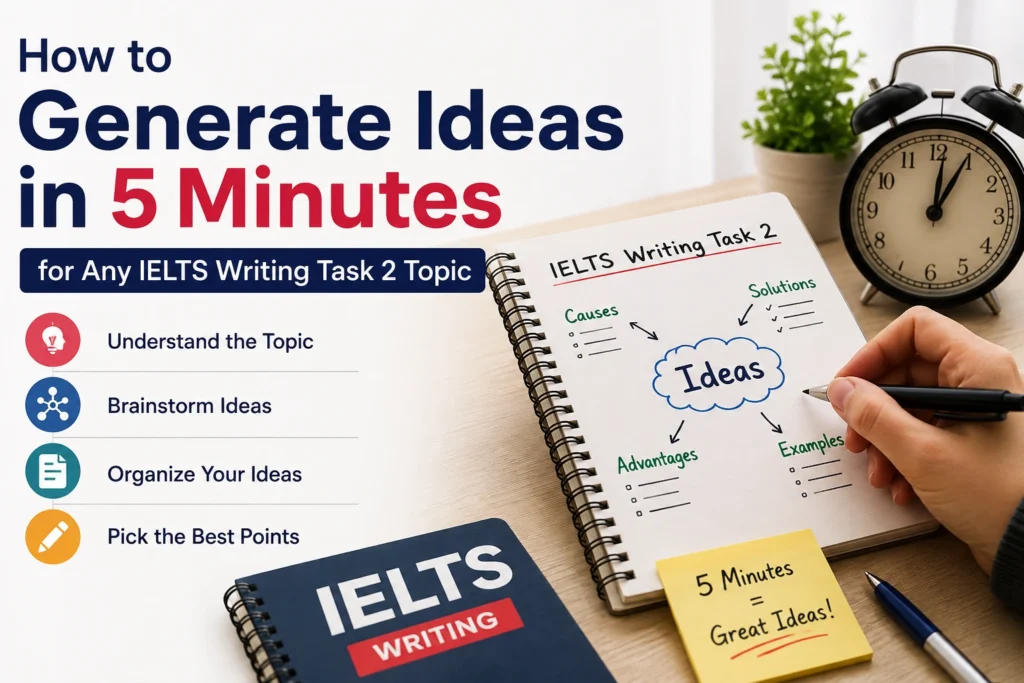
How to Generate Ideas in 5 Minutes for Any IELTS Writing Task 2 Topic Many IELTS students struggle with Writing Task 2, not because their English is weak, but because they cannot think of ideas quickly. As soon as they read the question, they feel confused or unsure about what to write. This usually happens when students try to be too creative or intellectual. In reality, IELTS focuses on clarity, relevance, and logical development of ideas. 1. Start by understanding the question Before thinking of ideas, it is important to understand what the question is asking. Every Task 2 question has a topic and an instruction word, such as discuss, agree or disagree, or to what extent. Identifying these keywords helps you stay on track. Example: If the question says, “Discuss both views and give your opinion,” you must write about both sides first and then clearly share your opinion. Ignoring one part will reduce your score. 2. Use the “why” technique to develop ideas After choosing an idea, ask yourself why it happens or why people believe it. Then ask “why” again to go deeper. This helps you extend your answer naturally without adding irrelevant content. Example: If the topic is about online education, you can say it is convenient. Ask why — because students can study from home. Ask why again — because it saves travel time and allows flexible schedules. 3. Think in terms of common, everyday situations Many students think they need expert knowledge or statistics to score well. This is not true. IELTS accepts general ideas based on daily life experiences, as long as they are explained clearly. Example: For a health-related topic, you can talk about poor diet, lack of exercise, or stress from work. These are common situations that examiners easily understand. 4. Stick to one main idea per paragraph Trying to include many ideas in one paragraph often leads to a weak explanation. It is better to choose one clear idea and develop it properly using explanation and an example. Example: Instead of writing about education quality, teacher salary, infrastructure, and technology in one paragraph, focus only on teacher quality and explain it properly. 5. Keep planning short and practical Planning should not take too much time. Writing short keywords or phrases is enough. You do not need full sentences while planning. Once ideas are clear, start writing immediately. Example: Instead of writing full lines like “Online education is beneficial because…”, simply note: flexibility – saves time – working students. Final Thoughts Generating ideas in five minutes is a skill that improves with regular practice and correct guidance. When students practise analysing questions and developing ideas under exam conditions, writing becomes much easier. At Focus Education, students are guided to plan smartly, write relevant content, and receive clear feedback so that Writing Task 2 feels structured and achievable.