
How to Write a Strong Overview in IELTS Writing Task1
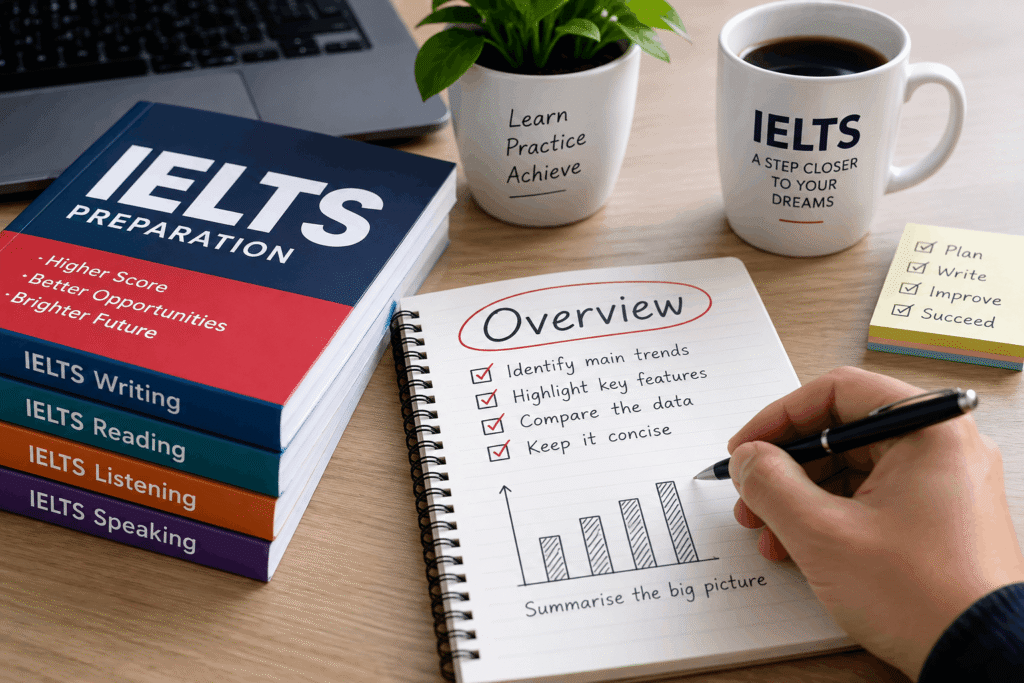
How to Write a Strong Overview in IELTS Writing Task 1 In IELTS Writing Task 1 (Academic), you are required to describe visual data such as a bar graph, line graph, pie chart, table, map, or process diagram. You should spend about 20 minutes on this task and write at least 150 words. One of the most important parts of your answer is the overview. Many students ignore it or write it poorly, and this directly affects their band score. What Is an Overview? An overview is a short paragraph (usually 1–2 sentences) that summarises the main trends or key features of the chart. It does not include specific numbers. Instead, it answers the question: What are the most noticeable things in this data? According to the IELTS marking criteria, a clear overview is essential for achieving a Band 6 or higher in Task Achievement. Where Should You Write the Overview? You can write the overview: After the introduction (recommended), or At the end of the report Most teachers suggest writing it after the introduction, so the structure becomes: Introduction Overview Body Paragraph 1 Body Paragraph 2 This keeps your answer organised and easy to follow. What Should You Include in an Overview? Your overview should include: The main trend (increase, decrease, fluctuation, stability) The highest and lowest points Any major differences or similarities Any significant changes over time You should not: Write exact numbers Give detailed comparisons Explain reasons Give opinions Example of a Weak Overview “Overall, the graph shows different changes in the data.” This is too general. It does not highlight key features. Example of a Strong Overview “Overall, it is clear that sales increased steadily over the period, with Company A consistently outperforming Company B.” Notice that: No numbers are used. The main trend is clearly identified. The comparison is summarised. How to Identify Key Features Quickly Before you start writing, spend 2–3 minutes analysing the chart. Ask yourself: Is the trend upward or downward? Which category is the highest? Which is the lowest? Are there any dramatic changes? Are there similarities between categories? For example: If one country shows a sharp rise while others remain stable, that is a key feature. If all categories follow a similar pattern, that is also important. Your overview should focus only on the big picture, not small details. Overview for Different Types of Task 1 Questions Line Graph / Bar Graph / Table: Focus on trends, highest and lowest values, and comparisons. Pie Chart: Focus on the largest and smallest proportions. Map: Focus on major changes (new buildings, removed areas, expansion). Process Diagram: Focus on the number of stages and whether it is a linear or cyclical process. Example for a process: “Overall, the process consists of five stages, beginning with the collection of raw materials and ending with distribution.” Common Mistakes Students Make Writing too many details in the overview Copying sentences directly from the question Forgetting to include an overview Writing opinions like “This is a good development.” Remember, Task 1 is an objective report. You only describe what you see. Final Advice A strong overview shows the examiner that you understand the data clearly. Even if your vocabulary is simple, a clear and accurate overview can significantly improve your score. Practice identifying key features from different charts, and train yourself to summarise them in 1–2 clear sentences. At Focus Education, we guide students step-by-step on how to structure Writing Task 1 effectively and write strong overviews that help them achieve higher band scores.
Vocabulary for Giving Examples & Explanationsin IELTS Writing Task 2
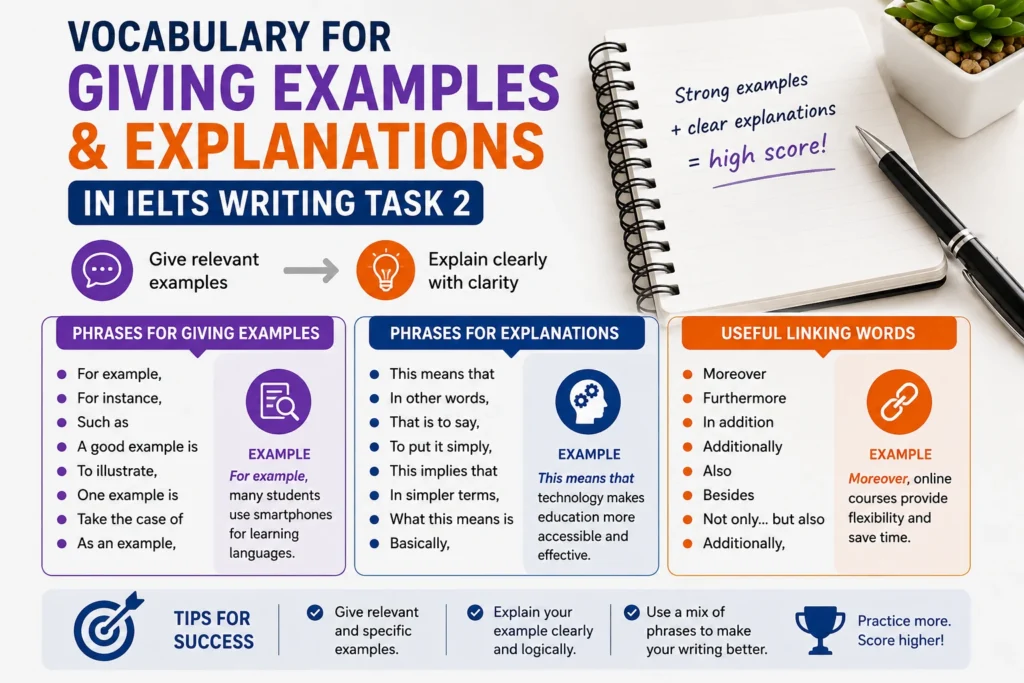
Vocabulary for Giving Examples & Explanations in IELTS Writing Task 2 Many IELTS students believe their problem is grammar. Some think they lack ideas. However, in reality, a large number of candidates lose marks because they do not develop their ideas properly. They write a main point. They add one short example. And then they move to the next paragraph. The result? An essay that feels incomplete. In IELTS Writing Task 2, strong vocabulary is not only about advanced words. It is about using the right phrases to introduce examples, explain them clearly, and connect them back to the main argument. This is what separates a Band 6 essay from a Band 7 or higher response. Why Development Matters So Much The IELTS examiner evaluates your essay based on four main criteria. Three of them are directly affected by how you use examples: Task Response – Are your ideas fully developed? Coherence and Cohesion – Is your logic easy to follow? Lexical Resource – Do you show variety in language? If your example is short and unexplained, the examiner feels your idea is underdeveloped. Even with good grammar, your band score may remain limited. That is why learning how to expand examples is essential. Step 1: Stop Repeating “For Example” Most students rely heavily on: For example, For instance, These are correct, but when used repeatedly, they reduce your lexical range. Instead, you can rotate between more academic expressions such as: To illustrate this point A clear example of this is This can be seen in One compelling example is A good illustration of this idea is Using varied phrases makes your writing sound more mature and controlled. However, vocabulary alone is not enough. Step 2: Always Explain the Example This is where real band improvement happens. Many students give an example but fail to explain why it matters. In IELTS, an example without explanation feels incomplete. After giving your example, you can continue with phrases like: This demonstrates that… This highlights the fact that… As a result… Consequently… This means that… In other words… These connectors help you link the example back to your argument. They show logical thinking, which examiners value highly. Weak vs Strong Development Let us compare two short versions of the same idea. Weak version: Many people prefer online education. For example, students can study from home. This paragraph feels unfinished. The example is clear, but there is no analysis. Improved version: Many people prefer online education. For example, students can study from home. This reduces commuting time and provides greater flexibility, making learning more convenient and cost-effective. The second version explains the impact of studying from home. The idea is now developed. It feels complete. This small change can significantly affect your Task Response score. A Simple Structure You Can Follow If students struggle with idea expansion, they can follow a practical four-step paragraph model: 1. Topic sentence 2. Explanation of the idea 3. Example 4. Further explanation or result This structure ensures that no paragraph feels rushed. It also naturally increases word count in a meaningful way, without adding unnecessary filler. The Real Goal: Clarity, Not Complexity Many candidates try to memorise complicated vocabulary to impress the examiner. But IELTS writing rewards clarity over difficulty. Instead of learning rare words, focus on: Explaining ideas logically Connecting examples clearly Showing cause-and-effect relationships Avoiding sudden jumps between ideas When your examples are well-developed, your essay automatically sounds more academic. Band 7 and above essays are not necessarily filled with difficult words. They are filled with clear thinking and structured development. Final Thought Improving IELTS Writing Task 2 is not about writing more. It is about writing better. When students learn to introduce and explain examples properly, their essays feel more complete, more persuasive, and more organised. That is when band scores begin to improve consistently. If you want structured guidance on idea development, vocabulary building, and high-scoring writing techniques, the mentors at Focus Education provide specialised IELTS training designed to help students break through the Band 6 plateau. Strong writing is not a talent. It is a skill that can be trained — with the right method and feedback. Ready to upgrade your IELTS writing? Connect with Focus Education and take your preparation to the next level.
HOW TO SOLVE SUMMARY COMPLETION IN IELTSREADING
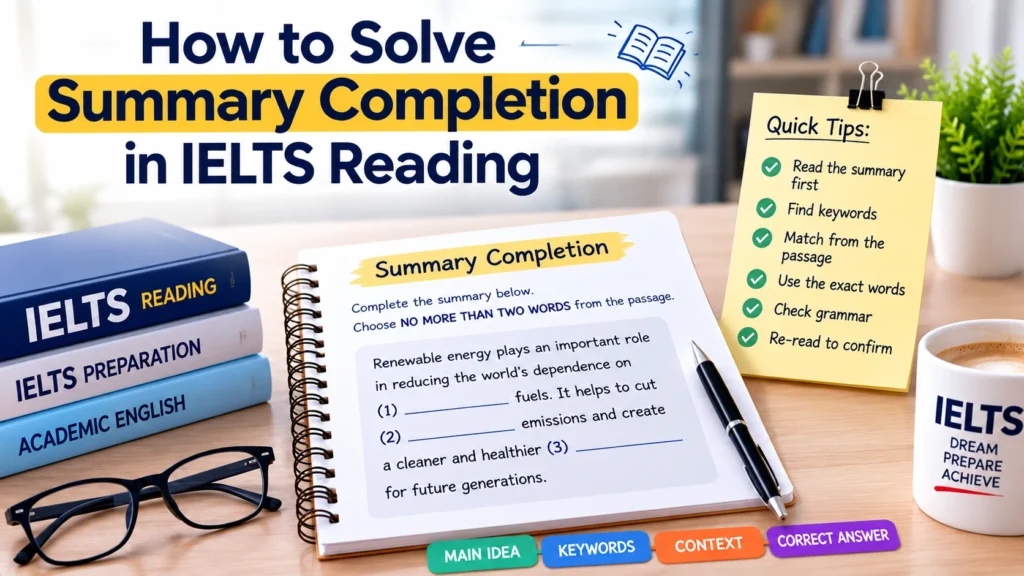
HOW TO SOLVE SUMMARY COMPLETION IN IELTS READING What Is Summary Completion in IELTS Reading? Summary completion is a common question type in the IELTS Reading test where you are given a short summary of a part of the passage, and you must fill in the missing words. The summary presents the main ideas in a concise form, but certain keywords or phrases are removed. Your task is to complete these gaps accurately so the meaning remains clear and matches the information in the text. There are two variations of summary completion: Selecting words directly from the passage – where the instructions tell you exactly how many words you may choose (for example, NO MORE THAN TWO WORDS). Selecting words from a given list of answer options – where the gaps must be filled using the set of options provided. In IELTS Reading, you will often find that the options in matching questions use different forms of the same idea. Sometimes the words in the questions appear as synonyms or antonyms of those found in the passage, and other times they are taken directly from the text with slight changes in form. Because of this, candidates need to build a strong vocabulary, understand word families, and learn how to identify groups of related words. This skill helps them recognise the correct information even when the wording is different. In this blog, we will focus on the second type, where you choose the correct answer from a list. Sample Academic Reading Summary Completion ATTITUDES TO LANGUAGE (An extract taken from Cambridge 9, Test 3, Passage 1) In its most general sense, prescriptivism is the view that one variety of language has an inherently higher value than others, and that this ought to be imposed on the whole of the speech community. The view is propounded especially in relation to grammar and vocabulary, and frequently with reference to pronunciation. The variety which is favoured, in this account, is usually a version of the ‘standard’ written language, especially as encountered in literature, or in the formal spoken language which most closely reflects this style. Adherents to this variety are said to speak or write ‘correctly’; deviations from it are said to be ‘incorrect! All the main languages have been studied prescriptively, especially in the 18th-century approach to the writing of grammars and dictionaries. The aims of these early grammarians were threefold: (a) they wanted to codify the principles of their languages, to show that there was a system beneath the apparent chaos of usage, (b) they wanted a means of settling disputes over usage, and (c) they wanted to point out what they felt to be common errors, in order to ‘improve’ the language. The authoritarian nature of the approach is best characterised by its reliance on ‘rules’ of grammar. Some usages are ‘prescribed,’ to be learnt and followed accurately; others are ‘proscribed,’ to be avoided. In this early period, there were no half-measures: usage was either right or wrong, and it was the task of the grammarian not simply to record alternatives, but to pronounce judgement upon them. These attitudes are still with us, and they motivate a widespread concern that linguistic standards should be maintained. Nevertheless, there is an alternative point of view that is concerned less with standards than with the facts of linguistic usage. This approach is summarised in the statement that it is the task of the grammarian to describe, not prescribe, to record the facts of linguistic diversity, and not to attempt the impossible tasks of evaluating language variation or halting language change. In the second half of the 18th century, we already find advocates of this view, such as Joseph Priestiey, whose Rudiments of English Grammar (1761) insists that ‘the custom of speaking is the original and only just standard of any language! Linguistic issues, it is argued, cannot be solved by logic and legislation. And this view has become the tenet of the modern linguistic approach to grammatical analysis. Complete the summary using the list of words, A-I, below. Write the correct letter, A-I, in boxes 9-12 on your answer sheet. According to 9 ____ , there is only one correct form of language. Linguists who take this approach to language place great importance on grammatical 10 _____. Conversely, the view of 11 _____, such as Joseph Priestley, is that grammar should be based on 12 ____. A descriptivists B language experts C popular speech D formal language E evaluation F rules G modern linguists H prescriptivists I change Step 1: Read the Question (Strategy 1 in action) Before touching the passage, we first look at the summary: According to ___, there is only one correct form of language… Linguists who take this approach… place great importance on grammatical ___… Conversely, the view of ___ such as Priestley… is that grammar should be based on ___. From this, we note: The first gap needs a group of people or a type of linguist. The second gap requires something related to grammar (rules, evaluation, standards). The third gap refers to another group of people. The fourth gap needs something grammar should be based on (probably “popular speech” or “custom of speaking”). This prediction prepares us for what to look for in the passage. Step 2: Read the Passage for the Main Idea (Strategy 2 in action) Now we read the passage, especially the first two paragraphs, because they talk about prescriptivism and descriptivism. We do not search for single words yet. We notice: “Prescriptivism” emphasises one correct form of language. They value “rules”. The “alternative view” is by descriptivists like Joseph Priestley, who believe grammar should be based on the “custom of speaking”, meaning everyday speech. Understanding this overall meaning makes matching the options easier. Applying Both Strategies: Solving the Example Summary Sentence 1 “According to ___, there is only one correct form of language.” In the passage, this idea clearly describes prescriptivists. Answer: H (prescriptivists) Summary Sentence 2 “Linguists who take this approach place
True, False, Not Given – How to Finally Master the Trickiest IELTSReading Task
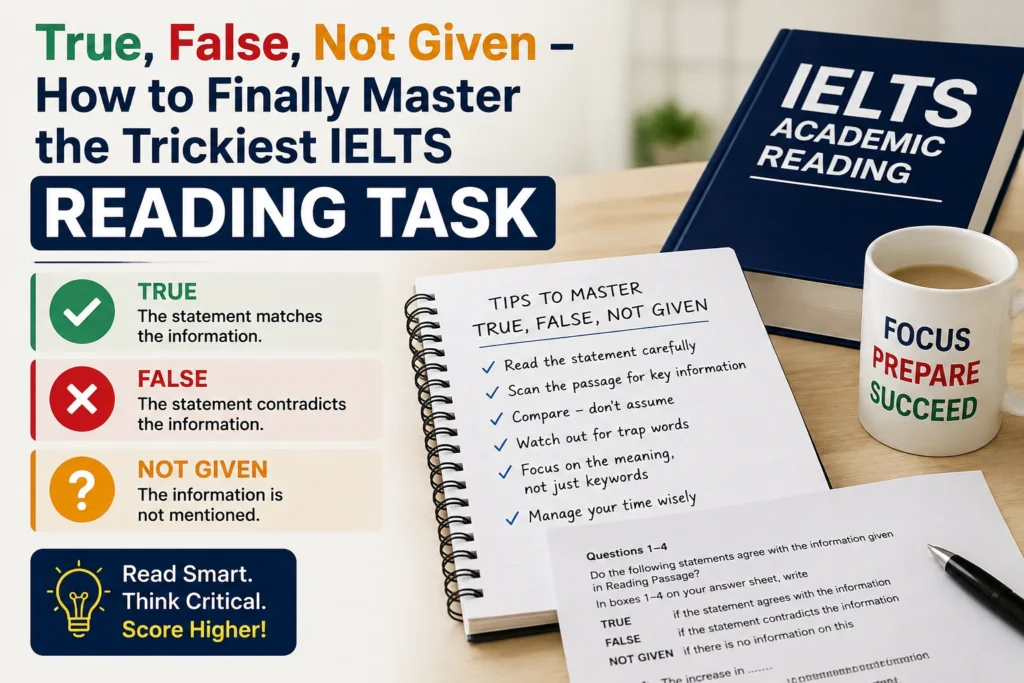
True, False, Not Given – How to Finally Master the Trickiest IELTS Reading Task If there’s one IELTS Reading question type that confuses almost every test taker, it’s True / False / Not Given. Many students lose easy marks here just because they don’t fully understand what the test wants from them. Let’s make it simple today. 1. What Are True / False / Not Given Questions? In this type of question, you’ll read a passage and then a few statements related to it. Your task is to check whether each statement agrees with the information in the passage. These questions are designed to test your reading accuracy and understanding — not your general knowledge. That means you must rely only on what’s written in the passage, not what you personally know or think is true. 2. True / False / Not Given vs. Yes / No / Not Given Many students don’t realize these two are slightly different. Here’s how you can tell them apart easily: Type Used For What You Check True / False / Not Given Facts Does the statement agree with factual information in the text? Yes / No / Not Given Opinions or beliefs Does the statement agree with what the writer or speaker thinks or believes? So, when the passage says “Scientists believe…” or “The writer suggests…”, the question will usually use Yes / No / Not Given. When it’s about simple facts or data, it’s True / False / Not Given. 3. Understanding the Difference Between True, False, and Not Given Let’s break it down simply: TRUE → The statement matches the information in the passage exactly (even if the wording is different). FALSE → The statement contradicts the information in the passage. NOT GIVEN → The passage does not mention this information clearly, so you can’t decide. Example: Example 1: (Cambridge IELTS 15 – Reading Test 1 inspired) Passage extract: “Some experts believe that children learn languages faster than adults because their brains are more flexible during early development.” Statement Answer Explanation Children are able to learn new languages faster as their brains are more adaptable. TRUE Same meaning – “more adaptable” = “more flexible.” Adults can learn languages more quickly because their brains are fully developed. FALSE Contradicts the passage – adults are not said to be faster. Most adults are not interested in learning new languages. NOT GIVEN Interest of adults is never mentioned. Example 2: (Cambridge IELTS 14 – Reading Test 2 inspired) Passage extract: “The railway system expanded rapidly in the 19th century, improving both travel speed and trade connections across Europe.” Statement Answer Explanation The development of railways helped increase trade between European countries. TRUE Matches the idea of “improving trade connections.” Railways reduced the need for road transport completely. FALSE The passage never says “completely reduced.” Railways were first built in the 20th century. FALSE Contradicts the 19th-century detail. Example 3: (Cambridge IELTS 17 – Reading Test 3 inspired) Passage extract: “While many scientists agree that climate change affects rainfall patterns, they disagree on the extent to which it influences ocean currents.” Statement Answer Explanation All scientists think climate change affects ocean currents in the same way. FALSE The passage clearly says they “disagree.” There is general agreement that climate change has some effect on rainfall. TRUE Matches “many scientists agree.” Scientists believe rainfall changes are caused mainly by human activity. NOT GIVEN Cause of rainfall change is not mentioned. These examples show that IELTS tests your ability to understand meaning, not matching words. Even small differences like “all scientists” vs “many scientists” can change the answer completely. 4. Tips to Solve These Questions Better These questions become easy once you follow a clear step-by-step process. Step 1: Locate the right area Use keywords from the question to find where in the passage that topic is discussed. These keywords can be: Names (e.g., Einstein, London) Numbers (e.g., 1995, 3 million) Adjectives (e.g., difficult, dangerous) if no names or dates are present. Step 2: Read carefully Once you locate it, read that section slowly. Don’t rush! You’ll often find the meaning hidden behind paraphrasing — the same idea expressed in different words. Step 3: Match ideas, not words Don’t look for exact word matches. IELTS loves to use synonyms or change sentence structure to test real understanding. Step 4: Watch for negative words and contrasts Words like “not,” “however,” “although,” “but,” “only” can completely change meaning. Missing one small word can turn a True into a False. 5. The Myth of the “False Word List” You may find lists online claiming that if you see certain words like “always,” “never,” “every,” or “none,” the answer will be False or Not Given. That’s completely wrong. The IELTS exam is designed to test meaning, not trick you with keywords. While these words can indicate extreme statements, they don’t automatically decide the answer. You still need to read the passage carefully and understand the context before choosing. Final Thoughts True / False / Not Given questions test how well you can understand and interpret information — not how well you can guess. If you train your eyes to notice paraphrasing, logical contrasts, and exact meaning, this section can actually become your strongest area. Learn Smarter with Focus Education At Focus Education, we don’t just teach IELTS — we train you to think like the examiner. For more such practical tips and tricks, join our IELTS coaching today! Come for admission now and get exciting rewards!
Debunking Common Myths About IELTS Writing
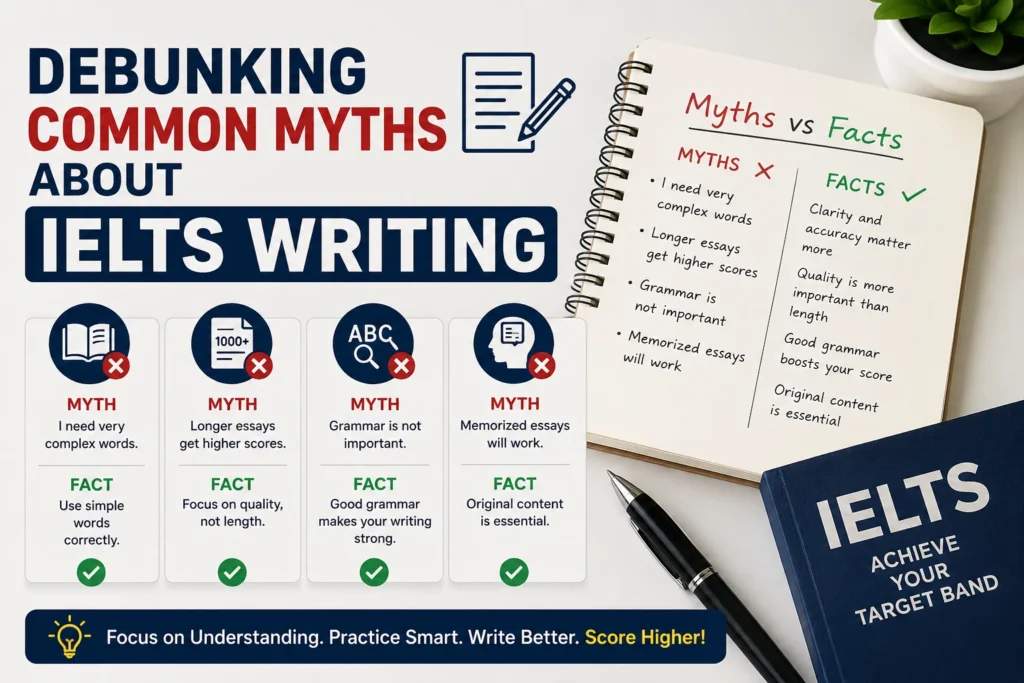
Debunking Common Myths About IELTS Writing Preparing for the IELTS Writing test can be confusing. With so much advice available online and from peers, students often end up believing things that aren’t true. These myths can easily affect their performance and lower their overall band score. At Focus Education, we often meet learners who work hard but struggle because of these misconceptions. Let’s clear up some of the most common ones and understand what truly matters in IELTS Writing. 1. Task 1 is less important than Task 2 While Task 2 carries slightly more weight in the overall writing score, Task 1 is still crucial. Many students focus only on essays and neglect Task 1, which results in an unbalanced score. Both tasks test your ability to organize ideas, present information clearly, and use correct grammar and vocabulary. Ignoring Task 1 can reduce your overall band, even if your essay is strong. A balanced approach to preparation is key. 2. Using fancy vocabulary guarantees a high score Examiners do not reward difficult or uncommon words if they are used incorrectly. Using words just to sound impressive often leads to awkward or unclear sentences. What truly helps is using vocabulary that is accurate, suitable for the context, and shows some range. Simplicity with precision is far better than complexity with confusion. 3. Using too many linking words boosts cohesion Linking words like however, moreover, and on the other hand are useful, but overusing them can make your writing look mechanical. Cohesion is about the smooth connection of ideas, not about inserting connectors everywhere. Natural transitions and logical flow are what examiners value, not a checklist of linking phrases. 4. Trying multiple tenses shows grammatical range Some students believe that switching tenses frequently can demonstrate their grammar skills. In reality, it usually causes errors and breaks the flow of writing. IELTS Writing rewards accuracy and consistency. If the question is about a general issue, stick to present tenses. If you describe a past trend or data in Task 1, use the past tense. Choose the right tense for the context, not for display. 5. Only creative or intellectual ideas can get Band 8+ Examiners are not judging your creativity; they assess how well you answer the question. A clear, logically developed argument is far more effective than an unusual or “interesting” one. Even simple examples or common ideas can earn high bands if they are relevant, coherent, and well-supported. IELTS rewards clarity, not cleverness. 6. Memorizing templates can save time and effort Templates may seem like a shortcut, but they can limit your ability to express original thoughts. Examiners can easily recognize memorized patterns, and this often lowers your score under “Task Response” and “Coherence and Cohesion.” Learning how to structure an essay is useful, but relying on the same sentences in every answer will make your writing repetitive and less natural. 7. Length equals quality Many students believe that longer essays automatically score higher. However, once you exceed 300 words, you’re more likely to make grammatical mistakes or repeat ideas. Examiners prefer essays that are concise, well-organized, and stay within the recommended word range—150 words for Task 1 and around 250 words for Task 2. Quality of expression always outweighs quantity. Final Thoughts The IELTS Writing test isn’t about using fancy words or lengthy essays—it’s about how effectively you communicate your ideas. Understanding what the exam truly measures can help you focus your preparation on clarity, structure, and precision. At Focus Education, we help learners build these exact skills through practical guidance and feedback-driven writing practice. Our aim is to help every student understand how to write smarter, not just more.
IELTS Writing Task 1 Marking Criteria Explained Simply
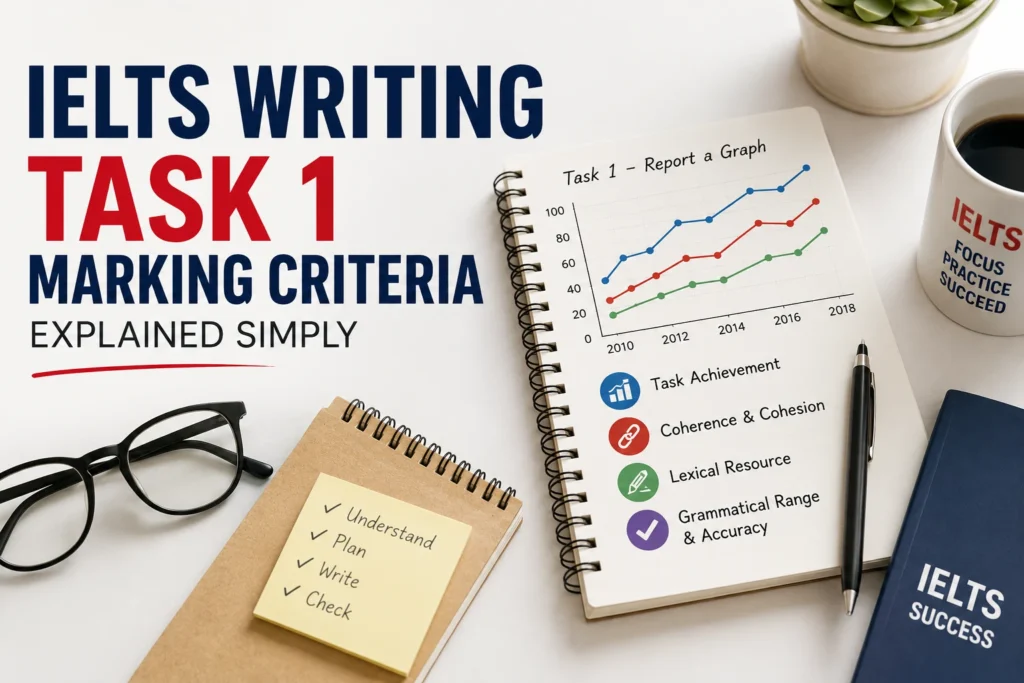
IELTS Writing Task 1 Marking Criteria Explained Simply Many IELTS candidates practise Writing Task 1 by memorising formats or learning vocabulary, but still struggle to improve their band score. One major reason for this is that students often do not clearly understand how IELTS examiners actually mark Writing Task 1. In this blog, we will break down the four official IELTS Writing Task 1 marking criteria simply and practically, so you know exactly what examiners look for and how you can score better. What Is IELTS Writing Task 1? In IELTS Academic, Writing Task 1 requires you to describe visual information such as a graph, chart, table, map, or process diagram. You are expected to write at least 150 words in around 20 minutes. Your answer is not judged on opinions or creativity, but on how clearly, accurately, and logically you present the given data. The Four IELTS Writing Task 1 Marking Criteria Each criterion carries equal weight, which means ignoring even one can limit your band score. 1. Task Achievement Task Achievement checks how well you have understood and answered the question. Examiners look for: A clear introduction that paraphrases the question A proper overview highlighting key trends or features Accurate reporting of main data and comparisons No personal opinions or irrelevant details Common mistakes students make: Missing the overview Writing too much detail without comparing Including reasons or explanations not given in the graph To score well, your content must be relevant, complete, and accurate, not lengthy. 2. Coherence and Cohesion This criterion focuses on how well your ideas are organised and connected. Examiners check: Logical paragraphing (Introduction, Overview, Body Paragraphs) Clear grouping of information Smooth flow between sentences Appropriate use of linking words Good coherence means your reader can easily follow your report without confusion. Good cohesion means your ideas are connected naturally, not forcefully. A common misconception is that using many linking words improves the score. In reality, overusing connectors can make your writing sound unnatural. 3. Lexical Resource (Vocabulary) Lexical Resource assesses how effectively you use vocabulary to describe data. Examiners look for: Topic-appropriate words (increase, decline, fluctuate, proportion) Ability to paraphrase the question Avoidance of repetition Correct word choice and spelling Using “fancy” or uncommon words does not guarantee a higher band. In fact, incorrect or forced vocabulary can reduce your score. Clear, precise, and accurate vocabulary is always better than complicated language. 4. Grammatical Range and Accuracy This criterion checks how well you use grammar. Examiners assess: Sentence structure (simple and complex) Correct tense usage Subject-verb agreement Punctuation and articles You do not need extremely complex grammar to score well, but you must show control and accuracy. Frequent grammatical errors, even in simple sentences, can significantly affect your band score. How These Criteria Work Together Many students focus heavily on vocabulary and grammar, but forget Task Achievement and Coherence. However, a high band score comes from balance. For example: Good grammar without a clear overview limits your score. Strong vocabulary with poor structure confuses the examiner. Accurate data without comparisons looks incomplete. Understanding the marking criteria helps you write with purpose, not guesswork. Final Thoughts IELTS Writing Task 1 is not about memorisation; it is about understanding what examiners expect and delivering it clearly. Once you know how your writing is evaluated, your preparation becomes more focused and effective. At Focus Education, we train students to approach Writing Task 1 strategically by working closely with the marking criteria, analysing real band descriptors, and providing detailed feedback after every practice task. A clear understanding of the criteria can make a noticeable difference — and the right guidance makes it easier to achieve.
IELTS Listening Vocabulary Words to Boost Your Score
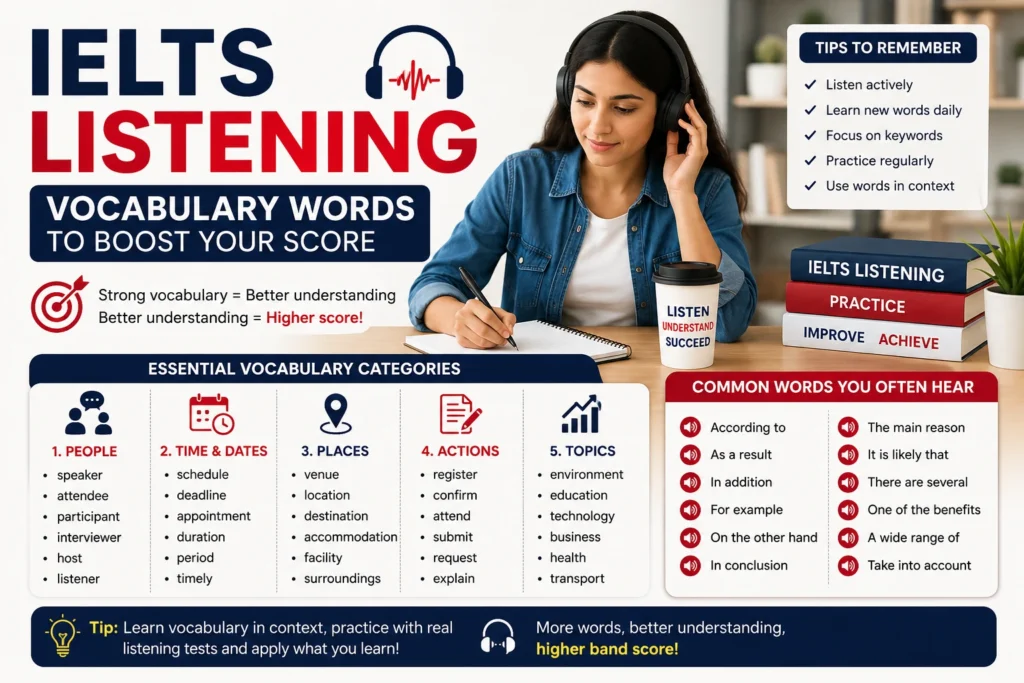
IELTS Listening Vocabulary Words to Boost Your Score A strong vocabulary is one of the most reliable ways to increase your score in the IELTS Listening test. Most questions in Listening depend on your ability to recognise words, understand paraphrasing, and follow information even when the speaker changes the structure. Building topic-wise vocabulary helps you predict answers, avoid confusion, and listen more accurately. Below is a complete list of essential vocabulary grouped according to the types of topics that commonly appear in Parts 1 to 4. Part 1 Vocabulary Part 1 usually deals with everyday conversations such as bookings, enquiries, forms, and basic descriptions. 1. Days of the Week Monday, Tuesday, Wednesday, Thursday, Friday, Saturday, Sunday Weekdays, weekend, fortnight 2. Months and Seasons of the Year January to December Spring, summer, autumn, winter Annual, yearly, quarterly 3. Shapes Circle, square, rectangle, triangle, oval Cube, sphere, pyramid Straight edge, curved 4. Transportation Bus, coach, train, tram, metro Taxi, cab, shuttle, ferry Flight, departure, arrival, boarding pass Lane, traffic, roundabout, junction 5. Colours Red, blue, yellow, green, white, black Beige, navy, maroon, turquoise, grey Light, dark, pale, bright 6. Useful Verbs Book, reserve, arrange, confirm Borrow, lend, return Collect, deliver, purchase, enquire Locate, identify, select 7. Common Adjectives Cheap, expensive, affordable Available, suitable, convenient Local, modern, traditional Spacious, narrow, crowded 8. Numbers, Time, and Currencies Half past, quarter to, noon, midnight Per hour, per day, annually Dollars, pounds, euros, rupees Single, double, triple Part 2 Vocabulary Part 2 often includes descriptions of places, maps, and directions. A clear understanding of these words helps you follow the speaker’s instructions. 1. Rooms in Buildings Lobby, reception, corridor Auditorium, laboratory, cafeteria Storage room, basement, terrace Conference room, gallery 2. Place Markers Entrance, exit, doorway Staircase, escalator, lift Front, rear, side, corner, edge Ground floor, first floor, wing, block 3. Directions and Prepositions of Place Opposite, next to, behind, in front of Adjacent to, across from Turn left, turn right, go straight At the end of, near, beside, between Part 3 Vocabulary Part 3 usually involves discussions between students and professors, or academic conversations. These words help with more technical listening. 1. Academic Terminology Hypothesis, analysis, survey, findings Assignment, presentation, tutorial Data collection, research method Feedback, assessment, draft 2. School Subjects Mathematics, literature, biology, chemistry Geography, history, economics Computer science, psychology 3. University Disciplines Engineering, architecture, sociology Business management, environmental science Linguistics, anthropology, and medical sciences Law, fine arts, philosophy 4. Examinations Midterm, final exam, quiz Pass, fail, distinction Grade, score, marking criteria Retake, submit, deadline Part 4 Vocabulary Part 4 is always a monologue on academic or general-interest topics. These words help you follow high-level explanations. 1. Health Diagnosis, symptoms, treatment Nutrition, immunity, prevention Infection, disorder, recovery Surgery, therapy, vaccination 2. Animals and Their Habitats Species, mammals, reptiles Ecosystem, marine life, wildlife Forest, desert, tundra, rainforest Adaptation, survival, breeding 3. Continents and Countries Asia, Europe, Africa, Oceania Industries, population, migration Developing nations, global regions 4. Environment Pollution, conservation, sustainability Climate change, greenhouse gases Deforestation, renewable resources Erosion, biodiversity 5. Government Policy, regulation, legislation Funding, taxation, public services Administration, council, authority 6. Energy Solar, wind, hydroelectric Fossil fuels, natural gas, coal Consumption, efficiency, generation 7. General Academic Words Process, structure, function Comparison, cause, effect Increase, decrease, fluctuate Significant, moderate, minimal Additional Categories to Strengthen Listening Vocabulary Here are a few more high-value categories often found in Listening exams: 1. Work and Employment Salary, shift, contract, vacancy Supervisor, department, training 2. Travel and Tourism Itinerary, accommodation, package tour Reservation, cancellation, tourist attraction 3. Technology Software, hardware, device Digital, automated, network, upgrade Final Thoughts Improving your IELTS Listening vocabulary is not about memorising long lists but about understanding common topics and recognising how words are paraphrased in the audio. Regular practice with recordings, along with topic-wise revision, can greatly improve your accuracy and confidence. At Focus Education, our Listening classes follow a structured method that builds vocabulary, teaches prediction skills, and trains students for real exam conditions. With guided practice and expert support, you can confidently work towards your target band.
Common Myths About the IELTS Listening Test
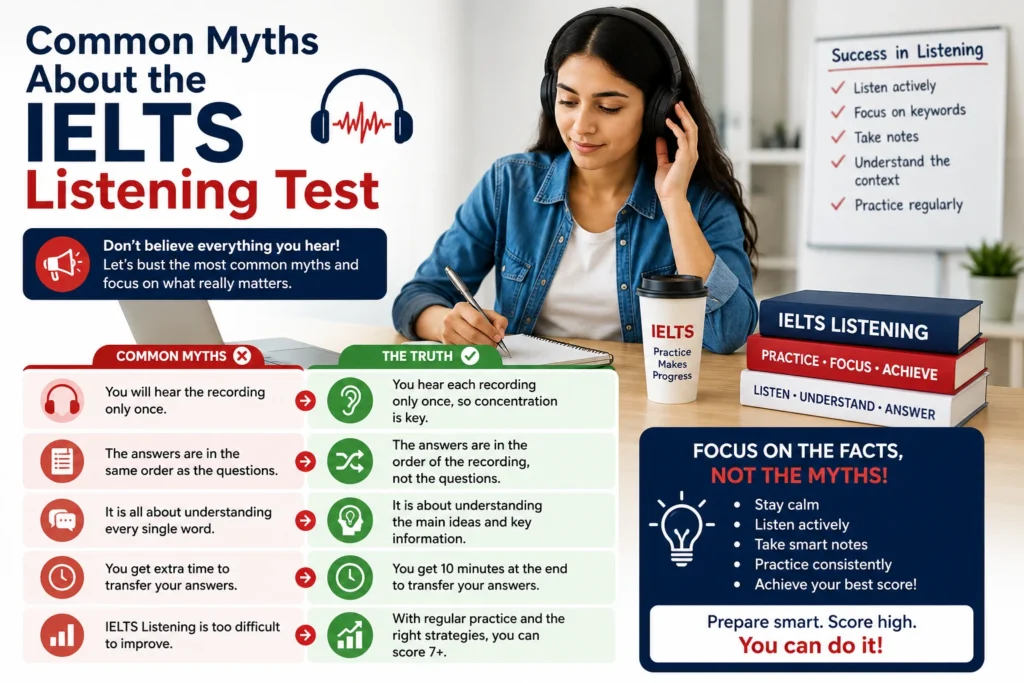
Common Myths About the IELTS Listening Test The IELTS Listening test often feels simple on the surface — you just listen and write, right? But in reality, this section tests a lot more than hearing ability. Many students lose marks because of wrong assumptions or myths that circulate among test-takers. Let’s uncover the most common ones so you can approach this section with clarity and confidence. 1. Spellings and Grammar Don’t Matter Much This is one of the biggest misconceptions. In IELTS Listening, correct spelling and grammar are essential. Even if your answer is conceptually right, a small spelling mistake can make it wrong. For example, writing enviroment instead of environment will cost you a mark. Similarly, using the wrong form of a word, like writing running instead of run, can lead to errors. Always double-check your spellings during review time. 2. The Audio Will Play in a Random Order The audio in the IELTS Listening test follows the order of the questions. That means you will hear the answers in sequence — you won’t have to go back or jump between sections. This structure helps you stay focused and move smoothly through the paper. However, the challenge lies in staying alert, as the speakers often paraphrase information or distract you with extra details. 3. Listening Is Only About Accent Understanding While understanding different accents (British, Australian, Canadian, etc.) is part of the test, Listening is more about understanding meaning and identifying details. The test checks your ability to catch information, follow arguments, and recognize opinions — not just accents. Practicing with different English accents is useful, but focus more on comprehension and prediction skills. 4. You Can Predict All Answers Before the Audio Starts The short time given before each section helps you guess the topic and type of answer, not the exact words. For example, if the question says “The meeting will be held on ______,” you know a day or date will fit, but not what it will be. The key is to use the preview time to identify possible answer types and underline keywords, not to fix your mind on a single answer. 5. Capital Letters Are Mandatory You can write your answers in all capital letters if you prefer — it won’t lower your score. However, it’s not mandatory. Many students find it safer to write in capital letters to avoid issues with handwriting. Whether you use all caps or lowercase, consistency and accuracy are what matter most. 6. You Can’t Take Notes During Listening You absolutely can. In fact, note-taking is encouraged. Writing short notes, especially for multiple-choice or map-labelling questions, helps you track information as the audio progresses. The key is to jot down quickly without losing focus on the next sentence. On the computer-based test, you can use the on-screen notes or your rough sheet for this purpose. 7. Listening Test Is Easier on Paper or Computer Many students assume one mode is easier than the other. The truth is, both have the same level of difficulty. The difference lies in personal comfort. On the computer, you can type answers directly and get results faster. On paper, you can underline and circle keywords physically. It’s best to try both formats during practice and choose the one that feels more natural. 8. Guessing Is Useless If You Don’t Know the Answer Never leave a question blank. IELTS has no negative marking, so guessing gives you a chance to earn a mark you might otherwise lose. If you miss an answer, make a logical guess based on the topic or surrounding questions. A blank answer guarantees zero; a guess at least gives you a chance. 9. I Can Take Time to Write Down My Answers In the Listening test, the audio plays only once, and time moves fast. On paper, you get an extra 10 minutes to transfer answers at the end, but in the computer-based test, that time is not given. You must write or type your answers as you go. Learn to multitask — listen, think, and write simultaneously — so you don’t fall behind. 10. The Audio Is Repeated or It Pauses The recording is played only once and never repeated. It doesn’t pause for your convenience either. That’s why it’s crucial to stay focused throughout the test. If you miss one answer, don’t panic — move on quickly. Losing focus for a few seconds can cause you to miss several questions in a row. Final Thoughts IELTS Listening is not about luck — it’s about awareness, preparation, and calm focus. By clearing these myths, you can approach the test more strategically and avoid common traps that many students fall for. At Focus Education, we guide students with proven methods and practice strategies that help them build confidence in every section of the IELTS. If you want to learn practical test techniques and improve your overall score, join our next batch and start your IELTS journey the smart way.
Understanding the IELTS Listening Test
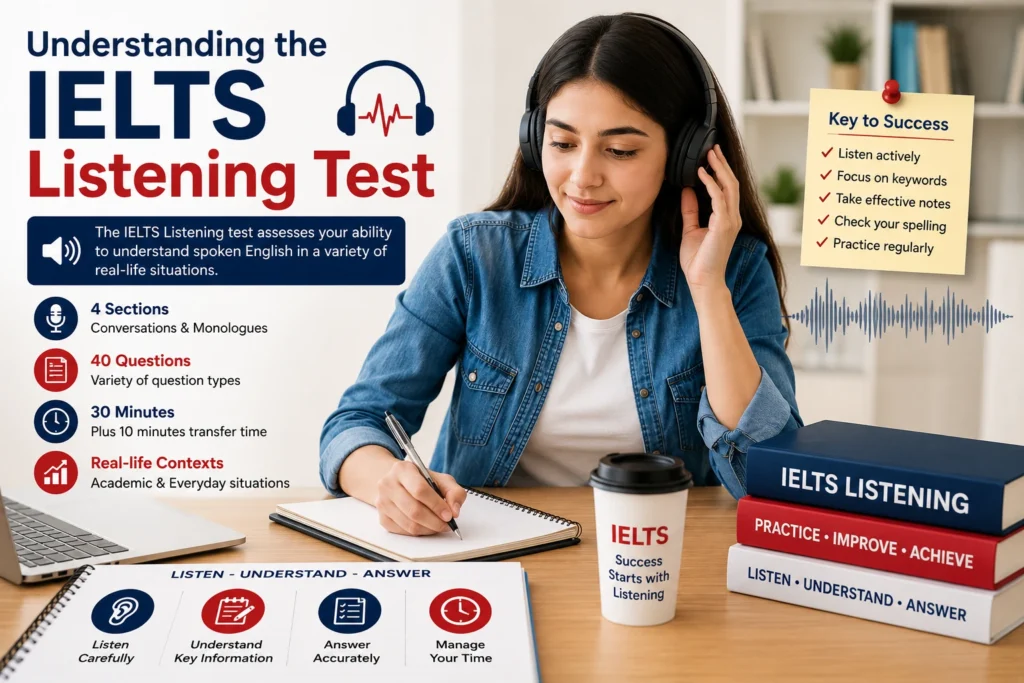
Understanding the IELTS Listening Test For many IELTS aspirants, the Listening module appears simple at first glance. However, a lack of clarity about the test format, scoring system, and expectations often leads to avoidable mistakes. Understanding how the IELTS Listening test is structured is the first and most important step towards improving your score. In this blog, we will explain the IELTS Listening format, clarify whether there is any difference between Academic and General Training listening, and briefly look at how band scores are calculated. IELTS Listening Test Format Explained The IELTS Listening test is the same for both Academic and General Training candidates. It consists of four sections and lasts for approximately 40 minutes, including transfer time. Each section becomes progressively more difficult. Section 1 focuses on a social or everyday situation. This could be a conversation about booking accommodation, joining a course, or enquiring about services. The language is simple and clear, making it a confidence-building start for test takers. Section 2 is usually a monologue related to everyday contexts, such as a speech about local facilities, travel information, or events. There is no interaction here, so students must rely entirely on listening carefully. Section 3 involves a discussion, often between two or three speakers, in an academic or training context. This section tests your ability to follow opinions, agreements, and disagreements. Section 4 is an academic monologue, such as a lecture or talk on an educational topic. The speech is faster, the vocabulary is more advanced, and the ideas are more complex. Across all four sections, you will answer 40 questions, and the question types may include multiple choice, form completion, sentence completion, matching, and map labelling. Academic vs General Listening: Is There Any Difference? One common misconception among students is that IELTS Academic Listening is harder than General Training Listening. In reality, there is no difference at all. Both Academic and General Training candidates: Listen to the same type of recordings Attempt the same number of questions Are marked using the same band score system The difference between Academic and General Training IELTS exists only in the Reading and Writing modules, not in Listening or Speaking. Therefore, preparation strategies for Listening remain exactly the same, regardless of which IELTS version you are taking. Understanding this helps students focus on skill-building rather than worrying unnecessarily about the test version. IELTS Listening Band Score Explained The Listening test is marked out of 40, with each correct answer earning one mark. Your raw score is then converted into a band score ranging from Band 1 to Band 9. For example: Around 16 correct answers may place you at Band 5 23–25 correct answers are usually required for Band 6 30–31 correct answers often lead to Band 7 35+ correct answers are needed for Band 8 and above Accuracy is critical in IELTS Listening. Even small errors, such as incorrect spelling, wrong plural forms, or exceeding the word limit, can cost you marks. This is why understanding instructions, spelling, and grammar is just as important as understanding the audio. Another key point is that IELTS Listening does not penalise you for wrong answers. Therefore, it is always better to attempt every question rather than leave it blank. Why Understanding the Listening Test Matters Many students practice listening tests repeatedly without understanding what the test is actually assessing. IELTS Listening checks your ability to: Follow spoken instructions Understand main ideas and specific details Recognise paraphrasing Stay focused under time pressure When students understand the format, scoring system, and expectations, they approach practice more strategically and confidently. Final Thoughts A strong IELTS Listening score begins with a clear understanding of the test itself. Knowing the structure of the four sections, recognising that Academic and General Listening are the same, and understanding how band scores are calculated can significantly reduce exam anxiety and improve performance. At Focus Education, we help students build this foundation through structured practice, clear strategy, and regular feedback, ensuring they approach the IELTS Listening test with confidence and clarity.
IELTS Speaking: How to Perform at Your Best in Part 3
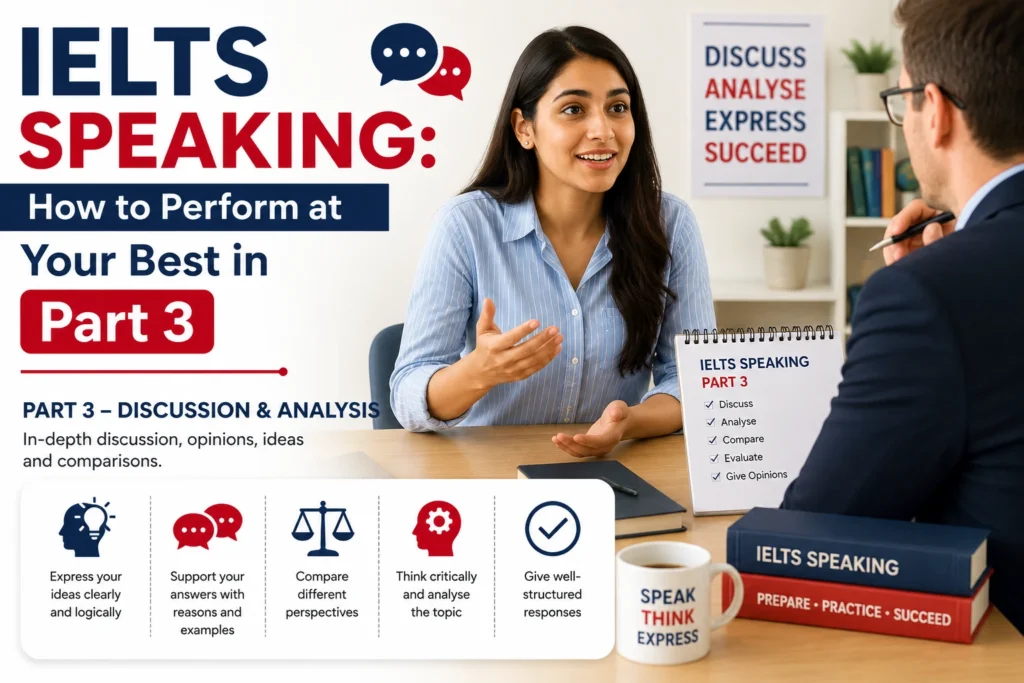
IELTS Speaking: How to Perform at Your Best in Part 3 After discussing how to handle Part 1 and Part 2 of the IELTS Speaking test, it is time to understand the final stage — Speaking Part 3. This section builds directly on your cue card topic and moves into a more general, analytical discussion. So, what can a student expect in Part 3? Part 3 consists of follow-up questions connected to the theme of your Part 2 cue card. For example, if Part 2 asked you to “Describe a book you recently read,” then Part 3 may include broader questions such as “Do people read fewer books today?” or “How has digital media changed reading habits?” These questions require opinions, explanations, comparisons, and predictions. Topics can range across education, technology, environment, culture, society, and lifestyle. Below are the key strategies that help you perform well in this section: 1. Speak about topics in general Part 3 is not about your personal life unless the examiner specifically asks for it. Your answers should focus on society, trends, behaviour, and broader viewpoints. Instead of saying, “I don’t read books,” shift your response to “Many people today prefer short online content because…”. This shows you understand the aim of Part 3: giving reasoned, general opinions. You can use the following phrases to extend the discussion in a more general way: In my country, most people believe that… If I compare my country to Australia, the way we [farm/travel/work/eat/celebrate] is quite different The local communities in my country… Thinking about this in general, the main reason why most people… From my perspective, if I take my country as an example… I have seen this happen in my city, and it's a major issue. To deal with this problem, we should… There are a lot of examples of this in my country. The list of bullet points taken from the IDP Website* 2. Use linking words and phrases Part 3 requires structured and connected ideas. Linking words help the examiner follow your thoughts smoothly. Useful phrases include: “Firstly…, secondly…” “On the other hand…” “This is mainly because…” “As a result…” “In my opinion…” Avoid overusing them, but use enough to create a clear organisation. 3. Use topic-related vocabulary, not forced difficult words Students often think complex or uncommon words will improve their score. In reality, the examiner wants accurate, appropriate vocabulary. If the topic is “environment,” words like pollution, conservation, climate, sustainability, and eco-friendly are more relevant than long, unnatural words. Appropriacy matters more than complexity. 4. Extend your answers without going off-topic Part 3 answers should be longer than Part 1 but still focused. A good structure is: Give your main point Explain why Give an example or result This keeps your response detailed but controlled. Avoid drifting into unrelated information. 5. Use a wide range of grammar Examiners expect more grammatical flexibility in Part 3 compared to Part 1. This includes: Conditionals Comparisons Complex sentences Passive structures Future predictions (will / might / likely to) Accuracy is important, but showing variety is equally valuable. 6. Use a wider range of vocabulary Part 3 gives you the chance to show mature, analytical vocabulary. Instead of simple words like “good” or “bad,” try “beneficial,” “harmful,” “significant,” “challenging,” or “effective.” Again, clarity and correctness are more important than sounding complicated. Look at the mind-map image below, which shows vocabulary and phrases related to the topic ‘Famous People.’ Image taken from the IDP Website* 7. Stay calm and avoid rushing Because the questions are deeper, students often speed up or panic. Taking one second to think is completely acceptable. A short pause shows the examiner you are organising your ideas. Speaking too fast leads to errors, unclear pronunciation, and incomplete answers. 8. Ask for clarification if needed If you do not understand a question, it is better to clarify than guess. You can say: “Could you please repeat the question?” “Do you mean…?” This does not affect your band score and prevents you from answering incorrectly. Final Thoughts Part 3 is where you demonstrate your ability to think, explain, and analyse in English. With the right strategies—structuring answers, using general ideas, maintaining clarity, and showing mature language—you can perform confidently and naturally. Practising regularly with a trainer helps you improve the depth of your responses and understand what examiners are actually looking for. At Focus Education, students receive guided practice, weekly speaking mocks, and personalised feedback to help them excel in all parts of the IELTS Speaking test. If you want focused training and structured speaking practice, our IELTS classes can help you prepare effectively.