
IELTS Speaking: How to Perform at Your Best in Part 1
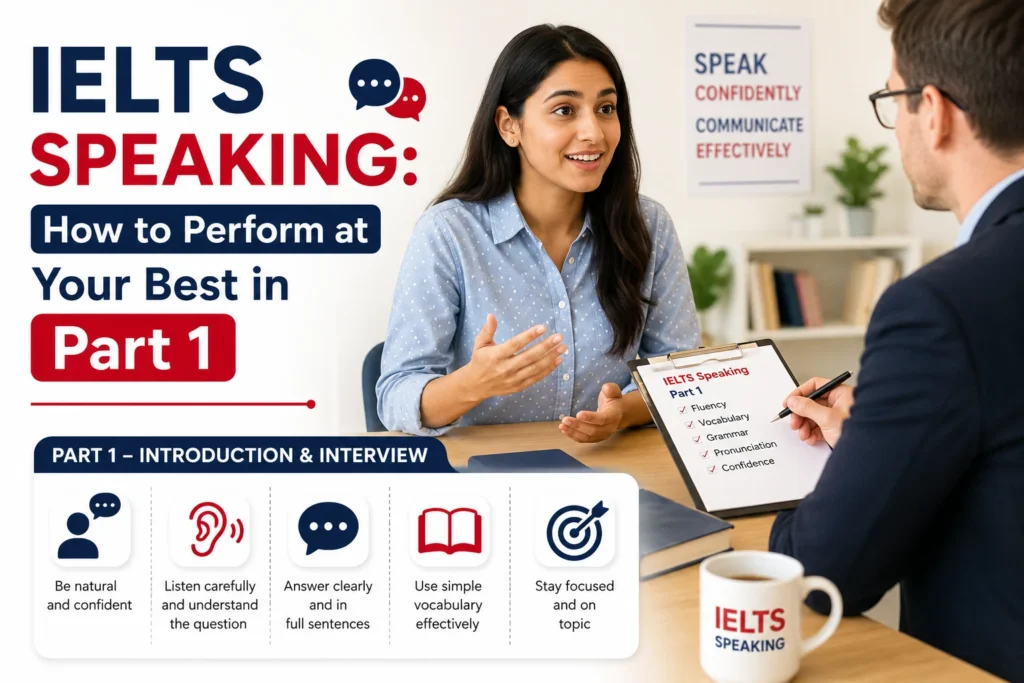
IELTS Speaking: How to Perform at Your Best in Part 1 The IELTS Speaking test is either a face-to-face or virtual interview that lasts 11–14 minutes and is divided into three parts. Part 1 is the introduction and interview section, where the examiner asks simple, everyday questions about your life, habits, and personal experiences. Although this part is often considered the easiest, many students underestimate it and end up feeling nervous or giving very short answers. In this blog, we will focus on how you can perform your best in Part 1. In the coming blogs, we will also talk about how to succeed in Part 2 (the cue card) and Part 3 (discussion questions). Why Part 1 Still Needs Practice Many students feel that Part 1 will be easy because the questions are personal. However, once the test begins, even simple questions can feel challenging. Students sometimes worry about grammar, hesitate while speaking, or give quick one-line answers because they are unsure how much they should say. They may also fear being judged, making mistakes, or not understanding the question. But with the right preparation, Part 1 becomes a great opportunity to build confidence and start the test strongly. How Part 1 Begins Part 1 always starts in a predictable way. The examiner will: Greet you Ask your name Check your ID Ask general questions such as: Where are you from? Do you work or study? What kind of place do you live in? The topics in Part 1 are simple and familiar: hobbies, daily routine, friends, food, hometown, weather, music, and so on. Tips to Perform at Your Best in Part 1 Answer in the Correct Tense Listen carefully to the tense of the question: “Do you like cooking?” → Present simple “Did you enjoy school as a child?” → Past simple “Will you travel next month?” → Future Matching the tense shows accuracy and control. Extend Your Answers (but not too much) The examiner does not want one-word replies. They also do not want long stories. Your answer should be: 2–3 sentences Clear and relevant For example: Q: Do you enjoy reading? A: Yes, I do. I enjoy reading mainly in the evenings because it helps me relax after a long day. I prefer non-fiction books. Practice Common Topics Beforehand You cannot predict the exact questions, but you can practice the topics that come again and again. This helps you become familiar with the type of answers expected in Part 1. If You Don’t Understand, Ask for Clarification It is perfectly acceptable to say: “Sorry, could you repeat the question?” “Could you explain what you mean by…?” This does not reduce your score. It shows confidence. Use Natural Expressions Using functional language helps you sound more fluent and natural. They also help you extend your answers easily. Useful Functional Language for Part 1 These phrases help you start and extend your answers naturally: Well, I would say that… To be honest… I usually… I once… When I was young… These days… If I think about it… Actually, I prefer… For example… In my free time… You do not need to use all of them, but including a few makes your speaking smoother and more confident. Examples of Part 1 Questions Here are some typical questions the examiner may ask: Home & Hometown Where do you live? What do you like about your hometown? Work & Study What do you do? Why did you choose that field? Daily Life Do you enjoy cooking? How do you usually spend your weekends? Likes & Preferences Do you like travelling? What kind of music do you listen to? Putting It All Together: Sample Answers Q: Do you enjoy watching movies? A: Yes, I do. I watch movies at least once a week because it helps me relax. These days, I mostly enjoy watching light-hearted comedies. Q: Where do you usually go on weekends? A: I usually spend my weekends at home. After a busy week, I like having some quiet time. Sometimes I meet friends for a short outing. Q: Did you enjoy school as a child? A: Yes, I did. When I was young, I really enjoyed going to school because I liked my teachers and I loved taking part in activities. Final Thoughts IELTS Speaking Part 1 is simple, but performing well requires clear communication, correct tense usage, and confident delivery. With steady practice, you can turn this section into a strong start that sets the tone for the rest of your test. Build comfort with common topics, practice extending answers naturally, and remember that small mistakes are normal. The key is to stay relaxed and speak naturally. If you want guided speaking practice and personalised feedback, Focus Education offers structured sessions to help you perform your best.
IELTS Speaking: Common Questions in Part 1, 2, and 3
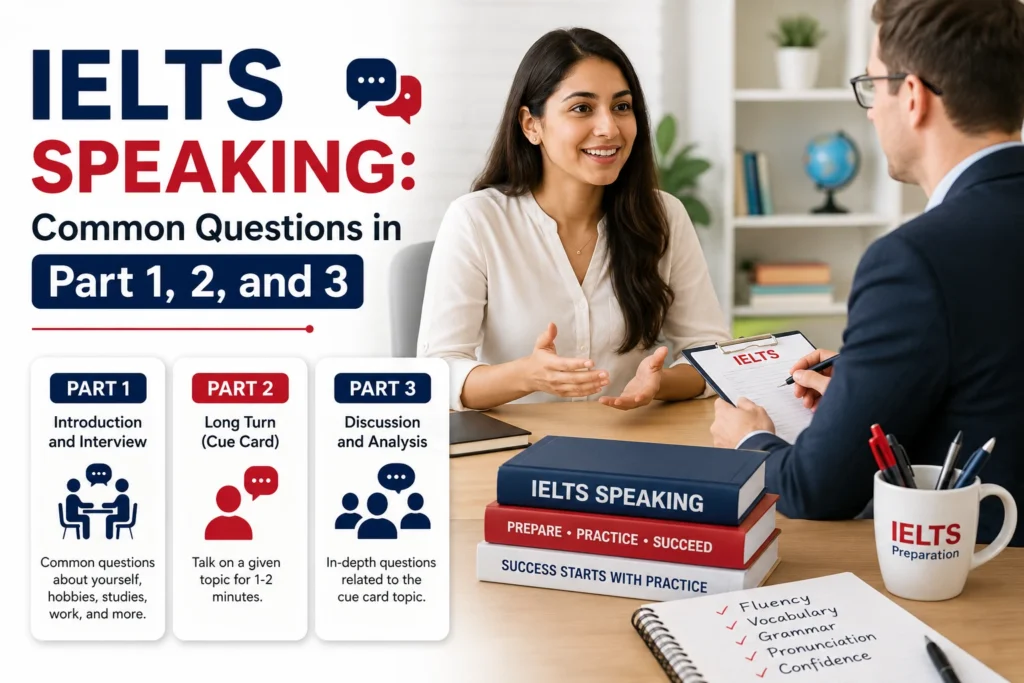
IELTS Speaking: Common Questions in Part 1, 2, and 3 IELTS Speaking Test The IELTS Speaking test is designed to assess a candidate’s ability to communicate effectively in English. Unlike other sections of the exam, this test is conducted as a live interaction with a certified examiner, making it more conversational and real-life in nature. The test is the same for both IELTS Academic and General Training candidates and aims to evaluate how well a student can express ideas, opinions, and information clearly in spoken English. What Does the IELTS Speaking Test Assess? The Speaking test does not judge knowledge or intelligence. Instead, it focuses on how naturally and accurately a candidate can use English. Examiners assess four key areas: fluency and coherence, lexical resource (vocabulary), grammatical range and accuracy, and pronunciation. The goal is to see whether a candidate can communicate ideas smoothly, organise responses logically, and be understood without effort. Format of the IELTS Speaking Test The IELTS Speaking test lasts 11 to 14 minutes and is divided into three parts, each testing different speaking skills. Part 1 (4–5 minutes):This section includes general questions about familiar topics such as home, work, studies, hobbies, or daily routines. It helps the examiner understand the candidate’s basic speaking ability. Part 2 (3–4 minutes):Candidates are given a cue card with a topic and one minute to prepare. They are expected to speak for up to two minutes on the given topic, followed by one or two follow-up questions. Part 3 (4–5 minutes):This part involves a deeper discussion related to the Part 2 topic. Questions are more abstract and require opinions, explanations, and examples. Latest IELTS Speaking topics (2025) Here are some common IELTS Speaking topics that often come up in the test: Hometown Part 1:Where are you from? Part 2:Describe your hometown.You should say:where it is located,what it is famous for,and explain what you like or dislike about it. Part 3:How do cities change when they become more developed? Work / Studies Part 1:Do you work or are you a student? Part 2:Describe a subject or job that you find interesting.You should say:what it is,why you chose it,and explain why it interests you. Part 3:How important is job satisfaction compared to salary? Technology Part 1:How often do you use technology in your daily life? Part 2:Describe a piece of technology you use regularly.You should say:what it is,how you use it,and explain why it is important to you. Part 3:Do you think technology has changed the way people communicate? Hobbies and Free Time Part 1:What do you usually do in your free time? Part 2:Describe a hobby you enjoy.You should say:what it is,how long have you been doing it?and explain why you enjoy it. Part 3:Why do people need hobbies in today’s busy life? Travel Part 1:Do you like travelling? Part 2:Describe a place you have visited and liked.You should say:where it was,what you did there,and explain why you liked it. Part 3:How has tourism affected local cultures? Food Part 1:What kind of food do you like? Part 2:Describe a meal you enjoyed recently.You should say:what the meal was,where you had it,and explain why it was memorable. Part 3:How have people’s eating habits changed over time? Education Part 1:Did you enjoy studying when you were in school? Part 2:Describe a teacher who influenced you.You should say:who the teacher was,what they taught you,and explain how they influenced you. Part 3:What qualities make a good teacher? Health Part 1:Do you do anything to stay healthy? Part 2:Describe a healthy habit you follow.You should say:what the habit is,how often you do it,and explain why it is important to you. Part 3:Who should be responsible for public health: individuals or the government? Family Part 1:Do you spend much time with your family? Part 2:Describe a family member you admire.You should say:who the person is,what they do,and explain why you admire them. Part 3:How have family structures changed in modern society? Environment Part 1:Are you concerned about environmental issues? Part 2:Describe an environmental problem you are aware of.You should say:what the problem is,what causes it,and explain how it affects people. Part 3:What steps can governments take to protect the environment? Why Is It Important to Practise Different Speaking Topics? Builds confidence for unfamiliar questionsThe IELTS Speaking test can include a wide range of topics, and candidates cannot predict which one will appear. Practising different topics helps students feel more confident, even when they receive a question they have not prepared for specifically. Develops topic-based vocabulary naturallyEach topic comes with its own commonly used words and phrases. Regular practice across topics helps students use suitable vocabulary naturally, instead of forcing difficult words during the test. Improves fluency and idea developmentWhen students practise multiple topics, they learn how to extend answers smoothly and organise ideas logically. This reduces hesitation and improves flow, especially in Speaking Parts 2 and 3. Strengthens paraphrasing skillsPractising varied questions helps students restate ideas in different ways. This is useful when responding to the examiner without repeating the question word for word. Reduces over-reliance on memorised answersExposure to different topics encourages spontaneous speaking. This helps students avoid memorised responses, which can sound unnatural and affect fluency scores. Final Thoughts The IELTS Speaking test is not about memorising answers but about developing the ability to communicate clearly across different situations and topics. Understanding the format and practising a variety of questions from Parts 1, 2, and 3 can make a significant difference to performance. At Focus Education, students receive guided speaking practice across multiple topics with regular feedback, helping them improve fluency, structure, and confidence in a practical and exam-focused manner.
IELTS Reading test: How to manage your time?
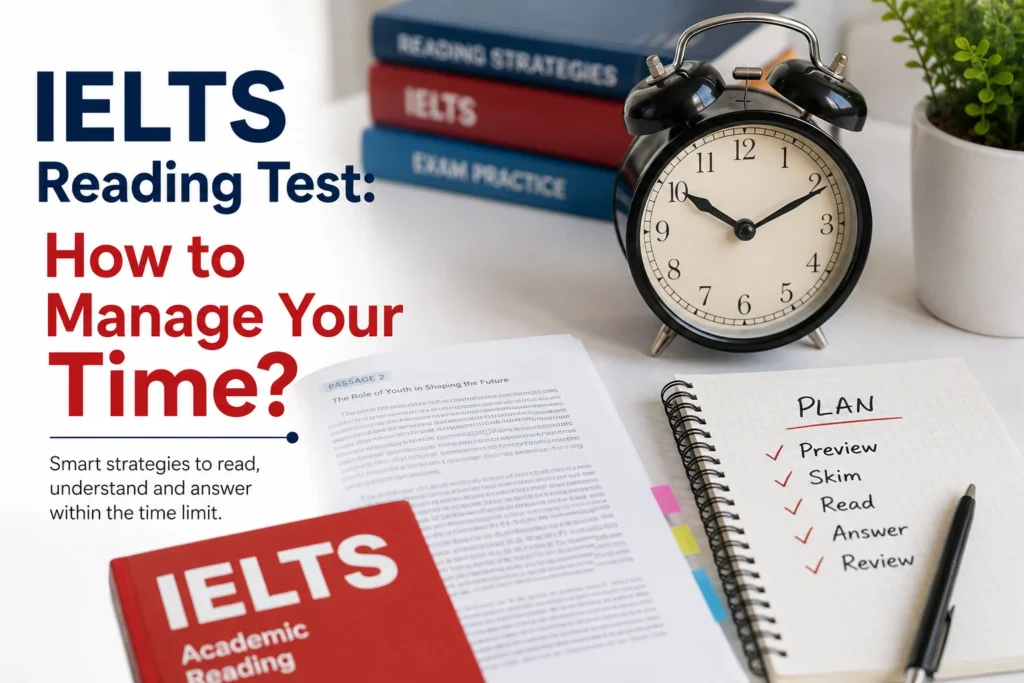
IELTS Reading test: How to manage your time? What Is IELTS Reading? The IELTS Reading test checks how well a candidate can understand written English. It assesses skills such as reading for main ideas, identifying specific information, understanding opinions, and recognising the writer’s purpose. The Reading module is the same in structure but different in difficulty and content for IELTS Academic and General Training. Candidates are given 60 minutes to answer 40 questions, and no extra time is provided to transfer answers to the answer sheet. This makes time management one of the biggest challenges in the IELTS Reading test. Time Given to Each Passage The IELTS Reading test consists of three passages, and students are expected to manage time on their own. It is always recommended to spend no more than 20 minutes on each part of the Reading test; however, if you find the first passage easy, you may finish it in a shorter time, allowing you more time to answer questions in the next two passages. The passages get harder as you move through the test, so make sure you keep enough time to tackle the final passage. Where Are the Reading Passages Taken From? IELTS Reading passages are taken from authentic sources such as newspapers, magazines, journals, books, and online articles. For Academic IELTS, the texts are more formal and academic in nature. For General Training, the passages are based on everyday English, workplace contexts, and general interest topics. Common IELTS Reading Question Types Understanding question types helps students save time and avoid confusion. Multiple Choice: Read the question first, scan the passage for the relevant idea, and eliminate options that clearly do not match the text. Identifying Information (True / False / Not Given): Check whether the statement agrees with the facts in the passage, contradicts them, or is not mentioned at all. Identifying a Writer’s Views / Claims (Yes / No / Not Given): Focus on the writer’s opinions rather than facts and decide whether the statement matches, contradicts, or is not stated. Matching Information: Scan the passage to find which paragraph contains the specific information mentioned in the question. Matching Headings: Read each paragraph for its main idea and choose the heading that best summarises it, not just matching keywords. Matching Features: Match statements to people, places, theories, or years by carefully tracking names and references in the text. Matching Sentence Endings: Match sentence beginnings with the correct endings by ensuring the completed sentence makes logical and grammatical sense. Sentence Completion: Complete sentences using words from the passage while strictly following the given word limit. Summary / Note / Table / Flow-chart Completion: Use information from the passage to fill gaps logically, paying attention to meaning, grammar, and word limits. Diagram Label Completion: Identify the correct part of the diagram by locating the description in the passage and transferring the exact wording. Short-Answer Questions: Answer directly using words from the passage and ensure the response fits the specified word limit. Each type requires a slightly different approach, so familiarity is essential. Time Management Tips for IELTS Reading Skimming and Scanning: Skimming helps you understand the general idea of the passage quickly, while scanning allows you to locate specific information such as names, dates, or numbers. Using these techniques correctly prevents unnecessary reading and saves valuable time. Mark Keywords in the Questions: Before reading the passage, underline or mentally note important words in the questions. Keywords guide your attention and help you find the relevant part of the text faster. Read the Questions Carefully: Many students lose marks because they misunderstand what the question is asking. Pay attention to whether the question is asking for facts, opinions, causes, or examples. A small misunderstanding can lead to choosing the wrong answer even if the information is present in the passage. Read the Instructions Carefully: Always read the instructions before attempting any question type. Check word limits such as “NO MORE THAN TWO WORDS,” spelling requirements, and whether answers should be taken directly from the passage. Ignoring instructions is one of the most common reasons for losing easy marks. Check Answers as You Go: If time permits, quickly review your answers while moving through the test. This helps identify spelling errors or incorrect choices before it is too late. Read the First and Last Line of Paragraphs: The first line often introduces the main idea of a paragraph, while the last line may summarise or conclude it. This strategy is especially helpful for matching headings and main idea questions. Final Thoughts Time management in IELTS Reading is not about reading faster, but about reading smarter. Understanding the test format, recognising question types, and applying the right strategies can significantly improve accuracy and confidence. With guided practice and expert feedback, students can learn how to approach each passage strategically. At Focus Education, students are trained to manage time effectively while improving comprehension, helping them perform better in the IELTS Reading module.
How IELTS Is Different from School and College English
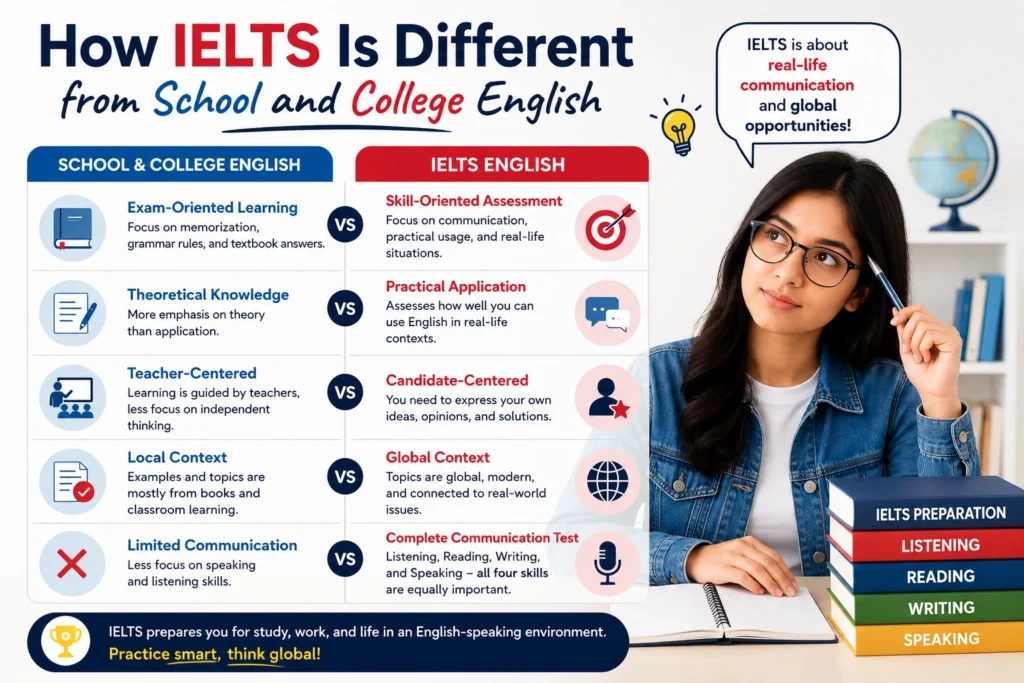
How IELTS Is Different from School and College English Many students believe that doing well in school or college English automatically means they will score high in IELTS. However, this is a common misunderstanding. IELTS is not a traditional academic English exam. It is a skill-based test designed to measure how well a person can use English in real-life situations. Understanding this difference is essential for effective IELTS preparation. This blog explains how IELTS English differs from the English most students are familiar with from their academic background. 1. Communication Over Theory In schools and colleges, English learning focuses heavily on grammar rules, textbooks, and literature. Students often study poems, stories, and fixed grammatical concepts, and success is usually based on how well answers are memorised. IELTS focuses on practical communication skills. Grammar is important, but only as a tool to express ideas clearly. The exam tests whether a student can understand spoken and written English and communicate thoughts effectively in speaking and writing tasks. 2. No Fixed or Memorised Answers Academic exams usually reward students for writing answers that closely match textbook content. Creativity is often limited. IELTS works differently. Especially in Writing Task 2 and the Speaking test, there are no fixed answers. Students are assessed on how clearly they explain ideas, how logically they organise thoughts, and how accurately they use grammar and vocabulary. As long as the response is relevant and well developed, different opinions are acceptable. 3. Speaking Is Actively Tested Speaking is rarely assessed formally in school or college. As a result, many students are not confident speaking English spontaneously. IELTS Speaking is a face-to-face interview where examiners evaluate fluency, pronunciation, vocabulary, and grammatical range. Students must think and respond in real time, which requires regular speaking practice rather than memorisation. 4. Practical Vocabulary Matters More In academic exams, students often try to impress examiners by using complex or “high-level” words, even if they are not used correctly. IELTS values natural and accurate vocabulary. Using simple but correct words appropriately is better than forcing difficult vocabulary. Topic-related vocabulary used naturally helps improve scores, especially in Speaking and Writing. 5. Structured Writing Is Essential School and college writing may allow storytelling, emotional language, or loosely organised ideas. IELTS Writing requires a clear structure, logical flow, and task-focused answers. Students must follow the question carefully, organise ideas into proper paragraphs, and maintain a formal tone when required. Writing extra or irrelevant information can reduce scores, even if the language is good. 6. Strong Time Management Skills Are Required Most academic exams provide predictable patterns and sufficient time. IELTS is strictly time-bound. Reading passages must be handled quickly, listening answers are heard only once, and Writing requires planning, writing, and checking within a limited time. Success depends not only on language ability but also on exam strategy. 7. Skill-Based Evaluation System Schools and colleges evaluate performance using marks or percentages. IELTS uses band descriptors that assess specific skills such as coherence, lexical resource, grammatical range, and pronunciation. Improvement depends on understanding these criteria and working on weaknesses, not simply studying more content. 8. Memorisation Does Not Help Many students succeed academically through memorisation, but this approach does not work in IELTS. Memorised answers, templates, and repeated phrases are easily noticed by examiners and can negatively affect scores. IELTS rewards originality, clarity, and genuine language use. Why This Difference Matters Students who prepare for IELTS using school or college methods often feel confused or stuck at the same band score. Once students understand that IELTS is a language proficiency test, their preparation becomes more focused and effective. At Focus Education, we help students shift from academic English to IELTS-oriented English through structured training, regular practice, and personalised feedback. Our goal is not just to teach English, but to help students use English confidently and accurately in the IELTS exam.
How to Analyse a Bar Graph in IELTS Writing Task 1
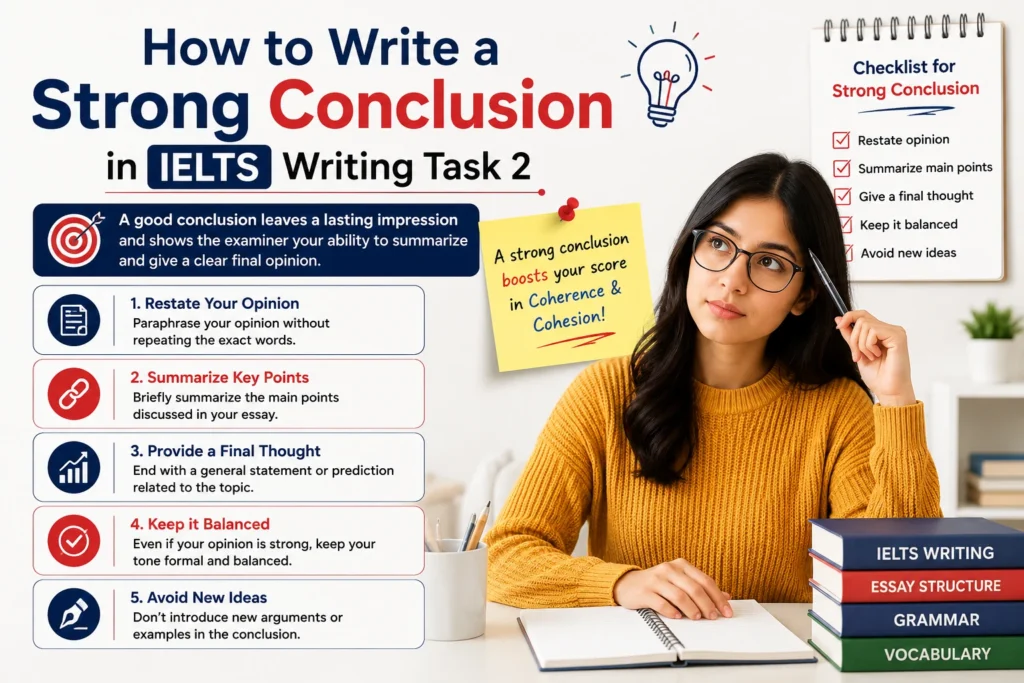
How to Write a Strong Conclusion in IELTS Writing Task 2 In IELTS Writing Task 2, students are required to write an essay of at least 250 words in about 40 minutes. While most students focus heavily on the introduction and body paragraphs, the conclusion is often rushed or poorly written. However, a weak conclusion can reduce your overall impression and affect your score in Task Response and Coherence & Cohesion. In this blog, we will understand what makes a strong conclusion and how to write one effectively. What Is the Purpose of a Conclusion? The conclusion is the final paragraph of your essay. Its purpose is to: Summarise your main position Restate your opinion clearly Bring your essay to a logical end It should not introduce new ideas. Instead, it should briefly reinforce what you have already discussed. What a Strong Conclusion Should Include A strong IELTS conclusion usually contains: 1. A restated thesis (your main opinion) 2. A summary of your main points It should be clear, direct, and concise. Usually, 2–3 sentences are enough. Example of a Weak Conclusion “Overall, this topic has many advantages and disadvantages. In conclusion, it depends on the situation.” This is too vague. It does not clearly state the writer’s position. Example of a Strong Conclusion (Opinion Essay) Question: “Some people believe that technology has made life more complicated than simple. To what extent do you agree or disagree?” Strong conclusion: “In conclusion, although technology has introduced certain challenges, I strongly believe that it has made life significantly more convenient and efficient. The benefits it offers in communication and productivity clearly outweigh the drawbacks.” Notice that: The opinion is clear. No new ideas are introduced. The language is simple but confident. How to Restate Your Opinion Do not copy your introduction word for word. Instead, paraphrase it. Introduction example: “I believe that governments should invest more in public transport than in building new roads.” Conclusion example: “To conclude, I firmly believe that prioritising public transport is a more sustainable and effective solution than expanding road infrastructure.” The idea is the same, but the wording is different. What to Avoid in the Conclusion Do not introduce new arguments. Do not write detailed explanations. Do not write emotional or dramatic statements. Do not make it too long. Remember, this is an academic essay, not a speech. Length of a Good Conclusion Your conclusion should be around 40–60 words. Writing a very long conclusion wastes time and may repeat information unnecessarily. Simple Conclusion Structures for Different Essay Types Opinion Essay “In conclusion, I strongly agree/disagree that… because…” Discussion Essay “To conclude, while both views have merit, I believe that…” Problem–Solution Essay “In conclusion, although this issue is serious, it can be addressed by…” Using simple structures keeps your writing clear and organised. Final Thoughts A strong conclusion does not need complex vocabulary or long sentences. It needs clarity, confidence, and logical closure. If your introduction starts your argument well, your conclusion should finish it clearly and effectively. With regular practice and proper guidance, writing strong conclusions becomes much easier. At Focus Education, we train students to structure their essays strategically so that every paragraph, including the conclusion, supports a higher band score.
Common Topics for IELTS Writing Task 2
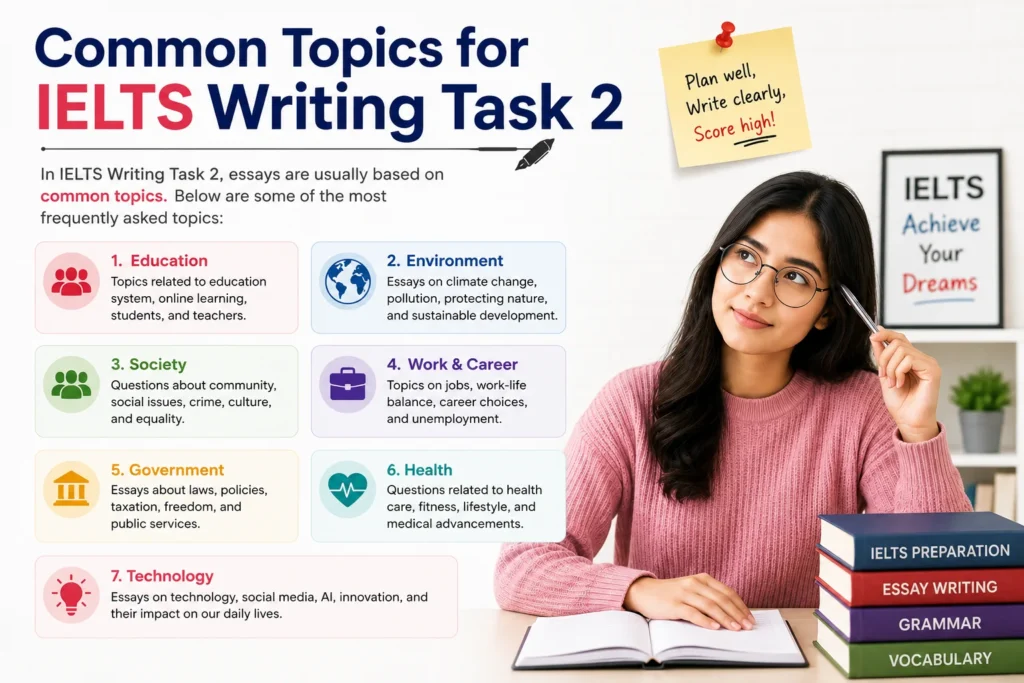
Common Topics for IELTS Writing Task 2 One of the most common questions IELTS aspirants ask is whether Writing Task 2 topics are predictable. While the exact questions change, the themes remain largely the same. IELTS tests your ability to present ideas clearly, organise arguments, and support opinions using common global issues. Knowing these recurring topics helps students prepare ideas, vocabulary, and examples in advance, which is especially useful under time pressure. Below are the most common IELTS Writing Task 2 topics: Education Education is a frequent topic, especially for students aiming to study abroad. Questions often focus on assessment systems, teaching methods, and the purpose of education. Some people believe that exams are the best way to assess students, while others disagree. Discuss both views and give your own opinion. Many people think universities should focus more on practical skills than academic knowledge. To what extent do you agree or disagree? Online education is becoming increasingly popular. Do the advantages outweigh the disadvantages? Health Health-related essays usually require balanced thinking and solution-based answers. Governments should invest more in preventing illness rather than treating it. To what extent do you agree or disagree? Poor lifestyle choices are responsible for many health problems today. What are the causes and what solutions can you suggest? Some people believe healthcare should be free for everyone. Discuss both views and give your opinion. Business and Work These topics are common in both Academic and General Training modules. Many employees now work from home. Do the advantages outweigh the disadvantages? Some people believe job satisfaction is more important than salary. Do you agree or disagree? Large multinational companies are replacing small businesses. Is this a positive or negative development? Family Family-based questions often test opinions and social understanding. In many countries, families are becoming smaller. What are the reasons and effects? Some people think elderly parents should live with their children, while others prefer independent living. Discuss both views and give your opinion. Family relationships are weaker today than in the past. To what extent do you agree or disagree? Technology Technology essays focus on modern life and social impact. Technology has reduced face-to-face communication. Do you think this is a positive or negative development? Some people believe children should have limited access to technology. Do you agree or disagree? Modern technology is increasing the gap between rich and poor. To what extent do you agree or disagree? Environment These questions often involve global responsibility and solutions. Environmental problems are too big for individuals to solve. Only governments can make a real difference. Do you agree or disagree? Some people believe economic growth is more important than environmental protection. Discuss both views and give your opinion. What are the main causes of climate change, and what solutions can individuals and governments take? Government Government topics test analytical thinking and policy awareness. Governments should spend more money on public services rather than defence. To what extent do you agree or disagree? Is it the responsibility of the government to ensure a high standard of living for all citizens? Some people think governments should control the internet. Do you agree or disagree? How to Prepare for Writing Task 2 To write effective Task 2 essays, students should regularly read news articles to build ideas and examples. Developing topic-wise vocabulary helps express opinions clearly without memorisation. Most importantly, consistent practice with feedback allows candidates to improve structure, coherence, and task response. At Focus Education, students are trained to approach these topics strategically, with guided planning, idea development, and continuous evaluation—helping them write confident, exam-ready essays.
Colour Idioms for IELTS Speaking
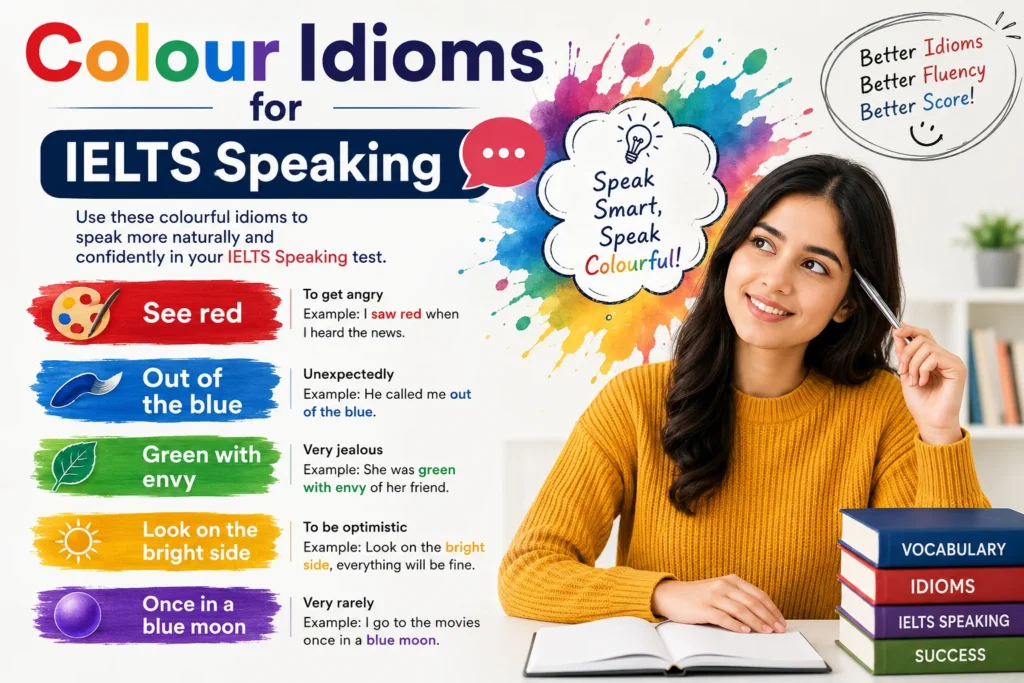
Colour Idioms for IELTS Speaking Idioms are commonly used expressions whose meanings are different from the literal meaning of the words. Native speakers use idioms naturally in everyday conversations, which is why they can be useful in the IELTS Speaking module. However, idioms should be used carefully and only when they fit the context naturally. In IELTS, idioms are not required for a high band score, but using a few common and appropriate ones can help make your answers sound more fluent and natural—especially in Speaking Part 2 and Part 3. Below are some easy and commonly used colour idioms that students can remember and use confidently. Common Colour Idioms with Examples 1. Once in a blue moon – something that happens very rarely.I visit my hometown once in a blue moon.Such events don’t happen often; they occur once in a blue moon. 2. In the black – financially stable or making a profit.The company is finally in the black after many losses.Small businesses aim to stay in the black. 3. In the red – facing financial loss.The shop is in the red due to low sales.Many startups remain in the red initially. 4. White lie – a harmless lie told to avoid hurting someone.I told a white lie to avoid upsetting my friend.Sometimes, white lies are socially acceptable. 5. Green with envy – very jealous.I was green with envy when I saw his new car.People often feel green with envy on social media. 6. Black and white – very clear, with no confusion.The rules are written in black and white.The law is not always black and white. 7. Grey area – something unclear or uncertain.Online privacy laws fall into a grey area.Some ethical issues remain a grey area. 8. Red flag – a warning sign.Poor communication is a red flag in relationships.Late submissions are a red flag for employers. 9. Green light – permission to start something.The manager gave us the green light to begin.Once approved, the project got a green light. 10. Out of the blue – unexpectedly.He called me out of the blue after years.The announcement came out of the blue. 11. Blue mood – feeling sad.I feel in a blue mood on rainy days.Music helps me overcome a blue mood. 12. Golden opportunity – a very good chance.Studying abroad is a golden opportunity.She didn’t miss the golden opportunity. 13. Pink slip – notice of job termination.He received a pink slip during layoffs.Many workers fear getting a pink slip. 14. White elephant – something expensive but useless.The project turned into a white elephant.Unused stadiums become white elephants. 15. Black sheep – someone different from the rest of the group.He is considered the black sheep of the family.Every family has a black sheep. How to Use Idioms Correctly in a Sentence (Syntax Explained) The safest way to use idioms in IELTS Speaking is to treat them like fixed phrases. This means you should not change their structure. Instead, you should place them naturally within a sentence, just like native speakers do. 1. Idioms as adverbs (tell us how often / when / in what manner)Idioms like once in a blue moon or out of the blue usually come at the end of the sentence or after the main verb.Structure:Subject + verb + object + idiomExample: I visit my hometown once in a blue moon. He called me out of the blue. Avoid placing such idioms at the beginning unless you are confident. 2. Idioms as adjectives (describe a situation or noun)Some idioms describe a condition or situation, like in the red, in the black, or a grey area.Structure:Subject + be verb + idiomExample: The company is in the red. The issue is a grey area. These idioms usually come after ‘is / are / was’. 3. Idioms as nounsIdioms like a red flag, a golden opportunity, or a white elephant act like nouns.Structure:Article + idiom + additional informationExample: Poor communication is a red flag in teamwork. Studying abroad is a golden opportunity. Always use articles (a / an / the) where required. 4. Idioms used after giving an ideaA safe IELTS trick is to first explain your idea in simple words, and then add the idiom.Structure:Idea + comma + idiomExample: I rarely meet my school friends, only once in a blue moon. Losing his job was unexpected, completely out of the blue. This avoids forcing the idiom and keeps the answer natural. 5. One Idiom = One IdeaNever use more than one idiom in a single answer in IELTS Speaking. Overuse sounds unnatural and reduces clarity. Final Thoughts Using idioms in IELTS Speaking can improve fluency, but students should avoid forcing them into every answer. One or two well-placed idioms are enough to sound natural and confident. Practising these expressions with correct context and feedback makes a big difference. At Focus Education, students are trained to use idioms naturally in speaking, with regular practice and guided feedback—helping them sound fluent without overdoing it.
‘Another’ vs ‘Other’ vs ‘The Other’: A CommonGrammar Confusion for IELTS Students
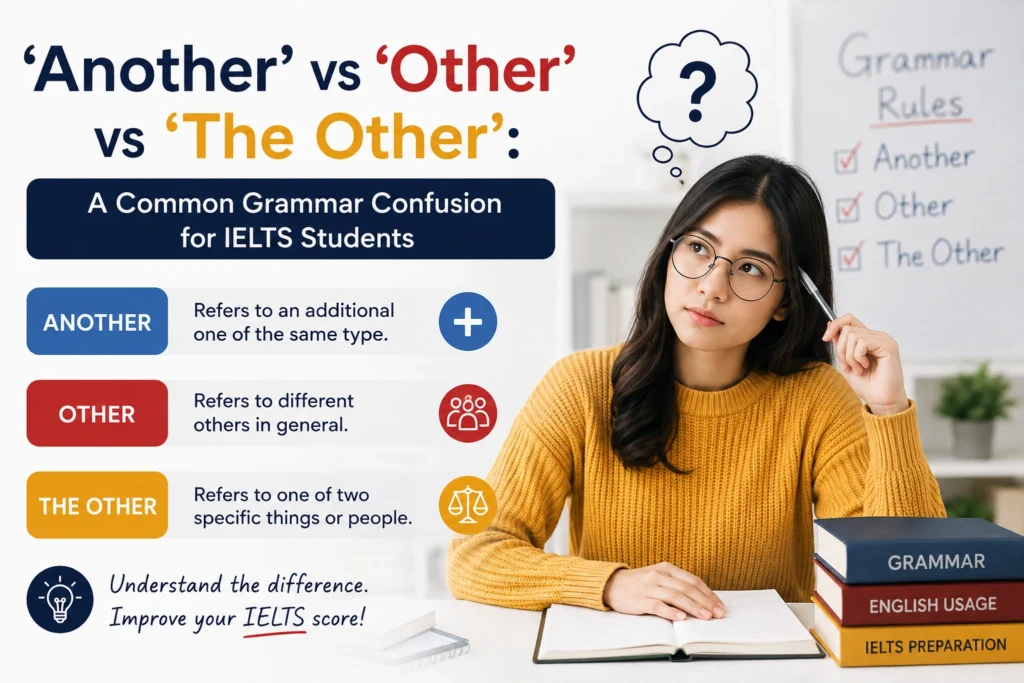
‘Another’ vs ‘Other’ vs ‘The Other’: A Common Grammar Confusion for IELTS Students Grammar accuracy plays a crucial role in the IELTS exam, particularly in Speaking and Writing, where even minor word choices can significantly impact clarity and meaning. One area where many students struggle is the correct use of another, other, and the other. Although these words look similar and are often used interchangeably by learners, they have clear grammatical differences. Understanding when and how to use these words correctly helps students sound more natural and precise in the English language. What Does “Another” Mean? Another means one more or an additional one. It is generally used with singular countable nouns and refers to something that is not specific. It answers the idea of “one more of the same type”. For example: I would like another cup of coffee. She is planning to take another IELTS attempt. In IELTS Speaking, another is commonly used when suggesting alternatives or adding ideas, which makes your responses sound more fluent. What Does “Other” Mean? Other is used to talk about additional or different items, usually in a general sense. It can be used with both singular and plural nouns, depending on the context. For example: Some students prefer online classes, while other students like offline learning. Do you have any other question? Here, other does not point to something specific. It simply refers to alternatives or differences in a broad way. What Does “The Other” Mean? The other is used when referring to the remaining one or ones from a specific group. It is definite and specific, which means both the speaker and listener know exactly what is being talked about. For example: I have two brothers. One lives abroad; the other lives in India. One chart shows sales in 2020, and the other chart shows data for 2023. In IELTS Writing Task 1, the other is particularly useful when comparing two visuals, categories, or trends. Key Differences at a Glance Another → one more, not specific Other → additional or different, general The other → the remaining one(s), specific Confusion usually happens when students forget whether the noun they are referring to is specific or general, or whether the group is already defined. Common Mistakes IELTS Students Make A frequent mistake is using another with plural nouns or using the other without a clearly defined group. Incorrect: She has many choices. The other options are expensive. Correct: She has many choices. Other options are expensive. Such errors may seem small, but repeated mistakes can reduce your Grammatical Range and Accuracy score. How to Use Them Correctly in IELTS Before choosing between another, other, or the other, ask yourself: Am I talking about one more item? → use another Am I talking about additional items in general? → use other Am I talking about the remaining item(s) from a known group? → use the other This simple mental check can prevent confusion during the exam. Final Thoughts Words like another, other, and the other are small, but they carry important meaning differences. Mastering their usage helps IELTS candidates express comparisons, alternatives, and ideas more clearly and confidently. At Focus Education, students are trained to recognise such common grammar traps and correct them through guided practice and exam-focused examples, ensuring stronger performance in both Writing and Speaking.
How to Analyse a Bar Graph in IELTS Writing Task 1
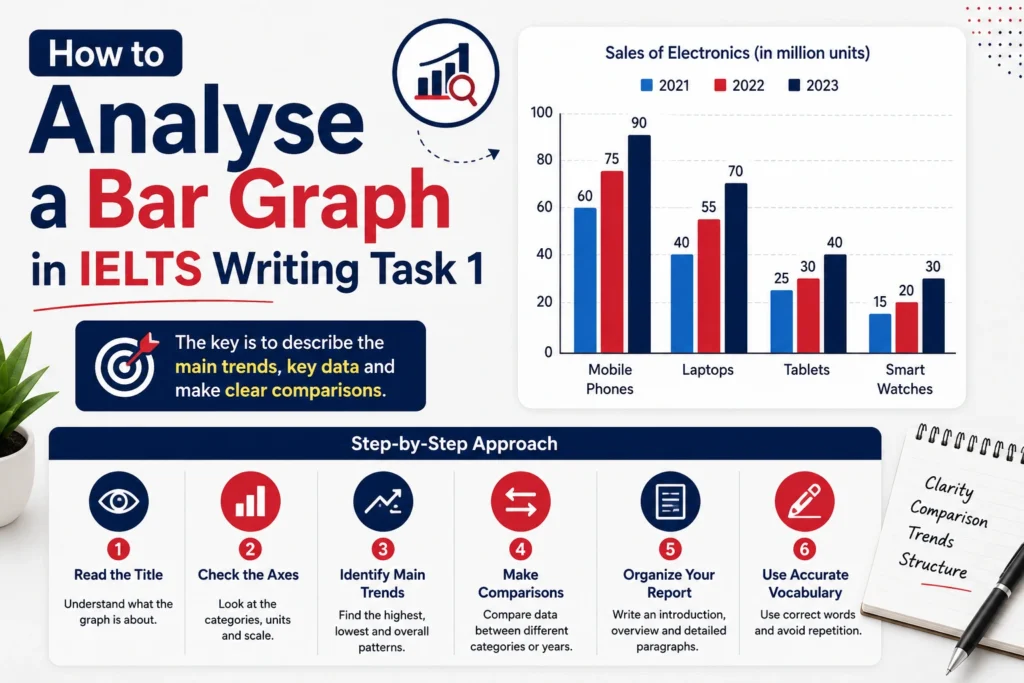
How to Analyse a Bar Graph in IELTS Writing Task 1 When you prepare for IELTS Writing Task 1, understanding how to analyse visual data is extremely important. Among all types of questions, bar graphs are among the most common. They measure changes, compare groups, and highlight trends clearly. In this blog, we will explain how to understand a bar graph correctly and how to present the information in a well-organised way. By following the steps below, you will be able to write a clear, accurate, and effective Task 1 report. What is Writing Task 1? Writing Task 1 in the Academic module requires you to describe information presented in a chart, graph, table, map, or process. Your main responsibility is to summarise the key data and report the significant features without giving personal opinions. You must select and compare information accurately. Ideal Time and Word Count The test recommends spending around 20 minutes on this task. You must write at least 150 words, but going up to 170–190 words is usually ideal for clarity and detail. Number of Paragraphs and the Correct Sequence A good response should have four paragraphs: Introduction Overview Body Paragraph 1 Body Paragraph 2 This paragraph structure helps present data logically and fulfils the organisation criteria. Types of Writing Task 1 Questions You may receive: Bar graphs Line graphs Pie charts Tables Maps (one map or two maps) Process diagrams Combination charts (e.g., a line graph + bar graph together) Each type requires a different approach, but the structure stays roughly the same. Marking Criteria in Writing Task 1 Examiners score your report on four main criteria: Task Achievement – Have you summarised key features accurately? Coherence and Cohesion – Is your writing well-organised and logical? Lexical Resource – Is your vocabulary range appropriate and accurate? Grammatical Range and Accuracy – Are your sentences varied and error-free? Understanding these points helps you write in a more focused and confident manner. How to Analyse a Bar Graph (Using the Example Provided) Let us analyse the bar graph that shows divorce rates in Finland and Sweden from 2011 to 2015. When you get a bar graph in the exam, your first step is to observe the details carefully. 1. What to Observe in a Bar Graph A student must pay attention to: a. X-axis This tells us the categories being measured. In this graph, the x-axis shows the years: 2011, 2012, 2013, 2014, and 2015. b. Y-axis This shows how the information is measured. Here, the y-axis shows percentages. c. Time Period and Tense Since the years are in the past, you must use past tense. d. Categories There are two categories: Finland and Sweden. e. Two Ways to Compare You can compare data in two ways: Year-by-year comparison But this becomes repetitive and does not highlight the relationship between categories. Country-wise comparison This is a better method. For example, discuss Finland’s pattern first, then Sweden’s pattern. This method is clearer and more organised. 2. How to Structure Your Answer Introduction (Maximum 2 Lines) Introduce the chart and paraphrase the question. Example: “The bar chart compares the percentage of divorces in Finland and Sweden over five years from 2011 to 2015.” Keep it short and factual. Overview (2–3 Key Features) This paragraph should present a general summary. Do not include numbers here. You can mention: Sweden had higher divorce rates than Finland in most years. Both countries experienced fluctuations over the period. Finland showed a gradual rise, while Sweden declined by the end. These are the main trends the examiner wants to see. Here is a clean, simple, trainer-friendly note you can directly use with your students. No extra fluff — just practical guidance. How to Decide the Order of Body Paragraphs When writing the body paragraphs for a bar graph, students often get confused about which category to describe first. There are two correct approaches, and both are acceptable in IELTS. The choice depends on the graph and the student’s writing style. Follow the Order of the Graph (Safer for Beginners) This means describing the categories exactly as they appear in the title, colour labels, or x-axis order. Use this approach when: The graph does not show a strong trend difference Both categories behave similarly Students prefer a predictable, easy structure The order in the graph is clear and logical Example: If the colour labels show Finland first and Sweden second, you describe Finland first in BP1. Why this works: Examiners expect a clear, simple, organised answer, and following the graph’s natural order keeps the writing structured. Start with the Dominant Trend This means describing the category that shows: higher overall values a more noticeable upward or downward pattern the most significant change Use this approach when: One country/group clearly stands out There is a dramatic rise/fall Data is easier to compare when you start with the stronger trend Students can handle flexible organisation Example: If Sweden consistently has higher divorce rates and shows a notable decline, starting with Sweden creates a cleaner logical flow. Why this works: IELTS rewards logical grouping and clear comparisons, not rigid order. What NOT to Do Do NOT describe every year one by one (this becomes repetitive). Do NOT jump back and forth between categories randomly. Do NOT switch the order halfway through the paragraph. Body Paragraph 1 – First Main Feature Focus on one country first. In this case, start with Finland. You should: Start with the first year. Group similar movements together. Use comparison language only when necessary. Example points: Finland’s divorce rate increased overall. It began at around 37% in 2011 and peaked at about 42% in 2014. There was a slight fall in 2015, but the figure remained higher than in the initial year. This paragraph shows a clear trend within one category. Body Paragraph 2 – Second Main Feature Now discuss Sweden. Example points: Sweden started with a comparatively higher rate of roughly 45% in 2011. It rose to nearly 50%
Grammar: Affect vs Effect
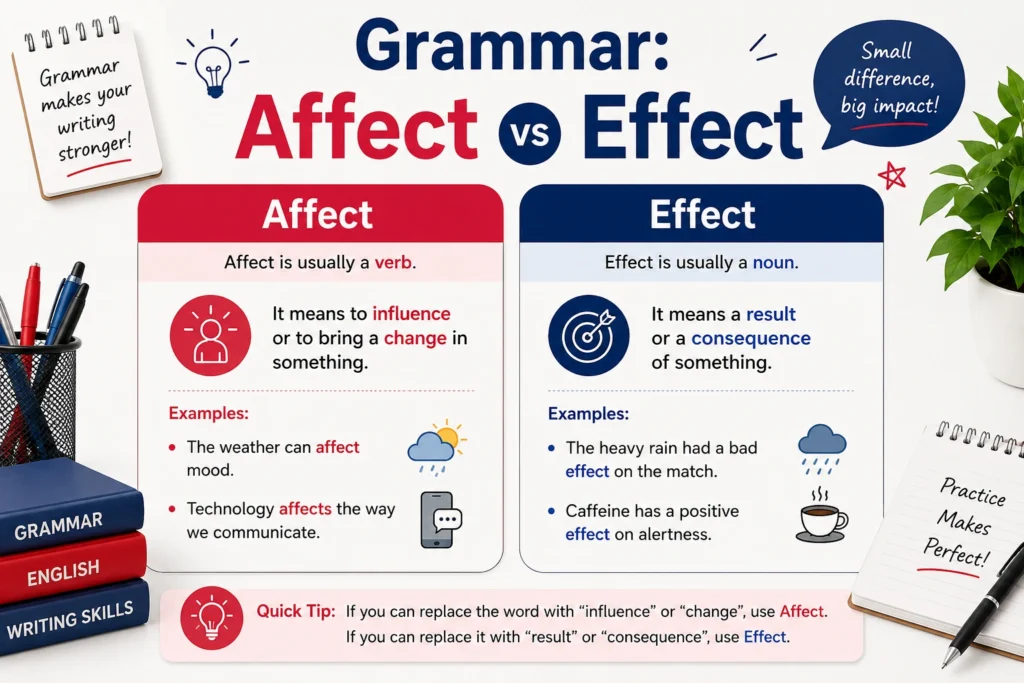
Grammar: Affect vs Effect Introduction Many students confuse “affect” and “effect” because they sound similar, but their usage is different. Understanding the distinction helps you write more accurately and clearly. Definition Affect: Usually a verb, meaning “to influence or make a difference to something.” Effect: Usually a noun, meaning “the result or outcome of a change or influence.” Difference at a Glance Word Part of Speech Meaning Example Affect Verb To influence or change The weather can affect your mood. Effect Noun The result of a change The new law had a positive effect on education. Synonyms Affect (verb): influence, impact, alter, change, modify Effect (noun): result, outcome, consequence, impact, repercussion Examples Using Affect (Verb) Stress can affect your concentration. The heavy rain will affect the match schedule. Smoking negatively affects lung health. His speech affected everyone in the audience. Lack of sleep affects memory and focus. Using Effect (Noun) The medicine had an immediate effect on her headache. The new policy had a significant effect on the company’s profits. Exercise has a positive effect on mental health. The movie’s special effects were impressive. Pollution has a harmful effect on the environment. Final Thoughts Remember: Affect is usually an action (verb), and Effect is usually a thing (noun). Using them correctly will make your writing precise and professional. Take your English skills to the next level with Focus Education. Learn the difference between tricky words like affect and effect, improve your writing, and communicate confidently. Join us today!